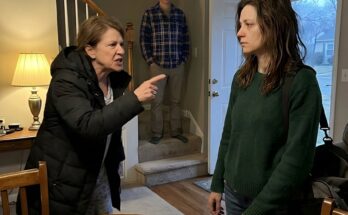
I had not been asleep. People assume midnight means silence, but I have never trusted silence enough to sleep deeply. I was sitting at my kitchen table with a cup of tea gone cold beside my laptop, reviewing notes for a case I was helping with through the nonprofit where I worked. My life had become one long pattern of late-night calls, emergency plans, coded messages, and quiet exits through back doors. I had spent the last seven years helping women leave dangerous homes, helping frightened mothers disappear before dawn, helping people collect documents, medication, cash, and courage in the span of an hour. It had changed the way I listened to the world.

So when I heard three knocks on my door, uneven and weak, I was already standing before the last one landed.
I checked the security monitor beside the hall, and the image on the screen made my stomach drop so fast it felt like missing a stair in the dark.
Naomi.
My twin.
Her face was half-hidden by wet hair, her body folded inward like she was trying to make herself smaller. One hand clutched the railing by my porch. The other hung limp at her side. Even through the grainy black-and-white camera feed, I could see she was shaking.
I yanked the door open.
“Naomi?”
She looked up at me, and for one suspended second neither of us spoke.
People like to say twins share everything. Thoughts. Feelings. Secrets. Maybe that is not literally true. But there are moments when you know your twin’s face the way you know your own reflection, and one glance can hold a year’s worth of truth.
Her lipstick was smeared. Mascara streaked the corners of her face. The neckline of her pale silver dress had been stretched out of shape, one sleeve slipping down her shoulder. There were dark marks already rising at the side of her neck.
She took one step toward me and then folded.
I caught her before she hit the floor.
“Oh my God,” I whispered, dragging her inside and kicking the door shut behind us. “Naomi. Naomi, look at me.”
She was freezing. Not the kind of cold that comes from weather. The kind that comes from shock. Her teeth were knocking together. Her breathing came in short, ragged pulls that barely seemed to fill her lungs.
I guided her to the couch, but the second I turned on the lamp and saw her clearly, something hard settled in the center of my chest.
The bruises on her neck were not random. The torn hem of her dress was not from a stumble. The way she flinched when I reached for her shoulder was not new.
This was not the first time.
It was only the first time she could not smooth her hair, hide it under silk, lift her chin at a dinner party, and pretend the shadows under her eyes were from a long week.
I knelt in front of her. “Who did this?”
Her eyes filled so quickly it looked painful.
“Naomi.”
She made a sound, almost a laugh, but broken straight through by panic. “He knows where you live.”
“Who?”
But I already knew.
Her mouth trembled. “Adrian.”
I closed my eyes for one heartbeat.
Adrian Vale. Finance golden boy. Magazine smile. Tailored suits. Private charity galas. Penthouse above the river. The sort of man people described as polished, ambitious, generous. The kind of man who remembered names, pulled out chairs, sent flowers to hospital rooms, and made older women tell their daughters, That one looks like a good husband.
The kind of man who knew exactly what mask to wear.
I opened my eyes again. “What happened tonight?”
She pressed both hands to her face. “He was angry. I was late getting back from dinner with the foundation board. He said I was embarrassing him. He said I liked making him look foolish. He said—”
Her voice snapped in half.
I moved beside her and wrapped a blanket around her shoulders. “You do not have to tell me all of it right this second.”
“Yes, I do.” She clutched the blanket so hard her knuckles turned pale. “Because he said he’d come here next. He said if I ran to you again, he’d make sure you stopped interfering.”
Again.
The word cut through me like wire.
I turned slowly. “Again?”
Naomi shut her eyes.
I stared at her profile, at the expensive earrings she had forgotten to take off, at the familiar line of her jaw, the face I had grown up with. We were identical when we were young enough to think matching dresses were a game. As adults the differences had become clearer. I wore my hair shorter, practical. Naomi wore hers long and glossy. I dressed for movement, weather, and ordinary rooms. Naomi loved clean lines, delicate fabrics, heels that turned sidewalks into stages. But the bones underneath, the shape of our mouths, the tilt of our eyes, remained so similar that strangers still hesitated before deciding who was who.
And suddenly I was twelve again, watching her climb over our back fence because she was too embarrassed to admit she had ripped her skirt at school. Sixteen, slipping into each other’s uniforms for a prank. Twenty-one, lying on the floor of our tiny apartment after college and promising no matter where life took us, we would never let anyone make us small.
“Naomi,” I said carefully. “How long?”
Her answer came so softly I almost missed it.
“Two years.”
The room went still.
She had been married for three.
I sat back.
Two years.
Two years of smiling photos and holiday cards and carefully posed captions. Two years of excuses when she canceled lunch. Two years of saying she was tired, saying Adrian was under pressure, saying marriage was more complicated than people admitted, saying she was happy often enough that I had eventually learned to stop pushing because every push only made her retreat.
I had sensed something. I had known something was wrong in the way a sister knows when brightness is being performed. But knowing something is wrong and knowing the size of it are not the same thing.
I swallowed against the taste of failure. “Why didn’t you tell me?”
She looked at me with such raw shame that I instantly regretted the question.
“I tried.” Tears rolled silently down her face. “The first time, I tried. Then he cried. He said it would never happen again. He said he was under pressure. He said he hated himself. He bought me tickets for Rome and looked at me like I was the only good thing in his life. Then the second time happened, and after that…” She dragged in a breath that shook. “After that he got smarter.”
I said nothing.
“He never left marks where people could see them at first. He knew exactly what to say after. He knew when to be sweet. He knew when to make me feel stupid for even thinking the word abuse.” Her hands tightened around the blanket. “He’d say I was dramatic. He’d say I was lucky. He’d say no one would believe me because everyone thinks he’s perfect.”
I reached for her hand.
She let me take it, and that, more than anything, told me how close she was to breaking.
“He started going through my phone six months after the wedding,” she said. “Then my emails. Then my accounts. He made it sound like concern. Like safety. Like marriage means no secrets. He stopped liking your visits because he said you looked at him like you were evaluating him.” A humorless smile touched her mouth. “You were.”
“Yes,” I said.
That almost made her laugh, and almost was enough to make me cry.
“I kept thinking I could manage it,” she whispered. “I kept thinking if I stayed calm, if I did everything right, if I avoided saying the wrong thing at the wrong moment, it would get better.” Her voice lowered. “Tonight he said if I ever walked out on him, he would ruin me. And then he said if I ran to you, maybe you needed a lesson too.”
I went cold.
Not angry at first. Cold.
There is a point in certain situations where rage is too loud and too useless. Training takes over. You begin sorting. Immediate safety. Evidence. Time. Risk. Escape route. Likely response from the aggressor. Police, if needed. Shelter, if needed. Medical care. Backup contact. Phone security. Camera coverage. Possible weapon access. You do not get to fall apart. Not yet.
I stood. “Can you walk?”
She looked startled. “Where?”
“You are not staying in the front room. He knows my address. If he’s angry enough and drunk enough and stupid enough, he may come here.”
“He will come.”
“Then we move now.”
My townhouse had a small converted storage room behind the laundry area. No windows, reinforced door, spare mattress, first-aid kit, backup phone, charger, bottled water, extra clothes. It had started as a practical solution after an attempted stalking case two years earlier. Friends joked that I lived like someone who expected emergencies. The truth was simpler. Emergencies had started expecting me.
I brought Naomi there, sat her on the bed, and crouched in front of her.
“Listen to me carefully. Lock this door after I leave. Do not open it for anyone except me. Not if you hear shouting. Not if you hear your name. Not if you hear my name.”
Her eyes widened. “What are you doing?”
I opened the metal cabinet, took out antiseptic, ice packs, and a clean sweatshirt. “Treating your neck. Then deciding.”
“No.” She grabbed my wrist. “I know that look.”
“What look?”
“The one you got in college when that guy followed Mia home and you spent three nights mapping every security camera between her apartment and campus security.” Her grip tightened. “Don’t do anything reckless.”
“Reckless is not my style.”
“Lena.”
That was my name on her mouth the way it had sounded since childhood. A warning. A plea.
I eased her hands away and began checking the bruising with the calm voice I used for survivors in crisis. “Can you swallow?”
“Yes.”
“Any dizziness?”
“A little.”
“Did you lose consciousness?”
“No.”
I kept going. Questions. Answers. Assessment. She had a bruise on her shoulder, another along her ribs, but nothing suggested immediate emergency care. I wanted a doctor to see her, to photograph everything properly, to document it all. But first I needed time, and time was exactly what Adrian would not want to give us.
“Lena,” she said again, softer now. “Please.”
I met her eyes. “Did he ever think I was you from a distance?”
She went still.
I hated the idea the moment it became a real possibility. Hated it because it was dangerous and because part of me knew it could work. We had not used our resemblance in years beyond accidental confusion in family photos or the occasional joke at reunions. But tonight, with my hair pinned differently, in low light, in one of her dresses…
“Answer me.”
She stared at me. “Sometimes,” she whispered. “From behind. In dim light. Why?”
I did not answer directly. “How drunk is he?”
“He’d had whiskey. Not enough to stumble. Enough to be careless.”
“Does he have staff at the penthouse tonight?”
“No. He sent everyone away after the dinner. He does that when he’s angry.”
Of course he did.
I stood and moved quickly. Naomi watched me with growing horror as I crossed into my bedroom and opened my closet. My hands were steady, which frightened her more than panic would have.
“Lena, no.”
I pulled out a black duffel from the top shelf and dropped it on the bed. Inside were zip restraints, a tactical flashlight, pepper gel, gloves, two charged burner phones, and a tiny body camera. Legal. Documented. Prepared.
“You are not going there.”
I unzipped the side pocket. “I am not going there as myself.”
“That is not better.”
“Maybe not.”
She came to the doorway of my room, one hand pressed to the frame like she needed it to remain upright. The blanket had fallen from her shoulders, revealing the marks on her neck again. Seeing them made every doubt inside me reorganize into purpose.
“I need you to hear me,” she said. “He is not just angry. He likes fear. He changes when he sees it. He—” She stopped, shut her eyes, tried again. “Please don’t walk into a room alone with him.”
“I do it all the time.”
“That’s different. This is personal.”
“Yes.”
“That is exactly why you should not go.”
For a second, we were not grown women in a house full of locked doors and emergency plans. We were children on the edge of the lake behind our grandparents’ place, Naomi crying because the water was too deep, me holding out my hand and telling her I’d go first. We had spent our whole lives trying to stand between each other and whatever hurt looked biggest from where we were standing.
But this was not deep water. This was a man who had spent years practicing how to control another human being.
I walked to her and touched her cheek gently. “I am not going there to prove something. I am going because he thinks tonight ends the way every other night ended. He thinks he can walk back into that apartment and finish whatever story he started with you. He expects fear. He expects silence. He expects the same woman.”
Naomi’s eyes flooded again. “And if he figures it out?”
“Then he figures it out.”
“That is not an answer.”
“It is tonight’s answer.”
She shook her head. “You can’t just—”
“I can.”
She stared at me, and then the last of her strength seemed to give way. “I should have told you sooner.”
I held her shoulders. “Yes. You should have. But you’re here now.”
Her face crumpled.
I hugged her hard, and for a moment she clung to me the way she used to after nightmares when we were girls sharing one room during thunderstorms. I felt how violently she was still trembling. I felt the shallow, brittle rhythm of her breathing. I felt the expensive fabric of her ruined dress under my hands and thought about all the photographs from charity events and anniversary dinners and holiday galas where she had smiled like her life was polished silver.
Then I pulled away and got to work.
First, I secured her phone. He likely had access to location sharing, messages, maybe even hidden tracking software. I powered it down and sealed it in a signal-blocking pouch. Then I handed her one of the burners.
“Only this. Only to call me. No outgoing messages to anyone else yet.”
She nodded numbly.
Next came evidence. I photographed the bruises with timestamps. Front, profile, shoulder, wrist, ribs. I documented her dress. I recorded her statement while details were fresh, asking short, careful questions so she could answer without collapsing. Date. Time. Words said. Physical actions. Prior incidents. Any witnesses. Any staff present earlier in the evening.
She answered like someone walking barefoot over glass.
When I finished, I encrypted the files and uploaded them to secure storage.
Naomi watched in silence. “You do this for people all the time.”
“Yes.”
“Does it ever get easier?”
“No.”
That truth settled between us.
I opened her garment bag that had fallen in the hall when she arrived. Inside was another dress, likely one she had planned to change into earlier that evening but never did. Not useful. What I needed was what she was wearing now.
“Take it off,” I said.
She blinked. “What?”
“The dress.”
“Lena—”
“Trust me.”
A minute later, she stood in my bathroom wearing my old sweatshirt and leggings, while I stepped into her silver dress. It fit almost perfectly. That was the thing about being twins. The body remembers an old symmetry even after life has shaped you differently. The waist was a touch tighter than I liked, the neckline lower than anything I ever wore, but in dim light it would do.
My hair was the problem.
Naomi’s hung halfway down her back, dark and glossy. Mine brushed my shoulders. Similar, but not enough.
I stared at myself in the bathroom mirror, then opened the drawer beneath the sink, took out scissors, and caught Naomi staring from the doorway.
“What are you doing?”
“Making a choice.”
“Lena.”
I gathered my hair and cut it bluntly at the jaw.
Her breath left her in a rush. “You are insane.”
“Possibly.”
I pinned what remained close to my head, then used one of her extension clips from the small velvet bag in her purse. Not perfect. Good enough. In low light, from behind, from a man too convinced of his own power to look carefully, it would work.
I copied the shape of her makeup, softening the eyes, changing the mouth. I borrowed her perfume, one light touch at the wrist and throat. Familiar scent mattered. Predators noticed more than people think; their confidence lives in patterns.
Naomi sat on the closed toilet lid, staring at me like she was watching her own ghost assemble itself in the mirror.
When I turned around, her mouth parted.
For a moment I saw it too. Not all of it. Not enough to fool anyone who truly loved her. But Adrian was not a man who saw Naomi. He saw his role, his rights, his control, his reflection in her fear. Men like that do not study the women they claim to own. They study reactions.
“Does it pass?” I asked.
She rubbed her arms. “In the dark, maybe.”
“Good.”
She stood suddenly. “No. Not good. None of this is good.”
“I know.”
“Then stop.”
I reached for the body camera and clipped it beneath the fold of the dress where it would catch audio and partial video. “I need him recorded. I need him speaking freely. I need him showing exactly who he is when he believes no one is watching.”
“You already have photos. You have my statement. We can go to the police.”
“We will.” I zipped the duffel. “But first I want him off balance.”
She stepped in front of the door. “What if he locks you in?”
“He won’t have time.”
“What if he hurts you?”
I looked at her neck.
She followed my gaze and flinched.
“That is exactly why he is not walking into tonight in control,” I said.
Her eyes filled again, but this time the tears were mixed with something else. Fury. Shame. Hope. All the terrible, powerful emotions that arrive when fear finally finds an exit.
“What do you want me to do?” she whispered.
“Stay hidden. Call 911 if I text you the word NOW. Call Mara if I do not contact you in forty minutes.”
“Mara from your nonprofit?”
“Yes. She knows the emergency protocol.”
“You already decided all this before telling me.”
“Mostly.”
That almost earned me a glare, which felt bizarrely reassuring.
I wrote down the address of the safe-contact office, the code to my downstairs lock, the passphrase for the emergency cloud folder, the names of two detectives I trusted from prior work, and the number of a private physician who handled discreet forensic documentation.
Naomi folded the paper carefully and put it in the pocket of my sweatshirt.
Then she looked up at me and said in a voice so small it nearly undid me, “What if he doesn’t believe it’s me?”
“Then he still walked into a room with someone prepared for him.”
She stared at me a long time. “You really aren’t afraid.”
I thought about that.
Fear was there. Of course it was. Fear of miscalculation. Fear of timing. Fear of what rage and entitlement can do inside private walls. But under it all was something harder and cleaner.
“I’m afraid of what happens if we keep letting him believe he can do this,” I said.
And that, at last, silenced her.
The drive to Adrian’s building took fourteen minutes.
Every traffic light felt too slow. Every quiet block felt sharpened at the edges. I parked two streets over, out of range of the front cameras but close enough to walk without attracting attention. The city had that late-night luxury-district stillness where sound travels differently—heels on polished stone, the hum of an idling town car, muted laughter rising from a hotel terrace three blocks away.
Adrian’s building staff knew Naomi. They also knew me, vaguely, from the wedding and a handful of charity events. Fortunately, wealthy people teach their employees an important survival skill: not looking too hard at the personal chaos of the rich.
I entered through the service elevator Naomi told me he preferred for private arrivals. No doorman. No audience. He liked privacy when he planned to say or do things that did not fit his public image.
On the ride up, I texted Naomi one word.
In.
She replied almost instantly.
Please come back.
I stared at the message until the elevator opened.
The penthouse was dark except for the low glow of the city spilling through the glass walls. Naomi had given me the emergency side entry code months earlier after joking that Adrian was always losing track of his own access cards. At the time I had thought it was convenience. Now I wondered if some part of her had been laying breadcrumbs toward escape long before she admitted she needed one.
Inside, the apartment smelled faintly of cedar, expensive liquor, and the remains of a dinner party cleaned too perfectly. Crystal reflected the skyline. A champagne flute sat abandoned on the counter. Somewhere, a clock ticked with absurd politeness.
I did not turn on any lights.
I moved to the living room and sat in the dark chair near the window, angled the way Naomi usually sat when she waited up for him after events. I crossed my legs the way she did in heels. Lowered my chin. Made my breathing shallow. Small. Contained. Visible enough for him to project fear onto it.
Then I waited.
The waiting was the worst part.
Because when your body is still and your mind is active, it offers you every possible failure. What if he came in calmer than expected? What if he called first? What if he brought someone with him? What if he had already tried Naomi’s phone and knew something was wrong? What if he noticed the difference immediately and became violent faster than planned? What if the recording failed? What if my timing with the backup call went wrong? What if—
The lock clicked.
The door opened.
I did not move.
His footsteps were sharp, impatient, familiar with ownership.
The door shut behind him with a solid, private sound.
For a second he said nothing, and I could feel him there, looking toward the shape of me in the chair. I kept my face turned partly away, hair falling just enough to conceal the line of my jaw.
Then he exhaled in disgust.
“There you are.”
His voice was smooth even when angry. Controlled in the way some men are controlled only because they enjoy deciding precisely when not to be.
I let silence answer.
He tossed keys onto the marble entry table. “Do you have any idea what kind of scene you caused tonight?”
Still I said nothing.
He walked farther into the room. “You leave in the middle of an argument? You make me send half the building staff looking for you?” A pause. “Pathetic.”
I tightened my fingers where he could not see.
He came closer.
I could hear the loosened knot of his tie when he tugged it open. Smell whiskey under expensive cologne. Hear annoyance, not concern. Ownership, not worry.
Good.
He thought Naomi had nowhere else to become.
“I’m talking to you.”
I lowered my head a fraction more.
His tone sharpened. “Look at me.”
Slowly, carefully, I turned just enough for him to see the profile of a familiar mouth, the curve of a shoulder in Naomi’s dress, the long dark line of hair.
He took the bait.
“There,” he said more softly, which somehow sounded worse. “That’s better. You know I hate it when you run from me.”
He moved to stand directly in front of me.
I kept my hands relaxed in my lap.
“You make things harder than they need to be,” he said. “If you would just listen the first time, none of this would happen.”
The body camera was recording every word.
My pulse stayed steady.
He leaned down, bracing one hand on the chair beside me. “Do you understand me?”
I said nothing.
“Answer me.”
My silence irritated him exactly as I had hoped.
He stepped back with a short laugh that held no amusement. “Oh, now we’re doing this? Fine.” He unbuttoned his jacket with one hand, then tossed it onto the sofa. “You know what your problem is? You forget who built this life for you.”
Built.
The word almost made me smile.
Naomi had brought more social capital into that marriage than he ever admitted. More grace. More patience. More humanity. Men like Adrian call women ornaments until they realize the room stops admiring them when the ornament walks out.
He kept talking.
He spoke about appearances. Embarrassment. Gratitude. Loyalty. The duties of marriage. The sacrifices he made. The pressure he carried. The reasons she should have known better than to push him. Every sentence was a monument to himself.
And then he said the line I would later replay in court in my head a hundred times.
“You make me do things I shouldn’t have to do.”
There it was.
The old anthem of cowards.
I lifted my gaze at last.
His eyes narrowed. Something in my expression had not matched what he expected.
He frowned. “What?”
I let one beat pass.
Then another.
He stepped closer.
I saw the moment he reached for certainty. Not recognition. Certainty. He needed to see fear. Needed the pattern restored. Needed her lowered eyes, trembling hands, apologetic voice. He needed the world to remain arranged around his authority.
Instead he found stillness.
His face hardened.
“Don’t look at me like that.”
I kept looking.
It is amazing how quickly men like him begin to unravel when obedience goes missing.
He bent down abruptly, fingers closing around my jaw.
That was the moment Naomi had feared most. The moment he crossed from language into touch because touch, for men like Adrian, is the proof that the room still belongs to them.
He tilted my face toward the city light.
And for one small, perfect second, confusion flashed across his features.
Not enough.
He was too angry, too arrogant, too certain of his own script.
His hand tightened.
“I asked you a question.”
I rose slowly from the chair.
He stepped back, reflexive.
That surprised him.
So I let the silence stretch.
Then he did what Naomi said he always did when control began slipping.
He lifted his hand.
Not wild. Not dramatic. Practiced.
The movement of someone who had done it before and expected no resistance now.
But I was not Naomi.
The second he swung, I caught his wrist in midair.
His whole body froze.
There are expressions you never forget once you see them. Real fear is one. Real grief is another. But the sharpest, perhaps, is the look of a cruel person encountering a boundary he truly believed no one would place in front of him.
His eyes widened.
The smugness vanished.
The color in his face changed.
“What the hell—”
I twisted his wrist down and forward with controlled force, the way I had been trained years ago, not enough to break, more than enough to destroy balance.
He dropped hard to one knee with a sound that was half grunt, half disbelief.
His free hand reached for me. I stepped aside and drove him lower.
He stared up at me.
And I leaned down until my mouth was close to his ear and whispered the only words he was never supposed to hear.
“Wrong wife.”
Everything in his face collapsed at once.
Shock first.
Then comprehension.
Then something ugly and primal that would have been dangerous if I had not expected it.
He jerked back hard, trying to wrench his arm free. “Where is she?”
I tightened my hold until he hissed.
“Safe.”
“You stupid—”
“Careful.”
He looked up at me, breath fast now, the mask stripped clean away. No polished husband. No gracious donor. No charming public figure. Just a man who had built his life on private intimidation and suddenly found himself without it.
I stepped back, forcing him to stay on one knee if he wanted to keep his wrist intact.
“Say it again,” I said.
He blinked. “What?”
“The line about how she makes you do things.”
His mouth opened and shut.
Interesting. He knew enough to be cautious when the room changed.
I smiled without warmth. “That is what I thought.”
He lunged.
Not smart. Predictable.
I pivoted, let his momentum betray him, and sent him sprawling against the edge of the low table. Crystal rattled. He caught himself with a curse, glaring at me as though I had broken some sacred rule simply by refusing to be afraid.
“Do you have any idea who I am?” he said.
“Yes,” I answered. “Unfortunately.”
He shoved himself upright, breathing harder. “If you think this ends well for either of you, you are even dumber than she is.”
The insult slid past me.
“Threatening language,” I said lightly. “Good. Keep going.”
Something flickered in his eyes.
Now he understood.
Recording.
Evidence.
Witness.
The room no longer belonged to him.
His gaze darted toward the sideboard where his phone lay charging. Toward the hallway. Toward the balcony doors. Calculating exits. Revisions. Damage control.
I had seen that look before too.
He straightened his cuffs with forced dignity. “I don’t know what Naomi told you, but she is unstable.”
I laughed once.
That shook him more than anger would have.
“You left marks on her neck.”
“She came at me first.”
“You expect that to sound believable?”
His jaw flexed. “You have no proof.”
I tilted my head. “That sentence never means what men like you think it means.”
He said nothing.
I let his silence convict him.
Then, because I wanted him stripped down to his own truth, I stepped closer. “Tell me something, Adrian. When you looked at her tonight, did you really see a person? Or just the part of your life you assumed would never leave?”
His nostrils flared. “Stay out of my marriage.”
The word marriage in his mouth sounded like property law.
“I think your marriage left the moment she ran.”
He took a step toward me, then stopped, remembering perhaps how quickly I had dropped him.
For the first time, his fear was not hidden under arrogance. It was anger wearing fear’s outline.
“Where is she?” he repeated.
“I told you. Safe.”
“You think you can hide her from me?”
“I think she hid for long enough.”
He moved again, faster this time, aiming not to strike but to get past me toward the entryway. Perhaps to call someone. Perhaps to leave and find Naomi on his own. I cut him off, shoved him back, and he hit the wall with a startled curse.
“Sit down,” I said.
He stared at me.
“Sit. Down.”
To my surprise, he did.
Not because he respected me.
Because for the first time in years, maybe in his entire adult life, he had no confidence in the outcome of defiance.
He sat on the sofa, chest rising and falling too quickly, tie hanging loose, one sleeve wrinkled, every inch of carefully curated power looking suddenly cheap in the half-light.
I stood over him and saw, with absolute clarity, the smallness at the center of men like Adrian. Not harmless smallness. Dangerous smallness. The kind that cannot tolerate feeling weak, so it hunts weakness in others and calls that strength.
“You’re finished,” I said.
He gave a brittle smile. “That’s dramatic.”
“No.” I took out my phone. “This is documentation.”
I read aloud the names of the files I had already stored. Naomi statement audio. Injury photos. Timeline notes. Restricted cloud upload. I watched the calculation in his face sharpen into alarm.
“You recorded me?”
“Yes.”
“That’s illegal.”
“In this state? No.”
He looked like he wanted to be sick.
I almost pitied him for one full second. Not because he deserved pity. Because there is something pathetic about watching a person discover that the private world they built on intimidation can collapse in one honest light.
Then I remembered Naomi on my porch.
Pity disappeared.
“You have two choices,” I said. “One, I call police right now from this room. Two, you sit quietly while my attorney and a detective I trust arrive, and you try very hard not to make this worse.”
He barked a laugh. “Your attorney?”
“You think women like Naomi survive men like you without finally learning to plan?”
He leaned back, smile curdling. “You don’t know how this works. Even if she leaves, even if she files something, I can bury her in court for years.”
Maybe he believed that. Maybe wealth had protected him so long he mistook delay for immunity.
“Try,” I said.
His eyes flicked to the kitchen.
I already knew what he was looking for. Knife drawer. Another stupid choice.
“I wouldn’t,” I said quietly.
That stopped him again.
The room stayed that way for several long seconds. City light. Tight breathing. Glass walls reflecting two people who no longer occupied the roles he had planned for the night.
Then my phone vibrated.
Mara.
I answered on speaker.
“Tell me you are not alone,” she said without greeting.
“No promises.”
“Lena.”
“He’s here.”
A pause. Then Mara’s voice went flat with professional focus. “Are you safe enough to speak freely?”
“Yes.”
“Good. Detective Owens is with me. We’re ten minutes out. Police can be dispatched sooner if needed.”
Adrian’s head snapped up.
I watched fear become real.
Not private fear. Public fear. Paperwork fear. Reputation fear. The kind men like him understand best.
I met his eyes while answering. “Come up through service.”
“Done.”
The call ended.
He stood so abruptly the sofa rocked.
“You brought police into this?”
“No,” I said. “You did.”
He began pacing. The composure was gone now, replaced by restless, sweating agitation. “This is insane. This is a misunderstanding. Couples fight. People say things. If Naomi is upset, we can handle this privately.”
Privately.
There it was again. The kingdom of abusers. Private. Unseen. Contained. Denied.
“No.”
He turned to me sharply. “Do you think she’ll thank you for this? For making it public? For ruining her life?”
I took one slow step forward. “You already tried that.”
He stopped pacing.
I could see him deciding whether to pivot to charm, tears, apology, blame, illness, stress, childhood trauma, alcohol, business pressure, public misunderstanding, media misinterpretation. Men like him are endlessly creative once consequences arrive. But the problem for Adrian tonight was that he had lost his primary audience.
I was not Naomi.
I was not invested in saving his image.
And I was not interested in his reasons.
He tried one last thing.
His voice softened. “Lena. Listen to me. Whatever you think happened, Naomi and I… we’ve had a hard year. She can be fragile. Emotional. Sometimes she says things in the heat of the moment. I love your sister.”
I looked at him for a very long time.
Then I said, “No, you love having someone weaker trapped within reach.”
He flinched as if I had struck him.
Good.
The intercom buzzed.
He turned toward it like a man hearing the bell at his own trial.
I walked over, pressed the access button, and opened the door without taking my eyes off him.
“Sit,” I said.
This time he obeyed instantly.
Mara entered first, wearing the same gray coat she always wore to crisis calls, her expression calm enough to fool anyone who did not know her. Detective Owens came in behind her, plainclothes, broad-shouldered, watchful, carrying the kind of patience that comes from years of seeing monsters in expensive shoes.
Adrian stood halfway.
Owens looked at him once and said, “Stay seated.”
And just like that, the room belonged to reality.
I did not realize how tightly I had been holding myself together until Mara came to stand beside me. She did not touch me immediately. She never touched survivors or responders without permission in moments like this. She only looked at me and said, very quietly, “You okay?”
“No,” I answered.
“Good,” she said. “That means you’re still sane.”
I almost laughed.
Owens began the formalities. Name. Time. Statement notice. Preservation of scene. Adrian tried twice to interrupt and was shut down twice with the same dead-eyed professionalism. He requested a lawyer. Good. He should have one. Everyone should. Especially when the truth is this ugly.
While Owens handled him, Mara pulled me aside and murmured, “Where’s Naomi?”
“Safe at my place.”
“Medical?”
“Needs documentation. No immediate ER indicators.”
Mara nodded. “I’ll send Dr. Patel.”
I shut my eyes for one second. Relief moved through me so abruptly it hurt.
By dawn, Naomi was sitting in my kitchen wrapped in a clean robe, hair washed, bruises documented, statement expanded, attorney scheduled, protective order paperwork in motion.
When I walked in, she stood so fast her chair scraped the floor.
“Is he—”
“He’s exactly where he should be for the moment.”
She stared at me. “Did you get hurt?”
“Not really.”
She came around the table and touched my face, checking, because sisters do that even when they are the ones bleeding.
Then she saw my hair.
A strange sound escaped her, half laugh, half sob. “You really cut it.”
I looked toward the window. Morning light was creeping over the houses, pale and honest. “Apparently.”
She covered her mouth.
And then, at last, after years of silence and one long brutal night, my twin sister broke in a different way than before.
Not from fear.
From release.
She collapsed against me, and we stood in the middle of my kitchen holding each other while the kettle boiled unnoticed on the stove and the sky brightened beyond the glass.
There would be more to come. Statements. Hearings. Calls from people who had once praised Adrian and now wanted to distance themselves from his name. Friends who would say they had no idea. Staff who had suspected more than they admitted. Financial maneuvering. Public fallout. Quiet shame from people who should have noticed sooner. Lawyers. Paperwork. Long afternoons where Naomi would doubt herself again because survival trains you to question your own memory.
Healing was not going to begin and end with one confrontation in a dark penthouse.
But that night had changed the direction of everything.
Because fear had finally been interrupted.
Because a man who believed the world would always rearrange itself around his comfort had discovered that some women, once pushed far enough, become impossible to control.
Because Naomi had reached a door and knocked.
And because when it opened, she was not alone anymore.
Months later, when people asked how she found the strength to leave, Naomi never described the bruises first. She never described the penthouse or the police or the whisper that dropped him to his knees.
She always described the porch light.
She said the hardest part was not running.
The hardest part was standing on my doorstep and deciding to knock.
That was the moment she chose to believe her life could still belong to her.
And maybe that is the truth at the center of every story like ours.
Not that monsters exist. We know they do.
Not that justice is clean. It never is.
But that escape often begins in the smallest possible motion. A hand lifting. A number dialed. A bag packed. A key turned. A door opened in the middle of the night by someone who recognizes you even when you barely recognize yourself.
Naomi kept the silver dress.
That surprises people when I tell them.
She had every reason to burn it, cut it up, throw it into the river, erase it from memory. Instead she had it sealed and boxed after the case closed. Not displayed. Not romanticized. Just kept.
“Why?” I asked her once.
She thought about it before answering.
“Because that was the night he thought he was coming home to the same woman,” she said. “And he was wrong.”
I understood.
The dress was not a reminder of what had been done to her.
It was proof of where the ending began to change.
As for me, I kept the hair.
At first because I had no choice. Then because every time I looked in the mirror, I remembered who I had been that night. Not fearless. Not invincible. Just clear. Cold in the necessary way. Willing to stand in the dark long enough for the truth to walk in and reveal itself.
People sometimes want stories like this to end in easy triumph. Villain punished. victim healed. sister avenged. Curtain down.
Real life is less tidy.
Naomi still woke from bad dreams for a long time. Some mornings she could not wear anything that touched her throat. Some sounds made her freeze. Some apologies from friends came too late to matter. Sometimes she hated how long she had stayed. Sometimes she hated that part of her still missed the version of Adrian who had never really existed.
That was real too.
Leaving someone dangerous does not erase the years spent surviving them. It only begins the work of living after.
But there were victories.
Small ones first.
The first night she slept all the way through without waking in panic.
The first meal she finished without checking the time every few minutes.
The first time she laughed so suddenly and freely that we both stopped just to hear it.
The first event she attended alone after everything became public, lifting her chin under the weight of stares that no longer had the power to define her.
The first morning she looked in the mirror and said, without bitterness, “I look like myself again.”
Adrian, for all his money and polished instincts, discovered something that men like him rarely expect: the world is more willing to believe a quiet, detailed truth than a loud, expensive lie once the evidence becomes impossible to ignore.
Not everyone turned away from him immediately. Some never do from men like that. There are always people who call it complicated, private, tragic, unfortunate, messy. There are always people more disturbed by scandal than by cruelty.
But enough saw him clearly.
Enough mattered.
And Naomi did not have to carry the whole burden alone anymore.
One evening, nearly a year after she showed up at my door, we stood together on my back porch watching rain darken the fence boards. The kind of slow summer rain that makes the whole world smell like wet leaves and earth.
She handed me a mug of tea and smiled a little.
“You know,” she said, “when I was hiding in your laundry room that night, I thought I was going to lose you.”
I leaned against the rail. “I know.”
“I was furious with you.”
“That, I also know.”
“You always were impossible.”
“That’s what older by four minutes gets me.”
She laughed under her breath. “You’re younger by four minutes.”
“Technicality.”
The rain thickened.
After a while she said, “When he raised his hand that night, did you know exactly what you were going to do?”
“Yes.”
“Were you angry?”
“Yes.”
She looked at me sidelong. “Were you scared?”
This time I answered honestly.
“Yes.”
That seemed to comfort her more than any brave answer could have.
We stood in silence for another minute before she asked, “Then why didn’t you move when the door opened?”
I looked out at the rain.
Because I wanted him close enough to see the moment his certainty died.
Because I wanted the room to hold still around the version of him no one else had been allowed to witness clearly.
Because I wanted, just once, for someone like him to walk into the dark expecting fear and find judgment instead.
But what I said aloud was simpler.
“Because I wanted him to come closer.”
Naomi nodded as if she had always known.
Maybe she had.
There are things twins understand without language.
That night had started with three weak knocks on a door.
It ended with something far more powerful than revenge, though revenge would have been easier to explain.
It ended with recognition.
Not mine of Adrian. I had recognized men like him my whole adult life.
And not Naomi’s recognition of danger. She had lived with that too long.
It ended with Naomi recognizing that she was allowed to reach for help before she became a headline, a rumor, a whisper, a tragedy someone else told in a lowered voice over coffee.
It ended with me recognizing that sometimes protection is not gentle. Sometimes it is not patient. Sometimes it is a trap laid carefully in the dark for a man who spent years mistaking silence for permission.
And it ended with Adrian recognizing the one truth he had spent years avoiding:
The woman he thought he owned was gone.
And the people who loved her were not afraid of him anymore.