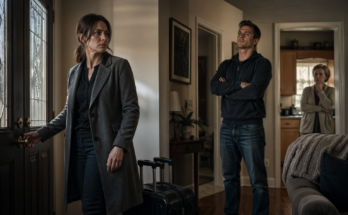
The rain had started just before midnight.
Not the soft kind that taps politely on windows and fades into the background, but the heavy, relentless kind that seems to press itself against the whole house. It drummed on the roof, slid down the glass in silver streaks, and wrapped everything outside in darkness and noise. The streetlights beyond our front yard looked blurred and distant through the storm, and every few minutes the wind pushed a branch against the side of the house with a dry scraping sound that made me glance up.
Mark slept through all of it.
He always could.
He was lying on his side of the bed, one arm bent beneath the pillow, his breathing deep and even after yet another long business trip. His suitcase sat open on the bench at the foot of our bed, half-unpacked, one polished shoe tipped on its side as though he had been too tired to finish the simplest task before collapsing into sleep.
For years I had found comfort in that scene.
My husband home.
His clothes draped over the chair.
His familiar scent lingering in the room.
The quiet promise that whatever the world demanded from him outside this house, he always came back to me.
For ten years, that belief had been one of the strongest things in my life.
I had trusted our marriage the way some people trust the ground beneath their feet. Not because it was dramatic or perfect in a movie-like way, but because it had seemed steady. Dependable. Real. We had built habits together, routines together, a language of ordinary love that felt stronger than grand gestures ever could. Morning coffee in silence. Grocery lists scribbled on the back of unopened mail. Shared glances at crowded dinners. His hand automatically reaching for mine in parking lots. The way he still called if he knew he would be late, even after all these years.
That was the shape of my happiness.
Not flashy.
Not loud.
Just solid.
Or at least that was what I had believed until last Tuesday night.
I was not planning to uncover anything.
That was the part I would keep replaying later, as though it mattered. As though intention could somehow soften the impact of what happened. But the truth is, I was doing something deeply ordinary when it began. I was tidying up before bed. Mark had returned home late, exhausted from a three-day trip, barely speaking more than a few words over reheated dinner before loosening his tie and sinking into bed with a sigh.
“You should leave the rest for tomorrow,” he had mumbled when he saw me reaching for his jacket.
“I just want to get the dry cleaning separate before I forget,” I whispered back.
He had already been half asleep by then. Within minutes, his breathing deepened, and the room settled into that intimate nighttime stillness I had known beside him for years.
I picked up his jacket from the chair and carried it toward the laundry basket near the bathroom door. The fabric was heavier than usual, damp at the shoulders from the storm outside, and when I turned it in my hands to check the pockets, something hard shifted where no hard object should have been.
I frowned.
At first I thought it might be a cufflink trapped in the lining. Or maybe one of those metal collar stays he sometimes forgot to remove from new shirts. I pressed my fingers against the inside seam and felt a small shape lodged there. Thin. Cool. Solid.
I turned on the brighter light in the bathroom and examined the jacket more carefully.
There was the tiniest tear in the inner lining, near the left side. Not enough to notice during normal wear, but enough for something to slip inside.
I pinched the fabric open and shook the jacket gently.
A small brass key dropped into my palm.
I stared at it for a long time.
It was old-fashioned, not like the clean, silver house keys we used every day. Its handle was rounded and slightly worn at the edges, the metal darkened with age in the grooves. It looked like the kind of key that belonged to something private. Something kept for years. A box. A cabinet. A lock no one else was meant to touch.
A strange feeling tightened low in my stomach.
There was no immediate reason for alarm. People keep old keys all the time. Keys to desks, memory boxes, filing cabinets, forgotten storage units. It could have belonged to anything.
But the discomfort would not leave.
Because the moment I saw it, I thought of the basement.
Not the whole basement. Just one part of it.
The back wall had a built-in shelving unit that came with the house when we bought it. Most of the shelves held normal things: paint cans, camping gear, holiday decorations in plastic bins labeled with thick black marker. But behind the larger bookshelf on the far left, tucked into a narrow recessed space, Mark kept a handful of old boxes and one dusty wooden chest I had never been allowed to touch.
The memory came back with unsettling clarity.
It had happened about four years into our marriage. I had been reorganizing storage because we were having the upstairs closets redone, and I had moved the bookshelf a few inches while sweeping. I remember seeing the chest and crouching slightly, curious more than anything. Before I even reached for it, Mark appeared at the basement door.
His voice had startled me.
“Leave that.”
He had spoken so sharply that I actually stood up too fast and hit my shoulder on the shelf.
I laughed awkwardly then, trying to lighten the moment. “What is it? Buried treasure?”
He had not smiled.
“Just old things,” he said. “Please don’t go through those boxes.”
There had been something in his face I rarely saw. Not anger exactly, but tension. A controlled kind of alarm, quickly buried.
I remember saying, “I wasn’t trying to pry.”
“I know,” he replied, softer this time, coming closer to slide the shelf back into place. “It’s just personal. Before us. I’d rather leave it alone.”
Before us.
At the time, that explanation had seemed fair.
Everyone has a past. Everyone has pieces of themselves they keep boxed away, not because they are doing something wrong, but because time turns some memories fragile. Painful. Embarrassing. Sacred. I had loved Mark long enough by then to believe respect sometimes meant not asking questions just because you had them.
So I never touched the boxes.
Never brought it up again.
Never let myself wonder for more than a passing second.
Until that key landed in my hand.
I looked toward the bedroom.
Mark had not moved.
A line of lamplight cut across the floorboards between the bedroom and bath. Beyond it, I could see the outline of his shoulder beneath the blanket. So familiar. So ordinary. The man I had shared a decade of anniversaries, holidays, arguments, reconciliations, lazy Sundays, and hard seasons with. The man who knew how I liked my tea. The man who rubbed my back when migraines hit. The man whose laugh I could identify in any crowded room.
My hand closed around the key.
I told myself I was being ridiculous.
Then I told myself that if it was something innocent, I would feel silly for even worrying, and life would continue exactly as it had before.
But another thought pushed quietly beneath that one.
If it was innocent, why had he hidden the key in the jacket lining?
Not in a drawer.
Not on a ring.
Not in the safe in his office.
Inside the lining, where no one would think to look.
That was what finally moved me.
I slipped my feet into slippers, wrapped my cardigan tighter around me, and stepped into the hallway. The house was cool and silent. The kind of silence that magnifies every small sound: the whisper of fabric against skin, the creak of a stair, the distant hum of the refrigerator downstairs.
The storm rattled the windows as I made my way toward the basement door near the kitchen.
By then my pulse was loud enough that I could feel it in my throat.
I paused with my hand on the basement knob.
There was still time to stop.
I could turn around. Put the key back in the jacket lining. Climb into bed. Wake in the morning and let the discomfort pass like so many small fears do. I could choose trust over suspicion and spare myself whatever ugliness might come from doing otherwise.
But trust, I realized in that moment, depends on feeling safe enough not to look.
And suddenly I did not feel safe.
I opened the door.
The basement stairs were narrow and painted white years ago by a previous owner. The paint had chipped at the edges from use, exposing older wood beneath. I kept one hand on the wall as I descended, not because it was dark, but because my legs felt oddly unsteady. At the bottom, I reached for the pull chain and the overhead light flickered on with a low hum, flooding the room in pale yellow.
Everything looked the same as always.
The workbench against the far wall.
The old treadmill we never used.
Plastic bins stacked three high.
A folded card table leaning beside the freezer.
I almost laughed from the sheer normalcy of it. How absurd fear looks when it has to stand in a room full of household storage.
Then I turned toward the back shelf.
The bookshelf was heavier than it looked. I had to push with both hands to shift it enough to reveal the recessed space behind it. Dust rose into the air as it scraped across the floor, making me cough lightly into my sleeve.
And there it was.
The chest.
It was made of dark wood banded with tarnished metal at the corners, not large enough to hold much but substantial enough to feel deliberate. A box chosen to endure. Dust had settled thickly across its lid, except for one faint arc near the latch that looked almost recently disturbed.
I crouched in front of it.
My fingers were trembling now. Not dramatically, not in some theatrical way, but enough to make the brass key tap lightly against the lock before I managed to guide it in.
For one strange second, I hoped it would not fit.
But it did.
Perfectly.
The click when I turned it seemed impossibly loud in the stillness. A sharp, final sound that cut through the rain and the basement hum and went straight through me. I froze after hearing it, as though the house itself might react.
Nothing happened.
No footsteps overhead.
No voice calling my name.
No sudden interruption to stop me.
Only the sound of rain.
I slid my fingers under the edge of the lid and lifted.
The hinges groaned softly.
I had no idea what I expected to find.
Something dramatic, maybe, because fear makes the mind theatrical. Bundles of cash. A second phone. A stack of letters. Photographs. Evidence of an affair. A weapon. Some object so clearly wrong that the whole truth would reveal itself in one glance.
But the chest contained almost nothing.
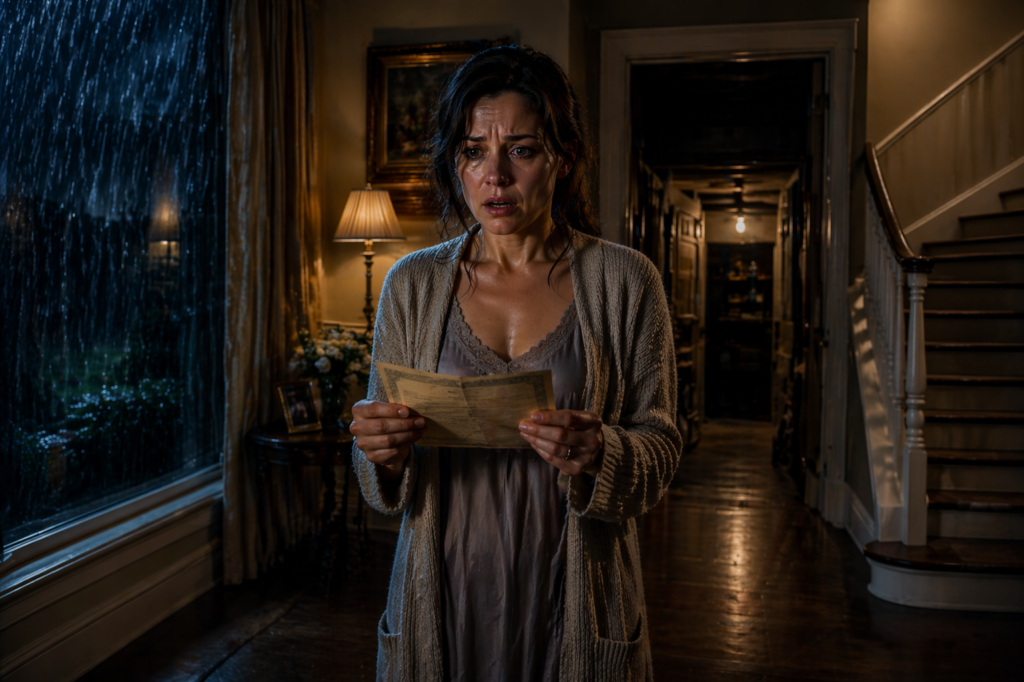
Just one folded document resting alone against the dark wooden bottom.
That was all.
For a second, I simply stared at it, confused. A single paper. Yellowed slightly at the edges, protected inside a clear plastic sleeve. It seemed too small to justify secrecy, too plain to explain the weight of the moment.
I lifted it with careful fingers.
Official seal.
Typed fields.
Raised stamp.
A birth certificate.
I did not understand at first because my eyes caught disconnected details before my mind arranged them into meaning.
Name of child.
Date of birth.
City.
Father.
Then I saw Mark’s full name.
Mark Davis.
I stopped breathing for a moment.
Not figuratively. Truly. My chest tightened and everything inside me seemed to pause as I lowered my eyes to the line again and read it more carefully, as though the letters might rearrange themselves into someone else’s truth.
They did not.
Father: Mark Davis.
My husband.
The room seemed to tilt, just slightly.
I had to brace one hand against the side of the chest.
A child?
Mark had a child?
My first thought was not even anger. It was confusion so sharp it almost felt clean. That kind of pure disbelief that leaves no room for anything else. My mind leapt clumsily through possibilities, each one collapsing under the next.
Could this be from before me?
Could he have been a donor?
Could it be forged?
Could there be another Mark Davis?
Could there be some explanation that would make this feel less impossible?
Then I saw the date of birth.
I knew our wedding date as intimately as I knew my own birthday. I did not have to calculate it carefully; my body seemed to do the math before my mind did.
The child had been born exactly nine months after our wedding day.
A pulse of cold moved through me so fast it felt like the inside of my veins had turned to ice.
I stared at the date, then at Mark’s name again, and then at the date once more. I counted backward. Once. Twice. Three times. Each time I reached the same awful conclusion.
This was not some distant life from before me.
This was from the beginning of us.
From the first bright, sacred season of marriage when I believed we were building something clean and whole.
My hand tightened around the edge of the plastic sleeve until it bent.
I think that was the moment when the first crack truly opened inside me.
Not because of the child alone, though that would have been enough to shatter almost anyone. It was because the timeline rewrote everything. Every vow. Every smile in our wedding photographs. Every toast made in our honor by friends and family who believed we were starting a life together with honesty. Suddenly, hidden behind those memories, another story ran parallel to mine. A story I had not been told. A story my husband had apparently protected for ten years with silence and a locked chest in the basement.
My eyes dropped lower on the page.
Mother.
I remember that part with unnatural clarity.
The basement light buzzing faintly overhead.
Rain striking the tiny ground-level window.
The smell of old wood and dust.
The way my thumb pressed against the edge of the document hard enough to ache.
And then the name.
I read it once.
My mind rejected it instantly.
I read it again, slower this time, each letter dragging across my brain like something sharp.
Then a third time.
There was no mistake.
It was my biological sister’s name.
For a moment, the world inside me simply stopped functioning.
I did not gasp.
Did not cry out.
Did not drop the paper.
I just stared.
There are shocks so severe that they do not arrive as emotion. They arrive as absence. An emptying out. A suspended, unreal silence in which the body has not yet informed the heart what has happened.
I knew that name.
Of course I knew it.
I had known it all my life.
Knew the slant of her handwriting on birthday cards.
Knew the sound of her laugh when she was trying not to laugh.
Knew the precise shade of her eyes, just darker than mine.
Knew the small scar near her wrist from the time we climbed a broken fence as children.
Knew the years of distance, tenderness, rivalry, memory, apology, and blood that only sisters can carry.
And now it was printed on a birth certificate.
On a document naming my husband as father.
My knees weakened so suddenly that I had to sit back against the concrete floor. The cold of it came through my robe immediately, but I barely felt it. I kept staring at the line as though some hidden truth might reveal itself if I only looked long enough.
But there it was.
Black ink.
Official form.
No room for misreading.
Mother: my sister.
I shook my head, once, then again, a small helpless motion.
“No,” I whispered aloud to the empty basement.
The word sounded thin and unfamiliar.
My mouth had gone dry. My skin felt too tight. Somewhere in the house a pipe clicked softly, and I flinched so hard that the paper rustled in my hands.
This could not be real.
Or rather, it was real in the undeniable, physical sense that the paper existed and the words were in front of me. But my mind could not fit that reality into the life I had been living. There was nowhere to place it. No category. No shelf sturdy enough to hold it.
Because if it was true, then what exactly had my life been?
I thought back to our wedding.
A warm afternoon in late spring.
My sister standing only a few feet from me.
Mark smiling at the altar.
Family gathered close.
The world full of flowers and light and certainty.
I remembered my sister adjusting my veil before the ceremony, her hands unexpectedly gentle as she said, “You really are happy, aren’t you?”
At the time I had laughed softly and said, “Terrified, but yes.”
She had smiled, though I remember now that it did not quite reach her eyes.
Had I imagined that?
Had I missed something?
Had something already happened between them by then?
Or had it happened after?
My thoughts came in fragments, crashing into one another too fast to hold.
Had they loved each other?
Had it been one time?
Had it been a betrayal or some twisted accident or something I could not even begin to name?
Did my family know?
Did anyone know?
What happened to the child?
Where was this child now?
Alive?
Gone?
Raised by someone else?
Was Mark supporting them in secret?
Was my sister?
And perhaps the most brutal question of all:
Had they looked me in the eye for ten years and said nothing?
I pressed the heel of my free hand against my sternum as though I could calm the strange crushing sensation building there. It did not help. Breathing felt like something I had forgotten how to do naturally.
I set the document carefully on my lap and leaned forward, looking inside the chest again with a kind of desperate hope that there would be more. Letters. Explanations. Photographs. Anything that could add shape to the horror.
There was nothing.
No note.
No stack of records.
No evidence of context.
Only the birth certificate.
One document, like a blade.
I looked around the recessed space, half thinking there had to be another compartment, a hidden envelope slipped beneath the lining, some second piece of paper that would tell me whether this was tragedy, betrayal, or something in between. But the chest was plain inside. Empty except for dust and the shallow imprint where the plastic sleeve had rested.
That emptiness made it worse.
Because it meant Mark had chosen the one thing he most needed to keep and hidden only that.
Not memories.
Not sentiment.
Proof.
I thought of him upstairs sleeping.
The sheer contrast of it almost made me dizzy. He was warm in our bed while I sat on the basement floor learning that part of my marriage might have been built over a secret so intimate, so devastating, that my mind could barely touch it without recoiling.
I closed my eyes.
And then memories began to shift.
Not full answers. Just moments. Small things I had overlooked over the years because trust has a way of editing reality into something bearable.
My sister canceling plans with me a week before my wedding and refusing to explain why.
Mark going strangely quiet anytime her name came up in certain family conversations.
The one Thanksgiving he volunteered to help in the kitchen the exact moment she stood up from the table.
A single photograph from years ago in which he stood too stiffly beside her, his smile fixed and unnatural.
The brief season early in our marriage when I thought my sister was pulling away from me emotionally for reasons she would not say.
At the time, I had blamed life.
Stress.
Distance.
Adulthood.
The ordinary drifting that happens even between people who love each other.
Now each memory floated back with a sickening new edge.
I pressed my fingers to my temples.
“No,” I said again, firmer this time, as though refusing could hold the world together a little longer.
But refusal was useless.
The fact remained in my lap, typed and sealed.
I picked up the birth certificate once more and forced myself to read every line.
Name of child.
Date of birth.
Hospital.
County.
Father.
Mother.
The child’s first name was unfamiliar to me. That somehow made everything more disturbing. If there had been a secret child in the edges of our family story, even one hidden from me, I would have expected some faint recognition. A whispered rumor. A memory of tension. A missing year explained badly. Some clue.
Instead, there was nothing.
Nothing except this page.
I thought about my sister’s face, trying to place her age at the time. Trying to remember where she had been living during that season. She had moved briefly, I recalled. Told everyone she needed space after a difficult breakup. We had not spoken as often for several months. I had been newly married then, wrapped in the glow and confusion of beginning a life with Mark, too busy to question much.
Had that been it?
Had she been pregnant then?
Had the breakup story been a lie?
I bent forward and covered my mouth.
A sound escaped me then. Not a sob, not yet. More like a broken exhale dragged out against my will.
Ten years.
Ten years of dinners and holidays and family gatherings and careful conversations and posed photographs and polite smiles and birthdays and condolences and ordinary life.
Ten years in which I had stood in rooms with two people who may have shared something they never confessed to me.
A fresh burst of rain hit the window well above me, loud enough to make me look up.
That movement jolted me back into the present.
I was in the basement.
Past midnight.
My husband asleep overhead.
A sealed document in my hands.
No plan.
The practical part of my mind, delayed but not gone, finally began to stir.
What was I supposed to do now?
March upstairs and wake Mark with the paper in my hand?
Call my sister in the middle of the night?
Photograph the certificate before he could hide it again?
Put everything back exactly as it was and pretend for a few hours that I still existed in the life I had known before this moment?
Every option felt impossible.
I imagined waking him.
I saw his face in my mind before he even opened his eyes: confusion, then recognition, then whatever would come after. Denial? Shame? Anger that I had gone through his secret things? Or worse, relief that the truth was finally out?
I imagined calling my sister.
Would she answer?
Would she know immediately, from the sound of my voice, that the secret had surfaced?
Would she lie?
Would she cry?
Would she hang up?
The thought of hearing her voice right then was almost unbearable.
I did what frightened people often do when reality becomes too large to hold: I focused on something small.
I smoothed the bent edge of the plastic sleeve with my thumb.
Then I looked again at the child’s date of birth.
Nine months after my wedding.
I do not know why that detail cut me more deeply than anything except the mother’s name. Maybe because it placed the betrayal so close to the beginning of the life I had cherished. Maybe because it made every wedding memory feel contaminated. Maybe because I could suddenly picture that first year of marriage as it truly was for Mark: not the clean beginning I believed in, but a period already tangled in secrecy, guilt, fear, or deception.
I remembered our honeymoon by the coast. Mark had been distracted one evening, standing on the balcony long after sunset while I got ready for dinner. When I asked if something was wrong, he smiled and said work stress followed him everywhere.
I believed him.
I remembered him disappearing for half a day a few months after the wedding, returning with the excuse that he had gone to help a friend in a minor emergency.
I believed him.
I remembered one phone call he took outside, speaking so quietly I could only hear the rise and fall of his tone, not the words. When he came back inside, he said it was nothing worth discussing.
I believed him.
How many times had I accepted half-answers because love trains us to do so gently, out of faith rather than weakness?
My eyes filled then, finally, but the tears felt hot and distant, as though they belonged to someone else sitting across the room.
I let one fall.
Then another.
They darkened the plastic sleeve in small round spots.
“I was right there,” I whispered, though I did not know whether I meant during the wedding, during those years, or during all the family gatherings that followed. “I was right there.”
The words dissolved into the basement air.
I thought of my sister as a child, standing beside me in our bedroom with a flashlight under her chin, trying to scare me with ghost stories. I thought of sharing clothes in high school, fighting over borrowed shoes, defending each other at school, crying together when our father was in the hospital. I thought of the strange way history binds siblings even when adulthood complicates everything. There are people you can grow apart from, and then there are the people whose existence is woven into your earliest understanding of home.
What would it mean if she had done this?
What would it mean if he had?
The storm eased slightly, shifting from pounding to steady rain. In the quieter soundscape, I could hear my own breathing again, ragged and uneven.
I needed proof beyond one glance.
With fumbling fingers, I took out my phone and snapped three photos of the certificate. Then, afraid the images might somehow blur or fail, I checked them immediately. Clear enough to read. Mark’s name. The date. My sister’s name.
I nearly dropped the phone.
I tucked it back into my robe pocket.
The simple act of preserving evidence made everything feel even more real. Until then, some fragile corner of my mind had still clung to the hope that if I put the paper back and closed the chest, this might become dreamlike by morning. But photographs meant permanence. They meant this moment would follow me upstairs.
I looked once more into the empty chest.
Only then did another possibility strike me, one so unsettling that it sent a fresh chill across my skin.
What if he checked it regularly?
What if the slight arc in the dust on the lid was recent because he had opened it not months ago, not years ago, but recently? What if whatever this document meant was not buried history but an active secret, still alive in the present?
I listened instinctively for footsteps overhead.
Nothing.
Still, urgency rushed into me. I needed to put everything back exactly as I found it.
I slid the birth certificate into the chest, aligning it with the rectangular dustless patch at the bottom. I lowered the lid carefully, trying to remember the angle in which I had opened it. The latch settled into place with a muted sound. I turned the key back, removed it, then hesitated.
Should I leave the key in the lock?
No. It had been hidden in his jacket.
I tucked it into my fist again, stood, and pushed the bookshelf slowly back across the concrete until it covered the recessed space. Dust smeared across my fingertips. My knees hurt from crouching. My heart had not slowed at all.
I looked around to make sure nothing seemed disturbed.
The basement appeared ordinary again.
Too ordinary.
I switched off the light and climbed the stairs, one hand tight around the brass key. Halfway up, I had to stop because the darkness above suddenly felt unreal. The kitchen looked unchanged. The counter still held the mug I had forgotten to put in the sink. The dishwasher light glowed blue. A dish towel hung from the oven handle exactly where I had left it.
How could the house stay the same when I did not?
I crossed the kitchen slowly, aware of every board beneath my feet. At the bedroom doorway, I paused and watched Mark sleep.
He had rolled onto his back. One arm lay outside the blanket now, his wedding band catching a strip of light from the hall. His face looked peaceful, almost younger in sleep. Untroubled.
I felt something dangerous then.
Not rage exactly.
Not yet.
Something colder.
A cracking apart between appearance and reality.
I stood there, looking at the man I had loved for ten years, and realized I no longer knew which parts of him belonged to my life and which had always belonged to the silence behind that basement shelf.
Very carefully, I crossed to the chair where his jacket still hung.
I opened the torn lining and slid the brass key back into the hidden gap.
When I withdrew my hand, I made sure the fabric lay just as it had before.
Then I went to the bathroom, shut the door softly, and braced both hands on the sink.
The woman in the mirror looked pale and stunned. My hair was falling loose around my face, and my eyes had the wide, disbelieving look people wear in the first minutes after a car accident, before the body fully understands what has happened.
I turned on the faucet and let cold water run over my wrists.
My reflection did not change.
I wanted to scream.
I wanted to throw something.
I wanted to wake him and force the truth out into the open immediately.
Instead, I stayed there in silence, listening to the water and the rain and the pounding inside my own chest.
Questions crowded so thickly in my head that I could hardly separate them.
Was the child alive?
Did my sister raise that child?
Did they give the child away?
Did my parents know?
Did his parents know?
Why had he kept the certificate?
Why had he hidden it so carefully?
Why had no one told me?
What else was I missing?
And beneath all of that was one raw, helpless thought:
How long had I been the only one who did not know?
I turned off the water and pressed my damp hands against the cool porcelain edge of the sink.
Somewhere beyond the bathroom door, Mark shifted in bed.
The sound froze me.
I lifted my head slowly and stared at myself again.
There are moments in life after which you are split into two people: the one who existed before the knowledge, and the one forced to live after it. I could feel that divide forming in real time, clean and terrible.
Before tonight, I had been a wife putting laundry away while rain fell outside.
A woman in a marriage she trusted.
A sister whose family history, however imperfect, still felt basically known.
After tonight, I was someone holding a truth too devastating to name aloud.
I opened the bathroom door and stepped quietly back into the bedroom.
Mark’s eyes were still closed.
I lay down beside him without touching him, staring at the ceiling while the storm moved slowly over the house. The mattress dipped slightly beneath his weight, a familiar sensation that suddenly felt unbearable. I kept my breathing measured so he would not wake and ask what was wrong. I did not know how to answer that question anymore.
Minutes passed.
Or maybe an hour.
Time had lost its shape.
Beside me, my husband slept.
Inside my phone, three photographs waited in silence.
In the basement, a locked chest held the proof.
And somewhere in the dark, beyond the reach of this room, lived the truth of a child, my sister, and the man I had trusted with my whole life.
I closed my eyes, but sleep did not come.
All I could see was that line on the page.
Father: Mark Davis.
And beneath it, the name under “Mother” that had made my blood turn cold in my veins.
My sister’s.