For ten years, I sent away three thousand dollars a month like clockwork.
It left my account with the same steady rhythm as breathing—rent, mortgage, utilities, groceries, repairs, prescription refills, overdue credit cards, emergency cash, extra cash, “just until next month” cash. Month after month. Year after year. By the time I was thirty-four, that money no longer felt like money. It felt like a toll. A fee I had to pay to remain connected to the people who shared my blood.
I told myself it was what good daughters did.
I told myself families went through hard seasons.
I told myself Brent would eventually mature, that my mother would eventually see me, that one day someone in that house would look at me and say, “You carried us when nobody else would. Thank you.”
But gratitude never arrived.
Expectation did.
Entitlement did.
Silence did.
And eventually, humiliation did too.
The Sunday it all came apart started like so many other endings do: quietly.
I had just returned from a ten-day work trip in Seattle, the kind that drains every part of you. I worked in operations for a logistics company, which sounded much cleaner and more organized than it felt from the inside. My job was long hours, delayed shipments, broken systems, missed deadlines, impatient clients, and managers who liked to praise resilience while quietly rewarding overwork. I was good at what I did because I had spent most of my life learning how to hold chaos together with a straight face.
That particular trip had been worse than usual. There had been staffing issues, a warehouse incident, and a client threatening to pull a major contract. I slept in fragments, lived on airport coffee, and spent the last forty-eight hours of the trip fantasizing about two things: a hot shower and my own bed.
Not a luxury hotel bed. Not the stiff, overly tucked sheets of another anonymous room. My bed. The one in the small upstairs room of the house I had kept standing.
The Keller house.
It had once belonged to my father, though “belonged” was a generous word by the end. He had died eight years earlier after a short illness that gutted our savings and left behind a house that was one missed payment away from becoming someone else’s investment property. I had stepped in then because nobody else did.
Brent was twenty-six at the time and too busy reinventing himself every six months to maintain stable employment. One year he was going to start a fitness brand. Then he was “getting into crypto.” Then podcasting. Then real estate. Then “high-ticket sales.” Then day trading. Then consulting. Each new identity came with confidence, a few new shirts, and absolutely no income.
My mother, Lorraine, said he was searching for his purpose.
I said nothing.
By then, silence was already my native language.
I was twenty-six when Dad got sick and twenty-seven when he died. I became the practical one because grief did not stop the power bill from arriving. I paid what I could at first, then more, then all of it. One year became two. Two became five. Five became ten.
At some point, the arrangement stopped being temporary and became permanent, but nobody ever sat down and said so. It just settled over us like dust on furniture—fine, silent, and everywhere.
I parked in the driveway that Sunday afternoon with my shoulders aching and my eyes burning from lack of sleep. The house looked the way it always did from the outside: tidy flowerbeds, pale siding, trimmed hedges, the illusion of order. I remember staring at the front window and thinking how strange it was that a place could look so calm when you had no idea what waited behind the door.
I unlocked it and stepped inside.
The first thing I saw was my suitcase.
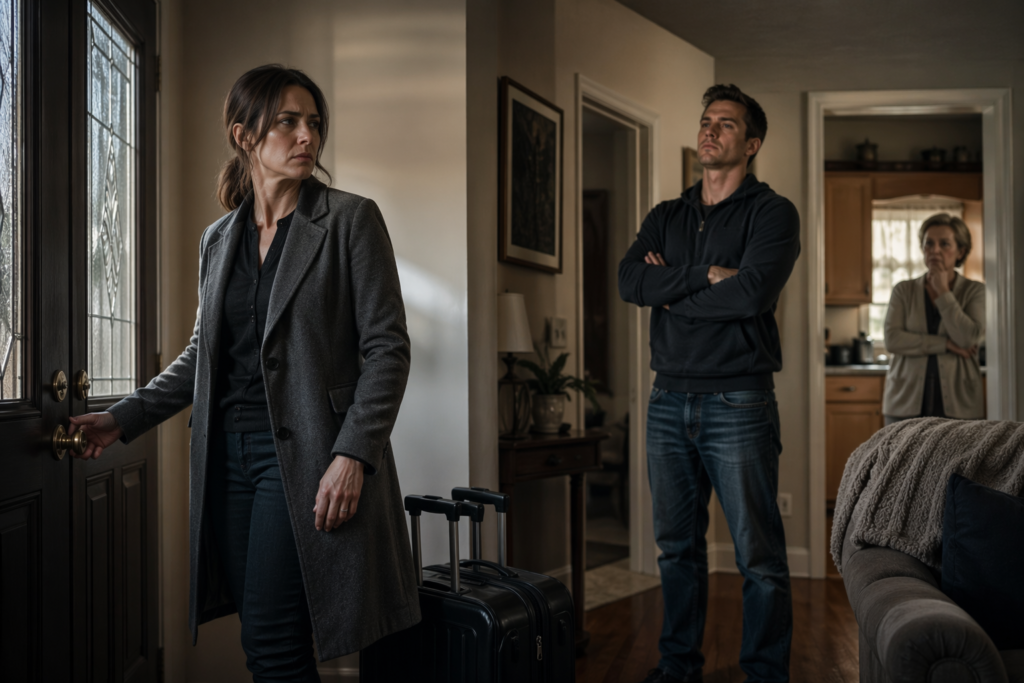
Not the one I was dragging behind me. My other suitcase. The older one I kept in the upstairs closet. It was sitting in the middle of the hallway, zipped shut, with a duffel bag beside it and two cardboard boxes stacked on top.
For a moment, I honestly thought we’d had some kind of leak upstairs and my mother had moved my things.
Then I saw Brent.
He was leaning against the wall near the staircase, arms folded across his chest, wearing the smug expression of someone who had rehearsed a victory speech in the mirror.
He did not look surprised to see me.
He looked ready.
“What is this?” I asked.
My voice came out flatter than I intended. Not angry yet. Just tired. Confused. The kind of tired where your body has not even caught up to the danger in front of you.
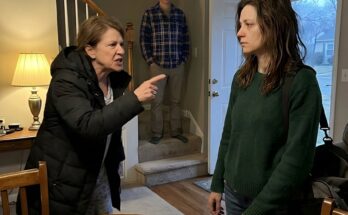
He straightened slowly and lifted his chin. “You can’t keep hiding out here, Naomi.”
I blinked. “What?”
“You heard me.” His mouth twisted into something halfway between a sneer and a smile. “You’re thirty-four years old and still clinging to Mom’s house. It’s pathetic. I need my own space. We need you gone.”
For a second, my mind refused to process the sentence. It moved over the words one by one as though maybe they belonged in a different order. Hiding out here. Mom’s house. We need you gone.
I laughed once, but there was no humor in it. “I just got off a plane, Brent. I’m exhausted, and I’m not in the mood for whatever this is.”
“It’s not a joke.”
That was when I noticed the boxes more clearly. Not random items. My things. A framed photo from college. A pair of boots I kept by the upstairs closet. A folded blanket from the end of my bed.
The air changed around me.
My grip tightened on the handle of my carry-on. “Are you serious?”
He pushed off the wall and crossed his arms again, posture widening, as if he were trying on authority. “Completely. This situation has gone on long enough.”
“What situation?”
He gave me a look full of contempt. “You living here. Hovering. Acting like this place revolves around you.”
I stared at him. “I pay the mortgage.”
He rolled his eyes.
“I pay the electric bill. The water bill. The internet. The groceries. The home insurance. The repairs. The taxes when Mom comes up short. I covered the furnace replacement last winter. I paid for your car battery in January. I paid for Mom’s dental work in March. What exactly are you talking about?”
His expression hardened, but not with shame. With irritation. The irritation of someone being forced to acknowledge facts that inconvenienced the story he preferred.
“You always do this,” he said.
“Do what?”
“You throw money in everyone’s face.”
I laughed again, sharper this time. “No. I mention money when the person living off it tries to remove me from the house I’ve been financially carrying for years.”
He took a step toward me. “That’s exactly why nobody wants you here, Naomi. You think because you pay for things, you own people.”
The sentence hit me so wrong that for a moment I could only stare.
Own people.
I had spent ten years shrinking my needs, biting back words, paying bills without question, canceling vacations, delaying my own plans, saying yes to emergencies that somehow only ever flowed in one direction. I had lived in one small room under a roof I kept afloat while being treated like a temporary guest. And he was calling me controlling.
Something old and familiar stirred in my chest then—not rage, not yet, but the ache of being rewritten in real time by people who depended on your silence.
“I have never asked any of you for anything,” I said quietly.
“Exactly,” Brent snapped. “Because this isn’t about helping. It’s about needing us. You cling to this family because without us, who are you? You don’t have a life, Naomi. You work, you come back here, you pay bills, and then you act like a martyr. It’s embarrassing. You buy your way into our lives because nobody else would choose you.”
His face was bright with the thrill of cruelty. He was enjoying himself.
I felt the words land in my body one by one.
You don’t have a life.
Nobody else would choose you.
There are insults that sting because they are cruel, and there are insults that sting because they are built from the insecurities other people have watched you carry in private. Brent knew exactly where to press because he had spent years benefiting from everything I withheld.
I had missed birthdays because of work.
I had not dated seriously in years.
I had postponed moving out because the house would collapse without my income.
I had let friendships thin because I was always tired, always traveling, always available to my family first.
He took every sacrifice I had made to keep them stable and rearranged it into proof that I was unloved.
I looked toward the kitchen doorway.
“Mom?”
I did not have to raise my voice. I knew she was there. My mother had a way of being close to conflict without entering it, listening just far enough away to later claim she hadn’t known what to say.
A second later, she appeared.
Apron on. Hair pinned back. Mouth tight. Eyes nervous.
She looked at Brent first.
Then at me.
Then down at her hands.
“Mom,” I said, and even to my own ears I sounded younger. Not thirty-four. Not exhausted. Not the woman who had flown across states that morning after ten days of work. Just someone’s daughter, still foolish enough to believe being seen was one conversation away. “Are you hearing this?”
She pressed her lips together.
“Tell him to stop.”
Instead of answering, she wiped her palms slowly against the front of her apron. A habit she had when she wanted sympathy before she had even spoken.
“Naomi,” she said softly, “please don’t make this worse.”
My chest tightened. “Worse?”
“Brent’s been under a lot of pressure.”
I turned toward him so sharply my neck hurt. “Pressure from what? Avoiding employment?”
“Naomi,” she said again, warning in her voice this time, not for him—for me.
That was the family pattern. Brent exploded. Mom soothed him. I reacted to the explosion, and suddenly my tone became the problem.
I looked back at her. “He packed my things.”
She flinched, but only slightly. “He just… he feels crowded.”
I laughed in disbelief. “Crowded? I’m gone half the month for work.”
“He’s a man,” she said, as if that explained everything. “He needs to feel like he has control in his own home.”
Something inside me went completely still.
His own home.
The phrase floated in the air between us, absurd and devastating.
I waited for her to correct herself.
She didn’t.
I thought of every check I had written. Every account alert. Every tense phone call from the road when the washing machine broke or the property tax was due or Brent needed gas money or Mom was “a little short this month.” I thought of eating airport sandwiches because I’d sent extra money after Brent claimed he was “finally close” to launching something. I thought of sitting in dim hotel rooms, spreadsheets open, calculating how to keep three lives afloat on top of my own.
And here stood my mother, granting ownership to the one person who had contributed the least.
“Say that again,” I whispered.
She looked miserable, which for years would have been enough to make me soften. But misery and accountability are not the same thing.
She swallowed. “If you really loved us, you’d understand.”
There it was.
The sentence she always used when she wanted obedience decorated as virtue.
If you loved us, you’d understand.
If you loved us, you’d stay.
If you loved us, you’d help.
If you loved us, you wouldn’t be upset.
If you loved us, you would accept what hurts you and call it loyalty.
I had heard versions of that sentence since I was seventeen.
When Brent crashed Mom’s car and she needed help covering the repair.
When Dad missed work and the pharmacy bill doubled.
When Brent borrowed money he never returned.
When I postponed graduate school.
When I gave up my apartment lease after Dad died.
When I stopped asking how long “temporary” would last.
If you loved us.
As though love had to move only one way to count.
I looked at Brent again. He was watching me with open satisfaction now. He thought my mother’s words had settled it. He thought this was the part where I sighed, took the blame, and adapted.
The truth arrived then, not like lightning, but like cold water.
I was not family in that house.
I was infrastructure.
Useful when functioning.
Ignored when stable.
Resented when visible.
That realization hurt in a way I can still feel when I think about it. Not because it was entirely new, but because it stripped away the last excuse I had left. So much of survival depends on the stories we tell ourselves to make pain bearable. They love me but they’re overwhelmed. They don’t mean it. It’s just a rough patch. He’ll change. She’s trying. Things will be different soon.
Soon is a dangerous word.
People build entire prisons out of it.
“So that’s it?” I asked.
Nobody answered.
I looked at my mother. “You’re choosing the son who contributes nothing over the daughter who has kept this house standing.”
Her face crumpled, but she still would not meet my eyes. “Please don’t speak about your brother that way.”
I almost smiled at the absurdity. Not because it was funny, but because the alternative was screaming.
“Your brother.”
Not “Brent is wrong.”
Not “This isn’t fair.”
Not “Thank you for everything.”
Not even “Let’s sit down and talk.”
Just a defense.
For him.
Always for him.
I waited another second, maybe two, for some hidden reserve of dignity in the room to show itself.
It didn’t.
My mother turned and walked back toward the kitchen. The swinging door moved once, then twice, and settled into silence.
And that was it.
No dramatic confrontation. No shattered plates. No speech sharp enough to force them into self-awareness. Real heartbreak rarely arrives with theatrical timing. More often it comes as a deep internal severing. A quiet recognition that the people before you are not confused. They are choosing.
I set my carry-on down beside the wall.
Then I bent and lifted the older suitcase Brent had packed.
He frowned. “That’s it?”
I looked at him.
For the first time in years, really looked at him.
At the confidence that had never been earned.
At the softness of a man protected from consequences.
At the little flare of triumph in his eyes because he believed power came from possession, not contribution.
He thought he had removed the nuisance while keeping the system that fed him intact.
I placed my keys on the granite counter by the entryway.
The sound they made was small, metallic, final.
Then I picked up the duffel bag and one of the boxes.
Brent shifted, confused now. “Wait. You’re just leaving?”
I almost said, You wanted me gone.
But I was beginning to understand that words are wasted on people who only hear advantage.
So I walked to the door.
My hand was already on the knob when he called after me, “You’ll be back.”
I turned then.
He had expected anger. Pleading. Negotiation. Maybe tears.
What he got instead was calm.
And calm unsettles cruel people more than any storm.
I looked at him, then past him toward the kitchen where my mother stood half-hidden in the doorway, listening.
For one suspended second, all three of us were perfectly still.
Then I said, “I hope you both remember this moment when the withdrawal hits on the first.”
The house went silent.
Brent’s face changed first. Not much. Just enough. The smugness faltered, then cracked.
My mother stepped fully into the doorway. “Naomi—”
But I was already outside.
The late afternoon air hit my face cool and clean, and for the first time in years I felt something I did not recognize right away.
It wasn’t relief.
Not yet.
It was the absence of obligation.
I loaded my things into the trunk with mechanical movements. Suitcase. Box. Bag. Then the second box. Brent did not come outside to help. Of course he didn’t. My mother didn’t either.
I got into the driver’s seat and shut the door.
Only then did I let myself breathe.
My hands were trembling so hard I had to rest them on the steering wheel. My body felt split in two. One half running on pure function. The other somewhere far behind, still standing in that hallway, trying to understand how ten years could end in a single afternoon and still somehow make perfect sense.
I started the car.
As I backed out of the driveway, I looked up once and saw Brent at the living room window.
He was smiling again.
Not because he had recovered from what I said. Because he hadn’t understood it yet.
That smile stayed with me the whole drive to the airport.
I didn’t have a plan. Not a full one. Just movement.
Away.
Sometimes survival begins with something as unglamorous as refusing to turn the car around.
I drove forty minutes on autopilot, checked parking, dragged my luggage inside, and stood beneath the departures board like someone who had stepped into a different life by accident.
The airport was loud in all the ordinary ways—rolling suitcases, delayed flight announcements, children whining, coffee orders being called out. Nobody there knew I had just been removed from the house I had financed. Nobody knew my entire family structure had collapsed in under an hour. The anonymity of it was strangely merciful.
I booked the first direct flight I could find to San Diego.
Not because I had anyone there.
Because I had been there once for work two years earlier and remembered, irrationally but clearly, the feeling of standing near the water after a meeting and thinking: If I ever disappear, I could start here.
I had laughed at myself at the time.
At the gate, I sat with my suitcase between my knees and opened my banking app.
Three thousand dollars.
Scheduled for the first of the month, automatic like a heartbeat.
I stared at the number for a long time, then canceled the transfer.
The screen refreshed.
That was all.
No thunder. No dramatic music. No alert sent to the heavens.
Just one cancelled payment.
And yet my whole life seemed to tilt.
I should have felt guilt right away. Panic. Fear. But what came first was grief.
Not for the money.
For the years.
For the version of me that had believed being needed was the same as being loved.
A woman sat beside me a few minutes later, maybe in her sixties, wearing a linen jacket and sensible shoes, the kind of face that suggested she had once been beautiful in a striking way and had now become beautiful in a steadier one. She glanced at the tissue in my hand, then at the untouched coffee cup near my feet.
“Bad trip?” she asked.
I almost laughed.
“Something like that.”
She nodded, not pushing. “Those are usually the worst kind.”
I don’t know what made me speak. Exhaustion maybe. Or the strange freedom of talking to someone who had no stake in my choices. I didn’t tell her everything. Just enough.
“I think I just left my family for good.”
She was quiet for a moment. Then she asked, “Did they know what you were carrying?”
The question hit harder than any expression of sympathy could have.
“No,” I said. Then, after a second, “Or maybe they did. Maybe they just thought I’d keep carrying it.”
She nodded slowly. “That happens too.”
Boarding began a few minutes later, and we stood.
Before she walked toward her row, she touched my arm lightly and said, “A lot of people confuse access with love. They are not the same. Don’t go back just because they panic when they lose access.”
I carried that sentence with me across the country.
The first message arrived before takeoff.
FROM MOM: Naomi please call me. You left in a rush and Brent is upset. We need to talk calmly.
I stared at the screen until the flight attendant told us to switch devices into airplane mode.
Brent is upset.
Not Naomi, are you okay?
Not I’m sorry.
Not please come home.
Brent is upset.
Of course he was.
The utility had unplugged itself.
I did not answer.
When I landed in San Diego three hours later, the sky had gone dark over the city. I got a hotel near the water and stood in the room with my suitcase unopened, listening to the air conditioner hum. My phone buzzed six times in twenty minutes.
Mom.
Mom.
Mom.
Brent.
Mom.
Unknown number.
I showered, sat on the edge of the bed in a borrowed hotel robe, and finally opened the messages.
FROM MOM: I think there has been a misunderstanding.
FROM MOM: Please don’t do anything drastic.
FROM MOM: Your brother didn’t mean it the way it sounded.
FROM BRENT: Real mature. Running away instead of talking.
FROM MOM: The mortgage is due in four days.
I read that one twice.
Then once more.
Not because I hadn’t understood it.
Because I had.
The speed of it.
The nakedness of it.
Hours. It had taken only hours for the emotional language to fall away and expose the machinery underneath.
Not We miss you.
Not Please forgive us.
Not Come back.
The mortgage is due in four days.
I laughed then. A hard, stunned sound in an empty hotel room.
And that laugh changed something.
Because until then, some part of me had still been waiting for the softer version of events to appear. The misunderstanding. The apology. The admission that things had gone too far.
Instead, they skipped directly to billing.
The next morning, I walked to the water before sunrise.
The beach was almost empty except for a few runners and a man setting up a folding chair to fish. The air smelled like salt and cold sand. I stood there in borrowed quiet and realized I could not remember the last time I had been anywhere without anticipating someone else’s needs.
That frightened me.
Then it steadied me.
By eight o’clock, Brent had called twice and left a voicemail.
“Naomi, enough with the drama. You made your point. Mom’s crying, the payment’s about to bounce, and you know how bad her blood pressure gets when she’s stressed. Just send the money and stop punishing everyone.”
Punishing everyone.
I listened to that message three times, not because it hurt, but because it clarified.
He still thought the money was his by moral entitlement.
He still believed my refusal to fund them was an act of cruelty rather than a boundary years overdue.
I saved the voicemail.
Then I called the mortgage company.
The woman on the line was polite and efficient. Yes, the account was in my name as primary. Yes, the autopay could be canceled, which I had already done. Yes, I could request documentation of the payment history. Yes, there were options if I no longer intended to reside in the property. No, she could not advise me personally, but she recommended speaking to an attorney before making any transfer of responsibility.
Primary.
I sat with that word after the call ended.
For years I had behaved like a guest because my mother called it her home and Brent called it Mom’s house. Yet legally, financially, functionally, I had been the one keeping it alive. The structure of my life had been built around minimizing conflict, not recognizing reality.
That afternoon, I rented a small furnished apartment for a month.
The price made me wince—and then I remembered what I had been sending every month and almost smiled.
For less than I had been paying to sustain resentment in that house, I could have privacy. Quiet. Space. My own groceries. My own furniture choices. My own life.
The realization was both liberating and humiliating.
I called my manager and asked to transfer temporarily to our Southern California office. It took two days, three conversations, and one carefully worded explanation about “family instability,” but because my role was flexible and they needed help there anyway, they said yes.
I extended the apartment for three months.
Then I called an attorney.
Her name was Denise Harper, and she had the kind of voice that made emotional fog clear itself out of respect. She listened without interruption while I summarized the last ten years, then the last twenty-four hours.
When I finished, she asked only practical questions.
Whose name was on the mortgage?
Mine and my late father’s estate originally, later refinanced into mine after his death.
Who had been making payments?
Me.
Did anyone else have legal ownership?
No.
Was there a rental agreement?
No.
Did they contribute financially?
Not consistently.
Did I wish to sell?
I didn’t know yet.
“Then your first task,” she said, “is to stop making decisions from guilt and start making them from fact.”
I wrote that down.
She told me to gather all records: bank statements, mortgage statements, utility payments, major repairs, insurance, taxes. Everything. She said if I intended to reclaim control of the property or sell it, documentation mattered. She also said something else that lodged under my ribs.
“You are not abandoning adults by refusing to subsidize their choices.”
Nobody had ever said it to me that plainly before.
Over the next week, I built a paper trail of my own life.
Statements. Receipts. Transfers. Confirmation emails. Home repair invoices. Medical copays. A furnace replacement. A roof patch. Car insurance I’d covered “temporarily” for Brent after he “fell behind.” Grocery deliveries paid from hotel rooms in other states. Venmo transfers labeled for medicine, gas, dog food, late fees, emergency cash.
Ten years of proof.
Ten years of emotional labor translated into numbers.
The total made me physically ill.
Not because it was abstractly large, though it was.
Because I could see, line by line, the pieces of my own life I had deferred to fund theirs. The apartment I could have bought. The retirement account I could have built. The graduate degree I’d put off. The trips I never took. The time I never got back.
Mom called every day.
Her messages moved through predictable phases.
Confusion.
Tears.
Pressure.
Nostalgia.
Health concerns.
Subtle blame.
Full blame.
Then silence when none of it worked.
One message said, “Families don’t keep score.”
I listened to that one while looking at a spreadsheet of every payment I had made since age twenty-four.
Families may not keep score, I thought. But users do. They just don’t like when the person paying starts counting.
By the second week, Brent stopped pretending this was about hurt feelings.
He sent: If you ruin this house over one argument, you’re proving exactly who you are.
As if one argument had cost me ten years.
As if his outburst had created the problem rather than exposed it.
I did not respond.
Instead, I let Denise send a formal letter requesting that all future communication regarding the property go through her office.
That shook them more than anything else.
Mom left me a voicemail sobbing. “How could you send a lawyer after your own family?”
I sat on my apartment floor, phone in hand, and almost answered out of reflex. To soothe. To explain. To reduce the emotional temperature in the room, even though I was no longer in the room.
Then I realized that explaining had always been the bridge back to obedience.
So I stayed quiet.
Silence, when chosen instead of imposed, is a very different thing.
A month passed.
Then six weeks.
My life in San Diego began to feel less like an escape and more like a beginning.
I bought real groceries instead of survival food.
I slept through the night.
I left dishes in the sink without hearing anyone complain later about “how tense the house felt.”
I sat by the window on Saturdays and read without waiting for a request, a crisis, or a guilt-laced phone call.
I started taking evening walks.
I said yes when a woman from work invited me to dinner with friends.
I laughed there—fully, unexpectedly—and realized how long it had been since laughter had come without caution.
One of those friends, Maya, became the first person in years to ask me a question and actually wait for the real answer.
“What do you want now?” she asked over Thai food one night.
Not what would be easiest.
Not what was fair to everyone.
Not what my mother needed.
Not what Brent was planning.
What do you want now?
The question was so unfamiliar it almost made me angry.
Then it made me cry.
“I don’t know,” I admitted.
“That’s okay,” she said. “But you get to find out.”
No one had ever given me permission that simply.
Three months after I left, Denise called with an update.
Brent and my mother had made no effort to take over the mortgage or utilities. Several notices had gone unanswered. The house required maintenance they were not handling. Denise recommended a decision soon: reclaim occupancy and evict them, or sell.
The old Naomi would have stalled.
Would have pictured my mother frightened.
Would have imagined Brent suddenly changing.
Would have tried to design a softer ending for people who had never offered me one.
But distance had given me something I had lacked for years: proportion.
I asked Denise to begin the process of selling.
That conversation left me shaking. Not because it was wrong. Because it was final.
My mother called that evening from a new number.
I almost didn’t answer.
But I did.
“Naomi,” she said, and her voice broke on my name. “Please. Please don’t do this.”
I stood by my apartment window and looked at the street below. A couple was walking a dog. Someone was carrying takeout. A teenager on a skateboard nearly clipped a trash bin and laughed at himself. Ordinary life moved forward while my mother cried into the phone.
“You chose this,” I said quietly.
“No, I didn’t.”
“Yes. You did.”
“It was one bad day.”
“It was ten years, Mom.”
She was silent.
Then, softly, “You know your brother doesn’t mean the things he says.”
I closed my eyes.
There it was again. The old absolution. The family myth.
“He meant them enough to say them,” I replied.
“He was angry.”
“And what were you?”
Silence.
I let it stretch.
When she finally spoke, her voice was smaller than I had ever heard it. “I was afraid.”
That hit a place in me still tender enough to ache.
Afraid of Brent’s temper.
Afraid of instability.
Afraid of losing the illusion of peace.
Afraid of naming what the family had become because naming it would require change.
I understood her fear.
But understanding is not the same as surrender.
“I was afraid too,” I said. “For years.”
She started crying harder then, but I did not rescue her from it.
That was another lesson of distance:
You can feel compassion for someone and still refuse to resume your role in their dysfunction.
The house sold two months later.
Not for a fortune, but for enough.
Enough to pay off the mortgage, cover fees, and leave me with a sum large enough to make my hands shake when I signed the final papers. Enough to start over properly. Enough to prove, in one brutal sweep, how much of my life had been anchored to a place that never loved me back.
Brent sent one final message the day the sale closed.
Hope you’re happy.
I looked at the words for a long time.
Then I deleted them.
Because happiness was not the point.
Truth was.
Freedom was.
The first thing I did with the money was not dramatic. I paid off my credit card. I increased my retirement contributions. I signed a lease on a one-bedroom apartment with hardwood floors, too much sunlight, and a balcony just big enough for two plants and a chair. I bought a new bed. Not expensive, just good. I bought towels that matched. I bought a dining table for two even though I lived alone.
The second thing I did was take a week off without sending any of it home.
I rented a car and drove up the coast with no itinerary and no one expecting anything from me. I stopped when I wanted. Ate when I wanted. Slept when I wanted. On the third day I pulled over near a cliffside overlook and stood staring at the ocean so long a stranger asked if I was okay.
“Yes,” I said, surprising myself with how true it felt. “I think I finally am.”
Healing did not arrive all at once.
I still woke some nights with guilt lodged under my ribs.
I still heard my mother’s voice sometimes when I bought something unnecessary for myself.
I still felt the old panic if my phone rang late.
But guilt began to lose authority once I stopped feeding it with obedience.
Months later, Maya invited me to dinner at her place. There were six people there, all loud in that warm, affectionate way families in movies are and real families sometimes can be. They passed dishes around, argued about music, laughed over terrible college photos. At one point, Maya’s brother got up to clear plates, and their mother swatted his shoulder lightly and said, “Don’t leave everything for your sister.”
The sentence was so ordinary I nearly cried into my wine.
Don’t leave everything for your sister.
Not because it was profound.
Because it was normal.
Because care was being distributed instead of extracted.
Because in that room, responsibility was not gendered or manipulated or weaponized.
On the drive home I realized something that should have been obvious long before:
I had spent years trying to be loved by people who were most comfortable with me depleted.
And once you see that, you cannot unsee it.
A year after I left, my mother sent a letter.
Not a text. Not a voicemail. A real letter, forwarded through Denise’s office because I had never given her my new address.
I sat with it unopened on the kitchen counter for two days.
Then I read it.
It was not a perfect apology. It did not contain the level of self-awareness that therapists probably dream about. But it was the closest thing to honesty I had ever received from her.
She wrote that she had depended on me too much for too long.
That she had mistaken my reliability for endless strength.
That she had protected Brent because it was easier than confronting him.
That she had called it keeping peace when really she had been sacrificing me to maintain comfort.
That the day I left, she knew I might never come back and still said nothing because she didn’t know how to stop what she had allowed for years.
There were excuses threaded through it. Fear. Grief. Habit. Shame.
But there was also one line that made me sit down.
I taught you that love meant endurance, and I am sorry for how much that cost you.
I read that line over and over.
Then I folded the letter back up and placed it in a drawer.
Forgiveness is not always a door flung open.
Sometimes it is simply a loosening.
A refusal to keep drinking poison from the past.
A decision to stop needing the apology to be perfect before you let it become real.
I never moved back.
I never resumed payments.
I never returned to being the answer to emergencies nobody else planned for.
I saw my mother once, two years later, in a café halfway between our cities.
She looked older.
Smaller somehow.
Less certain of her ability to steer the conversation with guilt.
We talked carefully at first. Weather. Work. Health. Safe things.
Then she said, “You seem lighter.”
I stirred my coffee and looked out the window for a moment before answering.
“I am.”
She nodded like the word hurt and relieved her at the same time.
Brent did not come up until the end.
“He still says you abandoned us,” she admitted.
I met her eyes. “Did I?”
She looked down at the table.
“No,” she said quietly. “You stopped carrying what was never yours alone.”
That was enough.
Not because it fixed everything.
Because it named it.
When I think back now to the hallway, the suitcase, the granite counter, Brent’s grin in the window, what stays with me most is not the cruelty. Not even the betrayal.
It is the silence after I said I hoped they remembered that moment when the withdrawal hit on the first.
That silence was the sound of a lie dying.
The lie that I needed them more than they needed me.
The lie that my role was permanent.
The lie that sacrifice guaranteed belonging.
The lie that love demanded self-erasure.
I once believed blood was thicker than water.
Now I think love is something else entirely.
It is respect.
It is reciprocity.
It is being able to breathe in a room without paying for the privilege.
It is not begging to be treated gently by people standing on your shoulders.
It is not financing your own humiliation and calling it devotion.
And freedom, I learned, does not always arrive with applause.
Sometimes it begins with a canceled transfer.
A suitcase in a hallway.
A hand on a doorknob.
One calm sentence.
Then a silence so deep it finally lets you hear yourself.
If you had asked me that morning who I was, I might have told you I was a daughter, a provider, a fixer, the dependable one, the one who made things work.
If you ask me now, I would answer differently.
I am Naomi.
I am the woman who left.
And when the house went quiet, I finally heard my own life calling me home.