At my father’s funeral, my brother stood in front of forty people and announced that the family home would be sold immediately to cover his debt.
Then my mother looked straight at me and told me I could find somewhere else to live.
There are moments in life when humiliation arrives so fast and so publicly that your body cannot keep up with it. Your mind hears the words, but your skin turns cold a second later. Your mouth stays closed because there is no version of language that feels strong enough. Your hands remain in your lap because you know that if you move even slightly, everyone in the room will see you shaking.
That was how it happened for me.
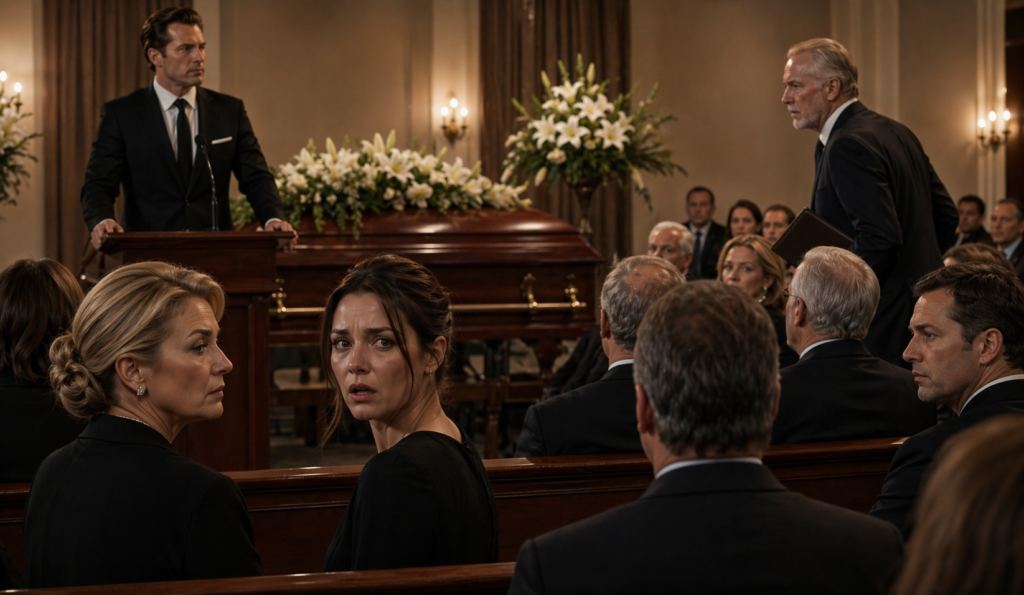
I was sitting in the third row at Peterson and Sons Funeral Home, dressed in black, staring at the mahogany casket that held my father, Richard Henderson. The chapel smelled of lilies and furniture polish and stale air-conditioning. Everything in the room was carefully arranged to suggest dignity and reverence. The flowers had been placed in elegant arcs. The lighting was low and flattering. The organ music had been soft enough not to interrupt conversation, but present enough to make people lower their voices.
Nothing about the room felt real.
Grief rarely does, at first. It comes in sharp flashes and dull stretches. It appears in strange details. The seam of a sleeve. The way dust settles on a polished shoe. The way strangers speak in hushed tones as though sadness were something they could perform correctly if they just used the proper volume.
I remember the lilies most clearly because my father hated them. He used to say they smelled like forced sentiment, like flowers chosen by people who wanted grief to look expensive. He preferred daffodils in the spring and the unruly rosebushes in the backyard of our house on Maple Street, the same house my brother was about to offer up like an asset in a board meeting.
To my left sat my mother, Eleanor Henderson, dressed in a black suit so impeccably tailored that not a wrinkle disturbed the fabric. She dabbed the corner of one eye with a tissue from time to time, but even in mourning she seemed composed, curated, almost theatrical in her sorrow. My mother had always understood presentation. She knew what grief should look like on a woman of her standing. She knew which friends to embrace and which ones to merely nod to. She knew how long to pause before speaking, how much softness to layer into her voice, how to convey pain without ever allowing herself to appear weak.
To my right sat my brother Marcus, who had inherited our father’s height, our mother’s taste for status, and neither one of their discipline. He wore a black suit that fit him too well to have been chosen in grief. His watch flashed when he shifted. He kept touching his cufflinks, tiny movements of impatience breaking through the solemnity he was trying to project. If you did not know him, you might have thought he was nervous from sadness.
I knew better.
Marcus was restless because he had already moved on to the next matter of business.
That was how our family worked. Even sorrow had a hierarchy, and practicality usually outranked tenderness. My father had not yet been laid to rest, and still Marcus was thinking about money, optics, exposure, pressure, solutions. Not because he was responsible. Not because he had suddenly become capable. But because consequences had finally caught up with him, and he needed someone else to absorb the impact.
The service began the way such services always do. A few soft words from the funeral director. A prayer. The shuffle of people settling deeper into the pews. A distant cough. A program slipping from someone’s lap to the floor. The ordinary mechanics of public mourning.
Then Marcus rose to give the eulogy.
He walked to the podium with the polished confidence of a man who had practiced in front of a mirror. He placed both hands on either side of the dark wood and lowered his face for a moment, as if steadying himself. When he looked up again, his expression was tender in a way that would have impressed anyone who had not grown up with him.
He began with a story about fishing trips.
That was the first sign that the entire speech was fiction.
My father hated fishing. He found it boring and damp and unnecessarily patient. He liked building bookshelves in the garage, listening to old jazz records on Sunday mornings, and washing his car with a level of attention usually reserved for surgery. He liked crossword puzzles, black coffee, neighborhood gossip, clean gutters, and exact change. He did not like fishing. But Marcus told the story with such easy warmth that several people in the room smiled through tears.
Then he moved on to “fatherly wisdom.”
He spoke about Richard Henderson as if he had been raised by a man who dispensed memorable advice from the porch at sunset, a man full of simple truths and generous lessons. My father had offered wisdom, yes, but never in polished, quotable lines. His lessons came through routine, through expectation, through long drives in silence, through the way he showed up on time and paid every bill before it was due. He had not been sentimental. He had been steady.
Marcus turned him into something softer, shinier, easier to applaud.
Around me, people nodded. A few even cried.
I sat perfectly still.
Because grief is already lonely, and there is a special kind of loneliness in watching someone rewrite your dead parent in front of witnesses who have no reason to doubt him.
When Marcus reached the end of his speech, he paused for effect. His voice caught at exactly the right place. He lowered his head. The room gave him the silence he wanted.
Then, instead of stepping away from the podium, he gripped its edges.
That was when I knew.
His knuckles went white. His shoulders shifted. The tone in the room changed so subtly that most people did not notice it until he had already begun.
“As many of you know,” he said, his voice dropping into a somber register that was meant to sound reluctant, “Dad’s passing has left us with some difficult logistical burdens.”
The phrase hit the room like a cold draft.
People straightened.
My mother did not move.
Marcus continued. “After discussing it with Mom, we’ve decided the best way to honor his memory is to sell the house on Maple Street immediately. To cover… family obligations.”
There was a pause after that phrase. A calculated pause. Long enough for people to wonder. Short enough to imply dignity.
A murmur moved through the chapel.
I did not need clarification.
I knew exactly what “family obligations” meant.
It meant Marcus’s gambling debt.
Three hundred and forty thousand dollars.
The number looked obscene even in my mind. Too large to belong to our family, too reckless to coexist with the suburban brick house where my father had mowed the lawn in straight lines and complained about the electric bill whenever anyone left on too many lights.
But Marcus had accumulated that debt the way he did everything else: arrogantly, privately at first, and then desperately once the truth could no longer be controlled.
I had learned about it six months earlier, not from Marcus, and certainly not from my mother, but by accident.
I had gone to the house on Maple Street on a Sunday afternoon because my father had asked me to help him set up online access for a new medical insurance portal. He had been irritated by passwords all morning and more irritated by the idea that he needed help. By then his health had already been slipping, though he dismissed it as age, stress, and doctors who liked to exaggerate. He was thinner than before, quieter than before, but still determined to act as if everything in the house remained under his management.
My mother was in the kitchen, speaking in a low voice on the phone.
She didn’t know I was standing in the hallway outside the doorway. She didn’t know I could hear every word.
“No, you cannot call here again,” she hissed. “He will handle it. I said he will handle it. We just need more time.”
A pause.
Then: “There is no money available until we decide what to do with the property.”
I remember freezing. Not because I understood everything instantly, but because of the tone in her voice. My mother only lost composure when the stakes were serious.
She came out of the kitchen moments later and saw me. For a split second something flashed across her face—fear, maybe, or anger at having been overheard. Then it disappeared.
“Briana,” she said coolly, “your father is waiting upstairs.”
Later that afternoon, Marcus arrived in a car too expensive for his actual life. He came in wearing sunglasses even though the sky was gray. He moved through the house like someone who still believed charm could solve anything. My mother took him into the den and closed the door. Voices rose. My father stayed upstairs longer than necessary.
When Marcus left, my mother emerged from the den with a headache and the thin, hard expression she wore when the world had inconvenienced her.
I asked my father if everything was okay.
He looked tired in a way I had not seen before. He sat down in the armchair by the window and rubbed a hand across his mouth.
“Your brother has made some poor decisions,” he said finally.
Only later did I learn what that meant.
Poor decisions.
That was the family phrase for disasters we wanted to dress in respectable clothing.
Marcus’s poor decisions had started small, the way ruin often does. Weekend trips that turned into habits. Sports betting disguised as confidence. Late-night wins that made him feel invincible and losses he insisted he could recover by doubling down. When he was younger, people mistook his recklessness for ambition. He liked risk, they said. He had an appetite for big things. He wasn’t afraid to bet on himself.
But there is a difference between ambition and appetite, and Marcus had always confused the two.
By thirty-nine, he had become a man who borrowed against the future as if consequences were a technicality. He had credit he could not support, promises he could not keep, friends who had become tired of rescuing him, and just enough inherited entitlement to believe none of it should actually cost him anything.
My mother had protected him every step of the way.
That part did not surprise me.
Marcus had been the chosen one for as long as I could remember. The favored child. The investment. The heir to a greatness no one ever stopped to define. In our house, his mistakes were temporary storms, while my smallest needs were treated like long-term burdens.
The rules had been set early.
When I was twelve, I wanted to join a summer art program at school. It wasn’t expensive, not by Henderson standards. I still remember the brochure in my hand, folded at the corners from being opened too many times. I stood in the kitchen while my mother reviewed it without interest.
“Why would we spend money on that?” she asked.
“Because I’m good at it,” I said.
She gave a short laugh. “Good at drawing won’t build a life.”
That same month, Marcus got golf lessons at a private club because my father had met a client whose son also played. The difference was never explained. It did not need to be.
Later, when I was sixteen, I was offered a place in a summer accounting enrichment program in the city. I had been thrilled. It felt practical, serious, useful—the kind of thing they said mattered.
But the program required commuting costs, materials, and time.
My mother glanced at the paperwork and said the line I would hear in different forms for years: “Why would we spend money on you? You’re a girl. One day you’ll be living in someone else’s house. Marcus needs opportunities that reflect his future.”
She said it with the calm certainty of someone reciting common sense.
My father was there when she said it. He did not agree aloud. He did not challenge her either. He simply stared at the evening news and remained silent in the way men sometimes do when they tell themselves that not choosing a side is the same as keeping peace.
It wasn’t peace.
It was permission.
Even so, my father and I found our ways toward each other in the years that followed. Not through dramatic declarations. Not through apologies. But through smaller things. He paid for one of my CPA exam prep courses without telling my mother. He called to ask whether I had eaten. He kept a spare set of my favorite tea in the pantry after I moved out, just in case I stopped by. He never said he was proud often, but when he did, the words landed heavily because I knew he did not waste them.
I built my life without expecting rescue from anyone.
I worked two jobs while finishing school. I learned how to stretch groceries. I rented tiny apartments with thin walls and windows that leaked cold in winter. I sat with spreadsheets late into the night and told myself exhaustion was temporary. I ate instant ramen at my desk and counted every dollar. I became a CPA because numbers were honest even when people were not. Numbers balanced. Numbers told the truth eventually. Numbers did not care who was favored.
It took me years to feel stable.
When I finally could, I moved into the small apartment above the garage at Maple Street to help my father after his health worsened. My job in the city remained demanding, and the commute was miserable, but my father had begun forgetting follow-up appointments and pretending he wasn’t. He insisted he was fine. My mother insisted everything was handled. Neither of them was telling the truth.
So I came home more often. Then I stayed longer. Then one day it became understood, though never formally stated, that I lived there.
Not because anyone had invited me warmly.
Because my father needed someone reliable, and everyone knew Marcus was not that person.
I drove Richard Henderson to specialists, managed insurance forms, organized prescriptions, and translated medical language into something human. I sat in waiting rooms with bad coffee and outdated magazines. I learned the names of nurses. I labeled medications. I argued with billing departments. I cleaned out the refrigerator. I brought groceries. I worked full days and then came home to a house where my mother acted as if my presence were both useful and slightly offensive.
Marcus visited when it suited him.
He breezed in with expensive cologne and loud concern. He kissed my mother on the cheek, clapped my father on the shoulder, and spoke in the tone of a man eager to be seen trying. Then he disappeared again. My mother praised him for showing up. I was simply there, which in our family meant my labor could be ignored.
When my father was first diagnosed, Marcus sent one group text that said, Let me know what’s needed.
What was needed, of course, was everything.
What Marcus offered, of course, was nothing.
And yet there he stood now at the funeral, using the word “we” as if he had carried any of this with us.
The room shifted uneasily after his announcement. No one said anything at first. People looked at each other, then at the casket, then back at Marcus. A funeral is the one place where greed still knows it should dress itself carefully, and even then it cannot fully hide.
My mother rose before anyone could question him.
She stood with one hand lightly touching the end of the pew, poised and elegant in black. She did not glance at the casket. She did not lower her head. She looked directly at me.
That was deliberate.
Everything my mother did in public was deliberate.
“Your father would understand,” she said.
I could feel the room listening differently now.
“Marcus needs the support,” she continued. “Briana is independent. She has her own life in the city. She can find somewhere else to live.”
There are sentences that do more than wound. They reorder the room.
In one moment, I was no longer a grieving daughter sitting at her father’s funeral. I was a logistical inconvenience. A removable item. A person whose place could be publicly revoked without warning.
Forty pairs of eyes turned toward me.
Some looked embarrassed on my behalf. Some looked relieved not to be me. Some carried that hungry kind of curiosity people get when a family conflict escapes its private walls and unfolds where they can witness it. A few of my father’s old friends frowned. One of my cousins stared at her hands. Someone near the back whispered, “Oh my God.”
I did not cry.
Not because I was strong.
Because shock can hold tears hostage.
My face felt hot, then numb. My chest tightened in sharp, shallow increments. I could hear my own pulse in my ears, louder than the organ, louder than the whispering, louder even than my mother’s voice.
A part of me wanted to stand up and ask the question that had lived under my skin for years.
How much more does he get to take?
But public humiliation does strange things to pride. It makes you still. It makes you suddenly aware of every angle of your body, every breath, every eye in the room. I stayed seated because standing felt like a performance I did not consent to give.
Beside me, my mother remained upright and composed, as though she had merely clarified a seating arrangement.
Marcus, meanwhile, had that look on his face he always wore after escaping consequences: the satisfaction of a man who believes the hardest part is over.
He knew I knew about the debt.
He also knew, or thought he knew, that I had no leverage.
I had never been the child my mother chose. I was the one expected to adapt. The one expected to absorb disappointment with grace. The one expected to prove adulthood by surviving what no one would have dared ask of Marcus.
It was a role assigned so early that sometimes I forgot it had been assigned at all.
Daughters in families like mine are often praised for resilience when what they are really being rewarded for is silence.
I looked at the casket again.
My father was gone.
That fact had not fully reached me until then. Not at the hospital. Not during the phone calls. Not when I helped choose the suit. Not when I signed forms with a pen that slipped twice in my hand. But in that moment, with my mother erasing me publicly and my brother turning our home into collateral, I understood something final and unbearable.
There would be no one left in that house willing to say my name with tenderness.
Maple Street had been more than an address. It was the narrow hall where my father measured our height in pencil marks that my mother hated on the wall. It was the kitchen where I learned to do taxes at the table because my father believed everyone should understand money. It was the den where he fell asleep with the newspaper on his chest. It was the squeak on the third stair, the rosebushes in the back, the cracked birdbath no one ever fixed, the smell of coffee before dawn.
It was also where I had spent the last two years helping him live with dignity.
And now, in front of forty witnesses, my right to even remain there long enough to breathe had been dismissed like a temporary arrangement no one needed to honor.
I thought of all the mornings I had gotten up before sunrise to prepare his medication. All the afternoons I had moved meetings so I could take him to appointments. All the evenings I had sat outside his bedroom door after hearing him cough, counting the seconds between each sound because fear had become its own routine.
I thought of my mother sleeping peacefully upstairs while I handled the things that frightened her.
I thought of Marcus sending occasional messages full of concern emojis and no action.
And I thought: this is what they think of me. Not daughter. Not caretaker. Not family. Just useful until inconvenient.
My mother sat back down as gracefully as she had stood. The matter, in her mind, was settled.
Marcus let one hand fall from the podium and gave a small nod, as if acknowledging an inevitable truth everyone should respect. He even had the audacity to look regretful.
That expression nearly broke something in me.
Because Marcus had always been best at sounding sorry for circumstances he himself created.
When he was fifteen and wrecked my father’s car backing it out of the driveway without permission, he cried and said he had only wanted to surprise everyone by washing it. When he failed his first year of college after spending more time partying than attending classes, he said he had been overwhelmed and ashamed. When he borrowed money from relatives and never paid it back, he framed it as temporary hardship. There was always a reason. Always a tone. Always some polished version of remorse that kept consequence at a distance.
My mother adored that version of him.
She called him sensitive.
She called him misunderstood.
She called him unlucky.
I called him what the math called him: a liability.
Only I never said it aloud.
Instead I built spreadsheets in my head. Years of them. Columns of who received what. Tuition. Cars. Bailouts. Excuses. Attention. Grace. Patience. More grace. More money. More patience. Then another emergency. Then another explanation. Then more family resources flowing in his direction like it was the most natural current in the world.
And somewhere far off to the side, there was me. Balanced. Self-funded. Efficient. Quiet.
It should not have surprised me that my mother chose him again.
What shocked me was that she did it there. In front of my father. In front of everyone.
Marcus stepped back from the podium at last.
He smoothed his jacket. Reached toward the chair where his coat rested. The service, apparently, was now over.
That was when a chair scraped in the back of the chapel.
The sound was small. Sharp wood against polished floor.
Yet it cut through the room with more authority than anything said at the podium.
Marcus froze.
My mother turned.
So did everyone else.
In the back row stood Gerald Whitmore.
For thirty years Gerald had been my father’s attorney, though attorney never seemed like the full word for him. He had been adviser, witness, keeper of papers, occasional dinner guest, and one of the very few people my father trusted without qualification. He was a man in his late sixties with silver hair, precise posture, and the kind of calm that made other people lower their voices instinctively. He did not move dramatically. He did not clear his throat for effect. He simply stood, buttoned his suit jacket, and looked toward the front of the room with an expression that had nothing to do with condolence.
Gerald had attended every major event in our family’s adult life. Closings. Contracts. Tax questions. Hospital paperwork. He had known us long enough to see through performance.
He also knew my father.
Not the public Richard Henderson. Not the easy version used in speeches. The real one. The man who checked every line before signing, who believed in documented intent, who distrusted assumptions, and who did not leave important matters vulnerable to Marcus’s improvisation.
Something in my chest shifted.
Not hope exactly.
Hope is too warm a word for what I felt.
This was colder. Sharper. Like hearing a lock click open in another room.
Gerald stepped into the aisle. Every face followed him.
“I’m afraid,” he said, and even that first phrase was enough to change the oxygen in the room, “you’ve misunderstood Mr. Henderson’s final instructions.”
Silence fell so completely that I could hear the faint hum of the ceiling vents.
Marcus’s expression changed first.
It wasn’t dramatic. Just a brief, involuntary tightening around the mouth. A tiny fracture in the confidence he had been wearing all afternoon.
My mother’s spine straightened.
Gerald continued walking toward the front, one measured step at a time. He carried a slim leather folder under his arm. My father had loved folders like that. Ordered, labeled, impossible to dismiss.
No one interrupted him.
No one dared.
Because unlike the grief in that room, Gerald’s authority was real.
I sat motionless, my fingers pressed so tightly together that the knuckles ached. My thoughts began moving too quickly to sort. Had my father known they would do this? Had he expected it? Had he seen enough, in the final months, to understand what would happen the moment his absence created space?
Images flashed through me in fragments.
My father at the kitchen table, reading something twice before signing.
My father asking me once, in a strangely casual tone, whether I still kept copies of all my financial records in both paper and digital form.
My father telling me, three weeks before he died, that people reveal themselves most clearly when they think nothing is being measured.
At the time I had assumed he was talking about Marcus’s debt.
Now I wasn’t sure.
Gerald reached the front of the chapel but did not step behind the podium. He remained slightly to the side, as if refusing to participate in the performance that had already happened there.
“Richard was very clear,” he said.
My mother’s face did not move, but her hands tightened over the tissue in her lap.
Marcus attempted a smile that did not fully form. “Gerald, maybe this isn’t the time—”
“It is precisely the time,” Gerald said.
He did not raise his voice. He did not need to.
The room held still around him.
There are people who command attention by taking up space. Gerald did it by removing all unnecessary motion. He had the controlled stillness of someone who trusted the strength of facts.
My brother dropped his hand from his coat.
My mother opened her mouth slightly, then closed it again.
For the first time since the service began, they looked uncertain.
And that uncertainty moved through me like the first clean breath after being trapped underwater.
I did not know exactly what was in that folder.
I did not know whether it would save the house, vindicate me, expose Marcus, embarrass my mother, or simply delay the inevitable.
But I knew this:
My father had not left the final word to them.
That knowledge alone altered the room.
The grief was still there, yes. So was the humiliation. So was the sharp, aching absence of the man in the casket just a few feet away. Nothing Gerald said could erase the fact that my father was gone, or that the people closest to me had chosen this day, this place, this moment, to show exactly where I stood in their loyalties.
Yet beneath all of that, another feeling began to take shape.
Recognition.
Because for years I had lived inside a story my family told about me: capable but secondary, useful but removable, independent therefore undeserving. The daughter who needed less and therefore received less. The daughter who would manage. The daughter who always did.
And now, as Gerald Whitmore opened the leather folder in the front of the chapel and forty people watched in absolute silence, I understood that my father may have seen that story too.
More importantly, he may have decided not to leave it unchallenged.
I looked at the casket one more time.
At the polished wood. At the white flowers my father would have mocked. At the soft light falling across the front of the room. At the faces turned toward Gerald in suspense.
Then I looked at Marcus.
His smile was gone.
Not softened. Not hidden. Gone.
What replaced it was something I had rarely seen on my brother’s face and never for long: fear.
Real fear does not look theatrical. It looks like calculation failing in real time. It looks like a man trying to remember which promises he made, which documents he never expected to exist, which assumptions he made too confidently. It looks like someone realizing that the stage he has been performing on may not actually belong to him.
My mother saw it too.
She shifted in her seat and lifted her chin, the movement small but unmistakable. Whenever she felt control slipping, she became even more still, as if poise itself could intimidate reality into obedience.
But some things cannot be managed by posture.
Gerald unfolded the first paper.
The room did not breathe.
And there, in the long, suspended silence between public betrayal and private truth, I felt the first crack appear in the version of events my family had tried to force into place.
My father’s funeral had begun with my erasure.
It did not end there.
It ended with the family lawyer standing in the aisle, the room frozen around him, and my brother no longer smiling.