On Fridays, the school always emptied faster than usual.
By three-thirty, the courtyard that had been noisy only minutes earlier turned thin and hollow, as if the laughter had been folded up and carried away inside lunch boxes and backpacks. The younger children rushed out first, chasing older siblings or running toward mothers with open arms. Motorbikes lined the curb in a bright disorder of helmets and voices. Fathers called names over the noise. Grandmothers adjusted little sweaters. Plastic water bottles knocked against metal gates. Shoes slapped wet concrete if it had rained, or kicked up pale dust if it had not.
Then, as the minutes passed, the sound drained out.
The teachers disappeared one by one with their tote bags and stacks of papers. Classroom windows shut. The guard at the corner booth stretched his shoulders and checked his phone. Even the birds seemed to settle once the shouting died down.
And every Friday, when all of that was over, Lina stayed.
She was eight years old, small for her age, with dark hair usually tied too loosely for it to stay neat through the day. By dismissal time, strands would cling to her temples and cheeks. Her socks slipped into her shoes. Her backpack, faded around the zipper, always looked heavier than it should have. Yet she stood with a patience that made her seem older in the saddest possible way.
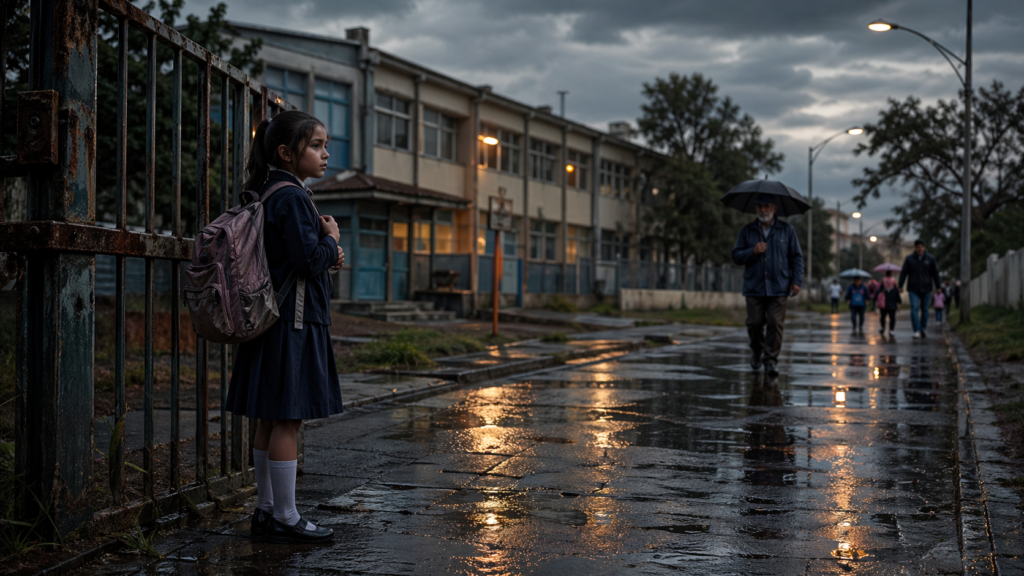
She stood by the rusted school gate.
Not right in the middle where the other children crowded when they spotted familiar faces, but slightly off to the side, near the bent section of metal where old paint had peeled away and orange rust spread like dried tears. From there she could see the road clearly. From there she watched every passing woman who slowed near the school entrance, every motorbike that approached, every pair of footsteps.
She always looked the same way.
Hopeful first.
Then alert.
Then uncertain.
Then quiet.
By then, most of the time, the road had already started to empty.
The first few Fridays, no one paid much attention.
Her class teacher, Ms. Dara, noticed that Lina was among the last children picked up, but that was not unusual. Some families worked long hours. Some children joined older siblings after school. Some waited for neighbors. Lina never made a fuss. She never cried or clung or wandered. When adults asked casually if someone was coming for her, she answered in a small but certain voice.
“My mom is coming.”
There was something so simple about the answer that it allowed everyone to move on.
The phrase settled over questions like a lid.
My mom is coming.
That was enough, until it wasn’t.
Lina lived in a narrow lane behind the old market, in a row of rental rooms built wall to wall under a sagging tin roof. Each room was barely wide enough for a bed, a plastic table, and a stove pushed against one corner. In the rainy season, water collected in the broken pavement outside and mosquitoes hovered above it at dusk. In the dry months, dust gathered in every crack. Laundry hung from wires. Children ran barefoot between doorways. Radios played in overlapping layers from one room to the next. Everyone knew pieces of everyone else’s life, though not always the most important pieces.
Lina and her mother had lived there for nearly two years.
At least that was what the neighbors believed.
Her mother, Sreyneang, had arrived with one metal trunk, one thin mattress, and a little girl who kept clutching a stuffed rabbit with only one ear. She had been polite but private. She worked irregular jobs—cleaning houses some weeks, washing dishes at a restaurant on others, sometimes disappearing before sunrise to stand in line for day labor. She did not complain much, which made people assume she was strong. She did not ask for help, which made people assume she was managing. In places like that, the line between dignity and desperation was easy to miss.
People learned to describe her in passing with the same few words.
Quiet woman. Hard worker. Keeps to herself.
Lina learned to do the same with their life.
My mom works late.
My mom is tired.
My mom said to lock the door.
My mom will come later.
Children often repeat what they need to believe. Adults often hear what is easiest to accept.
The first time Sreyneang left Lina alone overnight, she said it would only be for one night.
She crouched in front of her daughter on a Thursday evening, after a meal of rice thinned with broth and a fried egg they split in half. The single bulb in the room flickered as though struggling to stay awake with them. Lina sat on the edge of the mattress, swinging her legs, watching her mother tie her hair back.
“I got work,” Sreyneang said, not looking directly at her. “A woman I know needs help in another district. I’ll leave tonight and come back tomorrow evening.”
“Can I go with you?”
“No.”
The answer came too quickly, and Sreyneang softened her tone after hearing it herself.
“No, sweetheart. It’s too far. You have school tomorrow.”
Lina looked down at the rabbit in her lap. One of its button eyes was scratched white.
“Who will stay with me?”
“You’re a big girl.” Sreyneang touched her chin gently, lifting her face. “I’ll ask Auntie Vanna next door to listen if you need anything. You lock the door. Don’t open for strangers. Eat the rice in the pot tomorrow morning. Then go to school. After school, wait for me at the gate. I’ll come.”
She said the last part with deliberate care, like she was placing something fragile into her daughter’s hands.
After school, wait for me at the gate. I’ll come.
Lina nodded because children trust promises made at eye level.
That Friday she waited longer than usual, but Sreyneang did come.
She arrived just before sunset, hair wet with sweat, a plastic bag of bread rolls in one hand, apology and relief mixed on her tired face.
“See?” she said, smiling as if lateness were only a small inconvenience. “I told you.”
Lina had run into her arms so hard that the bread was crushed.
After that, the pattern began.
Not every week at first. Just sometimes.
A night away. Then two. Then a weekend of work. Then a gap that stretched in ways Lina did not know how to measure. Sreyneang always had a reason, and sometimes the reasons were probably true. Rent was due. A debt needed paying. Someone offered extra work. A woman in the next district knew a place hiring kitchen help. There was always one more short-term hardship that promised to solve the larger one.
She would leave instructions.
Rice in the pot.
Money under the cup.
Don’t answer the door.
Go to school.
Wait for me Friday.
Always Friday.
The day hardened into ritual because it carried hope more effectively than other days. Fridays felt like endings and returns. People came home on Fridays. Work finished on Fridays. Problems softened slightly on Fridays because the next morning there was no class. If a mother was going to return, Friday made sense to a child.
Then one Friday came and Sreyneang did not arrive.
Lina waited until the sky turned violet and the mosquitoes found her ankles. Eventually the guard locked one side of the gate and told her to move so he could close the other. He assumed the person collecting her had simply pulled up farther down the road. He assumed she knew what to do.
She did.
She walked home alone.
The next week, Sreyneang returned late Saturday morning instead, with bruised exhaustion under her eyes and a sweetness in her voice that Lina had learned to accept without questioning.
“I’m sorry,” she said, pressing a mango into Lina’s hands like a peace offering. “I couldn’t get back in time.”
Lina wanted to say that she had been scared. She wanted to say that waiting had made the road look too big, and every passing woman had briefly become her mother before becoming someone else. She wanted to say that the room had sounded different when she slept alone, as if even the spoon against the bowl had been lonely.
Instead she asked, “Will you come this Friday?”
Sreyneang put both hands on her shoulders.
“Yes,” she said. “Wait for me.”
So Lina did.
Children build faith not out of evidence but repetition. If a promise is broken and then renewed, they often cling harder, not less. They do not have the luxury of emotional distance.
Over the months, Lina’s life narrowed around these waiting hours.
At school she was not troublesome. She did her work. She copied from the board in careful handwriting. She did not talk much unless spoken to, though once in a while she laughed suddenly and brightly with another girl in class, and the sound startled people because it made them realize how little they usually heard from her.
She was often tired on Mondays.
Sometimes her uniform was not fully dry when she put it on, so the collar stayed damp into first period. Sometimes she smelled faintly of smoke because she had learned to warm food over the small stove by herself. Sometimes she came without the required activity money or without a signed slip folded into her notebook. When Ms. Dara asked about these things, Lina lowered her eyes.
“My mom was busy.”
Busy became a useful word. Wide enough to cover hunger, absence, late rent, and the fact that an eight-year-old had begun learning how long rice could stretch if you added enough water.
One Friday near the end of the rainy season, Ms. Dara was erasing the board when she glanced out the classroom window and saw Lina in the usual place by the gate. The other children were gone. Two teachers from the next room were already walking out with their umbrellas open.
Ms. Dara checked the time.
Nearly four-thirty.
She felt a pinch of concern, but the office clerk was calling from down the hall about monthly attendance sheets, and she still had exercise books to mark. She looked out again. Lina had not moved. She was standing with the same composed stillness, backpack on, shoes damp at the edges.
Ms. Dara stepped outside and called, “Lina, is someone coming?”
Lina turned.
“Yes, teacher. My mom is coming.”
The certainty in her voice eased something in Ms. Dara, though not fully. She walked closer.
“Do you want me to call anyone?”
Lina shook her head.
“She said Friday.”
That was not quite an answer, but it sounded like one if you were busy enough.
“All right,” Ms. Dara said. “Stay under the awning if it rains.”
Lina nodded.
Ms. Dara went back inside. She would think about that moment more times than she could later count.
The school janitor’s name was Mr. Vichea, though most children simply called him Uncle Vichea. He was in his sixties, thin as a bamboo pole, with a back bent not by one injury but by a lifetime of lifting and sweeping and carrying things that did not belong to him. He wore rubber sandals in all weather and a faded cap even indoors. He spoke little, but when he did, his voice had a slow gentleness that made frightened children settle.
He had worked at the school long enough to know patterns better than most teachers. He knew which children ran out first, which siblings fought over one umbrella, which parent forgot things, which motorcycle engine belonged to which family before it turned the corner. He also knew the rhythm of Fridays.
And he knew that the little girl by the rusted gate had become part of it.
At first he assumed what everyone else did. Then he began to notice details that didn’t fit.
No adult ever waved to her from the road.
No one ever hurried over apologizing.
No one ever asked the office to keep her a little longer.
No one ever phoned the school, at least not while he was nearby.
Some Fridays Lina left only after dark began pressing against the edges of the courtyard. Some Fridays she was there while he coiled the garden hose and stacked the last chairs from assembly. Once, after the sky had opened and rain hammered the roof hard enough to drown conversation, he saw her still waiting under the leaking awning, hugging her backpack to her chest.
He nearly approached that day. But the security guard said, “Her mother always comes late,” and the sentence passed between them as if it carried authority.
Always.
Late.
There is comfort in believing someone else has already understood a situation.
The Friday everything changed began with heat.
The morning had been sticky and bright, the kind of heat that made children restless and teachers short-tempered by noon. By afternoon, clouds had gathered in a heavy blue line. The air smelled like wet metal before the rain even started.
Lina had trouble concentrating during dictation.
She kept glancing toward the windows, where the light was slowly dimming.
“Eyes here,” Ms. Dara said once, tapping the board with her pen.
Lina looked down at her notebook and wrote the wrong word twice.
At dismissal, the storm broke.
Rain crashed onto the tin awning outside the classrooms with such force that the first wave of children screamed, then laughed, then huddled in clusters waiting for rides to pull closer. Parents arrived soaked. Uniforms darkened with rainwater. The usual Friday rush became chaotic and loud. Teachers shouted reminders over the weather. Helmets slipped. Plastic sandals squeaked across the floor.
By four o’clock, the rain had eased to a steady sheet, but the sky remained dark.
By four-thirty, almost everyone was gone.
Mr. Vichea was mopping the corridor near the front office when he looked through the open entrance and saw Lina at the gate again. She was standing under the broken light where the awning didn’t fully cover her. One shoulder of her shirt was already wet. Her backpack had a dark patch across the top from rain.
He rested both hands on the mop handle and watched for a moment.
No one came.
He left the bucket where it was, walked to the small storage nook, took out the school’s oldest umbrella—the one with a bent rib that caught in the wind—and went outside.
The concrete smelled of wet dust and leaves. Water dripped from the gate in thin lines. Lina did not seem to notice him until the umbrella tilted over her head.
She flinched slightly, then looked up.
“Uncle,” she said.
Her lashes were wet, though whether from rain or tears he could not tell.
“You’ll get sick standing here,” he said.
She adjusted her grip on her backpack straps.
“My mom is coming.”
Mr. Vichea looked at the road, then back at the child. There was no accusation in him, only something tired and careful. He had raised children. He had buried one of them. He knew the difference between ordinary waiting and the kind that carves itself into a person.
“How long have you been waiting like this?” he asked.
Lina blinked.
“For today?”
“For Fridays.”
The rain clicked softly against the umbrella.
She looked confused, not by the question itself but by the idea that it required counting.
“A long time,” she said.
“How long?”
Her lips moved as if she were trying to count backward in a language too large for her.
“Since… since before the New Year decorations.” She glanced toward the office wall, where only last week paper lantern cutouts had finally been taken down. “Maybe longer.”
He felt his fingers tighten around the umbrella handle.
“Does your mother come every week?”
Lina did not answer right away.
Sometimes children lie quickly when they are hiding something. Lina did the opposite. She took time because she was trying to be precise.
“She comes when she can,” she said at last.
“And the weeks she doesn’t?”
“I go home.”
“Alone?”
A pause.
“Yes.”
The rain suddenly sounded louder.
“Who stays with you at home?”
Lina shifted her feet.
“I do.”
“No adults?”
She shook her head once.
Mr. Vichea swallowed.
“Lina,” he said very gently, “when did you last see your mother?”
She looked down.
Not evasive. Searching.
There are moments when adults ask children questions without realizing the child has no safe version of the truth left to offer. This was one of those moments.
“She came on Tuesday night,” Lina said. “No… maybe Monday. It was dark.” Her brow furrowed. “She brought noodles. She said she got work again. She said wait on Friday because she would come for sure this time.”
For sure.
The phrase settled between them like broken glass.
“Did she leave money?”
“A little.” Lina held up two fingers close together. “I used some for bread.”
“Do your neighbors know?”
Lina’s face changed. It closed.
“She said not to tell.”
“Why?”
“She said people ask too many questions. And if I’m good and go to school and wait like she said, everything will get better.”
Mr. Vichea turned his face slightly away so she would not see what had risen in his expression. Rainwater dripped from the umbrella edge onto his sleeve.
The school yard behind them was nearly dark now. A flicker from the office light cast weak yellow onto the puddles. Somewhere across the road a dog barked twice, then stopped.
He looked back down at the child.
“When did you eat?”
“At lunch.”
“Nothing after?”
She shook her head.
He nodded once, as though he were merely confirming something practical and not fighting a wave of anger at the quiet machinery of neglect.
“Come with me,” he said.
Her whole body tensed.
“I have to wait.”
He crouched slowly so they were eye level.
“You can still wait,” he said. “But you can wait inside. It’s raining. I’ll make you something hot. And then we’ll call your mother.”
Lina looked at the road again.
That road had become more than a road. It was a test of loyalty. Leaving it, even for warmth, felt like betrayal.
“What if she comes and I’m not here?”
“I’ll watch the gate.”
She hesitated.
He added, “And if she comes, I’ll bring you to her myself.”
Children do not only evaluate words. They read the spaces around them. The umbrella. The dry patience in his face. The absence of hurry. The fact that he did not sound like someone trying to trap her into admitting wrongdoing. He sounded like a tired man offering shelter from rain.
Finally she nodded.
He led her to the office veranda, sat her on a bench, and found an old towel from the cleaning room so she could dry her hair. Then he boiled water on the small electric kettle that the office staff used for instant coffee and brought out a cup of noodles from his locker, the emergency kind he kept for long days. He watched her try to eat politely and fail, hunger overtaking manners by the third bite.
When the school secretary, Mrs. Sophea, came back from locking the records cabinet and saw a child on the bench at that hour, she frowned.
“She’s still here?”
Mr. Vichea turned toward her.
“Come here,” he said quietly.
Something in his tone made her listen.
Within ten minutes, the principal had been called back from the parking lot, and Ms. Dara, who had not yet left because the storm had delayed her, stepped back into the office with attendance sheets still tucked under one arm. Lina sat very still on the bench while adults spoke in low voices that kept breaking into sharp fragments.
“How long?”
“Alone?”
“Did no one know?”
“Her file—where’s the emergency contact?”
“Number disconnected.”
“There’s no father listed?”
“There is, but no address.”
“This can’t be right.”
Lina’s spoon clinked faintly against the cup.
Then Ms. Dara came over and sat beside her.
The teacher’s face had changed. The usual neat control was gone. She looked pale.
“Lina,” she said softly, “sweetheart, do you have any other family? A grandmother? An aunt? Anyone we can call?”
Lina wrapped both hands around the noodle cup, though most of the broth was already gone.
“There’s Auntie Vanna next door.”
“What’s her full name?”
“I don’t know.”
“Do you know her number?”
Lina shook her head.
“Do you know your home address?”
This one she could answer. She recited it carefully, including the turn by the old market and the blue door that was no longer very blue.
The principal sent the guard and one office assistant on a motorbike to the address immediately.
They returned an hour later soaked and grim.
Yes, the child lived there.
Yes, neighbors had seen the mother on and off.
No, no one had seen her in three days.
Auntie Vanna said the mother often left the girl alone but always claimed she would be back soon.
No one knew exactly where she worked.
One man said he thought he had seen her getting into a truck with other workers the week before.
Another woman muttered that debt collectors had come by once.
The room had very little food.
There was one thin blanket, a nearly empty container of rice, and school books stacked under the bed to keep them away from rats.
By then the district child welfare officer had been notified.
It was nearly nine at night when a woman named Chantha arrived, her blouse damp at the shoulders, hair flattened by the weather, a file folder tucked under one arm. She was younger than the title “officer” made Lina expect. Her face was tired but attentive, the kind of face that noticed small things: the cracked skin around a child’s knuckles, the fact that Lina kept glancing toward the gate even indoors, the way she tried to answer carefully so as not to make trouble.
Chantha did not start with hard questions.
She asked whether Lina was warm enough.
She asked whether her stomach hurt.
She asked if Lina wanted more noodles.
Only after that did she say, “I need to understand what’s been happening so we can help.”
Help. Another adult word children measure against tone more than meaning.
Lina looked at Ms. Dara, then at Mr. Vichea, then back at Chantha.
“My mom told me not to tell,” she whispered.
Chantha nodded once. “I understand.”
“If I tell, will she get angry?”
“I don’t know,” Chantha said honestly. “But what I do know is that you should not have to take care of all of this by yourself.”
Lina’s eyes filled without warning.
It was not dramatic. She did not sob or shake. The tears simply rose because for the first time all evening, someone had named the thing she had been doing.
Taking care of all of this by yourself.
The phrase opened a door.
What came after was not one clean confession. It came in pieces, the way truth often does when it has lived too long inside a frightened child.
Her mother left food sometimes, but not always enough.
Sometimes Lina borrowed salt or rice from Auntie Vanna and told her her mother was sick.
Sometimes the electricity ran out, and she did homework by the hallway light.
Sometimes she missed breakfast so the rice would last longer.
On Fridays, her mother always said to wait at the school because that was where she would come back.
She had been doing that for months.
Maybe longer.
She was not sure.
She did not like sleeping alone when it rained because the roof made strange sounds.
Once a man banged on the door late at night shouting her mother’s name, and she hid under the bed.
She never told the school because her mother said if people got involved, they might separate them.
At that, Chantha closed her eyes briefly.
That fear was common. Desperate parents used it because it worked. Sometimes they believed it themselves.
“What is your mother’s name?” Chantha asked gently.
“Sreyneang.”
“Do you know where she works?”
Lina shook her head.
“Did she ever say where she was going this time?”
“She said far.”
The room went silent.
Adults like neat categories. Abandoned. Neglected. Missing. Endangered. Unfit. But real lives rarely enter those words cleanly. There was love in this story somewhere, buried under instability and fear and bad choices. There was also harm. Both could be true.
That night, because no guardian could be located immediately, Lina was placed in temporary emergency care with a licensed foster family nearby—a middle-aged couple who had experience taking children in for short stays while family situations were assessed. Chantha explained this in simple terms. Ms. Dara helped pack Lina’s things from the classroom cubby. Mr. Vichea found a dry plastic bag for her notebooks. The principal signed papers with a face set hard in shame.
At the car, Lina stopped.
“Can I still wait Friday?” she asked.
The question was so small and devastating that no one answered at once.
Chantha knelt in front of her.
“For now,” she said carefully, “we are going to make sure you are safe. If your mother comes back, we will try to find her.”
Lina’s mouth trembled.
“But what if she goes to the gate?”
It was Mr. Vichea who answered.
“I will watch,” he said.
She turned to him.
“Really?”
“Yes.”
“And if she comes?”
“I will tell them. Right away.”
Lina nodded as if receiving an official guarantee.
That was the only way she could get into the car.
The foster home was cleaner and quieter than any place Lina had lived for years. The couple, Mr. and Mrs. Prak, had one grown daughter living abroad and a spare room decorated long ago for grandchildren who rarely visited. The bed had a yellow sheet with tiny flowers on it. There was a fan that did not wobble. There was soap that smelled like lemons. There were three proper meals a day.
For the first week Lina was too polite to touch anything without asking.
She folded her clothes into a stack on the floor rather than using the dresser until Mrs. Prak opened the drawer herself and said, “These are for you while you’re here.”
She ate quickly, as if the food might be removed.
She woke at the smallest sound.
She did not cry much, which worried Chantha more than crying would have.
When children have been frightened for a long time, comfort can feel almost suspicious.
At school the following Monday, everything was both the same and completely altered.
Children noticed Lina had arrived in a different shirt. One girl asked why. Another asked whether she had gotten sick on Friday because her aunt had seen her leaving with strangers from the school office. Rumors bloomed in soft, ugly ways that only children can manage without fully understanding their cruelty.
Ms. Dara stopped them.
“Lina is having a difficult time,” she said to the class. “We are going to be kind.”
The room quieted, but kindness commanded is not always kindness understood. It took time.
For Lina, the hardest hour of the week remained Friday afternoon.
Even after being placed in care, even after adults began searching for Sreyneang, even after routine checks were arranged and meetings scheduled, Friday still pulled at her like a string tied inside her chest. At dismissal she found herself looking toward the gate automatically. More than once Ms. Dara had to gently redirect her toward the carpool area where Mrs. Prak waited.
Once, on the third Friday after the rainy evening, Lina broke free from the line of children and ran to the rusted gate before anyone could stop her.
She stood there breathing hard, scanning the road.
The look on her face was so nakedly hopeful that it hollowed everyone who saw it.
Mr. Vichea crossed the yard slowly.
“Not today,” he said softly.
She did not look at him.
“How do you know?”
“Because I have been watching.”
“When will she come?”
He could have said he didn’t know. It would have been true. But truth is not always enough if it carries no shape.
“I don’t know,” he said. “But if she comes, you will not miss her.”
Lina finally turned toward him.
That sentence held her together for another week.
The search for Sreyneang moved in fits and starts.
Child welfare contacted the address where she had once worked as a cleaner, but she had not been there in months. The restaurant owner said she had washed dishes for a while and then disappeared after an argument over wages. One labor broker vaguely remembered a woman by that name traveling with a group to work in a factory two provinces away, but he could not be sure. Debt collectors had indeed come looking for her once, according to neighbors. There was no active phone number. No stable employer. No relatives easily traceable in the city.
Cases like hers slipped through systems because instability itself made paper trails thin.
Still, Chantha kept looking.
She interviewed neighbors. She checked shelters. She visited labor sites. She filed notices. She made call after call that led to people who almost knew something.
In the meantime, Lina’s case moved into formal review.
There would need to be an assessment. There would need to be evidence of abandonment or, if Sreyneang resurfaced, evidence of capacity and safety before reunification could even be discussed. The language of it all was dry and bureaucratic. Lina heard only pieces.
Meeting.
Review.
Temporary placement.
Guardian issue.
What she understood most clearly was this: her mother was not there, and adults were deciding things in rooms where she was sometimes present but never in control.
Children notice power more sharply than adults think.
At the foster home, Mrs. Prak tried to soften the edges of those weeks. She brushed Lina’s hair at night and separated the tangles with patient fingers. She showed her how to water the potted chilies by the kitchen step. She tucked a night-light into the wall because Lina seemed calmer with a small pool of amber glow in the room. On Sundays, Mr. Prak sliced fruit into neat pieces and pretended not to notice when Lina saved half for later out of habit.
One evening, after Lina had hidden a bread roll under her pillow, Mrs. Prak found it and sat beside her on the bed.
“You don’t need to save food here,” she said gently.
Lina stared at her hands.
“What if later there isn’t any?”
Mrs. Prak’s face changed the way kind faces do when they are trying not to show too much pain.
“There will be,” she said.
But reassurance and belief are not the same thing. Lina still saved pieces for another month.
At school, Ms. Dara began paying attention to things she wished she had noticed sooner.
The way Lina never complained when the lunch portion was small.
The way she lingered over classroom cleaning because there was nowhere urgent to go.
The way she flinched whenever adults said the phrase “we need to talk.”
Guilt settled into Ms. Dara like fine dust. Not loud, but everywhere.
She had seen signs. Small signs, yes, but real ones. The fatigue, the missing signatures, the Friday waiting. She had asked surface questions and accepted surface answers because a teacher’s day was crowded, because there were too many children, because serious harm often hides inside ordinary-looking routines.
One afternoon she sat with the principal after classes.
“We should have done more,” she said.
The principal rubbed her forehead. “We should have seen more.”
“I looked at that child standing there over and over.”
“We all did.”
The principal’s voice was flat with self-disgust.
“And we all assumed.”
That became the lesson no one wanted.
Not that Lina had been invisible. She had been visible in the most literal sense. People had seen her. They had simply failed to understand what they were seeing.
Weeks passed.
Then one Thursday in late November, Chantha received a call from a district clinic two towns over.
A woman named Sreyneang had been brought in after fainting at a garment workshop. She was dehydrated, underfed, and running a fever. In her bag they had found an old school notebook with “Lina S.” written on the inside cover and a folded paper listing the name of Lina’s school.
Chantha was there the next morning.
Sreyneang looked older than her records suggested. Hardship does that. Her cheeks were hollow. The skin along her hands was rough and cut in places. When Chantha introduced herself and explained why she had come, Sreyneang’s first reaction was not denial.
It was terror.
“My daughter,” she said, trying to sit up too fast. “Where is my daughter?”
“She is safe.”
Sreyneang burst into tears so abruptly it seemed as if they had been waiting behind her eyes for weeks.
People like stories with clean villains, but real suffering resists neat arrangement. Sreyneang had failed Lina in severe ways. She had also been unraveling in circumstances she did not know how to control. Both truths emerged slowly over the next hours.
After losing stable work, she had taken informal labor wherever she could find it. A recruiter promised factory work and advance pay in another town. She left intending to return within days, but the conditions were worse than described, the advance vanished into fees she had not agreed to, and her phone was stolen during transport. She borrowed money to get back once, then left again because rent pressure and debt had only worsened. Shame kept growing. Each absence became harder to explain than the last. Each promise to Lina became something she fully intended in the moment and then failed to fulfill. When she missed that last Friday, she had been sleeping in a crowded workers’ room, too sick to stand by the following Monday.
“Why didn’t you ask for help?” Chantha asked at one point, not accusingly, but because the answer mattered.
Sreyneang covered her face with both hands.
“Because once people know, they take your child,” she whispered.
It was the same fear Lina had repeated.
Sometimes damage travels through a family not as violence but as dread shaped into instructions.
“I thought if I could just get enough money together and come back properly…” Sreyneang said. “I thought one more week. Then one more.”
“And in the meantime?”
Sreyneang shook with quiet sobs.
“I told myself she was smart. I told myself the neighbors were nearby. I told myself she knew to wait at school because it was safer than the room.”
Chantha’s jaw tightened.
“She is eight.”
The words landed with the weight of law and grief at once.
There would not be immediate reunification. That much was clear.
Sreyneang needed medical treatment, housing support evaluation, financial assessment, and parenting review. She would need to account for the repeated unsupervised nights. She would need to show a realistic plan, not apologies alone. The system, imperfect as it was, had rules for a reason.
Still, when Chantha asked whether Lina should be told her mother had been found, she knew the answer even before Sreyneang spoke.
“Please,” Sreyneang said, voice breaking. “Tell her I came back.”
That Friday, Lina sat in the child welfare office coloring the edge of a worksheet she had no interest in finishing. Chantha had brought her there after school under the pretense of a routine case check. Lina’s legs swung under the chair. Every few seconds she glanced toward the door.
Children living in uncertainty become experts at reading adult timing.
“You found something,” Lina said finally.
Chantha pulled her chair closer.
“Yes.”
Lina went completely still.
“Your mother has been found. She is sick, but she is safe.”
For one suspended second, Lina did not react. It was as if the sentence had arrived too quickly to fit.
Then she asked, “Did she go to the gate?”
Chantha’s throat tightened.
“No. She was far away. But she had your school written down. She was trying to come back.”
Lina’s face crumpled, then smoothed, then crumpled again. Relief and hurt collided so visibly that Chantha felt almost ashamed to witness it.
“Can I see her?”
“Not today,” Chantha said. “We need to make a safe plan first.”
“Does she know where I am?”
“Yes.”
“Did she ask for me?”
“Yes.”
Lina pressed both palms over her eyes.
Adults often imagine children in these moments will choose one clear feeling: joy, anger, forgiveness, fear. But Lina chose all of them, one after another, and then all at once.
“I waited,” she whispered through her fingers. “I waited every Friday.”
“I know.”
“I thought maybe if I waited right, she would come.”
Chantha moved her chair even closer, close enough that Lina could lean sideways without deciding to. Eventually she did.
None of what followed was fast.
There were supervised meetings first.
The first one took place in a family services room painted in kind colors that did not quite manage to feel kind. There were posters about safety and trust, a box of toys in one corner, and a metal fan ticking at each turn.
Sreyneang looked smaller in clean borrowed clothes than Lina had remembered. Illness had pared her down. Shame had lowered her shoulders. When Lina entered holding Chantha’s hand, Sreyneang stood too quickly and then stopped herself as if she had forgotten the rules of approaching her own child.
“Lina.”
That was all she said before tears took the rest.
Lina did not run to her.
That hurt Sreyneang more than any official report could have.
Children do not always meet reunion with open arms. Sometimes they stand still, measuring whether hope is dangerous.
Sreyneang sank back into her chair and wiped her face.
“I’m sorry,” she said. “I’m so sorry.”
Lina looked at her as if trying to compare two photographs taken far apart in time.
“You said Friday,” Lina said.
There was no accusation in the tone, which made it worse.
“I know.”
“You said if I waited, you would come.”
“I know.”
“Why didn’t you?”
The room held its breath.
Sreyneang did not defend herself. Perhaps treatment, or exhaustion, or finally being unable to hide had stripped away excuses.
“Because I was wrong,” she said. “I kept thinking I could fix things before you knew how bad they were. And I hurt you more.”
Lina’s chin trembled.
“I was scared at night.”
Sreyneang folded in on herself.
“I know.”
“No,” Lina said, and for the first time anger appeared. Small, fierce, long delayed. “You don’t know.”
The social worker supervising the visit glanced at Chantha, ready to step in if needed. But Chantha shook her head slightly.
Let her speak.
Lina’s hands had curled into fists at her sides.
“The roof made noise and the man banged the door and I didn’t have enough rice and I still went to school and I waited and everyone left and I waited.”
Each phrase came like a breath she had been holding for months.
Sreyneang cried openly now.
“I know I cannot undo it.”
“Then why did you say it?” Lina demanded. “Why did you say Friday if you didn’t know?”
There are questions that belong not to logic but to betrayal. No answer fully solves them.
“Because I needed to believe it too,” Sreyneang whispered.
The honesty of that did not heal the wound, but it changed its shape.
Lina stood frozen for a moment longer. Then, without warning, she began to cry the way she had not cried on the night of removal—deep, shaking cries that bent her body. Chantha rose, but Lina moved past her and stopped in front of her mother, not yet embracing her, just standing close enough to be held if she chose.
Sreyneang did not touch her until Lina leaned forward first.
Then the room was full of the sound of both of them breaking.
Reunification, when it happens well, is not a dramatic instant. It is a slow rebuilding of permission, structure, and trust.
Over the next several months, Sreyneang entered a support program that helped women in unstable labor conditions secure safer housing and documented employment. She met with a counselor who did not excuse what she had done but helped her face it without running from it. Parenting classes sounded insulting to her at first. Then necessary. She attended because Lina’s future depended on more than remorse.
Lina remained with the Praks during the early stages.
This was the hardest part for Sreyneang to accept. Loving a child did not grant immediate access to her after harm. Consistency had to be demonstrated, not promised.
She attended scheduled visits.
She arrived on time.
She learned to answer questions directly.
She saved money in a monitored account.
She found work in a local laundry with verified hours.
She moved into a safer room with a lock that worked and a window that actually closed.
Every step mattered.
Meanwhile Lina lived between worlds.
At the foster home she grew calmer. She laughed more. She stopped hiding food. She allowed Mrs. Prak to braid her hair tightly enough that it stayed neat through the school day. She started inviting one classmate to sit with her at lunch. She slept through storms more often.
Yet each improvement carried its own ache because it did not erase where she came from. Children can attach to safety and still long for the person who failed them. They can miss a mother and resent her in the same breath. They can enjoy a foster home and feel guilty for it.
One Friday in early January, after a supervised visit had gone particularly well, Lina asked if they could stop by the school on the way back, even though it was a holiday and the gate was closed.
Chantha agreed.
The courtyard was empty. Wind moved wrappers along the curb. The rusted gate looked smaller without children around it.
Lina stood before it for a long moment.
“Do you still watch?” she asked Mr. Vichea, who was there trimming dead leaves from the planter boxes.
He leaned on his rake.
“Yes.”
She nodded.
“Even now?”
“Even now.”
She absorbed that, then asked, “Why did nobody ask before?”
The question, simple as it was, cut more deeply than blame.
Mr. Vichea looked at the rust, at the road, at the child.
“Because adults can be foolish,” he said. “And tired. And too ready to think someone else knows more than they do.”
Lina considered this.
“Will it happen to another child?”
He was quiet for a while.
“We are trying not to let it.”
That was true.
After Lina’s case, the school changed procedures. No child could remain after dismissal without direct confirmation from a guardian or emergency contact. Teachers received new reporting guidance on repeated late pickups and signs of neglect. A small after-school waiting room was designated near the office. Staff were instructed to document patterns, not just incidents. The principal hated that such changes had to grow out of one child’s pain, but sometimes institutions only move when shame forces them to.
Ms. Dara began checking more carefully with children whose stories did not quite align from week to week. She learned to ask one more question than seemed necessary. Then another. Not because every inconsistency meant danger, but because silence had already proved costly.
By March, trial reunification visits began.
Lina spent Sundays with Sreyneang in the new room. They cooked together. They practiced routines. Homework on the table before dinner. Bath before dark. Check the rice jar. Fold the uniforms. They learned each other again in small domestic motions.
Trust did not return evenly.
Sometimes Lina clung too close, afraid that ordinary separations meant another disappearance.
Sometimes she became unexpectedly angry over tiny delays.
If Sreyneang was five minutes late from the corner shop, Lina’s face changed and the whole room cooled.
Once, when Sreyneang said, “I’ll be right back,” Lina replied with a flatness no child should have learned, “That’s what you said before.”
Sreyneang sat down immediately.
“You’re right,” she said. “So this time I’m taking you with me.”
They walked to the shop hand in hand.
The repair of trust often happens in such unremarkable choices.
Another time, while folding clothes, Lina asked, “Did you still love me when you left?”
Sreyneang dropped the shirt in her hands.
“Yes,” she said at once.
“Then why did it feel like you didn’t?”
Sreyneang could have said because love and fear got mixed up. Because poverty twists judgment. Because shame lies. Because survival can make adults cruel in quiet ways. All of those might have been partly true.
Instead she said the one thing Lina most needed.
“Because I did not protect you the way a mother should.”
Lina kept folding. But later that night, when Sreyneang tucked the blanket around her, Lina did not pull away.
Full reunification happened in June, nearly seven months after the rainy Friday at the school gate.
It was not celebrated with balloons or declarations. There was paperwork. A home inspection. A checklist reviewed line by line. A final meeting where Chantha, the Praks, the school representative, and Sreyneang all sat in one room and acknowledged what had been built, and what still required ongoing support.
When the official approval came, Lina smiled first at Mrs. Prak, then at Chantha, then finally at her mother.
That order mattered.
Children map safety in layers.
Before leaving the foster home for the last time, Lina walked slowly through the room where she had slept. She touched the yellow sheet. She opened the dresser drawer she had once been afraid to use. She hugged Mrs. Prak so tightly that the older woman had to blink several times before letting go.
“You can visit,” Mrs. Prak said.
“Really?”
“Really.”
“Even if I go home?”
“Especially if you go home.”
At the doorway, Lina turned back and ran to Mr. Prak because she had forgotten to hug him properly the first time.
He laughed, embarrassed, and patted her shoulder twice with rough hands.
“Study hard,” he said, because some men place all tenderness inside practical instructions.
She nodded seriously.
Then she left with her mother.
The new room was not luxurious. It was one room and a small wash area. The wall paint bubbled near the ceiling. Traffic noise filtered in from the street. But there was food in tins, a schedule on the wall, a mat for homework, and a door that locked firmly each night.
And this time, there was a promise Sreyneang did not make lightly.
“If I say I’m coming,” she told Lina one evening, crouched to eye level exactly as before but with a different steadiness in her face, “I come. If I’m delayed, I call. If I cannot do something, I tell you the truth.”
Lina studied her.
Then she asked, “Even if the truth is bad?”
“Especially then.”
Some wounds do not disappear. They become part of how a family learns to move.
Lina still watched gates more carefully than other children.
She still asked for precise times.
She still kept a small flashlight by her pillow even when she no longer needed one.
But she also began to loosen.
At school, she joined an art club.
She made a friend who came over on Saturdays.
She stopped staring at the road every time an engine slowed outside.
And on Fridays, when the final bell rang, something new happened.
Sreyneang arrived early.
Not always dramatically early. Sometimes only ten minutes before dismissal, standing by the wall with tired eyes and work-rough hands. Sometimes with a packet of sliced fruit. Sometimes empty-handed but present. Rain or heat, traffic or fatigue, she came.
The first few times, Lina looked stunned each time she saw her, as if regularity itself were a miracle.
Months later, Mr. Vichea watched them from the corridor on another rainy afternoon. Lina ran out under the awning, saw her mother, and grinned without caution. Sreyneang opened an umbrella over both of them. They did not leave immediately. They stood there talking, Lina gesturing animatedly about something from class, Sreyneang listening with full attention.
For a moment, the rusted gate looked almost ordinary.
Mr. Vichea turned back to his broom, but not before feeling a pressure behind his eyes.
Some stories do not end in perfect healing. This one did not. There were hard days still. There were reviews. There were bills. There were old fears that returned without warning. There were nights when Sreyneang sat awake after Lina had fallen asleep, ashamed anew of what had happened, determined not to let hardship turn her blind again.
But there was also this:
A child no longer waiting alone in the rain.
A question finally asked.
Adults who learned too late, then chose not to look away again.
A mother who returned not with excuses but with the slow work of repair.
And every Friday, as the schoolyard emptied and the echoes thinned and the familiar weekend hush began to settle, Lina no longer stood by the rusted gate trying to earn someone’s return through loyalty.
She walked toward someone who was already there.