By six in the morning, the market was already alive.
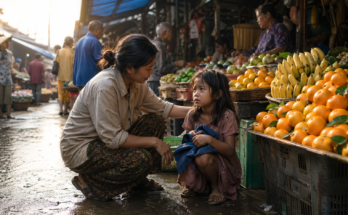
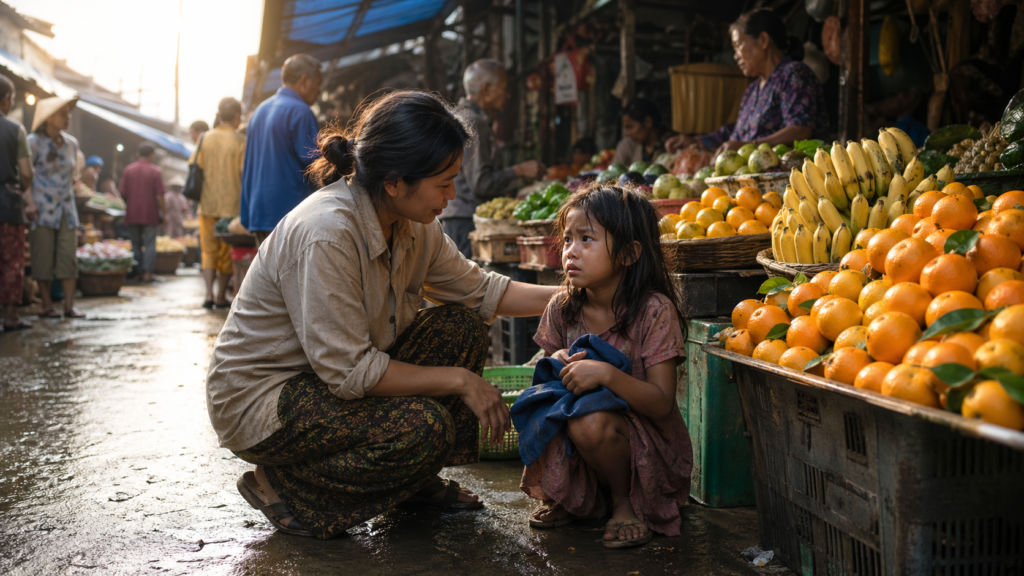
Metal shutters rattled upward one by one. Plastic crates scraped the concrete. Vendors called out prices over the noise of scooters, clattering baskets, and the first wave of customers trying to buy fresh greens before the sun turned the whole place heavy and hot. The air was thick with the smell of herbs, ripe bananas, wet cardboard, fish packed in chipped ice, and coffee brewing somewhere near the front entrance.
People who worked there every day moved like they were part of a single machine. They knew which aisles flooded when it rained, which stalls sold out before eight, which customers always asked for credit, and which children belonged to which mothers.
That was why everyone noticed the little girl.
The first time she appeared, most people barely looked twice. Children wandered into markets all the time, usually trailing behind a parent, a grandparent, or an older sibling. Sometimes they stopped to stare at bright fruit or tanks of live fish, and sometimes they cried when they lost sight of the adult they had been following. Usually, within minutes, someone came rushing back for them.
This girl looked around five years old, maybe six if she was small for her age. Her hair had been tied into two uneven ponytails, though one had already slipped loose. Her dress was faded yellow with tiny blue flowers that had almost washed away from age. She wore plastic sandals that were slightly too big for her feet, and she held the edge of her dress with one hand like she was trying to anchor herself to the world.
She did not cry.
She moved carefully through the crowd, her dark eyes scanning faces with a seriousness that didn’t belong on a child so small. Every few steps, when she saw a woman in a blue uniform shirt, she stopped.
“Mom?”
Her voice was soft enough that some women did not hear her the first time. Others turned, startled, then quickly softened when they saw her standing there.
“No, sweetheart,” one fish seller told her, glancing left and right as if her mother might appear from the next aisle. “Wrong person.”
The girl nodded once, as though she had expected that answer. Then she kept walking.
A few minutes later she asked another woman. Then another.
By seven o’clock, two vegetable sellers were talking about her while stacking morning glory into shallow baskets.
“She belongs to someone near the back, maybe,” one of them said.
“She’s been asking every woman in blue,” the other replied. “Maybe her mother works in a factory.”
“Or a school.”
“Or the hospital.”
One of the fruit sellers, a woman named Sina, watched the child from across the aisle while weighing guavas for a customer. Sina had worked in the market for sixteen years and had developed the kind of attention that noticed things other people missed. She noticed who came with empty hands and left with full bags they shouldn’t have been able to afford. She noticed bruises hidden under sleeves. She noticed when married couples stopped walking side by side. She noticed when children looked too quiet.
This girl was not wandering in the careless way children usually did. She was searching.
Sina finished with her customer, wiped her hands on a towel hanging from her waist, and stepped around her stall.
“Hey, little one.”
The girl turned.
“Are you lost?”
The girl hesitated, then pointed at the blue shirt Sina wore under her apron.
“Mom?”
Sina’s face tightened for just a second before she knelt to the child’s height.
“No,” she said gently. “I’m not your mother. What is your name?”
The child looked past Sina’s shoulder, already distracted by another woman in blue moving toward the meat section.
“Mom?”
Sina touched her arm lightly. “What is your name?”
The girl looked back.
“Dara,” she whispered.
“Dara,” Sina repeated. “That’s a beautiful name. Where do you live?”
Dara’s eyes dropped to the ground. One shoulder lifted in a small shrug.
“With who?”
No answer.
“Do you know your mother’s name?”
Dara nodded once, a quick little motion.
“What is it?”
“Mae Sorya.”
The name meant nothing to Sina then. It sounded familiar only in the way many names did after years of hearing thousands pass through the market. She smiled anyway.
“Okay. Mae Sorya. Do you know where she works?”
Dara looked at the blue shirts around them.
“Here.”
Sina followed the child’s gaze. Several women in the market wore blue that morning, but not the same kind. Some were factory uniforms. Some belonged to a grocery chain nearby. Others were from a cleaning company contracted by shops along the road.
“You’ve seen her here?”
Dara nodded again, more firmly this time. “Blue.”
Before Sina could ask anything else, a woman selling cooked rice called her back to her stall because a customer wanted change. When Sina turned around again, the girl had already moved on to the next aisle, where she stood before another woman in blue and asked the same question in the same quiet voice.
Mom?
The market swallowed the moment and carried on.
By the next day, Sina had almost convinced herself the child had been found.
Then she saw her again.
This time Dara came just after sunrise, entering through the side gate near the motorbike parking area. She walked with the same determined little steps, her oversized sandals slapping softly against the damp ground. She wore the same yellow dress. Her hair was uncombed, and there was a faint smudge on one cheek as if she had wiped her face with dusty hands.
Again, she moved toward the women in blue.
Again, she asked.
“Mom?”
Some vendors stopped what they were doing to stare. A flower seller left her stall for a minute and tried offering Dara a sweet bun. Dara took it politely, held it in both hands, and continued looking around without eating it. A security guard at the entrance crouched down and tried asking where her house was. Dara only said, “Looking for Mom.”
“And your father?”
A blank look.
“Grandmother?”
Nothing.
“Who brought you here?”
Dara pointed vaguely behind her, toward the road. “Walk.”
“How far?”
She just blinked.
The security guard eventually radioed someone from the small neighborhood police post half a block away, but before anyone arrived, a woman buying bean sprouts said, “I know that child. I’ve seen her near the old apartment buildings by the canal.”
“Which building?” the guard asked.
The woman frowned. “I’m not sure. Around there.”
By then the morning crowd had thickened. Motorbikes squeezed past handcarts, customers argued over prices, and the moment of concern lost its edge. The guard could not leave the entrance unattended. One vendor said she would keep an eye on the child. Another said she would ask around. Sina gave Dara a bottle of water and told her to sit on a crate near the fruit stall if she got tired.
Dara nodded, but she did not sit. She walked the market until nearly nine, then disappeared into the street like she had never been there at all.
On the third morning, some people started to get irritated.
Not with Dara exactly, but with the uncertainty around her.
“She shouldn’t be alone,” the fish seller muttered.
“Where are her people?” asked the woman from the spice stall.
“This is not safe,” said another vendor, looking toward the road where traffic screamed past the market entrance.
Yet when Dara appeared again on the fourth morning, the same people watched for her.
A noodle seller set aside a small bowl before she arrived, just in case. The flower seller brought an extra hair tie. Sina kept a peeled orange near the scale on her stall. Concern had settled over the market in pieces, unevenly at first, then more completely, until Dara became part of the morning conversation.
Did you see her yet?
Was she here yesterday?
Did anyone find where she lives?
Who is this mother she keeps looking for?
By the end of the first week, even customers noticed her. Some tried to help. Some asked questions that made her shrink into herself. Some photographed her until vendors snapped at them to stop.
Sina hated that part.
There was something about the way Dara asked her question that made it impossible to see her as a curiosity. She never shouted. She never made a scene. She walked up to a woman in blue, lifted her face with a hope so naked it hurt to witness, and asked one single word that seemed to come from somewhere much deeper than memory.
Mom?
Then, when the answer was no, she accepted it with a heartbreak too practiced for a child.
On the eighth morning, rain came early.
Water hammered the metal roof over the market and overflowed the gutters in silver sheets. Vendors dragged boxes farther from the edges and covered their goods with plastic tarps. Customers pushed inward to avoid getting drenched, turning the aisles muddy and tight.
Sina expected Dara not to come.
But just after six-thirty, she appeared at the entrance anyway, damp from the knees down, hair clinging to her forehead, dress darkened by rain. She looked smaller than ever.
Sina’s chest ached.
“Come here,” she called.
Dara obeyed this time. Sina wrapped a thin towel around her shoulders and sat her on an upside-down crate behind the fruit stall, safe from the crowd. She handed her half a steamed corn cob from breakfast.
“Eat.”
Dara stared at it.
“You have to eat, sweetheart.”
At last, Dara took a bite.
For several minutes they sat in silence while rain pounded overhead. Sina served customers, took coins, counted change, then returned between each rush to check that the child was still there.
After a while she asked, “Dara, where do you sleep at night?”
Dara chewed slowly before answering. “Room.”
“With your mother?”
A pause. Then: “No.”
“With who?”
“Grandma sleep.”
Sina frowned. “Your grandmother sleeps?”
Dara nodded.
“She is old?”
Another nod.
That at least was something.
“What do you do at home?”
Dara swallowed. “Wait.”
“For your mother?”
“Yes.”
“When did you last see her?”
Dara stared at the rain spilling from the roof. “Blue shirt.”
Sina leaned in. “Your mother wore a blue shirt?”
“Yes.”
“And then?”
Dara’s small fingers tightened around the corn. “She say wait.”
The words were simple, but something in the way the child said them made Sina go still.
“She told you to wait?”
Dara nodded.
“Where?”
No answer.
“Here? In the market?”
Dara’s expression changed, not to confusion, but to the stubborn silence of someone holding a memory too fragile to be pulled apart.
Sina did not press further.
By then she had already decided that after the morning rush, she was going to walk with Dara to the canal apartments and find out exactly where she belonged.
But when nine-thirty came and the crowd finally thinned, Dara was gone again.
Sina slammed a crate down harder than she meant to.
“You can’t just let her walk off,” she snapped at no one in particular.
The noodle seller lifted both hands. “I turned around for one minute.”
The security guard shook his head. “She slips through the crowd like smoke.”
Sina spent her lunch break asking around the outer streets. A motorbike taxi driver claimed he had seen the girl near an abandoned laundry shop two alleys over. A cigarette seller thought she lived with an old woman who coughed all day. A young man at a repair stand said he had seen her sleeping once on a mat near a ground-floor doorway, but he didn’t know the apartment number.
That afternoon, Sina could not stop thinking about the phrase.
She say wait.
At home that night, while washing rice in her small kitchen, she found herself imagining every possible version of the story and hating all of them. A mother who had left temporarily and never come back. A mother who worked long shifts and had no one to watch the child. A mother who had disappeared in some way no one had bothered to explain. Or worse, a mother who had meant to leave her daughter where someone else might take pity on her.
Sina tried to push the thoughts away, but they stayed.
The next morning she came to the market earlier than usual, before dawn, and stood near the side entrance with a cup of coffee in one hand. The street was still gray. Delivery trucks idled. Stray dogs nosed through piles of wilted leaves. For a moment she wondered whether she had imagined the urgency of it all.
Then Dara appeared.
She emerged from the alley by the drainage canal, carrying nothing, walking alone.
Sina set down her coffee and crossed the street before the child could step into traffic.
“Not today,” she said, taking Dara’s hand.
The little girl startled but did not resist.
“We are going to talk first.”
Dara looked up at her with wide, uncertain eyes. “Mom?”
“No,” Sina said softly. “But I’m going to help you.”
Back at the stall, Sina asked her sister’s teenage son, who often helped unload fruit on school holidays, to watch the stall for ten minutes. Then she knelt in front of Dara and spoke as calmly as she could.
“You’re going to show me where you sleep, okay?”
Dara hesitated.
Sina squeezed her small fingers. “I just want to help you find the right people.”
For the first time since they had met, Dara’s lower lip trembled.
“What if Mom come?” she whispered.
The question was so quiet Sina almost didn’t hear it.
Something broke open inside her.
“If your mother comes,” Sina said, fighting to keep her voice steady, “we will make sure she finds you.”
Dara searched her face for a long moment, then nodded.
They walked out of the market together.
The canal apartments were older than Sina expected, though she should have known. Everyone in the district knew those buildings had once housed workers from a textile factory that had closed years ago. The walls were stained with mildew. Laundry lines sagged between rusted railings. Broken tiles, plastic buckets, and old shoes crowded the narrow corridors. The smell of cooking oil, detergent, and stagnant water lingered in the heat.
Dara led Sina to the ground floor of the third building, then stopped outside a half-open door with a torn curtain hanging in place of a proper screen.
Inside, a woman lay sleeping on a woven mat.
At least Sina thought she was sleeping at first. Then she saw how still she was, how thin, how shallowly her chest moved beneath the blanket.
“Grandma,” Dara said.
The woman’s eyes opened with effort. She was older than Sina had guessed, perhaps not by years but by the kind of exhaustion that wears a face down faster than time. Her gray hair clung to her temples. Her hands shook when she pushed herself up on one elbow.
“Dara?”
When she saw Sina behind the child, alarm flashed across her face.
“I’m sorry,” she said quickly. “She went out again?”
Sina stepped closer. “You knew she was going to the market alone?”
The old woman closed her eyes briefly, shame washing over her features. “I try to stop her. I cannot walk fast. My chest…” She pressed a hand to her ribs. “She waits until I sleep.”
The room was almost bare. One fan turned slowly in the corner. A dented pot sat near a single-burner stove. Clothes were folded in neat stacks against the wall. There were only two mats, a few bowls, and a framed photograph placed high on a shelf to keep it safe from dust.
Sina looked around and understood in one terrible sweep just how narrow this child’s world had become.
“What happened to her mother?” Sina asked.
The old woman glanced at Dara, then back at Sina. “Please.”
“Please what?”
“Not in front of her.”
Sina drew a long breath, then turned to Dara. “Would you like to help me wash these oranges in the basin outside?”
Dara nodded.
The old woman watched them go with eyes full of apology.
Outside, in the corridor, Dara squatted by the basin while Sina poured water over a few oranges she had brought from the stall. The child carefully rubbed each one with both hands, taking the task seriously.
“Stay here for one minute,” Sina said. “I’ll be right inside.”
Dara nodded without looking up.
When Sina stepped back into the room, the old woman was sitting up fully now, though the effort clearly cost her.
“My name is Vimol,” she said.
“Sina.”
Vimol folded her hands in her lap. “You work in the market.”
“Yes.”
“I thought maybe one day someone would follow her home.”
There was no self-pity in the words. Only tired acceptance.
“Then tell me the truth,” Sina said.
Vimol looked at the doorway, making sure Dara could not hear. “Her mother was my daughter. Sorya.”
The name landed heavier this time.
“She worked at a garment factory across the district,” Vimol continued. “Blue uniform. Dara was right about that. Every morning, before her shift, she brought Dara with her to the market because it was on the way to the daycare woman who watched children in a room behind the rice shop. They would stop for breakfast sometimes. Fruit if money was good. Rice porridge if it was not. Dara loved the market. She remembered the colors, the noise, the blue shirts.”
Sina said nothing.
“One morning, about three months ago, my daughter left for work and never came back.”
Sina’s throat tightened. “What do you mean?”
“There was an accident on the highway. A truck.” Vimol swallowed. “Sorya was on the staff bus.”
For a moment the room seemed to lose its air.
“And Dara?”
“She was with me that day. I was sick, so Sorya left her here before work. She told her she would return that evening. But she never did.”
Sina pressed a hand to her mouth.
“We buried my daughter with borrowed money,” Vimol said. “I did not know how to explain death to a child who still slept with her face turned toward the door. Dara kept asking when her mother would come home. I told her she had gone far away.” Her voice cracked for the first time. “Then I made the mistake of telling her, one evening when she would not stop crying, that maybe her mother was still somewhere in her blue work clothes, somewhere people were busy, somewhere she had to keep searching if she wanted to find her.”
Sina stared at her.
“I only said it to calm her,” Vimol whispered. “I thought she would forget by morning. But children hold onto hope differently. She remembered the market. The uniforms. She made her own story from my weakness.”
“And you let her keep going back?”
Vimol’s eyes filled. “What was I supposed to do? I am sick. I cannot work. I take in mending when my hands are steady enough. Some days there is rice, some days only soup. I tried to keep her inside. I locked the door once and she cried until she was sick. She said her mother would come back and not find her. She said if she stopped looking, her mother would think she had been forgotten.”
Sina turned away because anger and sorrow were rising together and she could not tell where one ended and the other began.
“Why didn’t you ask for help?”
“From who?” Vimol asked, not bitterly, just honestly. “My husband died years ago. My son works in Thailand and sends money when he can, which is not often. The factory gave one small payment for funeral costs and then nothing. I did not know what office to go to. I did not know what papers to carry. I only knew how to keep the child fed one day at a time.”
Sina looked at the photograph on the shelf.
A young woman smiled back at her, maybe twenty-seven or twenty-eight. She wore a blue uniform shirt. Her arm was around a smaller version of Dara, whose cheeks were fuller in the photo, whose eyes were bright with the easy certainty of being loved.
Sina closed her eyes for a second.
“When did Dara start coming to the market?”
“Almost every day for weeks,” Vimol said. “Sometimes she leaves before I wake. Sometimes I think she is in the corridor playing. Then I hear from someone later that she was seen near the fruit stalls or fish tables. She always comes back by noon if she does not find what she wants.”
What she wants.
The words hit Sina harder than they should have.
“What name is stitched in her dress?” Sina asked suddenly, though she didn’t know why the thought came then.
Vimol blinked. “Her mother used to sew her name and our room number into some clothes. She was afraid Dara would get lost.”
That stayed with Sina all morning after she left the apartment. She brought Dara back to the market with her, not to search, but to sit beside the fruit stall and eat rice with sliced omelet from the noodle seller. Dara did not complain, though every time a woman in blue passed by, her eyes followed.
The next several days changed the market.
At first it was Sina and two other vendors who quietly started helping. They collected small things without making a show of it: leftover vegetables, a bag of rice, medicine for Vimol’s cough, hair ties, a second dress for Dara, money tucked into an envelope so the old woman would not be embarrassed. The noodle seller called her cousin, who worked at a local clinic, and got Vimol examined. The flower seller knew a woman from a neighborhood charity group and asked her to visit. Someone else found out how to apply for support for children who had lost a parent.
The market, for all its gossip and impatience and noise, knew how to become a family when it mattered.
But the real change came one Wednesday morning, nearly two weeks after Sina first spoke to Dara.
It was one of those bright, sharp mornings after rain, when everything seemed cleaner than usual. Mangoes glowed yellow in their crates. Red chilies shone like lacquer. Customers moved quickly, voices high and energetic. Dara sat on a stool near Sina’s stall wearing a washed blue dress donated by the flower seller’s niece. Her hair had been combed and braided properly for once.
She still watched the women in uniform.
Sina was bagging rambutans for a customer when Dara slipped from the stool and wandered two steps into the aisle. Sina looked up, ready to call her back, but froze when she saw where the girl was staring.
A woman had just entered the market through the front gate wearing a blue housekeeping uniform from one of the office towers downtown. She was not Sorya. She was too tall, older, her face shaped differently.
But Dara’s body had already reacted. Hope lit through her like a match.
She ran.
“Mom!”
The woman turned, startled, just in time for Dara to throw both arms around her legs.
The entire aisle seemed to pause.
The woman looked down in alarm, then confusion, then something much softer as she saw the child clinging to her uniform.
“Oh, sweetheart,” she murmured, crouching. “No, no. I’m not—”
Dara pulled back and stared at her face. For one suspended second everyone around them could see the exact moment hope collapsed.
The child did not cry immediately. That would have been easier to watch.
Instead, her shoulders slowly sank. Her hands dropped to her sides. Her mouth trembled with the effort of staying brave.
The woman in blue looked helplessly at Sina.
Sina was already there. She crouched beside Dara and opened her arms.
This time, Dara folded into her and finally wept.
Not loud. Not dramatic. Just small, broken sobs pressed against Sina’s shoulder while the market around them pretended not to notice. A fish seller suddenly became very interested in rearranging ice. A customer turned away and wiped her face. The security guard stared out toward the road with his jaw tight.
Sina held the child and understood that hope, if left alone too long, could become its own kind of wound.
That afternoon she went back to Vimol’s room and said, very gently but very clearly, “She needs the truth.”
Vimol looked like someone had asked her to cut out her own heart.
“She is too young.”
“She is old enough to be breaking herself every morning.”
Vimol sat in silence for a long time. At last she whispered, “Then stay with me when I tell her.”
So that evening, as the heat softened and the light turned the corridor gold, they sat together on the floor of the apartment. Dara leaned against Vimol’s side, holding a peeled orange in both hands. Sina sat across from them. The fan hummed. Somewhere outside, a radio played an old love song.
Vimol took several breaths before she could begin.
“Dara,” she said, smoothing the child’s braid. “Do you remember when Mama used to wear her blue shirt?”
Dara nodded.
“And do you remember how she kissed you on the forehead before leaving?”
Another nod.
Vimol’s voice shook. “Mama loved you more than anything.”
Dara looked up, sensing the weight in the room.
“She did not leave because she wanted to,” Vimol went on. “There was an accident on the road. Her body was hurt very badly, and she died.”
The child stared at her.
Children, Sina realized then, did not always react the way adults expect. There was no immediate scream, no dramatic refusal. First came stillness, as if Dara’s whole body had stepped back from the meaning of the words.
Then: “Died?”
Vimol’s tears fell. “Yes.”
“Like the bird by the drain?” Dara asked quietly.
Vimol closed her eyes. “Yes, little one.”
Dara turned to Sina, then back to Vimol. “She not coming back?”
The old woman made a sound that was half sob, half breath. “No.”
Dara looked down at the orange in her lap. One segment slipped from her fingers and rolled across the mat.
For a long time no one moved.
Then the child asked the question that tore through both women.
“Why you say wait?”
Vimol covered her mouth with both hands.
Sina moved beside them and gathered Dara close while Vimol fought to speak.
“I was wrong,” the old woman said at last. “I was scared. I did not know how to tell you. I thought if I gave you one more night with hope, maybe I could find the right words tomorrow. But tomorrow kept moving.”
Dara’s face crumpled.
“I looked every day,” she whispered.
“I know,” Vimol said, reaching for her.
“I called everybody Mom.”
“I know.”
Dara began to cry then, hard and openly, the kind of crying that shakes a child from shoulders to feet. She cried for the market, for the blue shirts, for all the mornings spent believing the next woman might be the right one. She cried because the truth had arrived too late and all at once. She cried because children forgive slowly when the world changes without asking them first.
Vimol held her and cried too.
Sina stayed until night, long after the first storm wind pushed through the corridor and the market noise had been replaced by the clink of dishes and distant television voices. She made porridge. She found a candle when the electricity flickered out. She did not try to fix anything, because nothing could be fixed that evening.
But something had shifted.
The next morning Dara did not go to the market.
That alone made the whole place feel strange.
People kept glancing toward the side entrance. The flower seller asked if she was all right. The noodle seller packed extra broth just in case. Even customers who did not know the full story noticed the missing small figure who had, somehow, become part of the rhythm of the mornings.
Sina went to visit after closing.
Dara sat on the mat drawing circles on scrap paper with a dull pencil. Her eyes were swollen, but she looked less frantic than before, as though grief, though heavier, was cleaner than confusion. Vimol looked exhausted beyond words.
“How was today?” Sina asked.
Dara shrugged.
“Did you eat?”
A small nod.
After a pause, Sina took something from her bag.
It was a square of blue fabric.
Vimol frowned. “What is that?”
“I asked one of the women from the garment factory to cut it from an old spare uniform shirt. Same color as Sorya’s.”
Dara looked up.
Sina sat beside her. “You don’t have to search for your mother in every blue shirt anymore. But maybe you can keep this and remember that she was real. She worked hard. She loved you. And she always came back until the day she couldn’t.”
Dara touched the cloth carefully, as though it might disappear.
“Mine?” she whispered.
“Yours.”
The child held it against her chest.
From then on, healing came in small, ordinary pieces.
A social worker from the charity group helped Vimol apply for support. The clinic doctor adjusted her medication and found a volunteer who could check on her twice a week. Sina’s sister arranged for Dara to start at the local public kindergarten class, even though the term had already begun. The market vendors took turns walking her there and back whenever Sina could not.
At first Dara still stared at women in blue shirts.
That did not stop overnight.
Sometimes in the market she would go quiet and hold the cloth square in her pocket. Sometimes she asked questions that made every adult in the room choose their next words carefully.
Did Mama feel pain?
Can she see me?
Why didn’t she say goodbye?
Each answer required honesty without cruelty, comfort without lies.
Vimol improved at this slowly. Sina helped where she could. They learned, together, that grief is not one conversation but many.
One Sunday, several weeks later, the market was closed for a local holiday. Sina visited the apartment carrying a bag of longans, soap, and a secondhand storybook with bright pictures. She expected to find Dara asleep.
Instead she found her sitting on the floor with Vimol, sewing clumsy stitches into the hem of her newer dress.
“What are you making?” Sina asked.
Dara looked up with a seriousness that reminded Sina painfully of the day they met.
“My name.”
Vimol smiled weakly. “And the room number.”
Sina sat down beside them. “Why?”
Dara pushed the dress fabric toward her to show the careful, uneven letters. “So if I get lost, people know where I go.”
Sina had to look away for a second.
“That’s very smart,” she said.
Dara returned to sewing, tongue peeking from the corner of her mouth in concentration. After a while she asked, “Can I still go market?”
“Of course,” Sina said. “But not alone.”
Dara nodded, as if she had expected that rule.
The first morning she returned, she wore the dress with her stitched name and carried a small basket. She walked beside Sina, not ahead of her. At the stall, the flower seller laughed and tucked jasmine behind her ear. The noodle seller gave her half an egg. The security guard saluted her like an important guest. Customers smiled when they recognized her.
No one said anything about mothers in blue shirts.
That silence was a kind of respect.
Weeks turned into months. The market moved through heat, through rain, through the endless cycle of prices rising and falling, mango season becoming rambutan season becoming pomelo season. Dara grew a little taller. Her cheeks filled out. She learned to help count oranges into piles of ten. She made friends with a butcher’s granddaughter and stopped flinching every time someone new walked into the aisle. Vimol’s health remained fragile, but she smiled more often, and the lines around her mouth softened.
On the anniversary of Sorya’s death, Vimol asked Sina to come with them to the pagoda.
They brought white flowers, incense, and a framed copy of the photograph from the shelf. Dara wore a plain blue ribbon in her hair. She stood quietly while the adults knelt and prayed. Then she placed one small orange beside the flowers.
“For Mama,” she said.
Afterward, as they sat beneath a tree in the temple yard, Dara leaned against Sina and asked, “Do you think Mama liked the market?”
Sina smiled. “I think she liked bringing you there.”
Dara thought about that. “I remember bananas.”
“And noise,” Sina said.
“And blue shirts.”
“Yes.”
The child touched the square of fabric she still carried in her pocket, though it was softer now from so much handling.
“I don’t look anymore,” she said.
Sina rested a hand on her back. “I know.”
“I still miss.”
“I know that too.”
Dara nodded, accepting the fact that one truth did not erase the other.
Years later, people in the market would still remember the season when a little girl went from stall to stall asking every woman in blue if she was her mother. They would remember the way the question traveled through the aisles and settled in each of them differently. Some remembered the ache of hearing it. Some remembered the helplessness. Some remembered the morning she cried in Sina’s arms. But most of them remembered what happened after.
Because the story people told later was not only about a child who searched.
It was about a child who was seen.
It was about a crowded market, loud and impatient and ordinary, making room for grief in the middle of business. It was about a fruit seller who looked closely enough to realize that some children are not lost in the usual way. It was about an old woman who failed, then tried again, and a community that stepped in where one family alone could not carry the weight.
And maybe that was why the story stayed.
Not because it was dramatic, though it was.
Not because it was sad, though it broke hearts.
But because somewhere between the fish tables and the fruit crates and the women in blue uniforms hurrying to work, a little girl learned the truth and survived it.
One humid morning almost a year after Sina first met her, Dara stood behind the fruit stall wearing a tiny apron someone had sewn from leftover fabric. She was helping line up oranges in careful rows while Sina bargained with a customer over the price of dragon fruit.
A woman in a blue housekeeping uniform stopped to buy bananas.
For the briefest moment, the old memory crossed Dara’s face. Sina saw it and held her breath.
But Dara only looked at the woman, then at the bananas, then back down at the oranges.
“Four for one thousand,” she said in her small but confident voice, repeating Sina’s line with perfect seriousness.
The woman laughed and bought six.
After she left, Sina bent toward Dara. “You did well.”
Dara shrugged with practiced dignity. “I know.”
Sina laughed then, real laughter, the kind that comes from relief so old it has almost become part of your bones.
A little later, when the rush eased, Dara pointed to the inside hem of her apron.
“I put it there too,” she said.
Sina lifted the fabric and saw the crooked stitching.
DARA
ROOM 12B
And beneath that, added in smaller, shakier letters:
SINA MARKET
Sina stared for a moment before looking at the child.
“What’s this?”
Dara smiled, shy but proud.
“So if I get lost,” she said, “people know where I belong.”