On the first Monday of October, the air turned sharp before dawn, and the city carried that gray-blue stillness that came just before morning had fully arrived. Delivery trucks rolled down empty streets. Traffic lights changed for no one. Somewhere in the distance, a bus hissed at the curb. In the alley behind Mercer’s Bakery, eleven-year-old Micah Reed opened his eyes before the sun came up, exactly as he always did.
He did not stretch the way other children might have. Stretching took up space, and space, in his mind, had to be borrowed carefully.
He sat up slowly on flattened cardboard that had softened from use and dampness, then folded the pieces in half, then half again, his movements practiced and quiet. He kept his backpack close to him all night, one strap looped around his wrist so no one could take it without waking him. Inside were three notebooks, two pencils, a toothbrush, a T-shirt, a pair of socks, and a photograph he tried not to look at too often.
The metal back door of Mercer’s Bakery stayed warm for hours after closing, and that warmth bled into the concrete just enough to make the spot bearable. It was not comfortable. It was never comfortable. But it was less cold than the bus stop and safer than the park.
Micah stood, rolled his shoulders once, and looked down at the creases pressed into his jeans. He brushed off his knees and lifted his backpack. A faint smell of yeast, sugar, and cinnamon clung to the air around the bakery, and even though he had lived with that smell for weeks, it still made his stomach tighten.
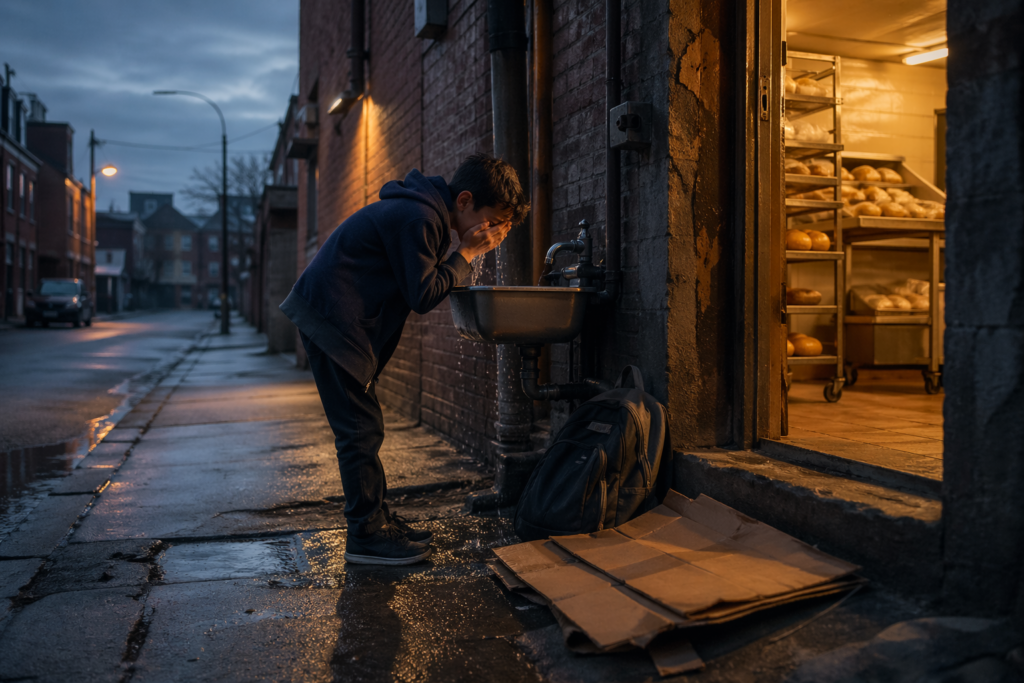
He waited until the street stayed empty before stepping from the alley. At the corner, near the public restroom attached to the small transit terminal, there was an outdoor sink that worked if you pressed the handle hard enough. He washed his face in water so cold it stung his skin awake. He wet his hair and flattened it with his palms. He brushed his teeth quickly, glancing over his shoulder every few seconds. Then he changed into a cleaner shirt in one of the restroom stalls and folded the old one into the plastic grocery bag he carried.
By six-thirty, he looked like a boy on his way to school.
That was part of his plan.
As long as he looked ordinary for long enough, maybe no one would ask questions he could not answer without everything falling apart.
Micah arrived at Rosewood Elementary twenty minutes before the first bell. He always did. The custodian, Mr. Lyle, sometimes nodded at him through the front glass while unlocking the office doors, and Micah always nodded back. He liked being early. Early meant quiet hallways, a chance to sit down before the room filled with noise, a few precious minutes where nobody expected anything from him except silence.
His classroom was on the second floor, Room 14, where the morning light slid across the windows and made the rows of desks look cleaner than they were. Mrs. Evelyn Carter had taught fifth grade for nearly eighteen years, and in that time she had learned that children almost always revealed themselves in fragments. Not all at once. Not in the dramatic ways adults imagined. A missing lunch. A strange flinch. Shoes that were too small. A sentence spoken halfway and then swallowed.
Micah Reed had entered her class in August as one of those children who seemed easy to overlook if you were not careful.
He was polite. He turned in his work. He never disrupted lessons. He did not seek attention. He did not cause trouble. He did not complain.
But after six weeks, Mrs. Carter had begun to notice the pattern of what he did not say.
On the first Friday in September, the class had done a simple writing exercise called A Place I Feel Safe. Most students wrote about a bedroom, a grandmother’s kitchen, the backseat of a car on a family road trip. Micah had stared at his paper for a long time, then written four lines about the school library.
Not books. Not reading. The library.
It was warm, he wrote. Quiet. Nobody argued there.
Mrs. Carter had circled the paper gently and written, “Beautiful details,” but the lines stayed with her longer than she expected.
A week later, during a lesson on community helpers, she asked the children what adults they could count on when life got hard. Hands flew up around the room.
“My mom.”
“My aunt.”
“My coach.”
“My neighbor.”
“My grandpa.”
Micah kept his eyes on his desk.
When she called on him lightly, trying not to make him feel singled out, he looked up with that respectful, guarded expression he always wore and said, “Teachers help.”
The answer was not wrong. But there had been something in the pause before it that left her unsettled.
By October, the weather had cooled enough that children started coming in with jackets. Micah still wore the same thin sweatshirt three days in a row. It was clean enough, but worn at the cuffs. He never had a lunch from home. He ate every bite of the school meal, even vegetables most children pushed aside. On Fridays, he often asked if he could keep his unfinished carton of milk to drink later. Mrs. Carter had told herself not to leap to conclusions. Some families struggled. Some children were shy. Some patterns looked heavier than they were.
And yet.
There was the backpack he never set down farther than arm’s reach.
There was the way he startled when a book dropped loudly in class.
There was the fact that he never joined conversations about weekend plans, and whenever someone asked where he lived, he answered in vague circles.
“Near Maple.”
“In the apartments.”
“Not far.”
Not lies. Just fog.
On that October Monday, Mrs. Carter stood at the front of the room during silent reading and watched her students settle. Micah held his book open but blinked too slowly, as if his eyes were heavier than usual. There were faint purple shadows under them.
“Micah,” she said softly when the others were occupied. “Did you get enough sleep last night?”
His head lifted at once.
“Yes, ma’am.”
It was the speed of the answer that told her it was rehearsed.
She gave a small nod and let it pass.
At lunch, she mentioned him to the school counselor, Dana Alvarez, who had worked with enough families to know the difference between ordinary stress and something more serious.
“He’s not acting out,” Mrs. Carter said, sitting across from Dana with a paper cup of soup she had already forgotten to eat. “That’s almost the problem. He’s too careful. Too contained.”
Dana rested her forearms on the table. “Any bruises? Major attendance issues? Hygiene concerns?”
“No bruises. Attendance is excellent. Hygiene is… managed. Better than I’d expect if things were stable, honestly. Like he’s working hard to stay one step ahead of people noticing.”
Dana nodded slowly. “That happens.”
“I asked about home in a writing conference last week,” Mrs. Carter said. “He smiled and redirected to a book he was reading. An eleven-year-old redirected me like a politician.”
Dana gave a faint, humorless smile. “Children who carry too much often get very skilled at that.”
“What do I do?”
“Keep watching. Stay gentle. Don’t corner him. If something is wrong, pressure will make him protect the secret harder.”
That afternoon, after dismissal, Mrs. Carter stayed late grading spelling quizzes. By the time she packed her tote bag, the sky had gone dim at the edges, and the school halls had fallen silent except for the distant squeak of a mop.
She stepped outside the side entrance and started toward her car, then stopped.
Across the street, half-hidden by a brick wall near the alley that led toward the transit terminal, stood Micah.
He was alone.
School had ended forty minutes earlier.
He clutched his backpack and a white plastic bag, looking not like a child waiting to be picked up, but like someone calculating where he could stand without being noticed.
Mrs. Carter did not call his name. Some instinct told her not to. Instead, she walked to her car and sat behind the wheel, watching through the windshield as he slipped down the alley and disappeared.
That night, she lay in bed thinking about the library essay and the milk cartons and the purple shadows beneath his eyes. She thought about how thin his wrists looked when he reached for pencils. She thought about the carefulness of him.
The next morning, she left home fifteen minutes early.
Rosewood Elementary stood only a few blocks from a small cluster of shops: a laundromat, a pharmacy, Mercer’s Bakery, and a diner that had once been painted red and now faded toward rust. When Mrs. Carter turned onto the side street near the bakery, the clock on her dashboard read 6:48.
She almost drove past him.
Micah was crouched near the public sink by the transit restroom, scrubbing his face with both hands, his backpack on the ground beside him. A flattened stack of cardboard leaned against the wall two yards away. He used a paper towel to dry his face, then bent to brush his teeth quickly, glancing toward the road.
Mrs. Carter’s hands tightened on the steering wheel.
For a moment she did not move. She had taught long enough to know that once you saw a truth clearly, you could not return to uncertainty. There was no unseeing this. No telling herself she might be mistaken.
She parked farther down the street and sat very still, heart pounding hard enough to make her feel foolish. She was angry, though she was not yet sure at whom. At the world. At whatever adults had allowed this. At herself for noticing too slowly.
Micah lifted his backpack and began walking toward school.
Mrs. Carter got out of the car before she could think herself out of it.
“Micah?”
He froze.
His shoulders rose first. Then, slowly, he turned.
Children that age often looked different outside the classroom. Louder. Messier. Closer to their actual age. But Micah did not. He looked the same and not the same at all. Smaller somehow. More alone.
“Mrs. Carter,” he said.
She kept her voice calm. “You’re here early.”
“Yes, ma’am.”
“I am too.”
He gave the tiniest nod, uncertain.
She stepped closer, careful not to crowd him. “Would you walk with me to school?”
He hesitated, and she could see the calculations moving behind his eyes. Refusal might look suspicious. Agreement might be dangerous. Trust, for him, clearly came with risk.
Finally he said, “Okay.”
They walked side by side for half a block. The sky above them was pale silver. A bakery employee unlocked the back door, and a warm gust of sweet air drifted over the sidewalk.
Mrs. Carter kept her eyes ahead. “I saw you this morning at the sink.”
He said nothing.
“I’m not angry.”
Still nothing.
“I’m worried.”
Micah swallowed. “I just wash there.”
“I know.”
A full ten seconds passed.
Then he said, almost too quietly to hear, “Please don’t call anybody yet.”
Mrs. Carter stopped walking.
He stopped too, face going pale, as if he had already made a mistake.
“Micah,” she said gently, “where did you sleep last night?”
He looked at the ground. The toe of his shoe scraped once against the concrete.
Finally he answered. “Behind the bakery.”
The words landed between them with terrible softness.
Mrs. Carter felt her throat tighten. “How long?”
He shrugged, but it was the kind of shrug children used when the real answer was too large.
“A while.”
“A week?”
Another shrug.
“More than that.”
She took a slow breath. “Do you have family nearby?”
“My mom did.”
Did. Not does.
Mrs. Carter’s heart sank. “Micah…”
“She left in June,” he said quickly, as if speed could keep the story from getting bigger. “She said she was going to find work in another city and get a place and come back for me. She left me with her friend for a little bit, but then her friend said I couldn’t stay there anymore because the landlord found out. Then I stayed with somebody else for a few days. Then at the shelter they said I needed an adult and there were too many people. So I just…” He motioned vaguely behind him. “I found places.”
Mrs. Carter stared at him. He spoke with the flat steadiness of someone reciting steps in a process he had repeated privately many times.
“Have you heard from your mother since June?”
He shook his head once.
“Do you know where she is?”
“No.”
“Has anyone been taking care of you?”
“I take care of me.”
No self-pity. No drama. Just fact.
Mrs. Carter had to look away for a moment. Cars moved through the intersection ahead, commuters carrying coffee, ordinary people starting ordinary days while an eleven-year-old stood beside her describing survival like it was a chore chart.
“How have you been eating?” she asked.
“The bakery throws away stuff at night sometimes. Not the good stuff. Just bread ends, muffins if they’re too hard, things like that. And school breakfast. School lunch. On weekends I go to the church pantry when it’s open.”
Mrs. Carter pressed her lips together.
He rushed on, panic edging into his voice now. “I still come to school. I do my homework. I’m not bad. Please don’t make them send me somewhere far away. Please.”
There it was.
Not fear of punishment.
Fear of being uprooted from the only stable thing left in his life.
Mrs. Carter forced her voice to remain steady. “You are not bad, Micah.”
His jaw tightened.
“You should never have had to handle this alone,” she said. “None of this is your fault.”
He blinked hard, once, then looked away toward the school building.
“I need to help you,” she continued. “That means I can’t keep this a secret.”
He nodded before she finished, but the nod was stiff and defeated.
“I know,” he whispered.
They stood in silence for a few seconds.
Then Mrs. Carter said, “Would it help if I stayed with you while we talk to the counselor?”
He did not answer right away. When he finally looked at her, his eyes were red but dry.
“Yes.”
Dana Alvarez had seen difficult things in her office. Custody disputes. Food insecurity. Grief that had no neat name for a child to use. But when Mrs. Carter walked in with Micah at 7:18 that morning, Dana took one look at the boy’s face and closed the folder in front of her without a word.
Mrs. Carter told her the basics first, carefully. Micah sat in the chair nearest the wall, hands clamped around his backpack straps.
Dana listened, then turned to him with a voice so gentle it barely disturbed the air in the room.
“Micah, thank you for telling the truth. I know that wasn’t easy.”
He stared at the carpet.
“We’re going to figure out what happens next,” she said. “You are not in trouble.”
He gave the slightest nod.
The hours that followed moved both too fast and too slowly. There were phone calls. Questions. A school social worker brought in from the district office. Child protective services. A police officer assigned to youth welfare rather than patrol. Mrs. Carter stayed with Micah during as much of it as she was allowed to. Dana found him a clean sweatshirt from the emergency clothing closet and crackers with peanut butter because by ten-thirty he looked pale with hunger even after breakfast.
Each adult asked him, in slightly different language, for the details of the same story. Where had he slept? Did any adult know where he was? Had anyone hurt him? Did he feel safe? Did he know relatives’ names?
Micah answered with discipline beyond his years, but by afternoon his shoulders drooped with exhaustion.
Mrs. Carter watched the process and understood, with a fresh wave of anger, why children hid. The truth did not emerge into soft hands and immediate relief. It emerged into forms, procedures, necessary steps, worried faces, and the humiliating repetition of pain.
By three o’clock, the social worker, a woman named Patricia Shaw with kind eyes and a tired voice, had uncovered the first solid thread.
“There is an aunt,” Patricia said quietly in Dana’s office while Micah sat nearby drawing absent circles on a piece of scratch paper. “Maternal side. Angela Brooks. Different last name, lives across town. We’re trying to reach her now.”
Micah’s pencil stopped.
Mrs. Carter looked at him. “Do you know your aunt Angela?”
He nodded once.
“When did you see her last?”
“Last Christmas.”
“Did you stay with her?”
“No. Mom didn’t like visiting her.”
Patricia glanced up from her notepad. “Do you know why?”
Micah hesitated. “She said Aunt Angela thought she was irresponsible.”
The adults exchanged a look.
Twenty minutes later, Angela Brooks arrived.
Mrs. Carter never forgot the sound of her footsteps pounding down the hall before the office door opened. Angela was in her late thirties, still wearing a grocery store uniform polo and black work shoes. Her hair was pulled back in a braid that had partly come loose. Her face was flushed, as if she had driven too fast and then run from the parking lot.
The moment she saw Micah, she stopped breathing properly.
He stood halfway out of his chair.
“Micah?”
His mouth trembled, just once. “Hi, Aunt Angie.”
Angela covered her mouth with her hand. Tears filled her eyes immediately, not polite tears or restrained ones, but the kind that rose from the body before dignity could arrange them.
“Oh my God,” she whispered. Then she crossed the room in three quick steps and dropped to her knees in front of him. “Baby, where have you been?”
That question did it.
Micah’s face crumpled with a shock so raw it seemed to startle him too. He had held himself together through police, social workers, forms, and structured questions. But one person kneeling in front of him, calling him baby like he still belonged to someone, broke the wall clean through.
He began to cry.
Not loudly at first. Not dramatically. Just silent tears spilling faster than he could wipe them away. Angela reached for him carefully, as if unsure whether he would let her, and when he leaned into her arms, he clung with a desperation that changed the whole room.
Mrs. Carter turned her face away and stared at the filing cabinet until her own eyes steadied.
Angela stayed for nearly two hours. There were explanations, pieces of history, painful gaps. She had known Micah’s mother, Talia, struggled for years with instability, missed jobs, sudden moves, broken promises. Their relationship had worsened after repeated attempts to help ended in angry accusations and silence. Talia had cut off contact months earlier. Angela had not known where they were living. She had been trying numbers that no longer worked.
“I thought she was moving around again,” Angela said, voice shaking with fury and shame. “I thought he was with her. I didn’t know. I swear to God, I didn’t know.”
No one in the room blamed her. Not fully. But the sentence hung there like a grief with edges.
By evening, emergency placement procedures were underway. Angela’s apartment had to be checked. Temporary kinship care paperwork had to be approved. Nothing, Patricia explained, could be handled exactly as simply as it should be. But the fact that Angela was family, employed, willing, and already known to the child accelerated everything.
Micah sat on the couch in Dana’s office while adults moved around him, and for the first time that day he looked less like a child bracing for impact and more like one struggling to believe the floor might hold.
Mrs. Carter crouched beside him. “How are you doing?”
He rubbed at his eyes with the heels of his hands. “Tired.”
“I imagine so.”
He nodded.
After a moment, he asked, “Will I still go to this school?”
The question pierced her.
“We will do everything we can to keep that the same,” she said.
He absorbed that with solemn seriousness. “Okay.”
“Do you want me to come tomorrow morning and check in on you?”
He looked at her, uncertain whether it was a promise adults could really keep.
“Yes,” he said.
“I will.”
That night Micah slept indoors.
Not in his own room, not yet. Angela’s apartment was small: two bedrooms, one already shared by her eight-year-old daughter Nia and a mountain of stuffed animals. Micah slept on the sofa under a clean blanket that smelled like lavender detergent. Angela left the hallway light on in case he woke up disoriented. She placed a glass of water on the coffee table and an extra pillow near his feet. She told him twice that the bathroom was at the end of the hall and that he did not need permission to eat anything in the kitchen.
At 2:13 a.m., she found him sitting upright in the dark.
“Micah?”
He looked startled. “Sorry. I wasn’t doing anything.”
She crossed the room and sat on the edge of the armchair. “You don’t have to apologize for being awake.”
He picked at the seam of the blanket. “I’m not used to sleeping inside somewhere new.”
Angela’s chest tightened. “Do you want me to sit with you a little?”
He gave the smallest nod.
So she sat in the dark while the refrigerator hummed in the kitchen and passing headlights slid pale stripes across the ceiling. After a while she said softly, “I should have found you sooner.”
Micah was quiet for a long time.
Then he said, “I didn’t know where to go.”
“I know.”
“I didn’t want people to think Mom threw me away.”
Angela closed her eyes.
“Oh, sweetheart,” she said, barely above a whisper. “What she did or didn’t do is not a measure of your worth.”
He looked down at the blanket.
“You hear me?”
He nodded, but not like he believed it yet.
The days that followed were not magical.
Stories like Micah’s did not turn warm and polished just because one good adult stepped in. There were school meetings. Emergency clothing vouchers. Health checks. Sleep problems. Questions from classmates he did not know how to answer. There was the practical awkwardness of being a child with almost no belongings and too much pride to ask for anything twice.
Mrs. Carter understood that the danger had not ended simply because the secret had been exposed.
Some children, once rescued, collapsed. Others became angry. Others grew even quieter.
Micah did not collapse. He simply became more watchful.
When Mrs. Carter checked on him the next morning before class, he was standing outside Room 14 with a new toothbrush still in its packaging sticking out of his backpack pocket. Angela had bought him school supplies the night before, along with two pairs of jeans, socks, underwear, and a winter coat one size too big so he could grow into it.
“You came,” he said when he saw Mrs. Carter.
“I said I would.”
He gave a tiny nod, then looked down at his shoes. They were new too, inexpensive black sneakers with stiff soles. He lifted one foot and set it back down, as though he still wasn’t used to how it felt.
“Do they fit?” she asked.
“Yeah.”
“Good.”
He hesitated. “My aunt made eggs this morning.”
The sentence was small, but it carried wonder.
Mrs. Carter smiled. “How were they?”
He looked almost embarrassed by his own answer. “Really good.”
In class, the children noticed the shoes, the coat, the way Micah seemed both the same and not the same. Children were observant, but not always wise with what they observed.
At recess, a boy named Trevor asked, “Did you move or something?”
Micah shrugged.
“You used to wear that gray sweatshirt every day.”
Mrs. Carter heard it from the edge of the blacktop before Micah answered. She began walking over, but Nia’s older cousin Jamal, a sixth grader who shared afternoon pickup with Angela’s family, beat her to it.
“So what if he did?” Jamal said sharply from near the fence. “Mind your business.”
Trevor mumbled something and backed off.
Micah looked startled.
Later, in the classroom, Mrs. Carter found him lingering by the bookshelves while the others lined up for music.
“You okay?”
He nodded, then after a second said, “I didn’t know somebody would say something.”
She leaned against the shelf. “Children notice change. That doesn’t mean you owe anyone your story.”
He absorbed that slowly. “Okay.”
“Your life is not public property, Micah.”
His eyes lifted to hers. Something in his face softened, just a little.
At Angela’s apartment, evenings developed a rhythm.
Nia did homework at the kitchen table and kicked her feet against chair legs. Angela cooked practical meals: rice, chicken, soup, pasta, whatever stretched across the week. Micah washed dishes without being asked, at first because he thought usefulness might be the price of staying, later because routine calmed him.
On the fourth night, Angela found him rinsing plates long after the sink was empty.
“You already did enough,” she said.
He stiffened. “Sorry.”
There it was again, that instant apology.
Angela crossed to the counter and lowered her voice. “Micah, you don’t have to earn a place here every day.”
His hands stopped moving.
“I’m serious,” she said. “You are not a guest who can be sent away because you forgot a chore.”
He kept staring at the sink.
She continued, gentler now. “You are family.”
His throat worked once, and he nodded without turning around.
The school district arranged a trauma-informed therapist named Dr. Leah Bennett, whose office had two soft chairs, a shelf of games, and windows facing a row of cedar trees. Micah did not like her at first, which Dr. Bennett later told Angela was not a sign of failure but of caution.
“Trust is expensive for him,” she said. “He has learned that adults often ask questions with power attached.”
During the first session, Micah answered with one-word replies.
During the second, he spent fifteen minutes arranging toy cars by size and color.
During the third, he asked if she was going to tell people everything he said.
“No,” Dr. Bennett answered. “Only if you were in danger and needed protecting. Otherwise this is your space.”
He studied her face. “So if I say I hate how bread smells now, you won’t tell my aunt?”
Dr. Bennett’s expression did not change. “Not unless you want me to.”
That was the first moment he looked relieved.
Over time, pieces of the hidden months emerged.
After Talia left, Micah had waited for three nights at her friend’s apartment, believing every sound in the hallway might be her footsteps. On the fourth day, the friend said she couldn’t keep him anymore. A shelter intake worker had tried to help, but policy required adult paperwork for longer placement, and the system had shifted him from desk to desk until evening came and no plan had fully formed. He learned quickly which public places opened early, which church pantry workers asked too many questions, which security guards chased him away, which corners were lit well enough to feel less dangerous.
He chose the bakery because the alley stayed warmer than most places and because the owner’s nephew sometimes forgot a bag of unsold rolls by the back steps.
He kept going to school because school was order.
School meant desks and bells and worksheets and adults who did not smell like alcohol or impatience. It meant breakfast at a fixed time and bathrooms that locked. It meant words on whiteboards that stayed where they were written until someone erased them on purpose.
Most of all, it meant a version of Micah that still belonged to the ordinary world.
When Dr. Bennett asked what frightened him most during those months, he did not say hunger.
He said, “That I would start looking like the kind of kid people stop expecting things from.”
Meanwhile, the search for Talia continued with uneven progress. Calls. Database checks. Old contacts. Nothing definitive. Angela lived with a hard knot of anger beneath everything else. Not simple anger. The kind that sat beside grief until both became difficult to separate.
One evening after Micah had been with her for three weeks, she stood in the kitchen after Nia went to bed, folding towels while he worked on math homework.
“I should tell you something,” she said.
He looked up.
“If your mother comes back, there will be meetings and decisions and people involved. Nothing will happen suddenly. Nobody is going to show up and carry you off without warning.”
Micah’s pencil stilled.
Angela set the towel down. “You understand?”
His face changed so slightly another person might have missed it, but she saw the fear rise before he lowered his eyes.
“I thought maybe if I unpacked too much, I’d have to pack it again.”
Angela had to grip the back of the kitchen chair.
“Micah,” she said, voice roughening, “you can unpack.”
He nodded, but the nod looked brittle.
The next day, she came home from work to find he had lined up his small collection of belongings inside one drawer and under half the bed Nia had insisted he share until Angela could buy a trundle frame. His backpack still sat ready by the door.
Progress, but cautious.
Mrs. Carter saw changes too, though they came in delicate increments.
Micah laughed once during a read-aloud and then looked startled at the sound of himself. He raised his hand more often. He stayed after class one Thursday to ask if he could borrow two library books instead of one because his aunt read with him now and they took turns doing voices for dialogue.
One rainy afternoon in November, the class was making gratitude lists. Mrs. Carter moved between desks, reading fragments.
Hot chocolate.
My dad fixing my bike.
My grandma’s soup.
My dog.
When she reached Micah, she did not mean to look too closely, but there it was in his careful handwriting:
A blanket that belongs to me.
A door that locks.
Being expected tomorrow.
Mrs. Carter had to blink twice before moving on.
Thanksgiving approached, and with it came school projects about family traditions. Mrs. Carter hated those assignments every year. They always assumed too much. Matching pajamas. Big tables. Predictable love. She replaced the lesson with one on meaningful meals instead, asking students to write about any food memory that mattered to them.
Micah wrote about eggs.
Not the taste exactly, though he mentioned the butter and pepper. He wrote about sitting at a table while his aunt turned the stove off and said, “Eat before it gets cold.” He wrote that he had almost cried because she had said it like there would always be another breakfast.
Mrs. Carter kept a copy after asking his permission.
In December, there was a setback.
A boy in class brought up homelessness during a social studies discussion on cities. The word hung in the room with all the carelessness of a label adults tossed around as concept rather than life. Another student said people without homes should “just go somewhere else,” and the room filled with the thoughtless confidence of children repeating things heard from grown-ups.
Micah went silent in a way Mrs. Carter recognized at once.
She stopped the lesson.
“Let’s be careful,” she said. “When people go through hard things, there are often reasons we do not see. We don’t reduce human beings to one struggle.”
The conversation shifted, but the damage had been done.
After school, Micah lingered while the others left.
“Were you talking about me?” he asked without looking at her.
Mrs. Carter’s heart sank. “No, Micah. I was talking about people generally.”
He kept his eyes on the floor. “They would think weird things if they knew.”
“Some people might misunderstand,” she said honestly. “But someone else’s misunderstanding does not define you.”
He nodded, though not with conviction.
That evening he told Angela he did not want to go back to school the next day. It was the first time since moving in that he had said that.
Angela called Mrs. Carter, who came by after dinner with hot chocolate in a travel mug and sat with Micah on the front steps of the apartment building while cold wind skimmed the parking lot.
“You know what I think?” she said.
He shrugged.
“I think there are people who confuse comfort with character. They assume if life has gone smoothly for them, it means they understand more than they do.”
He was quiet.
“But surviving hard things the way you did,” she continued, “with dignity, with discipline, still showing up to learn? That tells me more about your character than an easy life ever could.”
He stared at the steam rising from his cup.
After a while he asked, “You really think that?”
“I know that.”
The next morning he returned to school.
Winter settled in fully. Angela bought a secondhand desk for the corner of the bedroom. Nia decided half of her stuffed animals should be “on Micah’s side” so he would not feel left out, though she insisted on keeping the panda. Jamal began waiting for him at dismissal without making it a big thing. Dr. Bennett taught Micah grounding exercises for the nights when sleep still felt uncertain. Patricia Shaw helped Angela file for kinship support and tutoring services. Dana checked in at school discreetly, always giving him room to refuse conversation if he wanted.
None of it erased what had happened.
But steadiness, Micah discovered, could be built in repetitions.
A coat hung by the same hook each afternoon.
A lunch packed before bed.
Homework at the same table.
A voice calling, “Dinner.”
A light left on.
A blanket folded at the end of a bed instead of rolled into a hiding place.
In January, Rosewood Elementary hosted Family Reading Night. Children came in pajamas and parents sat on cafeteria floors beneath paper stars strung from the ceiling. Mrs. Carter stood near the entrance greeting families when Micah walked in beside Angela and Nia.
He had on a navy sweater Angela said made him look “like a little professor,” and his hair was neatly combed. He still moved with that inward caution sometimes, but there was more ease in him now, more child than survivor in the set of his shoulders.
Angela smiled when she saw Mrs. Carter. “He made me come early.”
Micah gave a small, embarrassed shrug.
Inside the cafeteria, students chose books from stacks on folding tables and curled up with family members around the room. Mrs. Carter glanced across the space twenty minutes later and saw Micah stretched on his stomach on a blanket, reading aloud to Nia while Angela listened with her chin resting in one hand.
It was an ordinary scene.
That was what made it nearly unbearable in its beauty.
Not dramatic. Not cinematic. Just ordinary.
The kind of ordinary some children never stop longing for.
By February, legal proceedings had begun regarding long-term guardianship. Talia remained unreachable. Angela attended hearings, met with caseworkers, signed forms until her hand cramped. She took unpaid hours from work she could not really afford to lose. More than once she cried in the parking lot before driving home because the process demanded calm language for things that were anything but calm.
At one hearing, the family court judge reviewed case notes and asked Micah, in a quieter side session designed to reduce pressure, how he was doing in Angela’s care.
Micah sat straight-backed in the chair too large for him.
“Good,” he said.
The judge, a woman with silver hair and serious eyes, asked, “Can you tell me what good means?”
He thought about it.
“It means I know where I’m sleeping,” he said. “And nobody acts mad if I’m hungry.”
Even the court reporter paused for half a second.
The judge lowered her pen. “Thank you, Micah.”
By spring, the bakery alley had gone from brutal to merely damp in memory, but memory had its own weather. Some mornings Micah still woke before dawn and sat listening for sounds that no longer threatened him. Once, when Angela accidentally closed the apartment door too hard, he dropped a glass in the kitchen and backed up against the fridge, breathing like he had been running.
Angela did not say, “Calm down.”
She did not say, “You’re safe,” as if safety was a switch that could be flipped.
She crouched a few feet away and said, “I’m here. You can breathe when you’re ready.”
Later, after the shaking passed, he whispered, mortified, “I don’t know why I do that.”
Angela brushed a curl from his forehead. “Because your body remembers what it had to survive. That doesn’t mean you’re broken.”
He turned that over quietly.
Not broken.
It was perhaps the hardest truth of all to trust.
In March, Mrs. Carter assigned personal speeches on a person or experience that changed your understanding of strength. She always let students choose whether to read aloud. Micah asked if he could write his but not present it.
“Of course,” she said.
When she read it later at her desk after dismissal, she had to set the page down halfway through.
He had written about teachers.
Not teachers as heroes in the grand way children sometimes wrote. Teachers as people who noticed small things. Who learned the difference between a child being quiet and a child disappearing. Who asked questions gently enough that the truth could survive them.
At the end, he wrote:
Sometimes people think help has to be loud to matter. But the reason I told the truth was because someone paid attention before they had proof. I think that is one kind of love too.
Mrs. Carter sat very still for a long time.
At the end of the school year, Rosewood held its annual student recognition assembly. Most awards were predictable: attendance, reading growth, citizenship, math achievement. Mrs. Carter disliked empty public sentiment, but this year she asked the principal for permission to create one additional certificate.
The language had to be careful. Private. Respectful.
When Micah’s name was called, he walked to the stage with the same measured steps he used for everything. Mrs. Carter handed him a cream-colored certificate that read:
For Quiet Courage, Steady Effort, and Remarkable Perseverance
The auditorium applauded. Not wildly. Warmly.
Micah looked down at the paper, then up at Mrs. Carter. For one unguarded second, pride lit his face so openly that she saw the child he might have been all along if life had given him gentler years.
After the ceremony, Angela found Mrs. Carter in the hallway.
“I don’t know how to thank you,” she said.
Mrs. Carter shook her head. “You don’t have to.”
“Yes, I do.” Angela’s eyes filled. “You saw him.”
Mrs. Carter glanced across the hall, where Micah and Nia were arguing over who got to carry the certificate home without bending it.
“He made it possible to see him,” she said softly. “He was incredibly brave.”
Angela smiled through tears. “He shouldn’t have had to be.”
“No,” Mrs. Carter said. “He shouldn’t have.”
That summer, Micah turned twelve.
Angela baked a chocolate cake from a box mix because he said bakery cake felt strange now and homemade felt better. Nia made a crooked sign with markers and taped it above the kitchen table. Jamal gave him a used basketball. Dr. Bennett sent a birthday card with one simple line: Proud of how far you’ve come. Mrs. Carter mailed a copy of The Westing Game because he had checked it out from the library twice and pretended it was for the mystery, though she suspected he also liked stories where hidden truths eventually came to light.
When Micah blew out the candles, Angela told him to make a wish.
He glanced around the tiny apartment: Nia grinning with frosting at the corner of her mouth, Jamal pretending not to care, Angela holding the cake knife, the kitchen window open to summer air.
Then he closed his eyes.
He did not say the wish aloud.
He did not need to.
Some months later, on the first cold morning of a new school year, Mrs. Carter arrived early to arrange desks for her next class. She passed the library and saw a familiar figure through the windows in the courtyard beyond.
Micah, taller now, stood with his backpack slung over one shoulder, talking to a smaller boy from the fourth-grade class. The younger child looked upset, face pinched and red. Micah listened, then reached into his bag, pulled out a granola bar, and handed it over. He said something Mrs. Carter could not hear, but whatever it was made the smaller boy’s shoulders lower.
The child took the granola bar.
Micah gave him a quick nod, not drawing attention to the exchange, and the two of them walked toward the building together.
Mrs. Carter stood still in the hallway, watching until they disappeared inside.
There are stories built around dramatic rescues, sudden revelations, and endings tied neatly like ribbon. Micah’s story was not one of them. His life had not transformed in a single shining moment. It changed because someone noticed. Because one question was asked softly. Because an aunt answered the phone and came running. Because systems, flawed as they were, still contained a few determined people. Because an eleven-year-old who had every reason to drift away from school kept walking into class as if his future still belonged to him.
That kind of courage rarely announces itself.
It folds cardboard before dawn.
It washes its face in cold water.
It hides hunger behind politeness.
It carries homework in the same backpack that holds its whole life.
And sometimes, if the world is lucky, someone finally sees it in time.
Years later, when Micah would remember that season of his life, he would remember the bakery smell first. Warm bread and sugar in a freezing alley. Then the sink water on his skin. Then the terror of telling the truth.
But woven among those memories would be others.
The scrape of a chair in Dana Alvarez’s office.
Mrs. Carter saying, You are not bad.
Aunt Angela on her knees, saying, Baby, where have you been?
Eggs on a plate.
A blanket that belonged to him.
A door that locked.
Being expected tomorrow.
Those things did not erase what came before.
They did something quieter.
They gave the future somewhere to begin.