The first thing Nira learned after both her parents were gone was that grief did not arrive in one clean wave.
It came in chores.
It came in the shape of a dented rice pot that still needed washing even after she had cried herself numb the night before. It came in the sound of a small boy asking if there was any sugar left for tea. It came in the silence that settled over their one-room house each evening when the sun went down and the darkness reminded her that there would be no lamp to switch on, no father to cough in the doorway, no mother to call her over and ask whether the rice was done.
Grief came in the ordinary things that refused to stop.
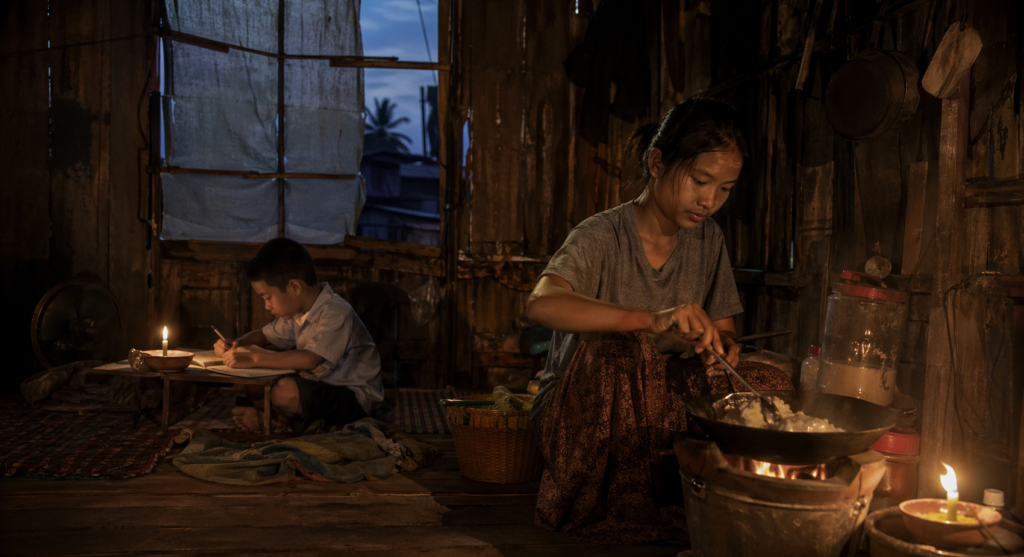
The house stood at the edge of the neighborhood where the paved road broke into dirt and loose stone. It had one narrow window, patched in one corner with cardboard because the glass had cracked during the rainy season. The roof leaked over the sleeping mat whenever the rain came hard from the east. In the dry months, dust drifted in through the gaps in the boards and settled over everything—over the folded clothes, the cooking tins, the wooden stool near the wall where her mother used to sit.
There was no electricity anymore because the bill had gone unpaid for too long. The company had come two months after her father died and cut the line while Nira stood in the yard with both hands clenched at her sides, pretending not to hear the neighbor women murmuring behind her.
Such a shame.
So young.
Who will take care of them now?
Nira had kept her face still until the men left. Then she had gone inside, closed the door, and sat on the floor in the dark until her little brother, Arun, climbed into her lap and touched her cheek.
“Are we in trouble?” he asked.
She had swallowed so hard it hurt. “No.”
That was the day she understood that from then on, the truth and what she told him would not always be the same thing.
Their mother had died in the early heat of June, six months after their father. It had happened slowly enough for hope to feel cruel.
At first their mother insisted it was just exhaustion. She moved more slowly, sat down more often, pressed one hand against her ribs when she thought no one was looking. Then came the fever, the weakness, the days when even lifting a cup seemed to cost her everything. Nira tried to hold the house together while neighbors offered advice they could not afford to follow. Herbal tea. A clinic visit. A different clinic visit. Rest. Better food.
Better food sounded almost insulting when the rice tin was already half-empty by the middle of each week.
On the last night, the room had smelled faintly of candle wax and boiled ginger. Arun had fallen asleep curled at their mother’s feet. Nira sat beside the bed, wiping sweat from her mother’s face with a cloth that had gone warm in her hand.
Her mother’s eyes had looked too large by then.
“Nira,” she whispered.
“I’m here.”
“You’re a good girl.”
“Don’t talk like that.”
Her mother gave the smallest smile, one that made Nira’s throat close. “Listen to me.”
Nira had leaned in, gripping the edge of the mattress.
“Take care of him.”
“I will.”
“No matter what.”
Her mother’s voice was weak, but the words pressed into Nira like a hand over her heart. “He is little. He won’t understand. He will only know whether he was left.”
Nira’s face crumpled before she could stop it. “I won’t leave him.”
Their mother lifted trembling fingers and brushed the back of Nira’s hand. “Then don’t let anyone teach him that loss is the only thing this world gives.”
Those were the last full words she spoke.
For months afterward, Nira lived inside that promise like it was a room she could not leave.
She was seventeen, though sometimes people guessed younger because hunger had sharpened her face and made her shoulders look smaller than they were. Arun was six, thin-legged and bright-eyed, with a stubborn cowlick in the front of his hair that never stayed flat no matter how much water she smoothed over it. He still slept curled toward her at night, one hand fisted in the edge of her shirt as if he might wake to find the world emptied again.
She did everything she could think of to keep them going.
In the mornings, before sunrise, she washed clothes for two women on the next street. It paid almost nothing, but they let her fill an extra container of water from their tap. Later she swept the floor of a tea stall in exchange for leftover bread or a little rice. Twice a week she sorted old plastic bottles and scrap behind a repair shop, the smell of oil and hot metal clinging to her skin all day. On good afternoons she helped an elderly seamstress cut thread, trim loose hems, and deliver finished blouses to customers. On bad afternoons there was no work at all.
Every small coin she earned went into a tin hidden under a loose floorboard.
Every day she counted backwards from what they needed.
Rice.
Oil.
Soap.
School pencils.
Candles.
If there was enough left, sometimes a boiled egg for Arun.
Never enough for meat unless someone paid late and added a little extra out of pity.
Pity was useful, but she hated the taste it left behind.
Arun still went to school because she refused to let that stop. Their mother had believed in school the way some people believed in luck. “If you can’t leave your children money,” she used to say, “you leave them chances.”
So each morning Nira scrubbed Arun’s uniform shirt by hand until the fabric thinned at the elbows. She stitched the hem where it had come undone. She polished his shoes with cooking oil rubbed into a rag because they had no polish left. Then she crouched in front of him and straightened his collar.
“Listen to your teacher,” she said.
He nodded.
“Do not fight.”
“I only fight if someone starts.”
“Then do not finish either.”
That made him grin, quick and crooked, and for a second he looked so much like their father that her chest tightened.
“Will there be egg tonight?” he asked one morning.
“Maybe.”
“Real maybe or soft maybe?”
She huffed a laugh despite herself. “Soft maybe.”
He considered this. “Soft maybe means no.”
“It means don’t be clever before breakfast.”
He stepped close and lowered his voice like he was sharing something important. “When I grow up, I’ll buy a house with lights in every room.”
She smiled, but something inside her pinched painfully. “That sounds nice.”
“And a fan.”
“Yes.”
“And a cold box.”
“A refrigerator?”
“That’s what I said.”
He had not, but she only touched his cheek. “Go on. You’ll be late.”
He turned to leave, then rushed back and hugged her around the waist so hard she almost lost balance.
When he ran out into the morning light, she stood in the doorway watching until he disappeared around the corner.
Only then did she let her smile fade.
The secret began small, then grew teeth.
At first it was only that she did not report their mother’s death immediately to the local office. The burial had been arranged with the help of neighbors and relatives who came, cried, prayed, and left. For a few days the house was full. Then, as always, people returned to their own lives. A cousin from their father’s side said Nira and Arun could come live with his family in the village, but his wife said it with the careful, tight smile of someone already regretting the offer. A woman from the church suggested that Arun might be better placed with a family that could “properly provide.” Another neighbor muttered that a girl of seventeen could not legally raise a child alone.
Nira listened, nodded, and kept giving the same answer.
“We are managing.”
They were not managing. They were surviving one day at a time, which was not the same thing.
But every time someone used words like placement, arrangement, temporary care, help, she heard something else.
Separation.
No.
Absolutely no.
She had seen what happened to children who were sent away. Some landed in homes where they were fed and clothed and forgotten in quieter ways. Others were passed between relatives until they learned not to unpack fully anywhere. A few grew into the sort of children who flinched when adults argued, because experience had taught them that whenever grown people made decisions, children were the things being moved.
She would not let Arun become one of those children.
So she learned how to speak carefully.
To the landlord, she said their uncle was helping.
To the shopkeeper, she said their papers were being sorted.
To the school, she said their mother’s illness had delayed a lot of things but they would catch up.
To Arun, she said only what a six-year-old could bear.
“We have to be brave for a while.”
He accepted this because he trusted her more than he trusted the world.
That trust was the heaviest thing she carried.
By August, the heat was brutal by midday. The little house trapped it, turning the room into a box of warm air and stale candle smoke. Nira began leaving the door open while she cooked just to make breathing easier. She stirred thin porridge over the single-burner stove they used with a canister that was almost empty and listened to children playing in the lane.
Arun sat on the floor drawing with a pencil worn almost to the metal.
“What is that?” she asked.
“Our family.”
She glanced over. Four stick figures stood beneath a crooked roof. The tallest had long hair. Beside it was a smaller boy. Off to the side were two figures with halos he had added in yellow crayon.
Her hand stilled on the spoon.
“Who are these?”
He looked up at her as though the answer were obvious. “Mama and Papa.”
Nira turned back to the pot before he could see her face change. “Oh.”
He crawled closer and pointed. “This is you. I made your braid too long.”
“Very kind.”
“And this is me.”
“I see that.”
He tapped the haloed figures. “Do you think they can still see us?”
The room seemed to tilt slightly.
She took a slow breath. “Maybe.”
“Even at night?”
“Yes.”
He looked satisfied by that. “Then they know you always give me the bigger part.”
Nira let out a sound that was almost a laugh, almost a sob.
That night, after he was asleep, she stepped outside and cried soundlessly beside the water jar with both hands over her mouth.
By September, people began to notice patterns.
Children always reveal what adults try to hide. Arun told his teacher that the power in their house had been gone “for many, many sleeps.” He told another boy his sister sometimes ate after he did because “she says she likes cold food better.” He asked one of the school staff whether children were allowed to live with sisters if both parents had “gone to God.”
Nira only learned this because his teacher, Mrs. Dava, stopped her at the school gate one afternoon.
Mrs. Dava was a woman in her forties with a calm face and tired, intelligent eyes. She wore her hair pinned tightly and always smelled faintly of chalk and soap. Nira respected her, which made the fear worse.
“Nira,” the teacher said, gently, “do you have a minute?”
Nira’s fingers tightened around Arun’s schoolbag. “Yes, ma’am.”
“Arun, go wait by the mango tree.”
He skipped off obediently, swinging the lunch tin.
Mrs. Dava lowered her voice. “How are things at home?”
“We’re fine.”
It came too fast.
The teacher watched her for a moment. “Are you?”
Nira forced a smile. “Yes.”
“You look exhausted.”
“I work a little.”
“A little?”
Nira said nothing.
The teacher folded her arms, not unkindly. “Arun is a bright child. He is also distracted and hungry most days.”
Heat crept up Nira’s neck. “I feed him.”
“I did not say you don’t.”
“But you meant—”
“I meant he needs help.”
The word landed between them.
Help.
Nira’s stomach tightened instantly. “We don’t need that kind.”
Mrs. Dava’s expression softened. “What kind do you think I mean?”
Nira looked away. Beyond the school wall, a bicycle bell rang in the street. Somewhere children were reciting tables in a classroom.
“The kind where people ask questions,” she said quietly.
“And if I ask questions now?”
Nira lifted her chin, but her voice wavered. “Then I’ll say the same thing. We are fine.”
Mrs. Dava studied her for another long second. “Sometimes children say ‘fine’ because they are afraid that the truth will cost them something.”
Nira did not answer.
In the distance, Arun waved at them from under the tree. Nira waved back at once.
Mrs. Dava followed the motion with her eyes. “He loves you very much.”
Nira swallowed hard. “He’s all I have.”
The teacher’s gaze returned to her face. Whatever she saw there made her tone gentler. “That is exactly why I am worried.”
For three days after that conversation, Nira kept Arun home from school by pretending he had a stomach illness. On the fourth day he cried because he wanted to go back and see his friends, and guilt drove her to walk him there herself.
Every adult glance felt dangerous after that.
Every knock at the door.
Every question.
Have you found steady work?
Where is your aunt these days?
Who signs his forms?
Who is the legal guardian now?
Nira answered as little as possible.
At night she rehearsed possibilities. If someone came to take Arun, where would she run? To which relative? For how long? Could they leave town? Could she work in another district? Would that be better or worse? The thoughts circled until dawn.
Meanwhile Arun remained six in the uncomplicated way that children remain children even inside hardship.
He still asked impossible questions while she washed clothes.
“Do fish get thirsty?”
He still carried home bent wildflowers and placed them in a chipped cup near their mother’s photo.
He still hated bitter greens and claimed he could tell when she was secretly sad because “your eyebrows go close together like angry caterpillars.”
Once, during a storm, when thunder shook the roof so hard that water leaked down the wall in three places, he climbed into her lap and whispered, “You won’t disappear too, right?”
Her arms tightened around him so hard he squirmed.
“No,” she said into his hair. “Never.”
It was a promise no human being should make, but she made it anyway.
In October, the landlord came.
He was not a cruel man, only a practical one, which sometimes amounted to the same thing. He stood in the doorway holding a notebook, his sandals muddy from the lane.
“You are behind again,” he said.
“I know.”
“How much can you pay today?”
Nira reached under the floorboard after he stepped inside and handed him a folded stack of notes, all smaller than they should have been.
He counted them once. “This is not enough.”
“I can bring more next week.”
“You said that last week.”
“I had less work.”
He sighed and glanced around the room. His eyes paused on the candles, the patched window, the two mats rolled against the wall. When they settled back on her, his face had changed slightly. “Where is the adult relative?”
Nira’s pulse jumped. “Traveling.”
“Still?”
“Yes.”
He rubbed his forehead. “Girl, do not lie to me when the room itself is answering.”
She said nothing.
From outside came the sound of Arun playing with bottle caps in the dirt, making race-car noises to himself.
The landlord lowered his voice. “People are talking.”
“People always talk.”
“This is not gossip. Someone reported concern.”
Her mouth went dry. “Who?”
He shook his head. “I do not know. Maybe the school. Maybe a neighbor. Maybe the health volunteer who came last week.”
Nira had forgotten all about the volunteer—a woman doing rounds about vaccinations and household conditions. Nira had kept her outside, said Arun was resting, and answered every question too quickly. It must have looked suspicious.
The landlord tucked the money into his notebook. “You should think carefully.”
“About what?”
“About asking family for help before strangers decide for you.”
The room seemed suddenly too small. “Thank you,” she said, though the words were stiff and cold.
He lingered a second longer. “I am not trying to harm you.”
Nira’s jaw tightened. “I know.”
After he left, she stood still for so long that Arun came running in.
“What happened?”
“Nothing.”
He looked from her face to the door. “Did he shout at you?”
“No.”
“You have the caterpillar eyebrows.”
Despite everything, a helpless sound escaped her. She crouched and pulled him close. He smelled like dust and sun and the faint smoke from the neighbor’s cooking fire.
“Arun,” she said, pressing her lips to his hair, “if anyone ever asks you questions, you tell them you’re safe with me. Do you understand?”
He leaned back, confused. “But I am.”
“I know.”
“Then why would I tell them?”
Because adults do not always believe children when the truth is poor, she thought.
Aloud she said only, “Just remember, okay?”
He nodded slowly.
A week later, Mrs. Dava came to the house.
Nira saw her approaching just before dusk, a cloth bag over one shoulder. Panic hit so hard and fast that for a second she could not move. Then she snatched up the candle from the table and motioned sharply to Arun.
“Inside the back corner. Don’t speak.”
His eyes widened. “Why?”
“Please.”
That frightened him more than if she had shouted. He obeyed at once, slipping behind the hanging sheet they sometimes used for privacy when changing clothes.
The knock came, polite but firm.
“Nira?”
It was unmistakably Mrs. Dava.
Nira opened the door only halfway. “Ma’am.”
The teacher took in her face, then the dimness behind her. “I was passing nearby.”
No she was not. The school was not nearby enough for passing.
“I brought some exercise books Arun forgot.” She held up the bag.
“That’s kind. Thank you.”
Nira reached for it, but Mrs. Dava did not let go immediately.
“May I come in?”
Everything in Nira went rigid. “The room is messy.”
“I have seen messy rooms before.”
Nira kept her hand on the edge of the door. “It’s not a good time.”
Mrs. Dava was quiet a moment. Then, very softly, she said, “Nira, if I wanted to harm you, I would not come alone.”
The sentence sliced through all her rehearsed defenses because it was true.
Her hand loosened.
Mrs. Dava stepped in slowly, as though entering a place where sudden movements might break something fragile. Her eyes adjusted to the dim room. They moved over the walls, the stove, the stack of folded laundry, the candle, the mats.
Then she saw the small bare feet beneath the hanging sheet.
“Arun,” she said gently, “you can come out.”
He peered around the cloth.
Nira closed her eyes for one full second.
When she opened them, the teacher was still standing there, but the expression on her face had changed. It was no longer suspicion. It was something harder to bear.
Understanding.
Arun shuffled toward them. Mrs. Dava smiled at him in a way that did not make him retreat.
“I brought your books,” she said.
He took them and looked up at Nira. “Can I say thank you?”
“Yes,” Nira whispered.
“Thank you.”
Mrs. Dava nodded. “You’re welcome.”
Silence filled the room after that, thick and awkward. Nira wanted to explain everything and nothing. Her pride was screaming at her to push the woman back out the door. Her fear was screaming louder.
Mrs. Dava set her bag down on the stool. “May I sit?”
Nira hesitated, then nodded once.
The teacher sat. Arun moved instinctively to Nira’s side and wrapped both arms around her leg.
Mrs. Dava looked from one sibling to the other. “How long has it been since your mother died?”
The directness stole the air from Nira’s chest.
“Four months,” she said at last.
“And your father?”
“Last year.”
Mrs. Dava exhaled slowly. “And no adult has been living with you?”
“No.”
“How have you been paying for food?”
“I work.”
“What kind of work?”
“Whatever people give me.”
“Nira—”
“I know what this looks like.” The words burst out sharper than she intended. “I know. I know exactly what it looks like. But he is fed. He goes to school. I keep him clean. I keep him safe.”
“Nira.”
“I’m trying.”
Her voice cracked on the last word. She hated that. Hated crying in front of anyone. Hated the quick sting in her eyes, the heat in her face, the feeling that once tears began they would expose all the places she had been holding herself together by force.
Mrs. Dava’s voice remained steady. “I can see that.”
That only made it worse.
Nira turned away, pressing the heel of her hand to her mouth.
Arun looked up at the teacher with alarm. “Don’t make my sister cry.”
Mrs. Dava’s expression broke completely then, softening into something almost maternal. “I’m not here to hurt her.”
He considered that carefully. “Promise?”
“I promise.”
Arun nodded, then tucked himself tighter against Nira.
Mrs. Dava waited until Nira’s breathing steadied. “Listen to me carefully. I am required to report children at risk.”
Every muscle in Nira’s body tensed.
“But,” the teacher continued, “reporting is not the same thing as taking him away tonight.”
Nira stared at her.
“There are different kinds of intervention. Some involve relatives. Some involve financial support. Some involve supervised care plans. The goal is supposed to be safety, not punishment.”
“Supposed to be,” Nira repeated.
Mrs. Dava did not pretend not to hear the bitterness. “Yes. Supposed to be.”
Nira’s laugh was tiny and broken. “That does not comfort me.”
“I know.”
The candle flickered between them.
Finally the teacher said, “Do you have any adult you trust at all?”
Nira thought of the relatives who offered help with conditions attached. The neighbors who loved gossip more than kindness. The cousin’s wife whose mouth had tightened at the idea of extra mouths to feed. The landlord. The pastor. No one.
Then, unexpectedly, she thought of an old name.
“Mira auntie,” she said.
“Your mother’s sister?”
Nira nodded. “She lives two districts away. We haven’t seen her much since my father died. Travel costs money.”
“Would she take your call?”
“I don’t know.”
Mrs. Dava leaned back. “Then we start there.”
“We?”
“Yes.”
Nira blinked.
The teacher’s face was tired, but certain. “You should not have been carrying this alone.”
Those words almost undid her more than anything else.
The next two weeks moved like a rope pulled too tight.
Mrs. Dava arranged for Nira to meet with a local family support officer, but not before helping her contact Aunt Mira. To Nira’s surprise, Mira came the very next day on a crowded bus, sweating through her blouse and carrying a basket with bananas, dried fish, soap, and a bag of rice so heavy Nira nearly cried when she saw it.
Mira was her mother’s older sister, a broad-shouldered woman with quick hands and a face marked by sun and years of work. She took one look at the room, one look at Nira’s thinner frame, and one look at Arun’s too-small sandals.
Then she put the basket down and slapped Nira lightly on the arm.
“Why didn’t you send word?”
Nira had no answer that did not sound foolish. Pride. Fear. Bus fare. Shame. The stubborn belief that if she admitted how bad things were, someone would decide she had already failed.
So she said, “I thought I could handle it.”
Mira’s eyes filled immediately, though her voice stayed rough. “You are a child.”
“I’m seventeen.”
“You are a child carrying another child.”
Arun, who had been watching from the mat, asked, “Are you really our auntie?”
Mira turned and softened at once. “I am. Come here.”
He approached cautiously. She crouched, opened her arms, and when he finally stepped into them, she held him so tightly his feet lifted from the floor.
“Your mother would scold us all,” she muttered into his hair.
That evening, for the first time in months, the house felt less like a trap and more like a place where adults might actually stand beside them instead of above them.
Still, nothing was solved by tenderness alone.
The family support officer arrived three days later with a clipboard, sensible shoes, and a way of scanning the room that made Nira feel reduced to a checklist. Her name was Ms. Chenda. She was not unkind, but she was precise.
“Are you enrolled in school?” she asked Nira.
“No.”
“Why not?”
“I left after my father got sick.”
“Do you have identification documents?”
“Some.”
“Income?”
“Odd jobs.”
“Any regular adult caregiver?”
“Aunt Mira is helping now.”
“Living here?”
“Not yet.”
Ms. Chenda made notes.
Arun sat beside Nira at the table, his knees bumping hers. Every time the officer asked a new question, he looked up at Nira’s face to judge whether he should be afraid.
She kept her expression calm for him. Inside she felt scraped raw.
Finally Ms. Chenda set the clipboard down. “I want to be honest with you.”
Nira’s throat tightened.
“This situation is unstable.”
The word unstable felt like a door beginning to close.
“But,” Ms. Chenda continued, “I also see protective factors.”
Nira frowned slightly.
“You. Your attachment. His school attendance. Support from a relative. Community witnesses saying you have cared for him consistently. That matters.”
Nira glanced at Mira, who sat on the stool behind them with both hands clasped.
Ms. Chenda folded her hands. “The question is whether a legal and practical arrangement can be made that keeps him safe without unnecessary separation.”
Unnecessary separation.
Nira seized that phrase like a rope. “So he doesn’t have to leave?”
“I did not say that.”
The fear came back so hard she nearly stopped hearing the rest.
“What I said,” Ms. Chenda replied evenly, “is that there may be options. But you need cooperation, paperwork, and adult accountability. Can you do that?”
“Yes,” Nira said instantly.
“Even if it means accepting oversight?”
Nira hesitated.
Mira answered before she could. “Yes.”
Nira looked at her aunt sharply.
Mira met her eyes. “Pride is expensive, girl.”
The officer left them with forms, instructions, and a timeline. There would be follow-up visits. Aunt Mira would need to agree to formal kinship support or guardianship involvement. Nira would need to return to some form of education or vocational training if possible. The home conditions needed improvement. Arun needed regular meals, medical checks, and stable schooling.
It was all reasonable.
It was also enormous.
After the door shut, Nira sat down hard on the mat.
“I can’t do all of that.”
Mira sat beside her. “You can do one thing, then the next.”
“They’ll still take him if I fail.”
Mira was quiet.
That silence was answer enough.
Arun climbed into Nira’s lap even though he was almost too big for it now. “I’m not going anywhere,” he announced, as if the universe had asked his opinion and he had given the final word.
Nira pressed her face into his hair and shut her eyes.
From then on, their life became a sequence of trying.
Aunt Mira did not move in full-time, but she began coming twice a week and staying overnight when she could. She brought groceries when possible and stern advice every single visit. She also brought a second-hand rechargeable lamp borrowed from a neighbor, which charged at the market stall where she worked. The first night they used it, Arun stared in wonder at the white glow filling their room.
“It’s like daytime,” he whispered.
Nira had to look away before he saw her tears.
Mrs. Dava arranged extra food support through the school breakfast program and quietly made sure Arun was never sent home over missing supplies. Once, when Nira protested, the teacher said only, “You are not the first proud person I’ve met.”
Nira muttered, “I don’t want charity.”
Mrs. Dava handed her a stack of worksheets for Arun. “Then call it investment.”
Little by little, the room changed.
A leak in the roof was patched by a church volunteer team that claimed they were “already doing repairs nearby.” Someone left a sack of clothes outside their door without a note. The seamstress gave Nira more steady work hemming school uniforms. Aunt Mira convinced a woman at the market to let Nira help early mornings in exchange for daily pay and leftover vegetables. It still was not enough, but it was more.
More mattered.
One evening, after a long day sorting greens and carrying crates, Nira came home to find Arun sitting cross-legged under the rechargeable lamp, tongue caught between his teeth as he carefully formed letters in a notebook.
“What are you writing?” she asked.
He covered the page. “Nothing.”
“That means something.”
“No.”
She laughed and lunged gently. He squealed and twisted away, but not before she saw the words in shaky pencil.
When I grow up I will buy my sister lights.
She stopped moving.
Arun froze too, his face turning pink. “You weren’t supposed to read that.”
Nira lowered herself to the mat beside him. “It’s very good writing.”
“It’s not finished.”
“I know.”
He stared at his notebook for a moment. “Will we always be poor?”
Children had a way of asking the largest questions in the smallest voices.
Nira sat very still. She could have lied. She could have said no, of course not, everything will be easy soon. But lately she had learned that hope built on false ground collapses too quickly.
“I don’t know,” she said honestly. “Maybe not always.”
He absorbed this, then nodded as though uncertainty itself were acceptable if she was the one saying it.
“Okay.”
She touched his chin lightly. “But poor is not the same as alone.”
He leaned into her hand. “I know.”
The follow-up visits continued for months.
Each one left Nira wound tight for hours beforehand. She swept the floor twice, boiled water, laid out their documents, brushed Arun’s hair flat. Every time Ms. Chenda arrived, Nira felt as though their future was being measured in invisible units she could not quite understand.
Yet something had shifted.
Instead of hiding, she answered.
Instead of insisting they were fine, she said, “We need help with the school papers,” or “The roof still leaks near the back corner,” or “I can work afternoons if someone watches him when school closes early.”
Asking felt like swallowing stones at first. Then, slowly, it felt like breathing.
One afternoon, after another visit, Nira found herself walking Mrs. Dava back toward the road.
“You still don’t trust this process,” the teacher said.
Nira gave a humorless smile. “Should I?”
“No.”
The honesty startled her.
Mrs. Dava adjusted the strap of her bag. “Systems are made of people. Some people care. Some don’t. Some are tired. Some are rushed. Some believe poverty is the same as neglect. It isn’t.”
Nira stared ahead.
“But silence helps no one,” the teacher continued. “Not for long.”
Nira kicked a pebble from the path. “Silence kept him with me.”
“For a while.”
She hated that those two words were true.
After a moment she asked, “Why did you help us?”
Mrs. Dava seemed to consider the question seriously. “Because too many children are spoken about, not spoken to. Because too many older sisters become invisible once people label them difficult. Because I have seen what happens when fear makes families hide until every option is gone.”
Nira’s throat tightened. “I thought if anyone found out, they would take him.”
“They might have,” the teacher said quietly. “At first.”
Nira stopped walking.
Mrs. Dava turned to face her. “That is what fear does. Sometimes it is not irrational. Sometimes it is based on real danger. But it also narrows the road until the only path you can see is the one that is hurting you.”
The words settled into Nira slowly.
When she returned home, she found Arun asleep with his cheek pressed to an open picture book and Aunt Mira shelling peas near the doorway.
“How did it go?” Mira asked without looking up.
Nira sat beside her. “Better.”
Mira handed her a small bowl and a second pile of peas. “Then shell.”
Nira laughed softly and did as she was told.
The true climax came in the final review meeting, though Nira did not think of it as a climax then. To her it felt more like standing at the edge of a river she might still be swept into.
It was held at the district office in a room with pale walls, a ceiling fan that clicked every few seconds, and metal chairs that made Arun swing his feet because they did not reach the floor. Aunt Mira sat on one side of Nira. Mrs. Dava had come too, invited as a school witness. Across from them sat Ms. Chenda and another official from child welfare.
Nira’s palms were damp.
The official read from a file. Household instability. Loss of parental caregivers. Temporary lack of formal guardianship. Evidence of consistent sibling care. Community support. Educational continuity. Relative involvement. Home improvements pending but sufficient. Ongoing vulnerability due to income insecurity.
The language was dry, but each phrase felt like it held their lives inside it.
Finally the official looked up. “We are prepared to recommend kinship-supported guardianship under the aunt, with the siblings remaining together in the current district, contingent on continued monitoring and support services.”
For one second Nira did not understand.
Then she did.
Her entire body went loose with shock.
Aunt Mira made a soft sound beside her, half laugh, half sob. Arun looked between them, confused.
“Does that mean I stay with my sister?” he asked.
The official’s face softened, just slightly. “Yes. It means you stay with your sister and your aunt helps make sure both of you are cared for.”
Arun beamed. “See? I told you I wasn’t going anywhere.”
A wet laugh broke out of Nira before she could stop it. She covered her face with both hands.
All the fear she had swallowed for months rose at once—not just relief, but exhaustion, grief, anger at how close they had come to losing each other because help always seemed to arrive wearing the same face as danger. She cried openly then, shoulders shaking, in front of strangers and family and the one child she had tried so hard never to frighten.
Aunt Mira put one arm around her and muttered, “Cry now. You’ve earned it.”
Arun wriggled closer and patted her elbow because he could not reach her shoulder.
“Don’t worry,” he whispered. “I’m still here.”
That almost started her crying all over again.
Life did not transform overnight after that.
There was no magical rescue waiting outside the office. No house with shining walls. No sudden wealth. No clean cinematic ending where every hardship was tied off with a bow and replaced by music.
They still returned to the same neighborhood.
The same one-room house.
The same narrow road.
The same endless arithmetic of money.
But some things were different in ways that mattered deeply.
Their fear no longer lived alone with them in the dark.
Aunt Mira became an official presence in their lives, not just a secret support. She still worked too much and complained loudly, but she came with the authority of family made visible. Nira entered a vocational training program two mornings a week arranged through a local aid partner and learned basic tailoring and bookkeeping skills that could lead to steadier work. The market vendor gave her more hours. Mrs. Dava helped Nira explore evening education options so she could eventually finish her own schooling.
Most important of all, Arun no longer lived under instructions to hide whenever someone knocked on the door.
The first time there was a visit after the arrangement became official, he started to dart behind the hanging sheet out of habit. Nira crouched and stopped him gently.
“You don’t have to do that anymore,” she said.
He stared at her. “Really?”
“Really.”
He looked toward the door, uncertain.
Nira smiled, a tired but real one. “You can just be a child.”
He thought about that like it was a surprising invitation. Then he opened the door himself.
It took longer for Nira to believe safety than it did for him.
Sometimes at night she still woke at the slightest sound, heart racing, body already braced. Sometimes she still hid money under the floorboard because part of her could not trust any future she had not physically prepared for. Sometimes she still ate less than she should because giving him the bigger portion had become instinct stronger than hunger.
Healing, she learned, was not neat. It moved forward, doubled back, and rose again.
One cool evening months later, after the first real rain of the new season, the neighborhood lost power for a few hours. Several houses went dark at once. Children groaned. Adults grumbled in the lane.
Inside their room, Nira lit a candle automatically.
Arun watched the flame catch and laughed. “Now everyone’s house looks like ours used to.”
Nira raised an eyebrow. “You find that funny?”
“A little.”
Aunt Mira, seated near the door mending a torn shirt, snorted. “That is because children are shameless.”
Arun grinned and moved closer to the candlelight, where he had spread out a workbook. “I don’t mind candles anymore.”
Nira looked at him—at the roundness returning slowly to his cheeks, at the confidence in the way he leaned over the page, at the total absence of fear in his posture—and felt something inside her ease.
“What are you writing now?” she asked.
He covered the page dramatically.
“Again?” she said.
“Yes.”
“You know that makes me want to read it.”
“That’s why I’m covering it.”
Aunt Mira laughed under her breath. “This boy will talk his way into trouble one day.”
Eventually Arun relented and slid the notebook toward Nira.
In careful handwriting, he had written:
When I grow up, I will buy a house with lights in every room, and my sister will not have to be scared of anything.
Nira sat still for a moment.
Then she reached out and smoothed his hair back from his forehead.
“That’s a very big promise,” she said softly.
He nodded with complete seriousness. “You made one too.”
She looked away because her eyes had suddenly filled.
Years later she would remember that moment more clearly than many others—not because it solved anything, but because it showed her what love had done in that room.
It had not made them rich.
It had not spared them grief.
It had not erased what they had lost.
But it had kept something human and tender alive through the worst of it, long enough for help to find them before fear destroyed what remained.
That winter, the school held a family day. Parents and guardians crowded into the courtyard carrying plastic stools and babies on their hips. Nira almost did not go. She owned only one decent blouse, and the idea of standing among complete families still made her feel like an exposed nerve.
But Arun insisted.
“You have to come. Everyone else has someone.”
So she washed her blouse that morning, braided her hair tightly, and walked with him to school under a pale blue sky. He held her hand until they reached the gate, then dropped it because first graders apparently did not need that kind of thing in public.
During the reading showcase, each child was asked to stand and describe a person they admired.
Nira half listened while shifting nervously on the bench. A boy chose his father because he drove a truck. A girl chose her grandmother because she sold vegetables and never complained. Another child chose a famous football player.
Then Arun stood.
His uniform still fit a little awkwardly because he had grown. His voice was thin at first, but steady.
“The person I admire is my sister,” he said.
Nira’s breath caught.
He looked out over the crowd until he found her. When he did, his whole face brightened.
“She takes care of me,” he continued. “She wakes up early. She works hard. She says sorry even when things are not her fault. She makes food from almost nothing. She is brave when she is scared. She thinks I don’t know when she is scared, but I know.”
A few adults in the audience smiled softly. One woman pressed her lips together.
Arun lifted the paper in his hands, though he no longer looked down at it.
“When our house was dark, she was my light,” he said.
The courtyard went silent.
Nira’s vision blurred so suddenly she had to blink hard to keep seeing him.
“And one day,” he finished proudly, “I’m going to buy her all the lights in the world.”
For a second nobody moved.
Then someone in the back began to clap, and the sound spread until the whole courtyard was filled with it.
Nira did not clap. She could not. She sat with one hand over her mouth and tears slipping freely down her face while Arun took a small, serious bow, as if he had simply delivered facts and did not understand why grown people were looking at him that way.
Afterward he ran straight to her.
“Did I do good?”
She dropped to her knees and held him so tightly he squeaked.
“You did perfect,” she whispered.
He leaned back, studying her face. “You’re crying again.”
“Yes.”
“Happy crying?”
She laughed through tears. “Yes.”
Mrs. Dava, passing nearby, touched Nira lightly on the shoulder. “I think your brother may grow up to be a writer.”
Aunt Mira, who had come late and caught the last half of the speech, sniffed noisily. “Or a politician. He talks too much.”
Arun gasped. “Auntie!”
The three of them laughed, and the sound felt new in Nira’s body—fuller now, less guarded.
That night, back in the one-room house, the electricity from the neighbor’s extension cable they had recently been allowed to share flickered on for the first time in months while they were eating. A single bulb hanging from the ceiling came alive with a weak yellow glow.
Arun stared upward with open delight.
“It works,” he breathed.
Nira looked up too.
The light was not bright. It barely reached the far corner. The walls still showed every patch and stain. The floor was still worn. The house was still small enough that one turn of the body could cross half the room.
But there it was.
Light.
Not a miracle. Not luxury. Just one humble bulb, glowing above three people at a low table with bowls of rice and soup.
Arun laughed and clapped once.
Aunt Mira shook her head as though trying not to smile. “You’d think we’d won a palace.”
Nira looked from the bulb to her brother’s face.
“No,” she said quietly. “Something better.”
Aunt Mira glanced at her. “What’s better than a palace?”
Nira reached over and tucked a loose strand of hair behind Arun’s ear.
“Staying together.”
No one spoke for a moment after that.
Then Aunt Mira cleared her throat and began fussing over the soup to hide her emotion. Arun launched into a serious discussion about where they would put a fan once they became rich. Nira listened, smiling into her bowl.
Outside, the neighborhood moved on in all its familiar noise—motorbikes passing, radios playing, a dog barking somewhere down the lane, someone calling a child in for the night.
Inside, the room that had once held only fear now held something else too.
Not certainty.
Not ease.
But a future.
Small, hard-won, and glowing softly above their heads.
And for the first time since the last night at her mother’s bedside, Nira felt she had done more than survive a promise.
She had kept it.