By the time most people were deciding what to order for dinner, Rian was already planning breakfast.
He did not think of it as breakfast the way other children did. There were no warm eggs, no tea waiting in cups, no bread bought fresh that morning. Breakfast, to Rian, meant whatever he could save from the night before without it spoiling. It meant dry rice tucked into an old plastic container. It meant half a boiled egg if luck was unusually kind. It meant bread that had gone stiff but not moldy, or noodles that could be reheated over a borrowed flame if he found enough charcoal and someone did not shout at him to move away.
He was twelve years old, though people often guessed younger because hunger had made his shoulders narrow and his wrists too thin. His face still had the softness of a child, but his eyes had become older than the rest of him. They watched everything. Doors. Hands. Delivery trucks. Street dogs. Rain clouds. Restaurant staff who stepped outside to smoke. Men who joked too loudly. Guards who liked power too much. Women who glanced away too quickly.
The city had taught him that surviving often depended less on strength than timing.
That was why he did not need a watch.
He knew the fried chicken place on San Meran Street dumped its waste thirty-five minutes after closing, unless the manager stayed late counting cash. He knew the noodle restaurant near the pharmacy threw away broth first, then vegetables, then rice. He knew the bakery in the corner lane wrapped unsold bread in clear bags and set them near the bins, while the steakhouse mixed everything together so carelessly there was no point digging through it unless the night had gone badly everywhere else.
He also knew people.
He knew that the night guard behind the shopping center limped slightly on his left leg and could not run fast, but he carried a long stick and liked to hit metal doors with it just to frighten children. He knew the older dishwasher at the seafood place sometimes left a separate bag by the wall if she had seen him earlier in the week. He knew the young cook at the burger shop acted harsh whenever others were around but once slipped him two wrapped burgers with a muttered warning not to come back too often.
Most of all, he knew that hunger had its own schedule.
If he was too early, there was nothing yet. If he was too late, the dogs got there first, or older boys did, or the bags were already soaked through with soup and dirty water and impossible to sort. The difference between eating and going to sleep empty could be ten minutes. Sometimes five.
That night, the sky had looked heavy since sunset. The air felt swollen, thick with the smell of oil, wet concrete, and drains waiting to overflow. Rian had hoped the rain would hold off until he reached the restaurant row near the business district. The place was better than the market on weekdays, especially near the end of the month when office workers stayed late, ordered extra, and left half their food untouched because they were too tired to finish it.
He left the room he shared with his sister just after eight.
Room was a generous word. It was a narrow space on the second floor of an old building behind a repair shop, rented by the week in cash. The walls had once been painted blue, but dampness had turned them into a patchwork of gray stains and peeling flakes. There was one thin mattress on the floor, one plastic basin, two shirts hanging from a nail, and a shelf made from a broken crate. On the shelf sat three treasures: a small red comb with missing teeth, a school notebook with only ten blank pages left, and a pink plastic cup with a cartoon rabbit faded almost white.
The cup belonged to his sister.
Mila was six. She was asleep when he left, curled on her side with one hand under her cheek and her mouth slightly open. Her hair had come loose from its braid. In the darkness she still looked like the little girl she should have been, not like a child who had already learned to stay quiet when adults argued in the hallway, to pretend she was not hungry when there was only enough for one of them, and to smile too brightly when neighbors asked where their mother was.
“Don’t wait up,” Rian had whispered before leaving, even though she was already asleep.
He always said it anyway.
He stepped into the corridor, eased the door shut behind him, and stood still for a moment until his eyes adjusted. Someone downstairs was listening to a radio. Somewhere outside a motorcycle backfired. The city did not truly sleep. It only changed shifts.
He slung his sack over one shoulder and headed out.
The sack had once been white rice packaging, stitched and restitched by hand until it became something between a bag and a blanket. It smelled permanently of old plastic and damp cloth, no matter how often he washed it. Inside he carried two smaller bags for sorting things, a bent spoon, a flattened bottle for water, and a short piece of wire he used to hook and lift tied garbage bags without tearing them open too quickly.
The first stop was bad.
The small grill house had hosted some kind of private dinner and everything useful was already mixed with bones, ash, and sauce. A dog growled at him from behind the bins, ribs showing under patchy fur. Rian backed away and gave the dog the larger half of a bread crust he had found by the drain. The dog snatched it and disappeared.
The second stop was worse.
A new guard stood outside the Thai place. He was young, broad in the chest, eager to prove he mattered. He told Rian to leave before the boy even reached the alley. His voice was loud enough to make two women in heels turn and stare. Rian lowered his head and walked away without arguing. Pride was expensive. He could not afford it.
By the time he reached the business district, the first drops of rain had started falling.
He ducked beneath the metal awning of a closed tailor shop and waited for the worst of it, counting the lights in the restaurant row across the street. One, two, three signs still glowing. The sushi place dark. The noodle bar still open. The bistro with the green canopy nearly finished. Office people under umbrellas hurried toward taxis with their heads down and their phones bright in their hands.
This part of the city always unsettled him a little.
Everything here was polished. Glass walls. Silver door handles. Men who wore the same exhausted expression as if it were part of their office uniform. Women who walked fast, smelled expensive, and looked like they were already thinking about tomorrow before today had ended. No one made eye contact unless they had to. Everyone seemed to know where they belonged.
Rian never stayed under the awning longer than necessary. Being still invited attention. So when the rain softened, he crossed the street and slipped into the narrow service lane behind the restaurants.
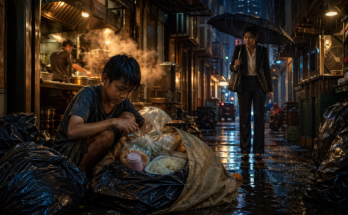
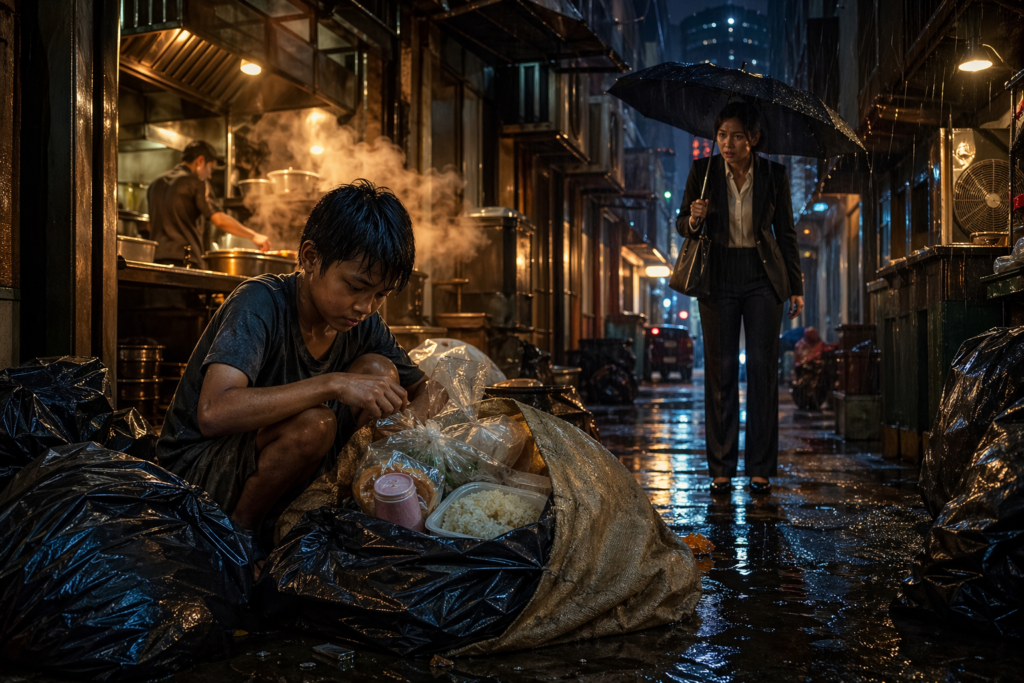
The lane was lit unevenly by two yellow security bulbs and a flickering sign above a back door. Water dripped from pipes and gathered in cracked cement hollows. A stack of empty crates leaned against the wall. Steam from one kitchen vent clouded the air and made everything smell of garlic, soy, burned sugar, and dish soap.
Rian felt calmer there. Back doors made more sense to him than front ones.
He started at the noodle bar. No luck yet. A bag of wilted herbs. Broken containers. Sauce cups. He moved on to the small bistro with the green canopy. Better. A packet of rice unopened. He checked the seal twice before dropping it carefully into one of his inner bags. Then two rolls in paper, still dry. A piece of grilled chicken with too much pepper on it, but usable if trimmed.
The rain picked up again, hard enough now to drum on the metal fire stairs overhead.
He kept working, quick but careful.
People who had never been hungry imagined this kind of searching as desperate grabbing. They were wrong. Carelessness ruined food. Carelessness meant broken glass cutting into rice, soup leaking over bread, dirty water soaking everything. Rian had rules. Separate dry from wet. Check smell. Check color. Never trust anything hidden too deep under meat waste. Anything sweet that bees touched during daylight was not worth the risk at night. Milk was dangerous. Bread could lie. Rice could still be good even when cold.
He was lifting another black bag with his wire when footsteps clicked at the mouth of the alley.
He did not look up immediately. Footsteps alone meant nothing. People used service lanes when rain forced them under any shelter they could find. But then he heard something else: the small pause of someone slowing down.
He glanced up.
A woman stood beneath a black umbrella, half protected from the rain, half caught in the alley’s weak yellow light. She looked like she had just come from the office and belonged to the bright buildings across the street. Her hair was pinned back, though the humidity had loosened strands around her face. She wore a dark business suit, shoes too fine for puddles, and the expression of someone who had almost continued walking.
Rian lowered his eyes.
It was easier that way. People who saw his face sometimes asked questions. Questions were dangerous because they could lead to pity, and pity rarely came without instructions, promises, or police.
He kept sorting.
The woman remained where she was.
He sensed rather than saw her looking at what he placed into the sack: a folded paper bag with half a sandwich wrapped cleanly inside, two untouched bread rolls, a cracked container of plain rice balanced so it would not spill. He reached for the pink plastic cup he kept tucked into the side of the sack and used it to scoop a little clean water from his bottle over his fingers before touching the bread again.
“Why do you have a child’s cup?” the woman asked.
Her voice was not harsh. That was what made him look up.
Some voices came at you like stones. Hers did not. It came carefully, as if she had surprised even herself by speaking.
Rian’s hand tightened around the cup.
“For my sister,” he said.
The woman stared at him for a moment. Rain hissed in the gutter beside them.
“How old is she?”
“Six.”
“And you take this home to her?”
He nodded once.
Something changed in the woman’s face then. Not pity exactly. Not yet. More like recognition. As though she had suddenly seen a doorway where before there had only been a wall.
“What’s your name?” she asked.
He hesitated. Names were not always safe either.
But there was tiredness in her eyes that felt real, and perhaps because the rain had closed the world down to this one alley, or perhaps because she had noticed the cup instead of pretending not to, he answered.
“Rian.”
“I’m Mara,” she said.
He did not know what to do with that information.
Adults who asked questions did not usually offer their own names in return.
“Do you have parents at home, Rian?”
The question made him still.
He thought about lying. He often did. Saying yes ended conversations faster. But there was something in her tone that made lying feel heavier than usual.
“No,” he said.
Mara swallowed. “No?”
“Our mother left last year,” he said, keeping his eyes on the sack. “She said she was going to work in another province. She sent money once. Then nothing. Our father was gone before that.”
There. Said. Clean and simple. Better that way.
Mara stepped farther into the alley, lowering the umbrella a little. “Who do you live with?”
“We rent a room.”
“That’s not what I asked.”
He looked at her then.
She seemed to realize it herself and softened her voice. “Who stays with you?”
“My sister.”
“No adult?”
He shook his head.
For a moment even the rain seemed quieter.
Mara pressed her lips together and looked back toward the street as if checking whether the city had heard what he had just said and was ashamed of itself. But the city remained what it had always been: bright in front, careless behind.
“I can buy you food,” she said at last.
Rian’s answer came quickly. “No.”
She blinked. “Why no?”
“People say that,” he replied. “Then they ask where we sleep. Then they tell someone. Then we have to leave.”
Mara was silent.
It was not the first time he had seen adults struggle with the fact that poor children learned patterns too. Promises. Questions. Hands that reached too kindly at first. Officials who arrived smiling and left with forms. Landlords who decided children alone meant trouble. Neighbors who suddenly remembered rules.
“I’m not trying to get you in trouble,” she said quietly.
“That’s what people say.”
He expected her to leave then. Most did once they realized he would not act grateful in the right way. Gratitude was another thing hunger made expensive. Too much of it invited ownership.
But Mara did not leave.
Instead she closed her umbrella, stepped carefully around a puddle, and crouched so she was closer to his height.
Up close, she looked older than he had first thought, maybe mid-thirties. There were faint shadows beneath her eyes and fine lines at the corners that did not seem to come from laughter alone. One sleeve of her jacket was damp where rain had splashed it. She carried no shopping bags, only a leather satchel and the smell of rain and office air-conditioning.
“What does your sister like to eat?” she asked.
It was such an unexpected question that he answered before he could stop himself.
“Eggs,” he said. “And bananas. And soup if it’s not spicy.”
Mara nodded, as if memorizing a list for an exam. “Does she go to school?”
“Sometimes.”
“Sometimes?”
“When I have enough.”
“For fees?”
He nodded again.
It was only a neighborhood learning center, not a proper school, just a room where donated books sat in metal cabinets and an older woman taught children letters and numbers in the afternoons. Mila loved it because they gave out pencils. Rian loved it because for two hours a day she got to be around other children and remember how.
Mara looked at the sack, then at his hands, then at his face. “Have you eaten tonight?”
He shrugged. “Not yet.”
“Come with me,” she said.
He stepped back immediately.
“No.”
“Just to the front,” she said. “The café on the corner is still open.”
“No.”
“I’ll buy food, and you can take it away. I won’t ask where you live.”
He almost laughed, but it came out like a sharp breath instead. Adults always said they would not ask until they wanted to.
Mara studied him for a long second. Then she reached into her satchel slowly, carefully enough not to alarm him, and took out a business card.
“I work three buildings over,” she said. “Human resources department. I’m not police. I’m not with the city. I go home this way almost every night.”
She placed the card on an upturned crate between them and stood back.
The card was white, heavy paper, her name printed in dark blue letters above the name of a logistics company he had seen on trucks. Mara Velas. Senior Operations Manager. There was a phone number beneath.
“I’m going to buy food,” she said. “If you want it, wait here. If you don’t, leave. I won’t follow you.”
Then she opened the umbrella again and walked out of the alley.
Rian stared after her until the rain swallowed her into the street.
He looked at the card.
He looked at the sack.
He looked toward the mouth of the alley again.
His first instinct was to run.
People changed their minds. People brought others back. People asked for something in return. He knew all that. But he also thought of Mila waking tomorrow, rubbing her eyes, asking in a small hopeful voice if there was anything good. He thought of the cracked rice container in his bag and the sandwich already beginning to soften. He thought of eggs. Bananas. Soup.
He hated that hope could be as dangerous as hunger.
Still, he stayed.
Seven minutes later Mara returned with two paper bags and a smaller bag from a pharmacy.
She did not come too close.
“This one has rice, chicken, vegetables,” she said, holding up the first bag. “This one has bread, bananas, and boiled eggs. The pharmacy bag has soap, bandages, and some medicine for fever. I asked for child-safe instructions.”
Rian could only stare.
The food was too much. Too clean. Too immediate.
“Why?” he asked.
Mara’s face shifted, as though the answer had more than one layer and she had to choose one fast.
“Because I saw you trying to keep bread dry in the rain,” she said.
Something in his chest moved uncomfortably.
No one had ever described him so exactly.
She set the bags beside the crate, next to the business card. “You don’t owe me anything. Not your address. Not a thank you. Just take it before the rice gets cold.”
He took one cautious step forward.
The steam still rose faintly from the container in the top bag. Real steam. Real warmth. His stomach clenched so hard it hurt.
“You can check it,” Mara said.
He did.
He opened each bag just enough to see. Chicken, still golden. White rice. Greens. Bread soft in clear wrapping. Four bananas. Three eggs. Soap. A box of plasters. Fever medicine. A small packet of sanitary wipes. He could not remember the last time anyone had bought things with his life in mind.
His throat tightened.
He did not cry. He had taught himself not to. But the effort of swallowing suddenly felt enormous.
“Thank you,” he said, and the words came out rougher than expected.
Mara nodded once, almost formally, as if accepting a business agreement.
Then she surprised him again.
“There’s a small diner two blocks from here,” she said. “Blue sign. Closed on Sundays. My aunt owns it. She needs help stacking crates after closing sometimes. Easy work. One hour, maybe less. If you want, I can ask her about cash. No questions. You could decide after seeing the place.”
Rian said nothing.
“I’ll be there tomorrow at nine,” she added. “Behind the diner. If you come, good. If not, I’ll leave it there.”
She tapped the card lightly with one finger.
Then she walked away a second time.
This time she did not look back.
Rian stood alone in the alley with the rain easing around him and three bags at his feet that felt heavier than their weight.
When he finally reached the room, Mila was awake.
She sat up so suddenly when he entered that the blanket slid off her lap. “You’re late.”
“I know.”
“Did it rain?”
“Yes.”
She saw the bags and froze.
Children who had learned not to expect much reacted carefully even to good things. Excitement came in pieces, as if joy itself had to knock first.
“Where did that come from?” she whispered.
“A woman bought it.”
Mila’s face changed. “Do we have to give it back?”
The question struck him like a hand to the chest.
“No,” he said quickly. “No. It’s ours.”
He set the bags on the floor and unpacked them one by one.
The room filled with smells so rich and strange in that small space that Mila covered her mouth with both hands and laughed silently, eyes wide. He gave her one banana immediately and she peeled it with trembling fingers, not even caring when the peel split badly down one side. Then the rice. Then the chicken broken into smaller pieces so she would not eat too fast and make herself sick.
“What’s this?” she asked, lifting the pink box of plasters.
“For cuts.”
“And this?”
“Soap.”
She held it to her nose. “It smells like flowers.”
He almost smiled. “Don’t eat it.”
She rolled her eyes in the way only younger sisters could and bit into bread instead.
Later, after they had eaten until their stomachs felt strange with fullness, Mila lay down again and turned the pink cup in her hands.
“Will you see the woman again?” she asked.
“I don’t know.”
“Was she nice?”
He thought of the umbrella. The business card. The way she had asked what Mila liked to eat, not what tragedy had put them in that room.
“Yes,” he said carefully. “But we still have to be careful.”
Mila nodded, though her eyes were already closing.
He waited until her breathing steadied before taking the business card from his pocket and placing it on the shelf beside the notebook.
In the morning he tried to decide not to go.
He told himself all the practical things. It could be a trick. The job might not be real. Mara might have told her aunt everything. Someone might ask questions. Someone might call authorities. He might lose the room. He might be separated from Mila. The city had a thousand ways to punish children for being visible.
But that afternoon the landlord came by and banged on doors for rent.
Rian paid three days late with coins wrapped in paper. The man counted twice, scowled, and warned him he was not running a charity. After he left, Mila sat quietly on the floor drawing circles on the notebook’s last blank page with a broken pencil, and Rian knew the truth: fear was not the only thing that could trap a person. So could habit.
That night at five minutes to nine, he stood behind the diner with the blue sign.
The alley there was cleaner. Stacks of empty drink crates rose against the wall. A bulb above the back door cast a strong white pool of light over damp pavement. He smelled onions, coffee, and bleach.
Mara was already there.
She wore no suit tonight, just a simple blouse and dark trousers, her hair tied back in a looser knot. Beside her stood a short broad woman with silver threaded through her black hair and arms sturdy from years of lifting heavy things.
“This is my aunt, Leda,” Mara said.
Leda looked him over in one quick sweep that somehow felt less like judgment than measurement. “Can you carry ten kilos?”
“Yes.”
“Can you count?”
“Yes.”
“Can you show up on time?”
He hesitated. “Usually.”
Leda snorted. “Better answer than lying.”
She pointed to the stack of crates. “You move those inside, sort glass from plastic, sweep when done. One hour. I pay cash. Any food left from the day that’s still good, you take. No stealing. No fighting. No bringing trouble to my door. Understand?”
“Yes.”
“Good. Start.”
Work, Rian learned, could feel different when it did not begin with shame.
The crates were wet and heavier than they looked, but manageable. He stacked them neatly under Leda’s watchful eye. He sorted bottles. He swept. When he finished, Leda handed him an envelope with enough cash for four days’ rent and a container of fish soup, another of rice, and two oranges.
He stared at the envelope.
“This is too much.”
“That’s the rate,” Leda said shortly. “If I wanted gratitude, I’d open a temple. Be here tomorrow.”
Mara stood by the door, arms folded against the night breeze. She did not smile too widely. She seemed to understand that too much softness could still frighten him.
“You did good,” she said simply.
And somehow those three words embarrassed him more than pity ever had.
The next weeks changed slowly, which is how real change often comes.
Not as rescue. Not as miracle. Not as one generous act that fixed everything. Change came like bricks laid one by one in wet ground.
Rian worked at the diner three nights a week, then four when Leda realized he learned quickly and stole nothing. He still knew every restaurant’s closing time, but now it became knowledge he used less and less. The sack did not disappear immediately. It hung by the door, ready for bad nights. Yet some evenings he came home carrying leftovers packed in proper containers, and Mila’s whole body would brighten at the sight of them.
Mara helped without crossing lines he had set.
She found a low-cost clinic and went with them the first time, sitting in the waiting room without pressing for details. She brought forms for a school scholarship and left them on the shelf, letting Rian decide when to sign. She showed him how to use a basic mobile phone she no longer needed, then taught him her number and Leda’s by memory in case the battery died.
“Why are you doing this?” he finally asked her one evening after the diner had closed and Leda was counting change inside.
Rain tapped softly on the awning overhead. Mara leaned against the wall, looking not at him but at the empty street.
“My mother cleaned offices when I was a child,” she said. “Night shift. She used to bring me leftover sandwiches from meeting rooms. I thought that was normal. Years later I realized she skipped meals so I wouldn’t.”
Rian said nothing.
Mara kept her eyes on the street. “She got sick when I was twenty-three. I had just started working. I kept telling her to rest, to let me handle things, but by then she had been surviving for so long she didn’t know how to stop. After she died, I spent years becoming the kind of person who looked too busy to notice anything painful.”
She gave a small humorless smile.
“Then I saw you protecting bread from the rain.”
He looked down at his hands.
“That’s all?”
“That was enough.”
He turned that answer over in his mind for days.
By the start of the next school term, Mila was attending regularly. She came home with songs, numbers, and stories about another girl who braided hair too tight and a teacher who wore red sandals even when it rained. She slept harder on school nights, the kind of sleep children have when the next day has a shape to it.
Rian wanted that shape too, though he did not say it aloud.
Leda was the one who forced the subject.
“Read this,” she said one slow afternoon, shoving a supplier invoice at him while the diner was quiet.
He stumbled through the words.
“Again,” she said.
He did.
“Worse than my nephew, but better than my brother,” she muttered. “Sit down after closing. Mara knows people at the community center. You’ll study.”
“I work.”
“You’ll study and work.”
“I’m too old.”
Leda gave him a flat look. “You’re twelve. Stop talking like a seventy-year-old mechanic.”
So he studied.
At first, late and clumsy, embarrassed by how much he had missed. Then with stubbornness. Then with hunger of another kind. Numbers began to settle into place. Words became less slippery. He learned to fill forms without panic. He learned that documents mattered in ways children alone rarely understood until it was too late.
That was how Mara eventually discovered the problem they had all been circling.
There were no papers for Mila.
No current registration. No school record that could carry her forward. No official proof of where their mother had gone. No reliable lease. No guardian listed. Their lives existed in fragments: old clinic slips, a faded photocopy of a birth notice, rent receipts without names. Enough to live in the cracks. Not enough to build on.
“We need help,” Mara said.
Rian’s whole body went rigid.
“No officials.”
“Not that kind,” she said quickly. “A legal aid office. Family documentation. They handle cases like this.”
“Cases like this” sounded to him like children taken away under fluorescent lights.
Mara must have seen it on his face because she spoke gently. “You come with me. We ask questions first. No signatures. No commitments.”
He wanted to refuse. He nearly did.
But then Mila came home that evening with a paper from school about next year’s enrollment, and for the first time he saw her future not as a vague hope but as something that could be lost through paperwork alone.
So he went.
The legal aid office was on the third floor of an old municipal building that smelled of paper and fans blowing warm air. Posters about housing, wages, and identity documents curled on the walls. A woman named Celia met them in a room with metal chairs and a desk scarred by years of elbows.
Celia did not speak to Rian like he was invisible. She also did not speak to him like he was fragile.
She asked for facts. Dates. Names. Places last known. She listened without widening her eyes at every hardship, which made telling the truth easier. Mara only stepped in when needed. At the end Celia folded her hands and said, “This will take time, but it is possible.”
Possible.
Rian had lived so long inside immediate needs that the word felt strange. Too broad. Too open. He mistrusted it.
Still, Celia kept her promise. She found a path for temporary guardianship arrangements without separating the children. She connected Mara and Leda to a neighborhood support network. She helped recover enough records to enroll Mila properly and start the process for Rian too. None of it was clean. None of it was quick. But it moved.
Months passed.
The sack remained by the door, then moved to a corner, then under the mattress.
One evening, after a full dinner at the diner, Mila found it and dragged it out.
“Can I use this for my dolls?” she asked.
Rian stared at the bag.
The stitches. The stains. The hardened crease where it had folded against his shoulder night after night. He could still smell alley rain in it if he tried.
“No,” he said at first.
Then he paused.
He knelt, took the sack from her, and ran a hand over the rough fabric.
“We don’t need this anymore,” he said slowly, more to himself than to her.
Mila tilted her head. “Then why are you sad?”
He looked at her, startled into a laugh that turned heavy at the edges.
“I’m not sad.”
“You are a little.”
Maybe he was. Because survival habits were not just things you used; they became shapes inside you. Letting go of them felt good and frightening at once. Like stepping out of a room you had hated, only to realize it had still kept the rain off you.
He folded the sack carefully and set it aside.
The following year, on a humid evening thick with the smell of coming storms, Rian walked past the restaurant row on his way back from classes at the community center.
He was taller now. Still thin, but stronger. His hair had been cut properly. He carried books in a secondhand backpack and wore a diner apron rolled in one hand. The city looked both familiar and newly arranged, as if old places had shifted slightly because he no longer approached them from the same hunger.
He paused at the mouth of the service lane.
The yellow bulbs still hummed. Steam still drifted from the vent. A boy, maybe ten, stood near the bins with a plastic sack and the watchful stillness Rian knew too well.
For one second the past and present overlapped so sharply it made his chest ache.
The boy flinched when he noticed him.
Rian raised both hands a little. “I’m not here to chase you.”
The boy said nothing.
Rain began as a scatter of small drops.
Rian looked at the bags, at the lane, at the boy’s bare feet darkened by wet cement. Then he reached into his backpack and took out the dinner container Leda had packed for him.
“It’s still warm,” he said.
The boy’s eyes flicked to the container, then back to Rian, suspicious.
“I’m not asking where you live,” Rian added.
Something loosened in the child’s shoulders.
He stepped forward slowly.
Rian handed him the container and, after the briefest hesitation, one of the diner’s small printed cards he carried for deliveries. On the blank back, he wrote an address and a time.
Blue sign. After nine. Ask for Leda.
The boy read it with difficulty, lips moving.
“If you come, you work,” Rian said. “No stealing. No fighting. Understand?”
The boy nodded.
Rian almost smiled.
He turned to go, then stopped.
“What’s your name?” he asked.
“Jun.”
Rian nodded once. “All right, Jun. Keep the food dry.”
He walked home through the rain with his heart beating harder than it should have for such a simple exchange.
Mara was at the diner when he told her later.
She listened, then looked at him over the rim of her tea.
“That alley again,” she said.
He leaned back in his chair. The diner was nearly empty, only the ceiling fan clicking and the glass pastry case reflecting streetlight. Leda was in the kitchen arguing with a supplier on the phone.
“Yes.”
Mara smiled, but there was wetness in her eyes. “Funny place for a life to change.”
Rian looked down at the scar on his thumb from an old broken bottle. “I still think about that night.”
“What part?”
He considered.
“Not the food,” he said at last. “Not first.”
“What then?”
“The way you asked what Mila liked to eat.”
Mara’s expression softened.
“No one asked things like that before,” he said. “Usually they asked what went wrong. Or where our parents were. Or why I wasn’t in school. Like we were a problem to explain.” He looked at her. “You asked something that made it sound like my sister was a person before she was a situation.”
Mara blinked quickly and glanced toward the kitchen.
“You were both people,” she said.
“Yes,” Rian replied. “But that night was the first time it felt like someone else knew it.”
Years later, when the story was told by those who knew pieces of it, some would describe Mara as the woman who saved him. She always hated that version.
“Saved is too simple,” she would say.
And she was right.
Because saving suggested a clean movement: one person reaching down, another lifted up, story complete. But real lives did not move that way. Real lives were made of repeated choices. Showing up. Not looking away. Respecting fear. Offering work, not performance. Paperwork. Rent. School forms. Clinic visits. Boundaries. Trust earned slowly enough not to break. A child deciding, again and again, to believe tomorrow might deserve planning.
If there was rescue in the story, it was made of many hands and many ordinary nights.
And yet the first turning point had still happened in a wet alley behind a row of restaurants.
Mila grew. Of course she did. Children do, even when early years try to hold them back.
She lost the roundness in her voice but kept her openness. She learned multiplication and read chapter books aloud too fast because she was always eager to know the ending. She outgrew the pink cup but refused to throw it away. It remained on the shelf through every room change after that, scratched, faded, and somehow graceful in its stubborn survival.
When she was old enough to understand more fully, she once asked Rian, “Were you scared all the time back then?”
He wanted to lie for her comfort. He did not.
“Not all the time,” he said. “Sometimes there wasn’t room for scared. There was only next. Next place, next meal, next day.”
She thought about that, twirling a pen between her fingers.
“And when did it stop?”
He looked at her across the table.
Outside, evening traffic murmured along the road. Their apartment now was small but solid, with a proper sink, two windows, and rent paid on time. On the stove, soup simmered. In the corner sat Mila’s school shoes beside his work boots. Such ordinary details would have once felt like luxury.
“It didn’t stop all at once,” he answered. “It got quieter.”
She nodded as if that made perfect sense.
Maybe to children who had survived, it did.
On the tenth anniversary of the diner, Leda hung new lights and pretended she did not care whether anyone complimented them. Mara brought a cake from the bakery she now insisted on calling “too expensive but worth it.” Regulars came and went. Someone put old songs on the speaker. Jun, no longer small or suspicious, argued with a delivery driver out back and came in grinning when Leda shouted at both of them equally.
Late that night, after the last table was wiped and the city had thinned into scattered headlights, Rian stood outside under the blue sign and watched rain begin to silver the street.
Mara joined him with two paper cups of tea.
“You’re thinking,” she said.
“I was just remembering.”
“Dangerous hobby.”
He smiled. “Do you ever wonder what would have happened if you kept walking?”
Mara was quiet for a long moment.
“Yes,” she said.
“So do I.”
Rain tapped the metal sign above them.
“At first,” Mara said softly, “I thought I stopped because I was a good person. Then I realized that wasn’t the truth.”
Rian looked at her.
“I stopped because something in that alley made it impossible to protect myself with distance anymore. I had spent years pretending pain belonged to other people’s lives. That night made it personal.”
He let that settle between them.
Then he said, “Maybe that’s not a worse reason.”
She glanced at him.
“No?”
“No. I think most people don’t change because they suddenly become better. I think they change because something gets close enough that they can’t stay the same.”
Mara laughed quietly into her tea. “When did you get so thoughtful?”
“Community college writing class.”
She looked genuinely delighted. “You liked it?”
“I hated it. Then I liked it.”
“That sounds right.”
He leaned against the doorframe and watched the rain gather along the gutter. Somewhere farther down the road a motorcycle passed, spraying water. The night smelled like wet asphalt and ginger from the kitchen vents.
“Do you know what I remember most?” he asked.
She waited.
“The clock above the pharmacy across the street. I used to check it in the reflection on the restaurant window because the glass was cleaner than looking straight through rain.” He smiled a little. “I thought if I could just learn enough times, enough patterns, enough routes, then hunger would never surprise me again.”
“And did it work?”
“For a while.” He lifted one shoulder. “But that kind of knowledge only keeps you alive. It doesn’t tell you what to do once living is possible.”
Mara said nothing, and he was grateful. Some truths improved when left without reply.
At home that night, Mila was studying at the table, humming under her breath. The old pink cup held pens now instead of water. She looked up when he entered.
“You’re late.”
He laughed.
It had been years, and still those were the first words she offered when she worried.
“I know.”
She wrinkled her nose. “You smell like rain.”
“It rained.”
“I noticed.”
He set down a bag from the diner. “Leda sent dessert.”
Mila’s whole face lit. “The coconut one?”
“The coconut one.”
As she unpacked it, he stood for a moment in the doorway and watched the life around him—the steady lamp light, the neat stack of textbooks, the pot drying beside the sink, the girl no longer little but safe enough to be impatient.
It did not look dramatic. It did not look like the kind of ending people wrote songs about. It looked ordinary.
That was what made it beautiful.
Because there had been a time when ordinary was all he had ever wanted.
Years earlier, in a wet alley behind polished restaurants, a woman in a business suit had seen a boy sorting the city’s discarded leftovers into something that might keep morning from hurting too much. She had stopped not because she knew how the story would end, not because she had a perfect plan, but because she noticed one small impossible detail: he was trying to keep bread dry in the rain, and tucked inside his sack was a pink plastic cup for someone else.
That was all.
A boy. A cup. A pause.
Sometimes an entire life turned on nothing more dramatic than being truly seen at the exact moment you had grown used to being invisible.
And long after hunger stopped deciding his schedule, long after he no longer knew every restaurant’s closing time, Rian never forgot the sound of rain on metal stairs, the warmth rising from that first paper bag, or the strange, terrifying, healing experience of being asked a question that made room for dignity.
What does your sister like to eat?
He had carried many things home in those years—rice, bread, shame, caution, determination. But the thing that changed everything was not something he found in a bin or saved in a sack.
It was the first fragile proof that the world, for once, might be willing to carry a little of the weight with him.