Elena Marlowe first noticed the silence before she noticed the betrayal.
It had been gathering for months in the corners of the house like dust she kept meaning to wipe away. It settled between dinner conversations that ended too quickly, in the half-finished sentences Marcus left hanging in the air, in the way he had started carrying his phone with him from room to room as if it were something alive he could not leave unattended. None of it was loud enough to name. None of it was sharp enough to cut. It was just there, a soft, constant absence where warmth used to be.
For a long time, Elena told herself this was what marriage looked like after twelve years.
Not unhappy, exactly. Just worn.
She was thirty-eight, a high school guidance counselor who had gotten good at reading pain in other people’s children while ignoring the thinner, quieter version of it in her own home. Marcus was forty-one, steady, handsome in a tired sort of way, with a face that had aged into seriousness. He worked in commercial property management and had the kind of dependable routine that used to comfort her. He left at 7:15 most mornings. He preferred black coffee. He folded towels badly. He still rubbed the bridge of his nose when he was stressed, the same way he had on the day they met outside a courthouse when she had been there for jury duty and he had been arguing on the phone with a parking enforcement officer.
She used to tell people she fell in love with him because he looked like a man who did not know how to pretend.
That memory embarrassed her now.
Their house sat on a quiet street in a suburb where people waved at each other from driveways and pretended not to notice when someone’s marriage was having trouble. They had a daughter, Sophie, who was ten, observant beyond her years, with Elena’s eyes and Marcus’s habit of going quiet when she was worried. Elena had built her life around ordinary things: packed lunches, birthday candles, grocery lists, teacher conferences, Friday movie nights, and the belief that even imperfect love could still be trustworthy.
Then came June.
The first week was hot enough to make the window screens hum. Sophie was at a sleepover the night Elena found the message. Marcus had fallen asleep on the couch with the television glowing low and blue across his face. His phone was on the coffee table, close enough for her to see it light up when the message came through.
She did not mean to look.
Later, when she went over that night again and again in her mind, she would try to pinpoint the exact second when curiosity became dread. The phone buzzed. She glanced down. She saw the name: Jenna. No last name. Just Jenna, followed by a red heart she had never noticed before.
Then the preview.
I hate leaving your bed and pretending none of this is real.
The room changed around her.
It was still her living room. The lamp by the bookshelf still cast that warm amber circle over the rug. The dishwasher still made its slow mechanical swishing in the kitchen. The ceiling fan still clicked once every rotation because Marcus had promised for two years to fix it and never had. But nothing in the room felt stable anymore. It all seemed to tilt slightly, as if the house itself had been resting on a truth too weak to hold.
Elena stared at the phone until the screen dimmed.
Her first instinct was not anger. It was refusal. A blank, desperate refusal inside her chest. There had to be another explanation. Jenna could be a client. A friend. Someone making a joke. Something inappropriate but not what it looked like.
She reached for the phone with trembling fingers.
Marcus stirred on the couch, but he did not wake.
The passcode had not changed. That hurt more than if it had. It meant betrayal had settled into his routine so completely he no longer imagined she might find it.
The messages were not confusing. They were not vague. They were intimate, practiced, ordinary in the cruelest way. Photos of restaurant plates. Complaints about traffic. A joke about his snoring. Plans. Familiarity. One message from Marcus made Elena stop breathing for a second.
I haven’t felt understood like this in years.
There are some sentences that do not end when you finish reading them. They keep opening inside you.
Elena set the phone back down exactly where it had been and sat very still in the armchair across from him. Marcus slept on, one arm bent awkwardly over his chest, his mouth slightly open, looking almost boyish in the dim light. For one wild second she wanted to wake him by throwing the phone at his face.
Instead she said his name once, low and flat.
“Marcus.”
He blinked, confused, then pushed himself upright. “What time is it?”
She did not answer. She only looked at the phone.
His face changed before he touched it.
Not shock. Not innocence. Recognition.
That was when the anger came.
Quietly, almost politely, Elena asked, “How long?”
Marcus rubbed his face. “Elena—”
“How long?”
He looked at the floor. “A few months.”
She stood so fast her knee hit the coffee table. Pain shot up her leg, but she barely felt it. “A few months.”
“I was going to tell you.”
Her laugh sounded ugly in the room. “Were you?”
“Yes.”
“When? After what? After she got tired of you? After Sophie noticed? After I kept making your lunch and washing your clothes and sitting next to you at your mother’s birthday dinner while you texted another woman under the table?”
His jaw tightened. “Don’t do that.”
“Do what?”
“Make it theatrical.”
The word was so absurd she had to grip the back of the armchair to stay steady. “Theatrical.”
Marcus stood too. “I know what I did.”
“No, I don’t think you do.”
He looked exhausted, which made her furious. As if this had been hardest on him. As if he had been carrying some heavy burden instead of choosing, again and again, to lie.
“Does she know you’re married?” Elena asked.
He did not answer fast enough.
Her mouth went dry. “She does.”
“Yes.”
“And she still—”
“Yes.”
The room fell silent.
Somewhere outside, a dog barked. A car door slammed. Life continued with insulting indifference.
Elena pressed both hands to her stomach as if she might physically hold herself together. “Did you ever plan to stop?”
Marcus looked at her then, really looked, and for a moment she saw something like shame. But it came too late to be useful.
“I don’t know,” he said.
That answer broke something cleaner than rage. Rage at least still felt alive. What replaced it was colder.
Elena turned and walked upstairs. Marcus followed her to the bedroom doorway but stopped there.
“What are you doing?” he asked as she pulled a suitcase from the closet.
“I can’t look at you.”
“Don’t leave tonight.”
She kept folding clothes with mechanical precision. A pair of jeans. Two blouses. Her toiletries. A charger. It was obscene how ordinary the motions were.
“Don’t leave tonight,” Marcus repeated, softer this time. “We should talk when we’re calmer.”
She zipped the suitcase and finally faced him. “You have had months to be calm.”
He leaned one shoulder against the doorframe, his face pinched in a way that might once have moved her. “It didn’t start the way you think.”
She stared at him. “You think details are the problem?”
“I’m trying to explain.”
“No,” she said. “You’re trying not to be the villain in your own version.”
That landed. She saw it.
Marcus looked away first.
She slept that night in the guest room at her friend Nina’s house with her shoes still on, one hand curled under her cheek like a child. At 3:11 in the morning she woke with a gasp, disoriented by the unfamiliar floral print of Nina’s spare pillowcases, and for one blissful second she forgot what had happened. Then she remembered. It returned all at once, not like information but like impact.
By morning she had three missed calls from Marcus and one text.
Sophie asks where you are. What do I tell her?
Elena sat on the edge of the bed and stared at the message until Nina knocked softly and came in with coffee. Nina had known Elena since college. She was the kind of friend who never said “I knew it” even if she had. She handed Elena the mug, sat beside her, and waited.
Elena showed her the text.
Nina exhaled through her nose. “Coward.”
“I don’t know what to say to Sophie.”
“The truth,” Nina said. Then, gentler: “An age-appropriate version of it.”
By noon Elena was back at the house.
Sophie met her at the door in pink socks and a camp T-shirt, her face small and tight with worry. “Mom? Are you okay?”
Children always ask the real question first.
Elena dropped to her knees and held her daughter carefully, as though Sophie too might crack under pressure. Her hair smelled like watermelon shampoo and sunscreen.
“I’m okay,” Elena lied. “I just needed to stay with Aunt Nina last night.”
“Why?”
Behind Sophie, Marcus stood in the kitchen, pale and silent, a coffee mug in his hand. Elena did not look at him.
She touched Sophie’s cheek. “Dad and I are having some grown-up problems. None of this is your fault. Do you understand?”
Sophie searched her face with painful seriousness. “Are you getting divorced?”
The question hung in the air.
Elena swallowed. “I don’t know yet.”
Sophie nodded once with the grim dignity of a child trying to be brave for adults who do not deserve it. Elena almost wept right there in the hallway.
The next few weeks passed in fragments.
Marcus moved into the downstairs den. Elena functioned because function was what mothers did. She drove Sophie to summer art camp. She answered emails. She paid bills. She attended a faculty planning session for the fall semester and nodded through discussions about student mental health while feeling as if someone had scooped out her center and left only a shell that knew how to speak in appropriate tones.
Marcus ended the affair, at least according to him. He said Jenna had been someone from a property developer’s office. It started with lunches, then emotional dependence, then the rest. He said he was sorry. He said he hated himself. He said he did not know how he had become this man. Elena listened with the detached horror of someone hearing a confession from across a great distance.
Some nights he tried to talk.
Some nights she let him.
One evening, after Sophie was asleep, they sat at opposite ends of the dining table while summer rain tapped softly against the windows.
“I’m not asking you to forgive me now,” Marcus said.
Elena nearly smiled at the absurdity. “How generous.”
He flinched. Good, she thought. Let him.
“I’m trying to understand it myself,” he said.
“No,” Elena replied. “You are trying to hand me a version that hurts less.”
“That’s not fair.”
“No fair?” Her voice sharpened despite herself. “You want to talk about fair?”
Marcus dragged a hand over his face. “I was lonely.”
There it was, the sentence countless betrayers seemed to believe was profound.
Elena leaned back in her chair and looked at him. Really looked. “You were lonely in a house where I slept next to you for twelve years. You were lonely while I handled Sophie’s school meetings, your father’s rehab paperwork, your mother’s doctor appointments, your forgotten birthdays, your entire life. You were lonely, so you looked for comfort in another woman instead of speaking one honest sentence to your wife.”
Marcus opened his mouth, then shut it.
Elena stood. “I’m not your witness stand. Stop making me listen to your defense.”
Yet even through her anger, another feeling had begun to rise, one she did not know how to name. It had less to do with Jenna and more to do with Marcus’s family.
In the years she had known them, the Hartwell family had always possessed a polished, careful way of surviving themselves. His mother, Lorraine, was elegant, composed, a woman who set tables beautifully and treated unpleasant truths like stains that could be covered with a runner or a centerpiece. Marcus’s older brother, Daniel, lived two towns over with his second wife and had perfected the art of strategic absence. Their father, Richard, had died eighteen months earlier after a long illness that rearranged the whole family around his decline. Elena had helped more than any of them during that time, cooking meals, driving to appointments, sitting in hospital waiting rooms where everyone spoke in low practical voices while old tensions flickered beneath the surface.
And yet during those months there had been moments Elena could not explain.
Times she walked into a room and conversation stopped too abruptly.
Times Lorraine looked at Marcus with a strange, burdened tenderness that felt closer to apology than affection.
Times Daniel seemed angry at Marcus for reasons that had nothing to do with the present.
Once, near the end of Richard’s life, Elena had found him half-awake in his hospital bed whispering, “He should have known. He had a right.”
She had assumed medication was making him confused. When she asked Marcus later, he dismissed it.
“Dad rambled a lot at the end,” he said.
Now, after the affair, that memory came back with unwelcome force.
The first real crack opened in late July.
Lorraine called Elena directly, which was unusual. Usually she called Marcus, then passed information through him like messages through a diplomatic channel.
“Elena, dear,” she said, voice thin but composed. “I wondered if you could stop by tomorrow. There are some boxes from Richard’s study I need help sorting. Marcus says he’s tied up at work.”
Elena almost said no.
But Sophie loved her grandmother, and despite everything, Elena still moved through obligations as if they were rails laid down years ago. She drove over the next afternoon.
Lorraine’s house smelled faintly of lemon polish and old books. The curtains in the sitting room were half-drawn against the heat. Elena found her mother-in-law in Richard’s former study, standing beside three cardboard boxes and a black trash bag. She looked smaller than Elena remembered, though her lipstick was perfect.
“You didn’t have to come,” Lorraine said.
“You asked.”
Lorraine gave a tight nod. “Yes.”
There was something strange in her tone, something rehearsed and brittle.
They worked in near silence for almost an hour, sorting receipts, old tax documents, yellowed newspaper clippings, condolence cards, golf photos, and brittle instruction manuals Richard had apparently saved since 1989. Dust collected on Elena’s fingertips. Lorraine kept opening folders, glancing inside, then setting them aside with a distracted urgency that made Elena increasingly aware this was not really about organizing papers.
At last Lorraine sat down heavily in Richard’s leather chair and pressed a hand to her chest.
“Are you alright?” Elena asked.
Lorraine gave a shaky laugh. “No. Not particularly.”
Elena froze, a folder in her hands.
Lorraine looked at her then, really looked, and Elena saw that her carefully maintained expression had cracks all through it.
“I should have done this years ago,” Lorraine whispered.
“Done what?”
Lorraine’s eyes filled. “Told the truth.”
The air in the room changed.
Elena slowly lowered the folder onto the desk. “What truth?”
Lorraine looked toward the closed door as though afraid the walls themselves might hear. Then she reached into the bottom drawer of the desk and took out a large sealed envelope, thick and slightly bent at one corner.
“I found this after Richard died,” she said. “I could not bring myself to open it until three weeks ago.”
She placed it on the desk between them.
On the front, in Richard’s unmistakable blocky handwriting, were six words.
For Marcus, if I lose courage.
Elena felt a slow chill move through her arms. “Does Marcus know about this?”
Lorraine closed her eyes briefly. “No.”
“Then why are you showing me?”
“Because I don’t know how to tell him. Because after what has happened in your marriage, I am ashamed to say part of me still feared protecting my son from pain more than I feared the damage of one more lie. And because you, Elena…” Lorraine’s voice broke. “You have always been stronger than the rest of us.”
Elena did not feel strong. She felt unsteady, suspicious, suddenly furious without understanding why.
“What is in it?”
Lorraine pushed the envelope toward her. “Read.”
Elena hesitated only a second before sliding a finger beneath the seal.
Inside was a letter and an old birth certificate copy.
The first lines of the letter blurred because she was already not breathing properly.
Marcus,
If you are reading this, then I have failed twice—once in my life, and once in my death. I should have told you myself years ago.
You are not my biological son.
Elena’s heart slammed hard enough to hurt.
She kept reading.
The letter was part confession, part plea. Forty-two years earlier, when Lorraine and Richard were newly married, Lorraine had become pregnant during a brief separation neither family ever knew about. The father was a man named Thomas Vale, someone she had loved before Richard, someone she had reconnected with for a short, reckless period when her young marriage was collapsing under pride and misunderstanding. By the time she reconciled with Richard, she was already pregnant. Richard agreed to raise the baby as his own on one condition: no one would ever speak of it again. Not to relatives. Not to Daniel. Not to Marcus.
Years passed. What began as a decision hardened into a family structure built around silence. Richard had loved Marcus, the letter insisted, though imperfectly. But resentment, shame, and fear never fully left him. He was writing now because illness had stripped him of his excuses and he could no longer bear the idea of taking the truth into the grave.
At the bottom of the letter Richard had written:
You spent your life trying to earn a place that was always yours. That is my sin, not yours.
Elena lowered the pages slowly.
The room felt suddenly too small.
Lorraine was crying now, but in the quiet, controlled way of women who trained themselves young never to make anyone else uncomfortable with their grief.
“I wanted to tell him so many times,” she said. “When he was a child and asked why Richard was harder on him than Daniel. When he was sixteen and came home after that fight with his father and said, ‘I don’t know why he looks at me like I’m wrong before I even speak.’ When he became a father himself. I wanted to tell him then most of all.” She pressed trembling fingers to her mouth. “I never did.”
Elena sat down because her knees would not hold her.
A thousand small memories rearranged themselves at once. Richard’s distance. Daniel’s strange hostility. Lorraine’s apologetic tenderness. The hospital whisper. The feeling that Marcus had spent his whole life standing slightly outside something no one would name.
But beneath the shock, another thought rose dark and immediate.
Marcus had betrayed her.
Marcus had shattered their marriage.
And yet sitting there, holding a dead man’s confession, Elena also knew that some essential wound in him had existed long before Jenna, long before their wedding, long before either of them had language for it.
That did not excuse what he had done.
It made it harder in a different way.
Lorraine wiped at her face. “Will you help me tell him?”
Elena stared at the letter in her lap.
There are moments when life asks something unreasonable of the already injured. This was one of them.
“I don’t know,” Elena said honestly.
Lorraine nodded as though she deserved nothing else. “I understand.”
Elena took the letter home in her bag because Lorraine said she could not bear to keep touching it.
The whole drive back, heat shimmered above the asphalt and her hands stayed cold on the steering wheel. At a red light she looked at her reflection in the rearview mirror and barely recognized herself. She looked older than she had that morning. Sharper. Like someone standing at the edge of a second disaster while still bleeding from the first.
That evening, Marcus was in the kitchen cutting strawberries for Sophie.
It was such a gentle domestic image that Elena had to stop in the doorway and steady herself. Sophie stood on a chair beside him, chattering about a painting project involving seashells and glitter. Marcus smiled at the right places. He handed her slices on a plate. He looked, for that little scene, exactly like the man Elena had trusted.
The knowledge in her bag felt hot and impossible.
“Can you go set the table, Soph?” Elena asked.
Sophie hopped down with the plate and disappeared into the dining room.
Marcus glanced at Elena. “You okay?”
That simple question almost undid her.
“No,” she said. “We need to talk later.”
His posture changed instantly. “About what?”
“Later.”
He searched her face, probably expecting another conversation about lawyers or separation or damage control. He had no idea the ground beneath him was about to move.
After Sophie went to bed, Elena sat at the dining table with the envelope between her hands.
Marcus came in and stopped when he saw it.
“What is that?”
“I went to your mother’s today.”
He frowned slightly. “Why?”
“She asked me over to help with Dad’s study.”
Marcus pulled out a chair and sat opposite her. His expression was guarded. “Okay.”
Elena pushed the envelope toward him.
He looked at the handwriting and went still.
“That’s Dad’s.”
“Yes.”
Marcus glanced up. “Why do you have it?”
“Because your mother gave it to me.”
A faint line appeared between his brows. “What is it?”
Elena could have softened it. She could have circled around the truth, let him approach it slowly. Instead she was too tired for ceremony.
“It’s a letter he meant for you. You should read it.”
Something in her tone made him obey without another question.
Marcus opened the envelope. He unfolded the pages. Elena watched his eyes move. Watched confusion, disbelief, then something deeper take hold of his face. His skin lost color. His mouth opened slightly as if his body had forgotten how to coordinate simple functions like breathing.
When he reached the birth certificate copy, his hand began to shake.
“What is this?” he whispered.
Elena said nothing.
Marcus read the first page again, as though repetition might produce a different truth.
“No,” he said softly. Then louder: “No.”
He pushed back from the table so abruptly the chair legs scraped hard against the floor.
“Elena—what is this?”
“A letter,” she answered, though the word sounded absurdly small.
“This isn’t real.”
“It is.”
He stared at her with naked panic. “My mother gave you this?”
“Yes.”
“When?”
“Today.”
Marcus turned away and braced both hands on the kitchen counter. For a few seconds he made no sound at all. Elena had never seen him like that. Not when Richard died. Not when Sophie was born. Not even on the night of confrontation. This was different. Too large, too old, too foundational.
“She knew?” he asked finally, voice raw.
“Yes.”
“All these years.”
“Yes.”
He let out one short, broken laugh that had no humor in it. Then he covered his mouth with his hand. Elena realized, with a jolt, that he was trying not to be sick.
“I don’t understand,” he said. “I don’t—Dad—”
He stopped. The word itself was no longer stable.
Elena rose slowly. “Marcus.”
He turned on her with wild, unfocused eyes. “Did Daniel know?”
“I don’t know.”
“He knew something.” Marcus dragged a hand through his hair. “He always—Jesus.”
He paced two tight circles in the kitchen, letter still clenched in one hand. “That’s why he treated me differently. That’s why Dad—”
He stopped again, then looked at Elena with a kind of stunned helplessness she had not seen since they were in their twenties and their car broke down in a blizzard on the way to Vermont.
“I thought it was me,” he said.
The sentence entered her like a splinter.
For a moment neither of them moved. Betrayal still stood between them. So did anger, humiliation, the wreckage of trust. But now another truth was in the room, one that reached so far back it made the last few months seem at once smaller and more tragic.
Marcus looked down at the letter. “He knew every day of my life.”
“Yes.”
“And she just watched.”
Elena did not defend Lorraine. She could not.
Marcus sank into the chair as if his bones had suddenly become unreliable. “Why would she give this to you first?”
The answer came before Elena could decide whether to say it.
“Because she couldn’t bear to tell you herself. And because your family has been making women carry the truth for men for a very long time.”
Marcus looked up sharply.
The words hung there, precise and merciless.
He looked away first.
What followed was not healing. It was fallout.
Marcus went to Lorraine’s house the next morning before work. He came back three hours later looking as if he had aged ten years. He told Elena only fragments at first. Lorraine confirmed everything. Daniel had known since he was nineteen; Richard told him during one drunken fight after Daniel accused him of favoring Marcus. Instead of creating sympathy, it had deepened Daniel’s resentment. He had grown up seeing Marcus as the child around whom everyone bent the truth. Richard swore him to secrecy. Daniel agreed because in that family silence was currency and cruelty often wore the mask of loyalty.
Marcus did not speak to Daniel for two weeks.
When he finally did, the call ended with Marcus throwing his phone across the den hard enough to crack the screen.
Sophie sensed the volatility even though the adults tried to soften it. She became clingier with Elena and uncharacteristically patient with Marcus, as children often are when they see a parent unraveling.
One night Elena found him sitting on Sophie’s bedroom floor after she’d fallen asleep, his back against the wall, hands clasped so tightly his knuckles were pale.
“She asked if I was sick,” he said without looking up.
Elena stood in the doorway.
“What did you tell her?”
“That I was sad.”
He gave a hollow laugh. “At least that’s true.”
Elena should have left. She knew that. Every instinct for self-protection told her not to drift back into emotional proximity with a man who had just betrayed her. But pain has its own gravity. She stayed.
Marcus looked at Sophie sleeping under her pale yellow blanket. “Do you know what I can’t stop thinking?” he said.
Elena said nothing.
“I can’t stop thinking about all the times I tried to make him proud.” His voice had gone strangely calm. “Baseball games. School awards. That stupid internship after college when I worked seventy-hour weeks because he said I needed to learn discipline. I built my whole life around proving something to a man who already knew exactly why he couldn’t love me cleanly.”
Elena leaned against the doorframe. “He did love you.”
Marcus shook his head. “Maybe. But not without conditions he never admitted.”
That was probably true.
Over the next month, Marcus changed in ways Elena had not expected.
Not nobly. Not neatly.
He became more transparent, but also less defended. He started therapy after Elena said, flatly, that if he was serious about understanding why he had detonated their marriage, he needed to stop talking to her like she was his only place to confess. He found a therapist specializing in family systems and trauma, which sounded like language Elena would once have rolled her eyes at. Instead she felt only exhaustion.
He cried once in front of her. Really cried.
It happened after his third session. Elena was in the kitchen chopping onions when Marcus came in from the garage, stood by the counter for a long moment, and said, “He told me I was trained to mistake emotional uncertainty for normal love.”
Elena kept chopping. “Your therapist.”
“Yes.”
She nodded.
Marcus swallowed. “And that I learned to perform instead of connect.”
The knife paused in her hand.
When she looked up, Marcus was staring at the floor with the expression of a man holding something hot and unbearable.
“I don’t know what to do with that,” he said.
Neither did she.
Yet as summer folded toward fall, the secret continued to reveal its long shadow. Marcus remembered incidents differently now. Richard praising Daniel publicly but correcting Marcus privately. Lorraine flinching whenever extended family commented on how little Marcus resembled his father. Daniel’s cutting jokes about “special treatment.” Even the affair, Marcus admitted in therapy and later, painfully, to Elena, had not begun as lust so much as relief.
“With Jenna,” he said one evening on the back porch while cicadas filled the dark, “I felt chosen without having to earn it first.”
Elena felt the blow of that sentence in two directions at once.
Because part of her heard the boy beneath it.
And part of her heard the indictment of their marriage.
She turned toward him slowly. “Do you hear how cruel that sounds to me?”
Marcus closed his eyes. “Yes.”
“I chose you. Every day. Through things you didn’t even see.”
“I know.”
“No,” Elena said, voice shaking now. “I don’t think you do. I think you have spent so long moving through your own hunger that you don’t understand what it cost to be the person beside you.”
He nodded once, tears standing in his eyes. “You’re right.”
That mattered less than it should have. Truth after betrayal is a strange currency. You want it, but it arrives after being devalued.
They separated officially in September.
Not because there was no love left, but because love had become impossible to measure cleanly amid damage, grief, resentment, and this newly unearthed history that seemed to explain too much and excuse too little. Marcus rented a townhouse fifteen minutes away so Sophie could move between homes without changing schools. They told her together at the kitchen table on a Sunday afternoon while rain streaked the windows.
“We both love you very much,” Elena said, holding Sophie’s hand.
Marcus’s voice shook only once. “This is between Mom and me. Not because of you.”
Sophie cried silently, tears slipping down her face while she stared at the tablecloth. Elena held her. Marcus reached out after a moment and Sophie let him touch her shoulder, though only barely. That almost hurt more than the crying.
The first weeks of separation were brutal.
There were calendars to manage, routines to invent, teacher updates to share, legal consultations to attend. Elena moved through them all with a numb professionalism that impressed other people and frightened her privately. At night, in the quiet after Sophie slept, she began rereading old parts of her own life, asking herself impossible questions. Had Marcus ever fully belonged to their marriage? Had she married a wounded man she mistook for a reliable one? Had she ignored too much, or had he simply hidden better than she realized?
One Saturday in October, while Sophie was with Marcus, Elena cleaned out the hall closet and found a box of photographs she had not touched in years.
There they were at twenty-six and twenty-nine, grinning in windbreakers on a cheap beach trip, sunburned and foolish and tender. There was Marcus holding newborn Sophie with astonishment so pure it seemed almost holy. There was Marcus asleep in a hospital chair after Elena’s appendectomy, one hand still resting on the blanket covering her legs. There he was dancing badly at Nina’s wedding. There he was kneeling in the garden helping Sophie plant tulips.
The past did not vanish just because the present became unbearable.
That was one of the hardest truths.
In November, Lorraine had a minor stroke.
Not catastrophic, but enough to send everyone rushing back into one another’s lives with hospital bracelets on their wrists and old habits at their heels. Elena did not have to go, but she did. Not for Lorraine, she told herself. For Sophie. For decency. For the strange, lingering fact that despite everything, this family’s collapse was tied to hers.
Lorraine lay in a hospital bed looking frightened for the first time since Elena had known her. Without lipstick or jewelry, she seemed almost transparent.
When Marcus stepped out to speak with the neurologist, Lorraine beckoned Elena closer.
“I know I have no right to ask anything of you,” she whispered.
Elena stood stiffly beside the bed. “Then don’t.”
A flicker of shame crossed Lorraine’s face. “Fair.”
They sat in silence for a moment, monitors beeping steadily nearby.
Then Lorraine said, “I ruined him.”
Elena looked at her.
“No,” she said after a moment. “Not alone.”
Lorraine’s eyes filled. “Do you hate me?”
Elena considered the question honestly.
“I think you were weak in ways that made other people pay,” she said.
Lorraine nodded as if accepting a sentence.
“I loved Richard,” she whispered. “And I feared him. Both things can be true. By the time I understood what silence was doing to Marcus, the years had become their own prison. Every birthday that passed without telling him made the next one harder.” She turned her face slightly toward the window. “That is how people bury families while still feeding them dinner.”
Elena had no answer for that.
But walking back down the corridor later, she carried the sentence with her because it explained more than one life at once.
That winter was the season of consequences.
Marcus continued therapy. He cut contact with Daniel after a brutal confrontation in which Daniel said, “You always got to be the center of the family, even when no one told you why.” Marcus replied, “I was a child.” Daniel answered, “So was I.”
Elena heard about it secondhand from Marcus, and the bleakness of that exchange sat with her for days. Broken families rarely contained one villain and several innocents. Usually they contained damage passed hand to hand until everyone could claim injury and inflict it too.
Elena began therapy as well.
Her therapist, a calm woman named Dr. Shah, listened without flinching as Elena tried to speak about betrayal without sounding naive.
“What angers you most?” Dr. Shah asked in one early session.
Elena thought for a long time.
“That I keep being asked to have compassion for pain that showed up in the form of harm.”
Dr. Shah nodded. “That is a real burden.”
“I can understand Marcus better now,” Elena said, staring at the tissue in her hand. “And sometimes I hate that. Because understanding feels like pressure to forgive.”
“It isn’t,” Dr. Shah said. “Understanding gives context. Forgiveness, reconciliation, trust—those are separate decisions.”
That distinction changed something.
Slowly, almost invisibly, Elena stopped asking the wrong question.
She had spent months asking: Can I excuse what he did because I now understand where some of it came from?
The better question was: Even with understanding, what does trust require now?
In December, Sophie’s school held a winter concert. Elena and Marcus sat three seats apart in the auditorium with a polite no-man’s-land between them. Sophie stood on risers in a silver paper snowflake crown, singing slightly ahead of the beat. At one point she scanned the room, found both her parents, and relaxed visibly.
Afterward, outside under white string lights, Marcus handed Elena Sophie’s forgotten scarf.
Their fingers brushed. Both of them noticed.
“She did well,” he said.
“She did.”
Cold air smoked between them.
Marcus looked thinner than he had in summer. Less armored. More human, which irritated Elena because part of her still wanted him simple.
“I know I don’t get to ask this,” he said quietly, “but do you think there’s any version of the future where we aren’t… this?”
Elena understood the question immediately. He did not mean legally separated or married or co-parenting logistics. He meant this raw, unresolved distance. This life where every shared moment passed through wreckage first.
She tucked Sophie’s scarf into her bag. “I don’t know.”
Marcus nodded once. “Okay.”
It was the right answer.
In January, something unexpected happened.
Elena received a letter from Thomas Vale.
Marcus had found his biological father after months of hesitation. The man lived in Oregon, widowed, retired, with grown children. Marcus wrote first, saying only that there was an old family matter he needed to discuss. Thomas responded with shock, then sorrow, then a willingness to speak.
Elena did not know what to expect from that development. Perhaps a dramatic reunion. Perhaps fresh disappointment.
Instead, Marcus told her after their second phone conversation, “He sounded like a decent man who made one terrible decision and then lost the right to know anything after.”
There was no fantasy in it. No replacement father waiting in the wings. Just another human being living with consequences.
A week later Thomas wrote Elena privately after Marcus gave permission. The letter was brief, respectful, and unexpectedly moving. He thanked her for the years she had spent loving Marcus without ever knowing the full architecture of his family pain. He wrote, I do not expect absolution from anyone. I only wanted to say that the boy they raised in silence became a man capable of being deeply loved, and that tells me more about his life than biology ever could.
Elena cried after reading that, not because it solved anything, but because it was the first sentence in months that felt clean.
By spring, Marcus and Elena had built a cautious rhythm around Sophie.
Soccer games. Science fair boards. Alternate weekends. Emergency dentist appointments. Shared calendars. Texts about lunch money. Ordinary parental choreography layered over extraordinary emotional history. Sometimes they were even able to laugh together briefly, and then both would go quiet, startled by the sound of their old ease.
One Saturday afternoon in March, Sophie had a fever and wanted both of them. Elena came to Marcus’s townhouse to help. The three of them spent hours in a dim living room with blankets, cartoons, ice water, and the sour medicinal smell of children’s acetaminophen.
At one point Sophie fell asleep with her head in Elena’s lap and one socked foot resting against Marcus’s leg. Neither adult moved.
Marcus looked at their daughter, then at Elena. “I miss this.”
Elena’s throat tightened. “I know.”
He did not reach for her. She was grateful for that. The moment remained honest.
Later, while Sophie napped upstairs, Elena stood in Marcus’s kitchen rinsing out a thermometer cup. The townhouse was neat but impersonal, still not fully inhabited. Marcus came in and leaned lightly against the counter across from her.
“I’ve been trying to decide whether to say this for months,” he said.
Elena dried the cup with a dish towel. “Say what.”
“I think I spent most of my life afraid that if anyone saw all of me, they’d leave. So I learned to split myself into versions. The son who performed. The husband who functioned. The man who went looking for relief instead of truth.” He paused. “I don’t say that to ask for sympathy.”
Elena looked at him.
“I say it because it’s the first time I’ve stopped lying to myself about what I was doing.”
The kitchen was very quiet.
“And what do you want from me?” she asked.
Marcus answered carefully. “Nothing you don’t want to give.”
That, too, was different from the man he had been six months earlier.
Healing, Elena learned, is not a revelation. It is a pattern of costly choices that slowly become character.
In April, nearly a year after the affair began, Elena invited Marcus to walk with her after dropping Sophie at a birthday party. They went to a nearby lake where joggers passed and ducks drifted lazily through green water. Trees were just beginning to leaf out. The air smelled damp and alive.
Marcus kept his hands in his pockets. “You’re making me nervous.”
“Good,” Elena said.
He gave a small huff of laughter.
They walked in silence for a while. Elena listened to gravel crunch beneath their shoes and tried to feel the full weight of what she was about to say.
“I’m not done being angry,” she said finally.
Marcus nodded. “I know.”
“And I may never stop grieving what happened.”
“I know.”
She stopped walking and turned to face him. “But grief is not the only thing left.”
Marcus said nothing.
“I don’t forgive you in the cheap way,” Elena continued. “I don’t think your pain erased mine. I don’t think discovering what your family did somehow made the affair inevitable or acceptable.”
His eyes held hers. “I know.”
“But I also know you are not the same man who sat in our living room and called my pain theatrical.”
Shame crossed his face. “I’m sorry for that until I die.”
“I know,” she said again. “And I know I can see the boy underneath some of what you became. The part that learned love had conditions and truth was dangerous.” She inhaled shakily. “I can see him. I just don’t know yet whether I can trust the man.”
Marcus’s eyes filled.
“That’s fair,” he said.
Elena folded her arms tightly against the wind. “If there is any future for us beyond co-parenting, it won’t be because of history. Or Sophie. Or pity. It will be because trust is rebuilt so slowly and so honestly that neither of us has to pretend anymore.”
Marcus nodded once, tears slipping free now. He did not wipe them away. “Then that’s how I want to live, whether you choose me again or not.”
Something in her softened—not into certainty, not into reunion, but into possibility.
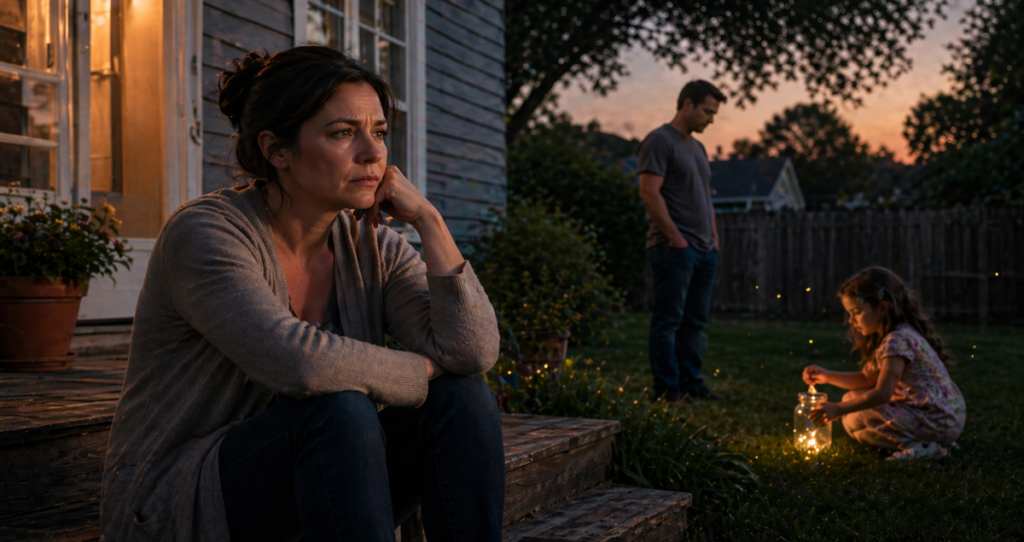
Months later, on a warm June evening exactly one year after the night of the message, Elena sat on her back porch while Sophie chased fireflies in the yard and Marcus stood nearby holding an empty jar.
They were not remarried. They were not even officially reconciled. But they had been attending joint counseling for three months, not to force a happy ending, but to determine whether a new relationship could be built where the old one had collapsed. Sometimes the sessions went badly. Sometimes Elena left furious. Sometimes Marcus said something so honest it hurt them both. There were no guarantees.
Yet there was a difference between the woman she had been a year ago and the woman sitting there now.
A year ago she thought betrayal was the whole story.
Now she understood that betrayal had opened a door into generations of silence, fear, cowardice, performance, and buried truth. She had walked through that door unwillingly, but once inside, she refused to become one more person who pretended damage had no roots.
Sophie ran over, laughing, holding out a blinking firefly in cupped hands. “Look!”
Elena smiled despite herself. Marcus crouched beside their daughter, his face gentler than she remembered it being in many years.
“Let him go,” he told Sophie softly. “He can’t shine if you hold him too tight.”
Sophie opened her hands. The firefly lifted and disappeared into the dusk.
Elena looked at Marcus then.
He glanced up as if he felt it.
For one suspended moment there was no script. Only a man who had done real harm. A woman who had survived it. A child they both loved. A family history no longer buried. And the fragile, difficult possibility that truth, once spoken fully, might still make room for something living to grow.
Not innocence. Never that again.
But something more honest.
Something earned.
Elena did not know what name the future would finally take.
She only knew this: the secret had not destroyed her the way silence was meant to. It had exposed the architecture of pain. It had shown her where the cracks began. And once you see the cracks clearly, you stop calling collapse a surprise.
You start choosing, instead, what can be rebuilt.
That night after Sophie went inside, Marcus stayed by the porch steps while Elena gathered up the empty glasses.
“Thank you for coming,” she said.
He nodded. “Thank you for asking.”
She hesitated, then stepped a little closer.
“Marcus.”
He looked at her.
“This only continues if the truth keeps continuing too.”
His face changed—not with relief, exactly, but with reverence for the cost of what she was offering.
“It will,” he said.
She believed that he meant it.
For now, that was not trust.
But it was the first stone laid in its direction.
And sometimes, after a family has spent years burying what was real, that is where healing begins—not in certainty, not in romance, not even in forgiveness, but in the brave and difficult refusal to hide anymore.