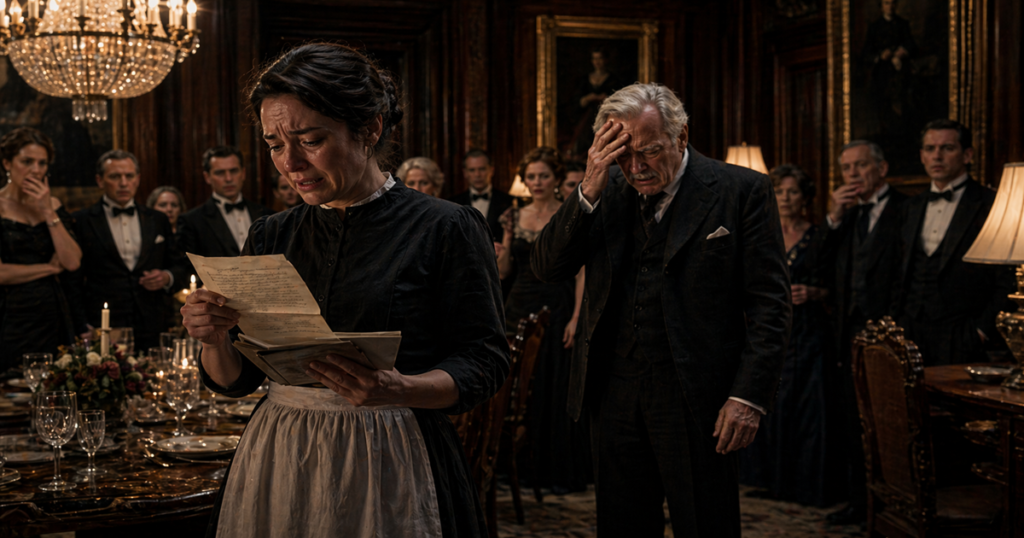
The first thing Elena noticed about wealthy people was how softly they spoke when they wanted to sound kind.
Not kind in a real way. Not the kind that saw another person and made room for them. Not the kind that asked whether you had eaten, whether your feet hurt, whether your mother’s medicine was working, whether your rent had gone up again.
No, wealthy people like the Halstons had another kind of softness. It lived in lowered voices and polished smiles and the careful way they said cruel things so no one could accuse them of being cruel at all.
“Please be more careful, Elena.”
“Try not to stand in the background like that, dear. It’s distracting.”
“Next time, let the guests finish before clearing.”
And, on bad days, when Mr. Halston was in one of his colder moods: “You people always manage to make simple things complicated.”
Elena had worked in the Halston estate for six years, long enough to learn the sound of every floorboard in the west wing, long enough to tell who was coming down the stairs by the rhythm of their steps, long enough to know which glassware Mrs. Halston preferred for charity dinners and which napkins were only for family holidays.
She came before sunrise and often left long after dark. She cleaned, pressed linens, carried trays, dusted picture frames, polished silver, arranged flowers, scrubbed kitchen tile, and once, during a winter storm when half the staff could not make it in, shoveled snow from the front walk in a borrowed coat that did not belong to her.
The mansion stood on a rise above the older part of town, all stone walls, black iron gates, and long windows that reflected the sky like they owned it. The kind of house people slowed down to look at from the road. The kind that made delivery drivers sit straighter in their seats.
Elena had never stopped being impressed by it, but she had stopped being intimidated.
At thirty-four, she no longer believed a large house meant a large heart.
She lived instead in a narrow duplex on Mercer Street with her mother, Rosa, whose arthritis made stairs painful and winter almost unbearable. Their kitchen window stuck in humid weather. Their bathroom sink rattled when the upstairs neighbor ran water. Their heat came late and left early. But their home, small as it was, had laughter when there was reason for laughter and silence that felt human when there was not.
Every Friday, Elena brought bread from the bakery near the bus stop, and Rosa made lentil soup in the dented silver pot they had owned since Elena was a child.
“You look tired,” Rosa said often.
“I am tired,” Elena answered.
“Then sit.”
“I can’t.”
“You say that every day.”
“And every day I’m right.”
Her mother would shake her head, but there was always a smile tucked into the corners of her mouth.
Rosa had cleaned houses too, years ago, before her hands stiffened and her knees gave out. She taught Elena how to remove red wine from linen without leaving a ring, how to polish wood with the grain, how to keep your dignity in rooms where no one offered it to you.
“Work is not shame,” Rosa had said when Elena first took the Halston job. “Never let them confuse your work with your worth.”
Elena held onto that sentence more than she admitted.
The Halston family consisted of Arthur Halston, his wife Vivian, their adult son Graham, who worked in the company downtown, and their daughter Celia, who lived in Boston but came home for holidays and charity galas and once, memorably, for three days after a breakup during which she cried loudly in silk pajamas and ignored everyone who tried to comfort her.
Arthur Halston was the axis around which the house turned.
He was sixty-two, sharp-featured, silver-haired, always impeccably dressed. He built Halston Development from a regional construction firm into a name that carried weight in three states. People called him disciplined, visionary, demanding. Local magazines liked phrases like self-made and relentless.
Elena had another word for him, one she never said aloud.
Hard.
Not loud. Not dramatic. Hard.
Hard in the way he looked through service workers as if eye contact were a luxury. Hard in the way he corrected people when no correction was needed. Hard in the way he could praise charity at a fundraiser and refuse an extra sick day to a housekeeper whose son had pneumonia.
He did not scream. Sometimes Elena thought screaming would have been easier.
A man who screamed revealed himself too quickly.
Arthur Halston preferred control.
The humiliation happened on a Thursday night in October, during one of Vivian Halston’s annual donor dinners for the children’s hospital. The house had been in motion since morning. Florists in the foyer. Caterers in the back courtyard. Extra glassware unpacked. Candles placed. Chairs measured. Place cards adjusted three times because Mrs. Halston decided the mayor should sit two seats closer to the center and one seat farther from a woman she disliked but still invited every year.
By six-thirty, the mansion glowed.
Music drifted from hidden speakers. The dining room table shone under low crystal light. Voices rose and floated from room to room, wrapped in perfume and money.
Elena wore the plain black uniform reserved for formal service nights, her dark hair pinned back, her expression calm. She moved with the other two evening staff through clusters of guests, collecting glasses, replenishing water, carrying trays of hors d’oeuvres the caterers passed off in the side hall.
She knew how to disappear when needed. She had learned it well.
The problem started with a spill that was not hers.
One of the younger servers, a college student new to the rotation, turned too quickly near the library entrance and clipped the corner of a side table. A champagne flute tipped, then another. Pale liquid spilled down a cream runner and onto the polished floor.
The room hushed for a heartbeat.
Elena was closest, so she stepped in automatically, setting down her tray, reaching for the cloth tucked at her waist.
“It’s all right,” she said quietly to the server, who looked pale with panic. “Get another tray. I’ll handle this.”
She knelt, moving quickly, blotting the runner before the liquid spread further.
That should have been the end of it.
But Arthur Halston had been standing only a few feet away, speaking with two board members and a city councilman. Perhaps he had already been irritated. Perhaps he had lost patience with something else entirely. Perhaps men like him simply waited for moments like this, moments where another person was low enough to remind.
Whatever the reason, his voice cut through the room before Elena could stand.
“For heaven’s sake.”
She froze, cloth in hand.
Arthur looked down at her, then slowly around at the faces turning toward them. He smiled, but it was the kind of smile that made a room colder.
“Must we do this now?” he said. “Honestly, Elena, if you’re going to make a mess, at least have the sense not to become part of the entertainment.”
A few guests gave the awkward half-laugh people offer powerful men when they are unsure whether they are expected to laugh.
Elena opened her mouth. “Sir, it wasn’t—”
He lifted a hand, silencing her without touching her.
“Please,” he said, his tone light and cutting at once. “Do not argue in front of guests. Clean it up and remember your place.”
This time the laughter came fuller. Not from everyone. But enough.
Enough for Elena to hear it.
Enough for the younger server to go red and look at the floor.
Enough for Mrs. Halston to glance away instead of intervening.
Enough for Elena to feel heat rush to her face while every instinct in her body told her to become smaller, quieter, less visible, less breakable.
She swallowed.
The cloth in her hand trembled once.
Then she lowered her eyes and said the only thing survival had taught her to say in rooms like that.
“Yes, sir.”
The conversation resumed around her with astonishing speed. Someone made a joke about gala season. Another guest asked where the auction sheets were. Crystal clinked. Music returned to the edges of the room.
But Elena heard none of it clearly after that.
She cleaned the spill. She replaced the runner. She lifted her tray. She moved through the rest of the evening with a face so controlled even she did not recognize it. Twice she caught someone looking at her with pity. Once she heard two women near the powder room whispering.
“So humiliating.”
“Well, these things happen.”
“No, I mean the way he said it.”
“Yes, but still. One has to be professional.”
Professional. Elena nearly laughed.
Professional, she thought, is swallowing your pride because your mother’s prescription refill is due Monday.
Professional is pretending a man did not just strip your dignity for sport while standing beneath a framed photograph of himself donating money to children.
Professional is knowing exactly how much humiliation your life can afford.
By the time the last guests left, it was after eleven.
The caterers packed out through the service entrance. The temporary staff signed out. The house settled into the tired quiet that follows performance.
Vivian Halston had already gone upstairs with a headache. Arthur remained in his study, according to the butler, reviewing something for a board meeting the next day. Graham had gone into town with friends.
Elena should have clocked out at eleven-thirty. Instead, one of the upstairs guest rooms needed a linen replacement after a woman stained the duvet with makeup, and the downstairs powder room trash still had to be collected. It was close to midnight when Elena finally crossed the upstairs east hall carrying a basket of folded hand towels and a stack of dry cleaning Mr. Halston had demanded for the next morning.
The east hall was quieter than the west wing, lined with old family portraits and a series of antique tables Vivian insisted made the hallway feel “historical.” Elena thought they mostly made it harder to dust.
Arthur’s private sitting room stood at the end near the study. Usually she left his things outside if the door was closed. That night, however, it stood slightly open, and a lamp inside was still on.
She knocked once.
No answer.
She knocked again. “Mr. Halston?”
Still nothing.
She hesitated, then pushed the door wider with her shoulder.
The room was empty.
The sitting room smelled faintly of cedar and tobacco, though Vivian hated cigars and Arthur never smoked in the open. A fire had burned low in the grate. On the side table lay an open file folder, a fountain pen, and several envelopes, one of them cream-colored and old enough that the paper had softened at the edges.
Elena set the dry cleaning neatly over the chair back. She placed the folded towels by the adjoining bath.
As she turned to go, the old envelope slipped from the edge of the table and landed near her shoe.
She bent to pick it up.
At first she thought it was unsealed, but when she lifted it she realized the flap had merely come loose with age. Her fingers touched the front, and her breath caught.
Written in dark blue ink, in a careful hand, were the words:
For Elena Marquez — To be given on her twenty-eighth birthday.
She stared at it so long the room seemed to narrow around her.
Her name.
Not Elena the maid. Not Miss Marquez, not staff, not housekeeper.
Just her name.
And not written recently. The ink had faded slightly. The envelope was old.
Very old.
Her first thought was absurd: perhaps there was another Elena.
But no. No one else by that name had worked in the house. Rosa had once mentioned it in passing, amused, that Vivian liked unique names on staff because “they sound less interchangeable.”
Elena’s heart began to pound.
Her twenty-eighth birthday had been six years ago.
Why would a letter addressed to her sit in Arthur Halston’s private room for six years?
She should have left it.
She knew that. Every instinct built from years of service and caution told her to place it back exactly where it had fallen and walk away.
Instead, she looked once toward the open door, once down the empty hall, and slid the paper from the envelope.
The letter was handwritten on thick cream stationery.
The first line made the floor disappear beneath her.
My dearest Elena, if this letter has reached you, then someone in this house has finally chosen truth over fear.
Her hand tightened so hard on the page it crinkled.
She read on.
The letter was signed by Margaret Vale.
The name meant nothing at first.
Then, faintly, a memory surfaced. A photograph in a back hallway years ago, before Vivian redecorated. A young woman beside Arthur, not Vivian, holding a baby wrapped in white. Elena had once dusted that frame before it vanished. When she asked another maid who it was, the woman shrugged and said it must be some relative from before his marriage.
Margaret Vale.
The letter trembled in Elena’s grasp.
My dearest Elena, if this letter has reached you, then someone in this house has finally chosen truth over fear.
You deserve to know who you are. You deserve to know why your mother left with you when you were still small, and why Arthur Halston spent years pretending you did not exist.
Elena stopped reading.
A sharp sound escaped her, half breath, half disbelief.
No.
No.
She read the sentence again, then again, as if the words might rearrange themselves into something less impossible.
Arthur Halston.
Pretending you did not exist.
Her knees weakened. She lowered herself into the nearest chair before she fell.
The rest of the letter came in fragments at first because her mind would not hold all of it at once.
Margaret wrote that she had worked in the Halston household decades earlier when Arthur’s father still ran the family firm from an office above the garage. Rosa, young then, had been hired as kitchen help. Arthur had been charming, ambitious, affectionate in private and cautious in public. He had promised things men like him promised women who had less power and more trust than they should have given.
When Rosa became pregnant, Arthur panicked.
His career was just beginning. The family name mattered. His father was ruthless about appearances. Rosa was dismissed quietly with money and instructions to disappear. Arthur promised he would “make arrangements.”
He married Vivian two years later.
Margaret, Arthur’s cousin, learned the truth only because Rosa came to her once, desperate, after Elena fell ill as a toddler and the money Arthur had promised stopped coming. Margaret confronted him. He admitted the child was his. He refused to acknowledge Elena publicly.
Margaret wrote that she had argued with him for years, on and off, whenever family gatherings forced them together. After her health declined, she wrote this letter and entrusted it to Arthur himself after extracting what she believed was a promise that he would give it to Elena when she turned twenty-eight, “old enough,” Margaret wrote bitterly, “for him to imagine the damage of truth mattered less than the damage of secrecy.”
There was more.
Too much more.
Included with the letter, Margaret wrote, were copies of bank records from a trust Arthur’s father created to protect “potential liabilities” related to private family scandals. One line named Elena Marquez, daughter of Rosa Marquez, beneficiary upon formal acknowledgment or legal determination of paternity.
Formal acknowledgment or legal determination.
Elena read that line three times before her eyes blurred.
At the bottom, Margaret had written one final paragraph.
If Arthur has failed again, then I am sorry beyond language. Your mother may have stayed silent to protect you from shame, or because the world gave her too many reasons to believe no one would listen. But shame does not belong to you. It belongs to the man who benefited from your silence.
Elena sat without moving.
The house seemed impossibly still.
She looked toward the table. Beneath the open file folder lay more papers. With fingers that no longer felt like hers, she lifted them.
Copies of old transfers. Legal notes. A memorandum on trust distribution. A typed statement prepared but unsigned years earlier: I, Arthur James Halston, acknowledge that Elena Marquez is my biological daughter.
Unsigned.
Never sent.
Never spoken.
Never given.
For one suspended moment, the entire architecture of Elena’s life shifted.
The pieces did not fall into place. They broke apart.
All those years her mother refusing to answer certain questions. The way Rosa went quiet whenever Elena asked about her father. The strange tension in her jaw if Arthur Halston’s name came up. The reason Rosa forbade Elena from applying anywhere near the Halston company offices. The reason she nearly fainted, years ago, when Elena came home saying she had found full-time work at the Halston estate and the pay was better than any housecleaning contract in town.
It had not been coincidence.
Her father had humiliated her in front of a room full of strangers.
Her father had watched her polish his floors, carry his laundry, serve his guests.
Her father had told her to remember her place.
She did not hear the footsteps until they were almost at the door.
“Elena?”
She stood so quickly the chair scraped the floor.
Arthur Halston stopped in the doorway.
His eyes moved from her face to the open papers in her hands.
Something rare crossed his expression.
Not anger.
Not first.
Fear.
It lasted only a second.
Then the familiar steel dropped back into place. “What are you doing in here?”
Elena could not speak.
Arthur stepped forward. “Put those down.”
Her mouth finally worked. “My name was on the envelope.”
He went very still.
She held up the letter. “My name was on the envelope.”
His jaw tightened. “You had no right to read private family documents.”
Private family.
The words hit her like a slap.
She laughed then, one sharp, broken sound she could not control. “Private family documents?”
“Elena—”
“No.” Her voice rose, shaky but clear. “No, don’t say my name like that now.”
He glanced toward the hall and lowered his voice. “You are upset. This is not the time.”
“When was the time?” she asked. “When I turned twenty-eight? When I was born? When my mother was sent away? When I served drinks to your guests tonight and you told me to remember my place?”
He stepped closer. “Lower your voice.”
She took one step back instead. “Why?”
His face hardened. “Because whatever you think you understand, you do not know the whole story.”
“Then tell it.”
Silence.
The fire clicked softly in the grate.
Elena stared at him, at the man whose features she had never once tried to compare to her own because it had never occurred to her to do so. Now, in the lamplight, she saw things she wished she did not. The shape of his eyes. The line of the brow. Even the way one corner of his mouth tightened when he was cornered.
He saw her seeing it.
“I intended to handle this,” he said.
She looked down at the unsigned acknowledgment and then back up. “When? Before or after I buried my mother without knowing?”
That landed.
He blinked. “Your mother is—”
“She’s alive,” Elena said, voice shaking. “But she has lived her whole life carrying something you created and then hid. So answer me. Did she know I worked here?”
He gave a minute nod.
Elena closed her eyes.
Of course.
Rosa knew. Rosa knew every time Elena came home tired and complained about Mr. Halston’s impossible standards. She knew every holiday Elena spent ironing his tablecloths. She knew every insult and swallowed it because survival had demanded swallowing everything else first.
“Did you know who I was when you hired me?”
Arthur said nothing.
She stepped forward. “Did you know?”
“Yes.”
The word was barely audible.
Elena’s face changed as if something inside her had collapsed at last. Not with tears. Tears would have been too simple. It was something more frightening than that—a kind of cold astonishment, the death of any remaining excuse.
“You let me work for you,” she said.
His answer came too quickly, as if he had rehearsed it for years. “You needed employment. I made sure you were paid above market rate.”
She stared at him.
He heard himself too late.
Above market rate.
As if money arranged morality. As if better wages transformed degradation into generosity.
“I was your daughter,” Elena said. “Not a payroll problem.”
He looked away first.
That told her more than anything else.
The confrontation might have ended there, in silence and damage, if Graham Halston had not arrived.
“Dad?” His voice came from the hall. “Are you still—”
He stopped in the doorway, taking in Elena’s face, the papers, his father’s expression.
“What happened?”
“No concern of yours,” Arthur said.
Elena almost handed the letter to Graham right then, out of sheer instinct to crack the lie open wider. But something in her resisted the chaos of that moment. Not because Arthur deserved protection. Because she suddenly understood that once the truth moved, it would not stop.
“I’m leaving,” she said.
Arthur straightened. “You will leave those papers here.”
Elena looked at the copies in her hand. “No.”
His voice sharpened. “Those are legal documents.”
“They’re about my life.”
Graham looked between them. “Dad?”
Arthur’s eyes locked on Elena’s. “If you walk out with those documents, there will be consequences.”
For the first time that night, her fear changed shape.
Consequences. The word that had governed the poor for generations. Consequences for speaking. Consequences for asking. Consequences for not smiling while being diminished.
Elena folded the letter carefully and placed it back in the envelope.
Then she met his eyes.
“I think,” she said, “you should be much more worried about yours.”
She walked past both men and out into the hall.
Neither stopped her.
The bus had stopped running by the time she reached the gate. She walked nearly two miles before she realized she was crying. Not graceful tears. Not cinematic ones. The kind that make breathing ugly and vision useless. She stood under a streetlamp near a closed hardware store, clutching her bag to her chest while cold night air burned her throat.
At home, Rosa was awake in the kitchen wearing her robe, a mug of untouched tea cooling beside her.
The moment Elena entered, Rosa looked at her face and knew.
That was its own wound.
Not surprise.
Recognition.
“Elena,” Rosa whispered.
Elena placed the envelope on the table between them.
Her mother sat down slowly, as if her body had aged ten years in one second.
“You knew,” Elena said.
Rosa covered her mouth.
“You knew.”
Tears filled Rosa’s eyes immediately. “I wanted to tell you.”
“When?”
“I don’t know.”
“You don’t know?” Elena’s voice cracked. “I served that man dinner, Mama. I worked in his house. He humiliated me tonight in front of everyone, and you knew who he was.”
Rosa’s shoulders shook. “I was afraid.”
“Of what? That I would hate him?”
“No.” Rosa looked up, raw and old and frightened in a way Elena had never seen. “That he would hurt you the way powerful men hurt people quietly. That he would deny it and make you look like you were begging for something. That you would go to him with hope and come back destroyed.”
Elena stood with both hands braced on the table.
“You should have told me.”
“I know.”
“I had a right to know.”
“I know.”
The repetition made Elena furious. She turned away, pressing her hands to her head. “Then why didn’t you?”
Rosa took a long, unsteady breath. “Because every version of the truth felt cruel.”
The words hung there.
Rosa wiped her face with trembling fingers. “When I was young, I believed him. That was my first mistake. When I was pregnant, he said he would help. Then his father found out and I was dismissed with money folded into an envelope like a charity tip. Margaret tried to help. She was the only one who did. Arthur sent support for a little while, always through someone else, never his own hand. Then less. Then almost nothing.”
Her voice dropped.
“I was ashamed, Elena. Not because of you. Never because of you. Because I had been foolish, and because I knew exactly what people would say if I spoke. That I was trying to trap him. That girls like me invent stories about men like him.”
Elena said nothing.
Rosa looked toward the old envelope. “When you got the Halston job, I wanted to forbid it. But we needed the money. My medicine had gone up. Rent was due. And I told myself maybe he had changed, maybe he would do the right thing if he saw you. Maybe he would have some human decency left.”
She laughed bitterly through tears. “Instead I asked you every day how work was, as if I could protect you by listening.”
Elena sank into the opposite chair.
The kitchen clock ticked too loudly.
“Why didn’t Margaret send this directly?”
“She was sick. She said she had leverage with him because she was family. She thought if the letter came from him, it would mean he had finally acknowledged you. Then she died. After that…” Rosa shook her head. “I assumed he destroyed it.”
“He kept it.”
Rosa closed her eyes. “Of course he did. Men like that keep proof of everything. They just do not call it proof. They call it records.”
They sat until nearly dawn, speaking in fragments, then in waves. Elena asked questions she had never thought to ask. Rosa answered what she could and admitted what she could not bear to revisit. By morning the story had shape, but not peace.
At eight-thirty, Elena called the estate and said she would not be coming in.
At eight-thirty-two, the house manager called back twice.
At nine-fifteen, Arthur Halston called from a private number.
She let it ring out.
By ten, Graham Halston stood at her front door.
Rosa saw him first through the window and stiffened. Elena almost refused to answer. But something in Graham’s posture—hands open, shoulders tight, no arrogance in sight—made her unlatch the chain.
He looked different outside the mansion. Younger. Less composed. More like a man caught in a storm he had not expected.
“I’m not here for him,” he said immediately.
Elena crossed her arms. “Then why are you here?”
He swallowed. “Because I asked questions this morning, and my mother finally told me enough to know he’s been lying my whole life too.”
Rosa remained visible in the hallway behind Elena, silent and watchful.
Graham glanced at her, then back at Elena. “Can I come in for five minutes? If you want me to leave after that, I will.”
Elena should have said no.
Instead she stepped aside.
He sat at the small kitchen table looking almost absurd in his expensive coat, knees too close to the cabinet under the sink, one hand pressed flat against the wood as though grounding himself.
“I didn’t know,” he said. “I need you to believe that.”
Elena did not answer.
“My mother said there had been… a situation before they married. She knew your mother existed. She says she never knew you were working at the house until after you were hired. Dad told her it was an unfortunate coincidence and that it was better not to ‘disturb settled lives.’” Graham gave a humorless laugh. “That sounds like him.”
Rosa turned away and busied herself unnecessarily with cups.
Graham continued. “I asked if he knew who you were when he hired you. She didn’t answer. Which told me enough.”
Elena studied him. “And what do you want from me?”
He looked at her directly. “Nothing. I came because if I were you, I’d assume everyone in that house was against me. I wanted you to know at least one person isn’t.”
“You expect gratitude for that?”
“No.” He shook his head. “I expect anger. You have every right.”
She leaned back. “Then hear this clearly. I am not interested in private apologies, quiet arrangements, or being handled.”
“I know.”
“Do you?”
His gaze flicked briefly to the envelope on the counter, then back. “More than I did yesterday.”
He reached into his coat pocket and took out a business card, placing it on the table. Not his father’s company card. A law firm.
“My college roommate works there. Family litigation. Quiet, competent, not afraid of wealthy men with reputations to protect. I already called him and said a woman may need advice urgently. He won’t know your name unless you contact him. I did not tell him details.”
Elena looked at the card but did not touch it.
“Why would you do that?” she asked.
Graham’s face tightened. “Because last night I watched my father look at you like a threat instead of a person. And I realized he’s been building our family story on top of your erased one. I don’t know what to do with that yet. But I know silence would make me more like him.”
He stood.
At the door, he paused. “For what it’s worth, the guests noticed what he did to you. Not all of them approved.”
Elena almost laughed. “That’s not worth much.”
He accepted that with a small nod. “Probably not.”
Then he left.
By afternoon, Elena had called the lawyer.
By evening, Arthur’s lawyer had called first.
That did not surprise her. Men like Arthur always moved quickly when control began to slip.
The caller introduced herself politely and suggested a “private conversation to resolve misunderstandings.” She spoke of discretion, emotional complexity, unfortunate historical circumstances, and the danger of sensationalizing family matters.
Elena listened until the woman finished.
Then she said, “Tell Mr. Halston I spent six years being discreet for free.”
She hung up.
The legal process began with paternity testing, though the old documents already carried enough weight to make Arthur uneasy. He delayed, objected, pushed for confidentiality clauses before disclosure, framed every step as concern for “all parties involved.” Elena’s lawyer, Dana Pierce, who was barely forty and spoke with the calm precision of someone who enjoyed dismantling polished men, refused to let process become a burial ground.
“He has two instincts,” Dana told Elena during their second meeting. “Deny until denial looks foolish, then offer money in exchange for silence. Your job is to decide what you actually want, because those are not the same thing.”
They sat in Dana’s office overlooking downtown, where the windows were clean but the furniture practical and no one tried to impress anyone.
“What if I don’t know?” Elena asked.
Dana folded her hands. “Then start with what you do know.”
Elena looked down. “I know I don’t want him to buy his way out of shame.”
“Good.”
“I know my mother should never have had to carry this alone.”
“Good.”
“I know he should not be allowed to pretend I appeared out of nowhere the day this became inconvenient.”
Dana nodded once. “Also good.”
Elena exhaled shakily. “I don’t know if I want public revenge.”
Dana was quiet for a moment. “Most people who’ve been humiliated think they want revenge. What they often want is acknowledgment, accountability, and a world where the person who hurt them can no longer control the narrative.”
That settled somewhere deep.
“Yes,” Elena said softly. “That.”
The paternity result came back three weeks later.
A match.
Ninety-nine point nine nine percent.
Legally decisive. Emotionally devastating in a way proof always is, even when it confirms what you already know.
Arthur requested another private meeting.
This time, Elena agreed.
Not because he deserved it. Because she wanted to look at him once more when the lie was no longer sheltering him.
The meeting took place in Dana’s conference room. Arthur arrived with counsel, wearing a charcoal suit and the expression of a man determined to appear above the circumstances. Vivian did not come. Graham did, sitting quietly beside the far wall, uninvited by his father and unashamed of that fact.
Arthur’s lawyer began with formalities. Dana cut through them.
“My client has received the test results,” Dana said. “Unless Mr. Halston intends to challenge accredited science, we can stop pretending uncertainty exists.”
Arthur looked at Elena.
“I am prepared,” he said, “to provide substantial financial compensation, retroactive support, and a trust arrangement that ensures long-term stability.”
Elena said nothing.
He continued. “I regret that the matter was not addressed earlier with more sensitivity.”
Dana’s eyebrow lifted almost imperceptibly.
More sensitivity.
Not honesty. Not courage. Sensitivity.
Elena leaned forward at last. “Do you regret it because it was wrong, or because it can now be proved?”
Arthur’s jaw tightened. “This does not need to become theatrical.”
“Theatrical?” She almost smiled. “You humiliated me in front of your guests. You let me work in your house knowing exactly who I was. You watched me disappear every day and said nothing. If this feels theatrical now, perhaps that is because the audience has changed.”
His lawyer shifted in her seat.
Arthur inhaled carefully. “I made mistakes.”
“Mistakes are forgetting an appointment,” Elena said. “This was a choice repeated over decades.”
For the first time, a flicker of anger broke through his control. “You have no idea what pressures existed then.”
Elena’s answer came without force, which made it sharper. “I know exactly which person paid for them.”
Silence.
Graham looked down.
Dana slid a document across the table. “My client is not interested in hush money. She will consider settlement only if it includes formal legal acknowledgment, public correction of employment records, compensation for emotional damages, retroactive financial restitution, and a written statement of truth.”
Arthur stared at the paper. “Public correction?”
“Yes,” Dana said. “Your household employed your biological daughter in a service position while concealing her status. That fact materially shaped the power imbalance and the humiliation she suffered.”
His face darkened. “This could damage my company.”
Elena looked at him steadily. “Now you understand how consequences work.”
What destroyed Arthur Halston was not one dramatic explosion. It was worse.
It was sequence.
First, the settlement negotiations leaked—not the details, but the existence of a paternity dispute involving a household employee. Then a local reporter, tipped off by someone Elena never identified and Dana never asked about, requested comment from Halston Development. Arthur declined. The reporter kept digging.
Next came the donor dinner witness.
A woman on the hospital board, one of those polished guests who had laughed too late and regretted it too long, gave a statement off the record, then on it. She described what Arthur had said to Elena that night. Another guest confirmed. Then the younger server, shaking but determined, admitted the spill had been his.
The story changed shape in public.
It was no longer only about a secret daughter.
It was about power, class, exploitation, and the private entitlement behind public philanthropy.
Local papers picked it up first. Then regional outlets. Old stories resurfaced: employee complaints, quiet settlements, patterns of intimidation masked as “strict management culture.” Halston Development’s board called an emergency meeting. Vivian withdrew from two charity committees citing “family health matters.” Donors began distancing themselves. A city contract under review was paused pending ethics questions.
Arthur did not go to prison. Real life is often less satisfying than fiction in that way.
But he lost the thing men like him value almost as much as money.
Control over how he was seen.
At the heart of nearly every article was one detail people could not stop repeating:
The maid he humiliated was his own daughter.
The sentence moved through town like weather.
Elena hated being turned into a headline. She hated strangers discussing her pain over coffee. She hated the photos they used—one of Arthur at a podium, one of the Halston mansion gates, one grainy shot of her leaving Dana’s office with her head down as if sorrow itself could be photographed and sold.
But she also understood something difficult and liberating:
For the first time, secrecy was costing him more than it cost her.
Rosa struggled through those weeks. She cried often, slept badly, and apologized so many times Elena finally held her face in both hands and said, “No more. We go forward now.”
Some evenings they sat together in the kitchen without speaking. Some evenings they spoke until midnight about things they had buried for years—Rosa’s youth, Elena’s childhood, the strange wounds left by absent men and the stronger ones left by present lies.
One Sunday, Graham came by with groceries unasked and left them on the porch because Rosa still did not want to make small talk with anyone carrying the Halston name. Elena appreciated the tact.
Weeks later, when the legal acknowledgment was finalized, Arthur signed because the alternatives had narrowed.
He signed a statement admitting paternity.
He signed restitution terms.
He signed an apology written under legal review that was cleaner than truth and still more than he had ever intended to give.
What he did not sign was forgiveness.
That remained unavailable.
The final meeting between Arthur and Elena happened in private at his request, after the papers were filed and before the public statement was released. Dana advised against it. Elena went anyway.
Not alone—Dana waited outside in the reception area—but alone enough for what needed saying.
Arthur looked older than he had only a month earlier. Not broken. Men like him rarely broke where others could see. But diminished, yes. There was strain at the mouth now. A kind of exhaustion beneath the eyes that expensive grooming could not hide.
“I wanted to see you without lawyers,” he said.
Elena remained standing. “You’ve seen me without lawyers for six years.”
A flicker passed over his face. Shame, perhaps, though it was too late and too guarded to trust.
“I was wrong,” he said.
She waited.
He seemed to expect the sentence alone might do something. When it did not, he continued.
“I told myself many things over the years. That acknowledging you would create scandal. That it would ruin my marriage, damage my children, destroy opportunities I had built. Then later I told myself enough time had passed and it would only reopen pain. I believed…” He stopped, as if hearing the poverty of his own justifications at last. “I believed delay was less cruel than disruption.”
Elena looked at him for a long moment. “That is the language of people who choose their comfort and call it mercy.”
He lowered his eyes.
For the first time since she had known him, silence seemed to belong to her, not him.
“I spent years wondering what kind of man my father might have been,” she said. “I imagined maybe he was dead. Maybe he was weak. Maybe he was frightened. I imagined all kinds of ordinary failures because ordinary failures are easier to forgive.”
She took a breath.
“The truth is harder. My father was not absent because he couldn’t find me. He was absent because he preferred a life where I did not complicate his reflection.”
He flinched.
Good, she thought, and was surprised by the steadiness of it.
He looked up at last. “What do you want from me now?”
It was an honest question, perhaps the first he had ever asked her.
Elena considered it.
Not the money; that was justice, not desire.
Not revenge; that had never healed anyone.
Not even remorse, though she hoped it would keep him company.
What she wanted was simpler and deeper.
“Nothing that should have to be asked,” she said.
She turned to leave.
At the door, she paused. “And for the record, I always knew my place. I was just wrong about yours.”
Then she walked out.
The public statement was released the following week.
It did not read like blood. It read like law and damage control and polished regret. But buried inside the language were facts Arthur could no longer erase. Elena Marquez was acknowledged as his biological daughter. Past failures were admitted. The company announced Arthur Halston would step down from several public-facing roles while “family matters” were addressed.
The newspapers were not gentle.
Neither was the internet.
Elena tried not to read too much, but certain headlines found her anyway.
Maid’s Letter Exposes Developer’s Secret Daughter Scandal
Philanthropist Accused of Exploiting Unknown Daughter as Household Staff
Halston Fallout Deepens After Witnesses Describe Public Humiliation
There was ugliness too. People always rushed in with opinions. Some accused her of chasing money. Some blamed Rosa. Some suggested the whole thing was timed for leverage.
Dana warned her in advance.
“When powerful men fall,” she said, “there is always a crowd ready to explain why the woman should have endured more quietly.”
Still, there was support from unexpected places.
Former household staff wrote letters. One woman who had worked in the kitchen twenty years earlier contacted Rosa and admitted she had suspected something from the way Arthur watched Elena as a child at a church fundraiser, “not with love,” she wrote, “but with recognition.” A hospital donor sent a note apologizing for laughing that night. The younger server came in person, so embarrassed he could barely speak, and Elena, seeing how young he was and how guilty, told him firmly that he did not carry the weight of what a grown man had chosen to do.
The greatest surprise came from Vivian.
She arrived one rainy afternoon alone, dressed plainly, no pearls, no driver waiting visibly out front. Elena almost did not let her in. Rosa nearly closed the door on her.
But Vivian stood on the step, wet at the shoulders, looking less like a social hostess than a woman who had finally run out of mirrors.
“I am not here to defend him,” she said.
That bought her five minutes.
They sat in the small living room. Vivian held her handbag in both hands like armor.
“I knew about your mother,” she said. “I did not know everything. Not at first. And later… I chose not to ask enough. That is its own guilt.”
Elena did not soften.
Vivian nodded, as though she had not expected her to. “When I saw you in the house these last years, I believed what he told me—that you were simply a capable employee and that any resemblance I thought I noticed was imagination. Then after you were hired, I learned the truth in pieces. I told myself it was too late, too complicated, too destructive to say anything.”
She looked down.
“I benefited from that silence. I will not pretend otherwise.”
Rosa spoke then, cold and clear. “You watched my daughter serve you.”
Vivian closed her eyes briefly. “Yes.”
The room held the answer like a stain.
She reached into her bag and withdrew a small photo album. “These belonged to Margaret. She left them to me years ago. I think they belong with Elena now.”
After she left, Elena opened the album slowly.
Inside were photographs from before her birth. Margaret as a young woman laughing in a garden. Rosa in an apron, younger than Elena was now, beautiful and unsuspecting. Arthur in shirtsleeves beside the summerhouse, one arm around Rosa’s waist, looking not kind exactly but easy in the confidence of a man before consequence.
At the back was one more picture Elena had never seen: herself as a baby, perhaps six months old, seated in Rosa’s lap on a park bench. Someone had written on the back in Margaret’s hand:
She has his eyes, but thank God she has her mother’s soul.
Elena sat with that photograph for a long time.
Winter settled in.
The legal matter concluded. The trust funds that had existed as contingency were released under court supervision. Elena used part of the money immediately to pay off Rosa’s medical debt, repair the leaking roof over their kitchen, and move them into a modest but warmer home with only three steps at the entrance instead of nine.
She resigned formally from the Halston estate, though by then it was symbolic. The house had already reduced staff, and rumors said parts of it might be sold.
Dana suggested Elena consider civil action beyond the settlement. Elena declined. Not because the case lacked merit. Because she was tired, and because there are moments when continuing the fight begins to preserve the wound instead of healing it.
Instead, she took classes in bookkeeping at the community college in the evenings and, with Graham’s quiet help but not his money, found a position managing operations for a small hospitality company run by a woman who interviewed Elena for an hour and then said, “Anyone who has run a mansion without public credit can run three boutique inns.”
It was the first job offer Elena ever accepted without feeling grateful for mere acceptance.
Months later, when spring returned, she stood outside one of those inns watching new staff arrive for training. A young housekeeper, nervous and eager, apologized three times for a mistake before Elena gently stopped her.
“Take a breath,” she said. “This is work, not judgment.”
The woman blinked, surprised, then smiled.
That evening, Elena went home to find Rosa on the porch with a blanket over her knees and a bowl of cut oranges in her lap. The air smelled like damp grass and distant rain.
“You look lighter,” Rosa said.
Elena sat beside her. “Do I?”
“Yes.”
Elena leaned back and watched the sky fade.
Lighter was not the same as untouched.
There were still nights she woke with her pulse racing from dreams of that dining room, that laughter, that sentence—remember your place. There were still moments when she caught her reflection unexpectedly and saw traces of Arthur in it, enough to sting. There were still people in town who stared a little too long, connecting her face to headlines.
But the story no longer felt like it belonged to him.
That was the difference.
Weeks later, Graham invited Elena for coffee. She almost refused out of habit. Then curiosity won.
They met in a quiet place across town where no one bothered them.
He looked less polished now, more deliberate. “I resigned from the company,” he told her after they ordered.
She raised an eyebrow. “That seems dramatic.”
He smiled faintly. “Maybe. Or maybe I got tired of building things on foundations I no longer respected.”
They spoke awkwardly at first, then easier. Not like siblings in any sentimental sense. They had no shared childhood, no common holidays, no language of intimacy. But they shared damage, and sometimes that is its own beginning.
Before they parted, Graham said, “I know we don’t know what each other is supposed to be now.”
Elena stirred the last of her coffee. “Maybe we don’t have to decide all at once.”
He nodded. “That sounds healthier than anything our family has ever done.”
She laughed then, genuinely.
When she told Rosa later, her mother smiled in cautious approval. “Maybe something decent can still grow from ugly soil,” she said.
“Maybe,” Elena answered.
The last time Elena saw Arthur Halston was nearly a year after the letter.
He was leaving a courthouse downtown after a hearing related to another corporate matter. Not criminal. Money, contracts, reputation—the usual machinery. He moved slower now, accompanied by an assistant instead of an entourage.
He saw her across the plaza and stopped.
For a moment, neither moved.
Then he approached.
No cameras. No lawyers. No audience.
He looked at her as if measuring whether he had any right to speak. At least he had learned enough to hesitate.
“Elena,” he said.
She waited.
“I heard your mother is doing better.”
“She is.”
He nodded. “And your work?”
“I’m happy there.”
A small silence.
“I’m glad,” he said.
This time she believed he meant it, though meaning it late remained its own tragedy.
He seemed about to say more, then stopped. Age had not made him gentle. It had only removed some of the illusions that once protected him.
Finally he said, “Margaret always said truth waits longer than pride can afford.”
Elena almost smiled. “She seems to have known you well.”
He accepted the wound.
There was nothing else to do with it.
As he turned to go, she felt no triumph. Not exactly. Destruction was too simple a word for what had happened to him. The letter had not ruined him in a single moment. It had done something more precise.
It had forced what he buried to stand in daylight.
That was enough.
She walked on through the plaza toward her own day, toward a life that had not become easier by magic, not become perfect, not become free from all grief. But it had become hers in a way it had never been before.
And sometimes that is the real ending.
Not when the man who harmed you loses everything.
But when he loses the power to define what your story means.