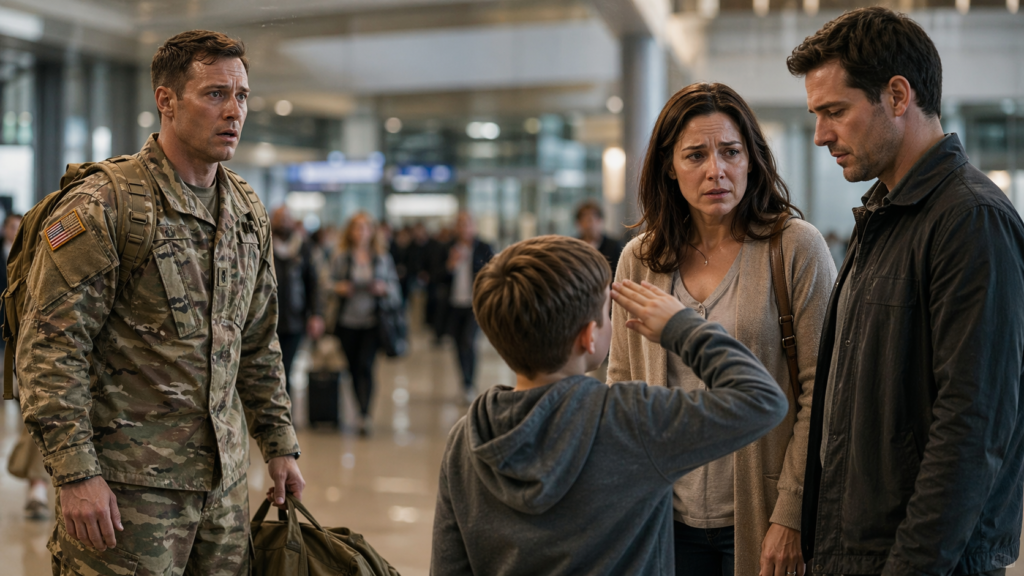
Noah Carter had imagined the reunion so many times that by the end of his deployment, the memory in his head felt more real than the one he was returning to.
In every version, the airport was bright and noisy, but none of that mattered because he would only see two faces. His wife, Leah, who would try not to cry and fail the second she saw him. And Eli, their five-year-old son, who would wiggle out of her grip, run full speed across the polished floor, and slam into Noah’s legs with the kind of force only little boys had.
Noah would laugh, scoop him up, bury his face in his son’s neck, and breathe in the smell of home.
That was how it was supposed to happen.
He had lived inside that scene during nights so long they felt endless. He had carried it through dust, heat, exhaustion, and the low dull fear that never fully left his body. When other men in his unit talked about what they missed, Noah talked about ordinary things. Pancakes on Saturday mornings. Leah’s hair tied up while she rinsed dishes at the sink. Eli’s toy trucks lined up on the living room rug like a traffic jam only a child could understand.
He had a picture of Eli in the inside pocket of his bag. In it, his son was four, missing his front tooth, grinning so hard his eyes nearly disappeared. Leah had sent the photo three months before. Along with it came a message: He misses you more than he knows how to say.
Noah had read that sentence until the screen went dim.
On the flight home, he sat by the window and slept in fragments. Every time he woke, his shoulders tightened before his mind caught up and reminded him he was safe. The man beside him, another soldier heading home two states over, had spent the last hour talking about what meal he wanted first. Burgers. Beer. His own mattress. Noah nodded at the right times, but his mind was somewhere else.
At one point he took out his phone and looked again at the most recent pictures Leah had sent. Eli in a blue T-shirt holding a paper airplane. Eli asleep on the couch with one sock on and one sock gone. Eli at preschool picture day looking stiff and serious in a tiny button-down shirt.
Noah smiled, but something in the photos pulled at him.
Eli had gotten older in a way Noah had not fully let himself accept. Not taller. Not just that. More settled somehow. A little more self-contained. The open, careless baby softness was gone from his face. It made Noah proud and hurt him at the same time.
When the plane landed, his stomach tightened like he was twenty again and about to step into something that mattered too much.
The airport was crowded with reunions already happening in every direction. Children squealing. Couples crying. Balloons bouncing above handmade signs. A woman in scrubs jumped into a man’s arms so hard he staggered backward and laughed through tears. A little girl in pigtails held up a poster that read WELCOME HOME DADDY in purple glitter.
Noah adjusted the strap of his duffel and scanned the crowd.
Then he saw Leah.
She stood near one of the metal pillars in a cream sweater and jeans, one hand resting on Eli’s shoulder. Her hair was longer than when he had left, and for a second that was all he noticed, that and how tired she looked. Not older exactly. Just worn thin in some private way. Beautiful, but strained around the eyes.
Eli stood pressed against her side.
And beside them was a man Noah did not know.
He was in his mid-thirties, maybe, with dark hair and a dark jacket. Nothing about him was unusual, which somehow made him worse. He wasn’t standing like a stranger who had simply accompanied them. He stood like someone who had been there long enough to stop thinking about where to place his hands. Comfortable. Familiar. Close.
Noah slowed without meaning to.
Leah saw him first. Her hand flew to her mouth. Tears filled her eyes instantly. She whispered something Noah could not hear and squeezed Eli’s shoulder.
Noah smiled. He lifted one hand.
Leah’s face folded with emotion, and she started toward him. Noah dropped his bag and met her halfway. When she reached him, she collided with his chest and clung to him so tightly his breath left in a broken sound. He held her with both arms and closed his eyes.
She was real.
Warm.
Shaking.
“I missed you,” she whispered.
“I’m here,” he said, the words coming rougher than he expected. “I’m here.”
When she pulled back, she was crying openly. Noah wiped under one of her eyes with his thumb. Then he looked past her to Eli.
His son had not moved.
Noah laughed softly, trying to lighten the sudden ache in his ribs. “Hey, buddy.”
Eli stared.
Noah crouched, knees popping in protest. “Come here.”
Eli took one step forward. His fingers twisted in the hem of his shirt. His eyes moved over Noah’s face as if checking it against something in his memory.
“It’s Daddy,” Leah said gently, her voice too careful.
Noah felt that word land strangely. Not wrong. Just fragile.
He opened his arms wider. “I missed you like crazy.”
Eli looked at him. Then looked away.
Not just away.
Up.
Toward the man standing quietly beside Leah.
Noah turned his head.
The man gave a tight, awkward smile, as if suddenly wishing he could disappear.
And then Eli lifted his tiny hand to his forehead and gave him a neat little salute.
The kind Noah had taught him in video calls months ago.
The kind Eli had once done for the camera while shouting, “For Daddy!”
Noah’s smile stayed on his face because he could not seem to move it. But something inside him dropped so fast it almost made him dizzy.
Leah went pale.
The stranger’s expression crumpled into embarrassment. “Eli—”
But Eli was already beaming shyly up at him, proud of himself.
Noah rose slowly to his feet.
He looked at Leah.
Her mouth opened, but no sound came out for a second. Then she swallowed. “Noah… this is Ben.”
Ben stepped forward half a pace and offered his hand. “I’m sorry. I should probably—”
Noah looked at the hand, then at Ben’s face, then back at Eli.
“Who is he?” Noah asked.
Nobody answered fast enough.
The airport noise rushed back in around them. Suitcases rolling. Announcements overhead. The ordinary world continuing with complete indifference to the fact that Noah’s chest felt split down the middle.
Leah rubbed Eli’s back. “Can we please not do this here?”
Noah laughed once, not because anything was funny but because he needed to make a sound that was not the one threatening to come out of him. “I just got home, Leah. My son saluted another man.”
Ben lowered his hand.
Eli’s smile disappeared. He looked between the adults, confused.
Leah’s voice dropped. “Noah, please.”
Noah looked at his son again. Eli was not running into Ben’s arms. He was not calling him Dad. He was just standing there, unsure and watchful and small.
That should have comforted Noah.
It did not.
What comforted him, if anything, was the expression on Ben’s face. Ben did not look smug. He did not look possessive. He looked miserable.
Noah picked up his duffel.
“Let’s go home,” he said.
The drive was the longest forty minutes of Noah’s life.
Leah drove. Eli sat in the back in his booster seat, hugging a stuffed dog Noah did not recognize. Ben was in a separate car, Noah learned, and was heading back to his apartment. That should have eased something in Noah, but it did not.
Noah sat in the passenger seat, staring out the window at roads he had driven hundreds of times. Everything looked slightly off, like a movie set built from memory. The gas station on Elm had a different sign. The diner had been repainted. A pharmacy where a hardware store used to be.
Leah kept glancing at him, then back at the road. Twice she opened her mouth to speak. Twice she stopped.
Finally Noah said, “You want to tell me who Ben is?”
Leah tightened both hands on the wheel. “He’s my brother’s friend from the fire department.”
Noah looked at her.
She kept going. “After Eli had that panic episode at school in October, the counselor suggested something called routine reinforcement. Kids with separation stress can attach to a person who makes them feel safe during transition points. Ben started helping when—”
“When what?”
“When I couldn’t be in three places at once,” she said, and there was steel under the exhaustion now. “When Eli started refusing to get out of the car at school. When he had nightmares. When he stopped sleeping through the night. When he got into fights because another kid said military dads don’t come back sometimes.”
Noah went still.
Leah’s eyes shone, but she kept them on the road. “I didn’t tell you all of it because you were deployed and already carrying enough. I kept thinking I’d fix it before you came home.”
A hot, defensive answer rose in Noah’s throat and died there.
He turned in his seat and looked at Eli through the gap between the front seats. His son was staring out the window, thumb rubbing one ear of the stuffed dog.
“Why would he salute Ben?” Noah asked quietly.
Leah’s voice broke on the first word. “Because Ben used to pick him up and say, ‘Show me how Daddy salutes.’ It made him smile when nothing else did.”
The answer was so simple it hurt more than anything complicated would have.
Noah leaned back and shut his eyes.
He had spent months preparing for betrayal because that was easier to picture than replacement by accident. Easier to be angry than to imagine his absence becoming a shape someone else had to help his family carry.
When they got home, the porch light was on.
Noah had thought stepping back into the house would feel triumphant. Instead it felt cautious, almost formal, as if he were entering a place that had kept going without asking permission.
Inside, his boots sounded too heavy on the hardwood floors. The living room was cleaner than usual. A new lamp sat near the couch. Eli’s drawings covered one side of the refrigerator in careful rows. Noah scanned them quickly, searching for some evidence of himself. He found it in a stick figure with a square body labeled DAD in crooked green letters.
He swallowed hard.
Leah knelt in front of Eli. “Do you want to show Daddy your room?”
Eli pressed closer to her.
Noah felt the flinch like a blow he deserved and still couldn’t absorb.
“It’s okay,” Leah said to both of them.
Noah set down his bag. “Maybe later.”
Leah nodded with visible relief.
That hurt too.
They ordered takeout because there was no food in the fridge that made sense for a homecoming. Noah barely tasted his meal. Eli talked a little, mostly to Leah, about a classroom pet named Pickles and a boy named Mason who cheated at memory games. Noah listened greedily, soaking up every detail of his son’s voice.
When Noah asked him a direct question, Eli answered politely but briefly, like a child responding to a teacher he didn’t know well.
After dinner, Leah gave Eli his bath and bedtime routine while Noah stood in the hallway feeling like a guest who had arrived too late. At one point Eli laughed at something Leah said, and Noah closed his eyes because the sound was both beautiful and unbearable.
When Leah came downstairs, she found him sitting at the kitchen table in the dark.
Only the stove light was on.
She sat across from him without speaking.
For a while the house was silent except for the soft hum of the refrigerator.
Then Noah said, “Did you sleep with him?”
Leah’s eyes closed.
The shame that flashed through him was immediate, but the question had been living in his throat since the airport and had forced its way out before he could stop it.
“No,” she said. “Never.”
He searched her face.
She met his eyes without flinching. “No.”
He nodded once.
“Did you want to?” he asked, quieter.
Leah stared at the tabletop. “Sometimes I wanted not to be alone. That’s not the same thing.”
The honesty of it hit him harder than denial would have.
Noah looked down at his hands. They were scarred in ways he had stopped noticing. Dry knuckles. A pale mark near his thumb. Tiny reminders of places Leah had not seen.
“I kept you at a distance,” he said.
Leah laughed once, bitter and exhausted. “You think?”
He winced.
She pressed her fingers to her eyes. “I know why, Noah. I know you were trying to protect me. But every time I asked how you were, you said ‘fine.’ Every time Eli cried on video call and asked when you were coming home, you smiled like it didn’t hurt you. Do you know what that does to a child? To a wife? You become a picture on a screen everyone is careful not to upset.”
Noah had no defense against that because it was true.
She let out a shaky breath. “Ben helped. That’s all. He picked Eli up from school when I was stuck at the hospital with my mom. He came over when Eli locked himself in the bathroom because a helicopter flew over the house. He taught him breathing exercises. He sat with him through two panic attacks. He never tried to take your place.”
“Looked like he had one,” Noah said before he could stop himself.
Leah’s eyes flashed. “No. It looked like my son survived your absence the best way he could.”
The words landed hard and clean.
Noah bowed his head.
Upstairs, a floorboard creaked.
Neither of them moved.
Finally Leah spoke again, softer. “You have every right to be hurt. But if you make Ben the villain because you’re ashamed of what you missed, you’ll lose sight of who really needs you now.”
Noah sat there long after Leah went to bed.
At midnight he climbed the stairs and paused outside Eli’s room. The door was cracked open. Moonlight lay across the rug in a pale rectangle.
Eli was asleep on his side, one hand tucked under his cheek, the stuffed dog pinned under his arm. Noah stepped inside quietly and stood over the bed.
Children changed fastest in sleep. Noah had forgotten that. Awake, Eli still resembled the little boy from Noah’s photos. Sleeping, he looked older and more delicate at the same time. His lashes rested against his cheeks. His hair curled slightly at the back where it had grown longer. His mouth was parted.
Noah knelt beside the bed.
“I’m sorry,” he whispered, though he knew Eli couldn’t hear him. Or maybe he hoped he could.
The next morning, Noah woke before sunrise from a dream he could not fully remember, only the feeling of being unable to reach something important while everyone else moved farther away.
For a few seconds he forgot where he was. Then he saw the framed wedding photo on the dresser and remembered.
Leah was already downstairs.
He found her in the kitchen making coffee. Her shoulders were tense, as if braced for another impact.
“Morning,” he said.
She looked up. “Morning.”
They stood there like polite strangers.
Noah cleared his throat. “I want to meet Ben. Properly.”
Suspicion flickered across her face, followed by cautious relief. “Okay.”
“And I want the truth. All of it.”
She nodded. “Okay.”
Eli came downstairs in dinosaur pajamas and froze when he saw Noah at the table.
Noah smiled carefully. “Hey.”
“Hi,” Eli said.
“Can I pour your cereal?”
Eli looked at Leah.
Leah’s heart seemed to stop in her chest before she said lightly, “You can answer Daddy.”
Eli hesitated. Then, barely audible, “Okay.”
It was not much.
To Noah, it felt like a door opening half an inch.
Over the next hour he learned more than he had in months of brief, guarded phone calls.
Eli had started wetting the bed again two weeks after Noah left.
He had become frightened of loud noises.
He refused to wear the little camouflage backpack Noah had sent because a classmate said soldiers wore camo when they got shot at.
He had once waited by the front window for three hours after Leah accidentally told him Noah might call that night, then cried himself sick when the signal failed and the call never came.
Noah sat perfectly still while Leah spoke, because any movement felt dangerous.
“Why didn’t you tell me?” he asked when she finished.
“Because you sounded so tired every time we talked,” she said. “Because I didn’t know how to say, ‘Your son is coming apart and I can’t hold him together by myself’ without making you feel helpless over there.”
“I was helpless.”
“I know.”
That was the worst part. She knew. He knew. And still the distance had remained, heavy and unchangeable.
Ben came by that afternoon.
Noah almost canceled. Pride fought with reason all morning, and pride nearly won. But when he looked at Eli—tracing circles on the coffee table, checking the window every few minutes without seeming to know he was doing it—Noah understood that this meeting was not about dignity. It was about whether he was willing to learn the emotional terrain of the family he had returned to.
Ben arrived carrying a small model airplane kit.
“For Eli,” he said, standing awkwardly at the door. “I can leave it and go.”
Noah studied him.
Ben held his gaze, uncomfortable but steady. There was no smugness in him, no challenge. Just concern and a kind of practiced humility.
“Come in,” Noah said.
Eli lit up when he saw Ben, then immediately looked guilty for lighting up at all.
That expression nearly broke Noah.
Ben noticed it too. He crouched to Eli’s level. “Hey, buddy. Guess what? Your dad’s the airplane expert today. I just brought the supplies.”
Noah glanced at him sharply.
Ben stood. “Mind if we talk outside for a minute?”
They went to the back porch.
For a moment neither man spoke.
Then Ben said, “I need you to know I never wanted that airport moment to happen.”
Noah folded his arms. “But it did.”
“Yeah. It did.”
Noah watched a squirrel run along the fence and hated that something so normal still existed.
Ben exhaled slowly. “Leah told you about school pickup, the panic attacks, all that?”
“She told me enough.”
Ben nodded. “Eli started saluting because it reminded him of you. I didn’t teach him to do it for me. I’d never do that.”
Noah’s jaw tightened. “He looked at you before he looked at me.”
Ben took that without defending himself. “He looked at the person he associated with feeling safe in a crowded place. That’s not a judgment on you. It’s conditioning.”
The clinical word irritated Noah on instinct, but he let it pass because he knew Ben was right.
“What are you, exactly?” Noah asked. “Firefighter? Child therapist? Neighborhood saint?”
Ben almost smiled. “Former Army medic. Left four years ago. Fire department after that. I volunteer with a veterans’ family support group two evenings a month.”
Noah blinked.
Ben rubbed the back of his neck. “Your brother-in-law knew. That’s how I got pulled in.”
“Why didn’t Leah tell me that part?”
“Maybe because then you would’ve heard it as pity.”
Noah looked away because that, too, was probably true.
Ben leaned against the porch railing. “I know what deployment does. I know what reintegration does. People talk a lot about soldiers coming home, but they don’t talk enough about the fact that everyone at home had to become someone else while they were gone.”
Noah’s throat tightened.
“I’m not your replacement,” Ben said quietly. “And I’m not hers either. I was a bridge. That’s all.”
A bridge.
Noah had expected the word to make him angry. Instead it made him tired.
Inside the house, Eli’s laugh floated faintly through the screen door.
Noah swallowed. “I don’t know how to walk back into my own life.”
Ben nodded once, as if Noah had finally said the thing that mattered. “Then don’t try to walk back into the old one. Build the new one on purpose.”
They spent the afternoon at the kitchen table building the airplane kit.
At first Eli sat closer to Ben than to Noah. Noah noticed every inch of distance. Then he forced himself to stop measuring it and start participating in what was actually happening.
“What piece is this?” Noah asked.
Eli held it up. “The tail.”
“You sure?”
“Yes.” A tiny smile.
“How do you know?”
“Because I did airplanes with Ben before.”
The words could have stung. Noah chose not to let them.
“Then I’m glad you’ve got experience,” he said.
Eli looked at him as if testing whether that answer was safe. Apparently deciding it was, he scooted the instruction booklet a little closer to Noah.
By evening, the plane was half built, and Eli had leaned against Noah’s arm twice without seeming to notice. The second time, Noah nearly stopped breathing.
That night, Leah found him in the garage staring at an old cardboard box of Eli’s baby things she had stored on a shelf.
“I didn’t know where else to put them,” she said softly.
Noah nodded.
Inside the box was a tiny pair of sneakers, a pacifier Eli had chewed flat at one edge, a Father’s Day card with a brown paint handprint and the words BEST DAD scribbled by Leah beneath it.
Noah sat down heavily on a folding chair.
“I thought I was doing this for them,” he said.
Leah stepped closer. “You were.”
“Then why does it feel like I abandoned you both?”
Because it was Leah, because months of strain had cracked her open too, she answered with the truth instead of comfort.
“Because in some ways, we experienced it that way.”
Noah shut his eyes.
She crouched in front of him. “That doesn’t mean it was your intention. It doesn’t mean Eli doesn’t love you. It means pain happened while you were gone, and nobody knew how to hold all of it at once.”
A week passed.
Then another.
Homecoming photos on social media made it look like a happy ending. Nobody posted the quiet work of repair.
Nobody posted Noah standing outside Eli’s bedroom door while his son screamed from a nightmare and begged for Ben because that was the person who had sat with him through the last three.
Nobody posted Noah in the bathroom afterward, gripping the sink so hard his knuckles whitened while he told himself not to take a child’s fear personally.
Nobody posted Leah in the laundry room crying soundlessly into a towel because she loved her husband and her son and could see both of them hurting in ways that did not cancel each other out.
But there were changes.
Noah started walking Eli to school each morning, even when Eli said almost nothing.
He learned the names of the stuffed animals on the bed.
He sat through a parent meeting with the school counselor and listened more than he talked.
He stopped pretending he was fine.
When Eli asked once, out of nowhere, “Did you ever get scared over there?” Noah could have lied.
Instead he said, “Yes.”
Eli looked surprised.
“Even soldiers get scared?” he asked.
“Especially soldiers,” Noah said. “Being brave doesn’t mean you don’t get scared. It means you keep going while you are.”
Eli considered this for a long time. Then he crawled into Noah’s lap for the first time since Noah had come home.
Noah held him so gently it felt like handling something newly returned after almost being lost.
Some evenings Ben still came by, but less often. Intentionally less often. Noah saw what he was doing and respected him for it.
One Saturday, they all ended up at the park for Eli’s school fundraiser. Ben kept his distance, chatting with another volunteer by the concession stand. Noah was helping Eli on the monkey bars when Eli slipped and scraped his knee.
It was not a bad fall. Just enough blood to shock him into tears.
For one terrible second Noah saw panic flash across his son’s face.
“Hey,” Noah said quickly, dropping to one knee. “Look at me. Look at me, buddy.”
Eli did.
“Can you breathe with me?”
Eli’s lower lip trembled.
Noah inhaled slowly. Exhaled slowly. Again.
Across the playground, Ben went still but did not move in.
Eli copied Noah’s breath once. Then twice. Then a third time.
“That’s it,” Noah whispered. “You’re okay. I’ve got you.”
Eli launched himself at Noah so suddenly Noah almost lost balance.
Noah held him through the crying and the hiccuping breaths and the sticky little hands gripping his shirt.
Later, while Leah cleaned the scrape with a wipe from her purse, Ben approached and handed Noah a Band-Aid without comment.
Their eyes met.
Something passed between them then—not friendship exactly, not yet, but understanding.
That night Eli asked a question at dinner that silenced the room.
“Can I have two heroes?”
Leah set down her fork.
Noah glanced at Ben, who looked like he wished he were invisible.
“Why do you ask that?” Noah said carefully.
Eli shrugged, embarrassed. “Because Daddy is my hero. But Ben helps me not be scared.”
The simplicity of it stripped the entire adult mess down to what it really was.
Noah looked at his son’s earnest face and felt something loosen inside him for the first time since the airport.
“You can have as many heroes as you need,” he said.
Ben looked down.
Leah’s eyes filled with tears.
Eli smiled, relieved.
After Ben left, Leah stood at the sink while Noah dried dishes.
“He meant that,” she said quietly.
“I know.”
She turned to look at him. “Did you?”
Noah set a plate down carefully. “I’m trying to.”
That was the most honest answer he had.
Months later, Eli’s first-grade class held a family appreciation day. Parents and guardians were invited to visit the classroom. Eli had spent a week making paper badges and drawing pictures of who was coming.
The night before, he asked Noah if Ben could come too.
Noah paused.
Leah waited, tension visible in every line of her body.
Then Noah said, “Is that what you want?”
Eli nodded. “I want everybody there.”
Noah had every selfish reason to refuse.
Instead he saw, all at once, what refusal would really mean. It would mean forcing a child to choose between pieces of safety he had needed to survive. It would mean making healing compete with pride.
“Okay,” Noah said.
The relief on Eli’s face was immediate and overwhelming.
At the school, tiny chairs were arranged in a semicircle while children showed off construction-paper projects. Eli introduced Noah first.
“This is my dad,” he said, standing a little taller. “He was away for work for a long time and now he’s home.”
Noah smiled.
Then Eli took Ben’s hand and added, “And this is Ben. He helped me while my dad was gone.”
Not replaced.
Not erased.
Helped.
Noah felt the difference like a hand steadying him.
On the drive home, Leah reached across the center console and squeezed Noah’s hand. He squeezed back.
That night, after Eli had gone to bed, Noah sat on the back steps with Leah while the neighborhood settled into darkness.
“I hated him,” Noah admitted.
Leah rested her shoulder against his. “I know.”
“I wanted him to be the reason everything felt broken.”
“He wasn’t.”
“No.”
They sat in silence.
Crickets sang in the bushes. Somewhere down the street a dog barked once and stopped.
Noah looked up at the sky. “I used to think coming home meant picking up where we left off.”
Leah followed his gaze. “I used to think so too.”
“But maybe it means learning what the distance did and loving each other through it anyway.”
She turned her head toward him. “That sounds harder.”
“It is.”
“Worth it?”
Noah thought of Eli asleep upstairs. Of the airport. Of the small salute that had pierced him clean through. Of the weeks since, full of humiliating, necessary tenderness. Of the fact that love had not disappeared in his absence. It had simply been forced to adapt in ways he had not witnessed.
“Yes,” he said. “Worth it.”
The real turning point came on an ordinary Tuesday.
No special event.
No dramatic argument.
No movie-worthy speech.
Just rain tapping the windows after dinner while Leah folded laundry on the couch and Noah helped Eli with a worksheet about community helpers.
The page had little cartoon drawings of firefighters, nurses, teachers, and police officers. The last box was labeled Someone I Trust.
Eli frowned over his crayons.
Then he drew three figures.
One tall figure in green, which Noah guessed was supposed to be his old uniform.
One woman with brown hair.
One man in blue.
Eli held it up.
“That’s you and Mommy and Ben,” he said matter-of-factly. Then he pointed to the green figure again and added, “But you’re my dad. So you go in every box.”
Noah laughed, and then to his absolute embarrassment, tears came out with it.
Eli looked alarmed. “Did I do it wrong?”
“No,” Noah said, pulling him close. “No, buddy. You did it exactly right.”
Later, after Eli was asleep, Noah texted Ben for the first time on his own.
Thanks for helping my family when I couldn’t.
Ben replied a few minutes later.
You’re helping them now. That’s what matters.
A year after the airport reunion, Eli’s school hosted a Veterans Day assembly.
Noah wore his dress uniform. He had debated it for days, unsure whether the symbolism would help or hurt. In the end, Eli made the decision for him by asking if he could “wear the shiny one.”
So Noah wore the shiny one.
The gym smelled like floor polish and construction paper. Children fidgeted in folding chairs while teachers whispered instructions. Parents filled the bleachers. Leah sat in the second row, hands clasped tightly in her lap.
Ben was there too, at Eli’s invitation, sitting off to one side near the other guests.
When the music ended, the principal invited family members with military service to stand.
Noah rose.
A handful of others stood across the room.
Eli turned in his seat and looked straight at him with a face so open and proud it nearly undid him.
Then, with the solemn concentration only children can bring to ceremonial things, Eli stood up, lifted his small hand to his forehead, and saluted.
This time, he was looking directly at Noah.
Noah returned the salute.
Across the gym, he saw Ben watching with a quiet expression, one hand resting over his own heart.
Noah would never forget the first salute at the airport.
Not because it meant his son had stopped loving him.
Not because it proved someone had taken his place.
But because it forced him to confront a truth he had spent months outrunning.
Love does not freeze in place while people are gone.
It bends.
It compensates.
It reaches for whatever helps people survive.
And if you are lucky—if you are humble enough to face what your absence cost and brave enough to stay for the repair—love makes room for your return too.
That night, after the assembly, Eli fell asleep in the back seat clutching the little paper flag he had waved during the ceremony.
At home, Noah carried him inside.
Halfway up the stairs, Eli stirred just enough to mumble, “Daddy?”
Noah adjusted him gently against his shoulder. “Yeah, buddy?”
“You came back.”
The words were slurred with sleep, almost dreamlike.
But Noah felt them all the way down to his bones.
“I did,” he whispered.
Eli’s arm tightened weakly around his neck for one second before sleep took him again.
Noah stood in the dim hallway outside his son’s room after laying him down, one hand still resting on the boy’s blanket.
From downstairs he could hear Leah moving through the kitchen, the quiet domestic sounds of a life that was no longer the same as the one he had left and was no less precious for that.
He understood now that reunion was not a single perfect moment in an airport terminal.
It was this.
Showing up after the tears.
Staying after the hurt.
Telling the truth.
Making room for the people who had held your family together.
Learning your child again without demanding he erase the way he survived you.
Accepting that love could include gratitude toward another man without becoming less yours.
Noah switched off the bedside lamp and stepped into the hallway.
Leah was waiting at the bottom of the stairs.
“How is he?” she whispered.
“Asleep.”
She smiled softly.
Noah descended the steps and stopped in front of her. For a second they simply looked at each other, husband and wife, older than they had been, sadder in some ways, but steadier too.
Then Leah reached for his hand.
He took it.
And this time, when they stood together in the quiet house, nothing about it felt like a stranger’s life.
It felt like home.
Not the untouched home Noah had dreamed about across oceans and sleepless nights.
A harder one.
A truer one.
Built not from fantasy, but from what all of them had endured and chosen, day by day, to repair.