After my husband died, I thought the hardest part would be learning how to breathe in a house that no longer sounded like him.
I was wrong.
The hardest part came three days after the funeral, when my in-laws sat at my kitchen table, folded their hands, and gently suggested that my eight-year-old daughter might be “better off” with them for a while.
They said it softly.
Kindly.
Like they were offering help.
But I knew what they were really saying.
They looked at my swollen eyes, the untouched coffee on the counter, the laundry I hadn’t folded, and the way I kept staring at the hallway as if Daniel might still walk through it. They saw grief and decided it meant weakness.
And then there was Ranger.
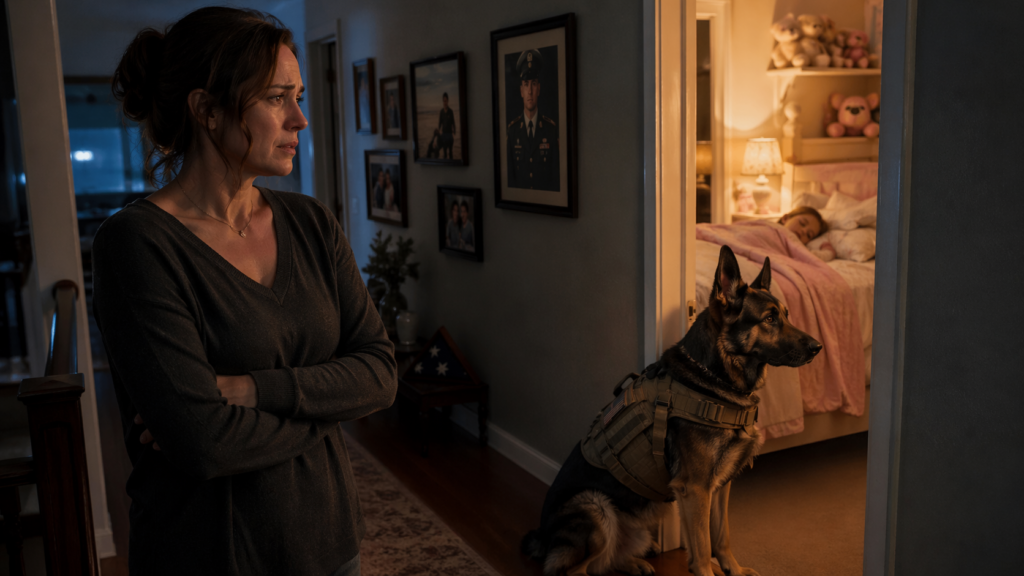
My husband’s retired military dog had always been calm, disciplined, almost eerily steady. But after Daniel passed, Ranger changed in one strange way: every single night, he lay down outside my daughter Ellie’s bedroom door and refused to move.
Not in my room.
Not by the front door.
Not beside Daniel’s old chair.
Only outside Ellie’s room.
At first, I thought he was grieving too.
Maybe he was protecting the person Daniel loved most.
But then my in-laws started coming by more often.
Too often.
My mother-in-law began bringing casseroles and sympathy smiles, while my father-in-law started asking careful questions about the house, the insurance, and whether I had “thought practically” about Ellie’s future. A week later, they mentioned lawyers. They told me a child needed stability. Routine. Structure.
As if I had not spent every day of my life giving those things to my daughter.
Then one night, long after midnight, I heard a low growl from the hallway.
Not loud.
Not wild.
Just enough to pull me out of bed.
I opened my door and found Ranger standing stiff and alert outside Ellie’s room. At the other end of the hall, my father-in-law was frozen in the dark.
He claimed he was checking on her.
But something about the look on Ranger’s face—and the way Frank stepped back so quickly—made my stomach tighten.
The next day, Ellie said something I still can’t forget.
She looked at Ranger, then at me, and whispered, “Daddy told him to stay with me if anything ever happened.”
That was the moment everything changed.
Because suddenly Ranger didn’t seem confused.
He seemed intentional.
And when he started scratching near the bottom of Ellie’s closet later that evening, I finally understood he wasn’t just guarding my daughter.
He was guarding something else.
What I found hidden in that room changed everything I thought I knew about my husband’s family… and why they were so desperate to get close to my child.
I went from grieving widow to terrified mother in a single week.
But I also learned something I will never forget:
Sometimes loyalty still speaks, even when the person you lost no longer can.
And sometimes the one still protecting your family isn’t the loudest person in the room.
Sometimes it’s the dog lying silently at your child’s door.
If you want the full story, keep reading. What Ranger protected that night left me in tears.
- CTA Line
- Read the full story on the website to find out what Ranger was guarding.
- Continue in the full story to discover the secret Daniel left behind.
- The next part reveals what was hidden in Ellie’s room.
- Full Website Story
The first night after the funeral, the house felt too clean.
People had left casseroles in foil trays inside our refrigerator. Somebody had wiped down the kitchen counter after making tea. Flowers lined the dining room like quiet witnesses, their sweet smell too heavy in the warm air. Even the living room looked arranged, as if grief itself had been asked to sit up straight and behave.
I stood in the hallway in my socks and stared at all of it.
My black dress was still on. I had kicked off my heels near the front door hours earlier, but I had not found the strength to change. My hair had slipped loose from the clip at the back of my head. I could feel the dull ache behind my eyes that came from crying so much the body no longer seemed to know whether it needed more tears or sleep.
At the end of the hall, the night-light in Ellie’s room glowed pale gold.
And just outside her door, Ranger lay on the floor.
He was perfectly still, his large body stretched across the hallway runner, his ears alert even in rest. He had been Daniel’s dog before he had truly become ours—a retired military working dog, part Belgian Malinois, part German Shepherd, with a dark mask over his face and intelligent amber eyes that missed nothing. Daniel used to joke that Ranger understood every word spoken in the house and judged most of us silently.
Now he looked like a carved statue guarding a place no one else could enter.
“Ranger,” I whispered.
One of his ears flicked, but he didn’t move.
I looked into Ellie’s room. She was asleep on top of the blanket, one arm wrapped around the stuffed rabbit Daniel had won for her at a county fair five years ago. Her cheeks were blotchy from crying. I could still hear her small voice from earlier that evening, asking me if funerals meant someone was gone forever or just for a very long time.
I had not known how to answer that without breaking in half.
“Come here, boy,” I said softly.
Ranger lifted his head and looked at me, then turned his eyes back toward Ellie’s door.
He was not refusing me exactly. He was choosing his post.
I swallowed hard and leaned against the wall.
Daniel had been gone six days.
Six days since a rainy Tuesday morning when the highway had snarled into a chain-reaction collision on the interstate outside town. Six days since the state trooper had stood on my porch, hat in hand, and asked if I was Mara Holloway. Six days since the sentence “There was an accident” had split my life into before and after.
Daniel had survived deployments. He had lived through heat, noise, fear, and the kind of work he never described in detail, not because he wanted to be dramatic, but because some things stayed in his face long after he stopped speaking. He had come home, retired, built a quiet life with me and Ellie, coached one season of youth soccer badly and enthusiastically, argued about lightbulbs and grocery lists and whether pineapple belonged on pizza.
And then he had gone out for a meeting and never come home.
There was a cruelty in how ordinary it had been.
I pressed my fingers to my lips and closed my eyes.
Behind me, a floorboard creaked. I turned and saw my mother-in-law, Linda, standing near the guest room door in a pale cardigan.
“Oh, sweetheart,” she whispered. “You’re still awake.”
I straightened immediately. Something in me had learned, over the past week, that I did not like being caught unguarded in my own house.
“I couldn’t sleep,” I said.
She followed my gaze to Ellie’s room, then to Ranger.
“He’s doing that again?”
I nodded.
Linda gave a small sigh that sounded sympathetic on the surface. “Animals grieve too.”
“Yes,” I said.
She stepped closer, lowering her voice. “Frank and I were talking. We think it might help Ellie to spend a few days with us next week. Just to get a change of scenery. You need rest, Mara.”
The hallway seemed to narrow around us.
“She needs me,” I said.
“Of course she does.” Linda placed a hand lightly against my arm. Her fingertips were cool. “But children also need stability. Routine. Right now this house is… well.” She let the sentence drift away in a gentle cloud of implication. “No one would blame you. You’ve been through something terrible.”
I looked at her hand until she removed it.
“Thank you,” I said carefully, “but Ellie is staying here.”
She smiled then. A small smile. Not warm, exactly. More like patience stretched over disagreement.
“We’ll talk tomorrow,” she said.
After she went back to the guest room, I remained where I was, one hand pressed against the wall, staring at Ranger. He had not moved once during the exchange.
I wanted to think Linda was simply concerned. I wanted to be fair. Grief makes suspicious people out of the wounded, and I knew that. But even through my exhaustion, I felt something sharp under her words.
Children need stability.
This house is…
You need rest.
What I heard was: You are failing already.
I stood in the hallway until my legs began to tremble. Then I went to my room alone and lay on Daniel’s side of the bed because it still faintly smelled like his soap and cedar aftershave. I did not sleep much. Every time I drifted off, I woke with the panicked sensation that I had forgotten something essential.
Once around two in the morning, I got up to check on Ellie.
Ranger was still there.
He watched me walk past him, but he did not leave his place outside her room.
The next morning, Frank was at my kitchen table before I had finished making coffee.
He was a broad-shouldered man in his late sixties, still neat even in grief, still the sort of person who ironed his shirts at home. He had Daniel’s height and none of his softness. Where Daniel used to listen with his whole body, leaning in, Frank sat back and made people come toward him.
He folded the newspaper and looked at me over his glasses. “You should eat.”
“I’m trying.”
He nodded once, as if noting a failed task. “Linda says Ellie barely touched dinner.”
“She was tired.”
“She’s too young to understand all of this.” He paused. “You shouldn’t have let her see so much yesterday.”
Something hot and immediate flared in my chest.
“It was her father’s funeral.”
“I know what it was,” he said, his voice remaining maddeningly calm. “I’m saying she needs protecting.”
I set my mug down harder than I intended. Coffee sloshed over the rim.
“Frank, with respect, I am protecting her.”
His gaze moved briefly to my shaking hand.
“Are you?” he asked.
The room went silent except for the ticking clock above the stove.
Before I could answer, Ellie padded in wearing pink socks and an oversized T-shirt she used as pajamas. Her hair was tangled, her face sleepy and swollen.
“Morning, Mama,” she mumbled.
I crouched immediately. “Morning, baby.”
She leaned into me, and I breathed in the warm, familiar scent of sleep and shampoo.
Frank’s expression softened then, but even that bothered me. It felt like an audience seeing a scene and drawing conclusions.
Ellie looked over my shoulder. “Where’s Ranger?”
“Right here,” Daniel’s voice would have said if he’d been alive. He used to answer for the dog in a low silly voice that made Ellie laugh every single time.
Instead, Ranger appeared in the doorway, silent as usual.
Ellie smiled for the first time in days and knelt to hug his neck. Ranger stood very still, accepting it.
Frank watched them carefully.
“You know,” he said, “Ellie has always loved our place. Bigger yard. More children on the street. It might be good for her for a while.”
Ellie looked up. “Why?”
“No reason, sweetheart,” I said quickly.
Frank gave me a look I recognized from the week before: restrained disapproval disguised as composure.
The problem with people like Frank was that they almost never raised their voices. They did not need to. They built pressure with tone, with implications, with a calm certainty that made other people feel childish for objecting.
I stood up. “Ellie, why don’t you pick cereal?”
She nodded and went to the pantry.
Frank waited until she was out of direct earshot. “Mara, don’t make this harder than it has to be.”
I stared at him. “Harder than what?”
He inhaled slowly through his nose. “Daniel is gone. We all need to think practically now.”
The words landed like stones.
Practically.
As if my husband had been a financial category. As if my daughter’s grief were a scheduling issue. As if a week had already been long enough for everyone to move from sorrow into management.
That afternoon, after they finally left, I locked the front door and leaned my forehead against it. My whole body felt heavy.
Ellie sat cross-legged on the living room rug coloring without enthusiasm while Ranger lay beside her.
I went through the motions of the day. I answered one email from work asking if I needed extended leave. I put soup on the stove. I signed a permission slip from Ellie’s school that had been sitting unopened in her backpack since before the accident. I folded two towels. Then I sat at the kitchen table and cried so quietly it barely made a sound.
A few minutes later, Ellie climbed into my lap without asking and rested her head against my chest.
“Are Grandma and Grandpa mad at us?” she asked.
I froze.
“No,” I said after a second. “Why would you think that?”
She shrugged but didn’t look up. “Grandma keeps saying she can help if you get too sad.”
The back of my throat tightened.
“Everyone gets sad sometimes,” I said carefully. “That doesn’t mean they stop being your mom.”
She traced the seam of my shirt with her finger. “Daddy said you’re strong.”
I nearly came apart right there at the table.
“He was right,” I whispered, though I did not feel strong at all.
That evening, after I got Ellie to bed, I stood in the doorway of her room watching her breathe. The night-light cast a faint halo over the quilt on her bed. Her dresser was cluttered with hair ties, library books, and the ceramic bird Daniel had painted with her at a father-daughter art day last spring. Everything in that room was so ordinary and so unbearably precious.
Ranger took up his place outside again.
This continued for four nights.
During the day, he behaved normally. He followed Ellie around the house, rested near the kitchen table, and perked up when I opened the pantry where his food was kept. But once Ellie changed into pajamas and got into bed, Ranger positioned himself outside her room and remained there until morning.
I tried once to coax him into the living room with a treat.
He took the treat, then returned immediately to the hallway.
By the fifth day, Linda had escalated from suggestions to plans.
She called midmorning while I was on the floor in Ellie’s room helping her choose a dress for school picture retakes—an event I had nearly forgotten.
“Mara,” she said in her bright, controlled voice, “I’ve been thinking. It might be best if Ellie stays with us for a couple of weeks while you get yourself sorted.”
I stared at the cartoon socks on my daughter’s feet.
“No,” I said.
Silence.
Then: “I’m not sure you’re hearing me.”
“I hear you,” I said. “My answer is still no.”
Linda exhaled softly. “You’re grieving, dear. And you’re not seeing things clearly. Frank and I are worried. Ellie needs consistency. You’ve barely been answering messages. The house—”
“What about the house?”
“It’s not a criticism,” she said quickly, which meant it was. “It’s just obvious you’re overwhelmed.”
I closed my eyes. “Linda, I appreciate your concern, but I am Ellie’s mother.”
“And we are her grandparents.”
“Then act like grandparents,” I said before I could stop myself. “Love her. Support her. Stop talking like you’re preparing to replace me.”
The line went quiet.
When Linda spoke again, her voice had lost its soft edges.
“We’ll do what’s best for Ellie.”
The call ended.
My hands were shaking so badly I had to set down the phone.
Ellie was looking at me from the bed, wide-eyed.
“It’s okay,” I lied.
It was not okay.
By afternoon, my fear had taken shape.
This was not casual interference. This was intention.
That evening, I called Nina Patel, a local attorney who had once represented my friend Sara during a custody dispute. Nina was practical, sharp, and incapable of being intimidated by people with expensive shoes and controlled voices. I had met her twice at birthday parties and once at a school fundraiser. We were not close, but desperation makes quick decisions.
She answered on the second ring.
When I finished explaining, there was a brief pause.
“Have they filed anything yet?” she asked.
“I don’t know.”
“Have they made threats?”
“Not directly. Just a lot of talk about stability and what’s best for Ellie.”
“That’s enough for me to tell you this,” Nina said. “Document everything. Save every text. Every voicemail. If they try to pick Ellie up from school, alert the school immediately that no one except you can take her.”
A cold rush went through me. “Do you really think they’d do that?”
“I think grief makes some people controlling,” she said. “And money can make it worse.”
Money.
I sat down slowly in the kitchen chair. “What do you mean?”
“There was a life insurance policy, right?”
“Yes.”
“And survivor benefits? Savings? Maybe a trust?”
“Daniel had some retirement money. We had a college fund. Nothing outrageous.”
“Maybe it’s not about money,” Nina said. “Maybe it’s about control. But don’t assume they’re harmless because they sound polite.”
I stared through the window above the sink. The backyard was dim in the early evening, the swing set unmoving.
“Okay,” I said.
“Can you come in tomorrow morning?”
“Yes.”
“Good. And Mara?”
“Yes?”
“Don’t let them make you feel guilty for grieving. Grief is not unfitness.”
When I hung up, I sat still for a long time.
Ranger was already in the hallway. I could see the outline of him from the kitchen table, steady and silent.
That night, I woke around one-thirty to a sound I had never heard from him before.
A low growl.
Not a panicked bark. Not aggression loose and uncontrolled. This was something colder, more deliberate. A warning.
My heart slammed against my ribs.
I threw off the blanket and hurried into the hallway.
The night-light from Ellie’s room cast a dull stripe across the floor. Ranger stood rigid in front of the doorway, his head low, shoulders tight, eyes fixed on the far end of the hall.
And there, just beyond the shadow of the linen closet, stood Frank.
He wore a pair of slacks and a white undershirt, his face pale in the dim light.
For one full second, nobody moved.
Then I said, too loudly, “What are you doing?”
Frank blinked, as if only just realizing how this looked.
“I heard Ellie moving around,” he said. “I came to check on her.”
Ranger’s growl deepened.
“Go back to bed,” I said, my voice shaking with anger now.
Frank looked at the dog. “Call him off.”
“He’s not doing anything to you.”
“He’s threatening me.”
“He’s standing between you and my daughter’s room at one-thirty in the morning,” I said. “Why?”
Frank’s jaw tightened. “I told you.”
“No,” I said. “You gave me an answer. That’s not the same thing.”
For the first time, he looked genuinely irritated.
“You are exhausted and emotional,” he said. “I’m trying to help.”
“By wandering outside my daughter’s bedroom in the middle of the night?”
His nostrils flared. “This is exactly what Linda meant. You’re suspicious of everyone. You need perspective.”
I almost laughed at the absurdity of that.
“Please leave the hallway,” I said.
We stood there locked in a terrible, quiet standoff until he finally turned away. As he walked back toward the guest room, Ranger remained motionless, watching him.
When Frank’s door clicked shut, I crouched beside Ranger. My hands were trembling.
“What was that?” I whispered.
He looked at me briefly, then back at Ellie’s room.
I stepped inside and found Ellie asleep, unmoving, one hand tucked beneath her cheek.
Nothing seemed disturbed.
Still, I did not sleep at all after that.
The next morning, I drove Ellie to school and went straight to Nina’s office downtown. I told the front desk woman I was there for a ten o’clock and realized, from the way my voice sounded, that I was still half in shock.
Nina listened without interruption as I described the hallway incident.
“Did he have any legitimate reason to be there?” she asked.
“No.”
“Did he enter the room?”
“I don’t think so. Ranger stopped him.”
She made a note. “Good dog.”
I let out a startled breath that was almost a laugh.
“I know this feels surreal,” she said, looking up. “But your instincts matter. We’re going to prepare as if this turns into a legal issue.”
I nodded, though the idea made my stomach twist.
Over the next twenty minutes, we reviewed the basics. Daniel’s death certificate. Insurance. The deed to the house, which was in both our names. School records. Pediatric records. Names of Ellie’s teachers. Nina asked whether Daniel had a will.
“Yes,” I said. “At least I think so. We made one after Ellie was born.”
“Do you have a copy?”
“I thought it was in the desk drawer in Daniel’s study, but I haven’t gone through everything yet.”
“Find it,” she said. “And keep it somewhere safe.”
I promised I would.
At school pickup, I stopped by the front office and added a written note stating that no one except me and my neighbor Sara could pick up Ellie. The secretary, a kind woman named Denise, put a hand on my arm and said, “You just let us know if you need anything, honey.”
That nearly undid me all over again.
When Ellie and I got home, Ranger met us at the door. He nudged Ellie’s hand first, then mine.
At dinner, she pushed peas around her plate and finally asked, “Are Grandpa and Grandma going to take me away?”
The fork slipped from my fingers and clattered against the plate.
“No,” I said immediately. “No one is taking you away.”
She looked unconvinced. “Grandpa asked if I’d like a bigger room at their house.”
A cold wave passed through me so hard I had to grip the edge of the table.
“When did he ask you that?”
She shrugged. “Yesterday. When you were in the laundry room.”
I closed my eyes for one second and forced my voice steady. “Did he say anything else?”
“He said they could help me if you stayed sad for a long time.”
Ranger, lying under the table, lifted his head.
I swallowed carefully. “Ellie, listen to me. Grown-ups say foolish things sometimes when they think they know what’s best. But you belong here. With me. Always.”
Her lower lip trembled. “Promise?”
I got up from my chair and knelt beside her. “I promise.”
She threw her arms around my neck. I held her so tightly I felt the fine bones in her back through her shirt.
Later, when I tucked her in, she was quiet for a while.
Then she said into the dimness, “Daddy told Ranger to stay with me if anything ever happened.”
I stopped smoothing the blanket.
“What do you mean?”
She rolled onto her side to face me. “The week before…” Her small face tightened. “Before Daddy went away. He was in here at bedtime and told Ranger, ‘Watch my girl. Stay with her if I can’t.’ I thought he was joking.”
A chill moved through my arms.
“Did he say anything else?”
She frowned, trying to remember. “He pointed at my closet. And he said, ‘You know where.’”
For a moment, I could not breathe.
“Ellie,” I said carefully, “why didn’t you tell me before?”
Her eyes filled. “I forgot.”
“Oh, sweetheart.” I kissed her forehead. “That’s okay.”
But after she fell asleep, my heart did not settle.
Ranger resumed his place outside her room. I stood there staring at him, replaying Ellie’s words.
You know where.
The closet.
A part of me wanted to dismiss it as grief grabbing at meaning. But Daniel had been methodical to his bones. He labeled storage bins. He kept backup flashlights in a drawer by the stairs. He updated our emergency contacts twice a year. When he spoke to Ranger, it was with commands and intention. He did not say things just to hear himself talk.
I stepped quietly into Ellie’s room and opened her closet door.
Inside were the ordinary pieces of childhood: hanging dresses, a shelf of board games, a row of shoes she kept outgrowing too fast, a pink plastic bin filled with art supplies. Nothing looked unusual.
Ranger got up and came into the room. He moved past me, stood before the closet, and stared at the bottom right corner near the baseboard.
Then he scratched the floor once.
Not wildly. Just once.
My breath caught.
I moved the plastic art bin aside. Behind it sat a narrow wooden toy chest Ellie no longer used much. I pulled it out. Empty except for old dress-up scarves and a broken tiara.
Ranger scratched again—this time at the strip of carpet beneath where the chest had been.
I crouched lower and ran my fingers over the edge of the carpet.
There was a slight rise there. An unevenness.
My pulse began hammering.
I lifted the carpet corner.
Underneath, tucked into a shallow recess in the subfloor, was a flat gray metal lockbox.
For a second I could only stare at it.
Then my eyes filled so fast everything blurred.
“Daniel,” I whispered.
The box was not large—about the size of a legal pad. There was a taped envelope on top with my name written in Daniel’s clean block letters.
Mara.
My hands shook so hard I almost dropped it.
I carried the box to the kitchen table, with Ranger following me like a shadow. The house was silent except for the hum of the refrigerator and the sound of my own breath catching.
The envelope was sealed. I opened it carefully.
Inside was a letter.
If you are reading this, something went wrong.
That was the first line.
I had to stop and press my palm over my mouth.
Daniel’s words were unmistakable—practical, direct, but warm beneath it all.
If you are reading this, something went wrong. I hope I am being dramatic and you found this because I forgot where I put it. But if not, I need you to know three things first.
One: I love you.
Two: You are the best thing that ever happened to me, and Ellie is the second.
Three: If my parents start talking about what is “best” for Ellie, do not trust them to mean your best, or hers.
My vision blurred again.
The next paragraph was shorter, tighter, the way Daniel wrote when something mattered deeply.
I overheard my father and mother two months ago arguing in the garage after Ellie’s birthday dinner. They think you are too soft and too emotional to raise her “properly” if anything happens to me. My father said they should “be prepared” to step in. My mother agreed. I confronted them. It got ugly. They promised to drop it, but I don’t believe they meant it.
My chest tightened until it hurt.
There was more.
I met with attorney Richard Gaines on March 14 and updated my will and guardian instructions. You are Ellie’s sole legal guardian. If for any reason your right is challenged, use the notarized copies in this box and call Nina Patel. Richard recommended her if family pushed. There is also a USB drive with a recorded statement in case paperwork becomes delayed or contested.
I stared at the page.
Nina Patel.
He had named the same attorney I had reached out to in desperation.
Tears slid down my face and fell onto the letter.
I kept reading.
One more thing. My father asked me twice about the insurance and the college account after I made him executor on the old will years ago. He is no longer executor. All beneficiary designations were changed. The trust for Ellie is controlled by you until she is twenty-five. If they know that, they may try to argue you are unstable. Do not let grief make you doubt yourself. Being heartbroken is not the same as being incapable.
I had to put the letter down.
I bent forward over the table and cried into both hands—not the sharp, shattering sobs of the first days, but a deep aching grief threaded with fierce relief and terrible clarity. Daniel had known. Not that he would die. But that if something ever happened to him, his parents might come for our daughter.
And he had planned for it.
When I finally lifted my head, Ranger was sitting beside the table, watching me with steady eyes.
“Good boy,” I whispered through tears. “You were protecting this.”
Inside the lockbox were copies of Daniel’s updated will, guardianship paperwork, beneficiary records for the life insurance, bank instructions for Ellie’s college fund, and a small flash drive in a labeled plastic sleeve.
There was also one more sealed note, written in Daniel’s hand:
If Ellie asks, tell her Ranger understood the assignment.
I laughed then, brokenly, tears still on my face.
The next morning, I took everything to Nina.
She read the letter in silence, then leaned back in her chair and let out a slow whistle.
“Your husband was prepared,” she said.
“That sounds like him.”
She gave me a look softened by sympathy. “This changes everything.”
That same afternoon, Nina received confirmation that Frank and Linda had indeed spoken with an attorney. They had not yet filed a formal custody petition, but they were gathering statements and exploring emergency guardianship “due to maternal instability.”
Maternal instability.
I repeated the phrase under my breath in Nina’s office and felt something harden inside me.
For nearly two weeks I had moved through life like I was underwater, trying simply to keep Ellie fed, dressed, comforted, and held together while my own body kept forgetting that Daniel was gone. But those words did something grief had not done. They drew a line.
I was still hurting. But I was no longer drifting.
When Frank called that evening, I answered.
“Mara,” he said, “your mother-in-law and I think it would be wise to sit down and talk.”
“We can do that through attorneys,” I said.
Silence.
Then: “You’ve hired a lawyer?”
“Yes.”
His voice cooled noticeably. “That seems extreme.”
“You standing outside my daughter’s bedroom at one in the morning seemed extreme.”
“That again?” he snapped before catching himself. “I was checking on her.”
“No,” I said. “You were not.”
He let out a slow breath. “You are making dangerous assumptions.”
“No, Frank. I’m finally making accurate ones.”
I ended the call before he could respond.
The formal petition came three days later.
Reading it was one of the most humiliating experiences of my life.
The document described me as emotionally fragile, isolated, overwhelmed, and incapable of providing a stable environment for my daughter in the wake of my husband’s death. It cited my leave from work as evidence of functional decline. It referenced the untidy state of the home in the days after the funeral. It mentioned that Ellie had been “observed appearing withdrawn,” as if grief in a child were a legal argument.
But what struck hardest was how coldly my life had been translated into accusations.
Every human moment had been reframed as failure.
Nina assembled our response methodically. School records showed Ellie was well cared for. Her teacher wrote that she arrived clean, prepared, and loved. Our pediatrician noted no concerns. My supervisor provided a letter confirming that my leave was both temporary and approved. Sara wrote a statement describing me as a devoted mother and attentive caregiver before and after Daniel’s death. Denise at the school confirmed that Frank had informally asked about pickup procedures without my knowledge.
Then there was Daniel’s letter. The updated will. The guardianship papers. The beneficiary documents removing Frank’s control. And, at Nina’s suggestion, the video file from the flash drive.
We watched it together in her office.
Daniel sat at his desk in his old navy sweater, shoulders squared, expression tired but clear. Behind him I recognized the framed photo of Ellie missing both front teeth and grinning at the camera.
If you’re seeing this, he said, I’m probably not there to explain things myself. So I need to be direct.
He looked into the camera the way he looked at people when he wanted them to trust him.
My wife, Mara Holloway, is the only person I want raising our daughter, Ellie, if anything happens to me. She is loving, capable, steady, and stronger than she knows. Grief will hit her hard because she loves hard. That does not make her unfit. It makes her human.
I broke down before the clip even ended.
Nina handed me tissues and pretended not to notice the ugly, grateful sound that escaped my throat.
The hearing was set for a Thursday morning.
I barely slept the night before. Ellie stayed with Sara, who promised movies, pancakes, and complete distraction. I wore a navy dress and a cream blazer because Nina said neutral colors photograph well and project calm. The sentence made me want to scream, but I understood the point.
At the courthouse, Frank and Linda stood together near the far wall. Linda wore pearls. Frank wore the same expression he always wore when he thought events would soon affirm his view of the world.
When he saw me approach with Nina, his jaw tightened.
Linda gave me a strained smile. “Mara, this didn’t have to become ugly.”
I looked at her for a long moment. “It became ugly when you tried to take my daughter.”
Her smile vanished.
Inside the hearing room, everything felt too formal and too intimate at the same time. The scrape of chairs. The muted cough from the back row. The thin stack of papers in front of the judge. It all made my pulse throb in my throat.
Frank’s attorney went first.
He spoke about concern, about the child’s best interests, about my grief as if it were a medical impairment rather than a wound. He described my in-laws as loving, stable, financially secure. He used the word environment three times.
When it was Nina’s turn, she rose with a calm I envied.
“Your Honor,” she began, “grief is not neglect. Mourning a spouse is not parental unfitness. And this petition is not driven by the child’s welfare. It is driven by control.”
She walked the judge through the timeline. Daniel’s death. The pressure from the grandparents almost immediately afterward. Their efforts to separate Ellie from me. Frank’s nighttime presence outside Ellie’s room. The inquiry at school. Then she presented the documents from the lockbox.
Frank’s attorney objected twice. The judge overruled him both times.
When Nina submitted Daniel’s updated will and guardianship instructions, something changed in the room. I could feel it. The case was no longer built on vague emotional claims. It had collided with direct evidence of Daniel’s intent.
Then Nina requested permission to play the video.
The judge allowed it.
Daniel’s face appeared on the small courtroom monitor.
The room went very still.
He spoke clearly, naming me as Ellie’s sole guardian, describing my character, and stating that he did not want his parents making decisions for our daughter if he was gone. He did not rant. He did not exaggerate. In some ways that made it more devastating. Daniel had always been measured. Hearing him calmly articulate a fear I had only recently understood gave his words extraordinary weight.
I glanced toward Frank and saw, for the first time since the funeral, something crack in his expression.
Not grief.
Exposure.
When the video ended, the judge removed her glasses and asked Frank a series of questions. Had he known about the updated will? He admitted he had not. Had he asked about pickup procedures at the child’s school? Yes, but he characterized it as harmless concern. Had he discussed Ellie living with them while her mother “recovered”? Yes.
Then the judge asked the question that seemed to shift the entire atmosphere.
“Mr. Holloway,” she said, “why were you in the hallway outside the child’s room after midnight?”
Frank began with the same answer he had given me.
The judge listened, expression unreadable.
When he finished, she asked, “Did the child appear to be in distress?”
“No.”
“Did you alert the mother before approaching the room?”
“No.”
“Did you have any emergency reason to go there?”
Frank hesitated.
“No.”
The judge nodded once and made a note.
My palms were damp. I kept them clasped so tightly in my lap that my fingers ached.
Nina then called me briefly. She did not ask me to perform. She asked simple questions: Who handled Ellie’s school routines? I did. Doctor appointments? Me. Homework? Me and Daniel together before he died; me afterward. Meals? Baths? Bedtime? Emotional care? All me.
“How would you describe your daughter’s relationship with you?” she asked.
I looked down for a moment, then up.
“She trusts me,” I said, my voice unsteady. “She comes to me when she’s afraid. She still crawls into my lap when she misses her dad. We read together every night. She knows I’m sad, but she also knows I’m here. I am not absent from her life because I’m grieving. If anything, I’m holding on harder.”
Nina nodded. “And what have the past few weeks felt like for you?”
I swallowed.
“Like I buried my husband,” I said quietly, “and then had to defend my right to mother my own child before I had even learned how to say the word widow.”
There was silence after that.
Not dramatic silence. Just the kind that comes when something true enters a room and people do not know how to move around it.
The judge ruled from the bench.
She denied the petition.
She stated plainly that there was no evidence of neglect, danger, or parental incapacity. She noted the strong evidence of Daniel’s wishes, the inappropriate overreach by the grandparents, and the lack of factual basis for emergency guardianship. She said that while continued contact with loving grandparents could be beneficial to a child, such contact must respect the legal and emotional place of the surviving parent.
I heard most of it through a rushing sound in my ears.
When it was over, my knees nearly gave out.
Nina touched my elbow lightly. “You did it.”
I turned to her with tears already spilling over. “He did it,” I whispered, thinking of Daniel’s letter, his planning, his steady belief in me.
Outside the courthouse, Linda tried to approach.
“Mara—”
I stepped back.
“No,” I said.
Her face tightened. “We were trying to help.”
“No,” I repeated. My voice was calmer now. “You were trying to decide that my grief disqualified me from motherhood. You were wrong.”
Frank did not speak. He looked older than he had two hours earlier. But I could not afford sympathy for him. Not yet. Maybe not ever.
I got into Nina’s car because I had been shaking too hard to drive myself. She took me straight to Sara’s.
The moment Ellie saw me through the front window, she came running.
I knelt before she even reached the door.
“Hey, baby,” I said, and she threw herself into my arms so hard I almost tipped over.
“Did they take me?” she asked against my shoulder, the words muffled and frightened and so heartbreakingly small.
“No,” I said, pulling back to hold her face in both hands. “No. Nobody is taking you anywhere. We’re going home together.”
She burst into tears then, huge relieved sobs that seemed too big for her little body. I held her until she settled, then thanked Sara, then drove us home.
Ranger met us at the door.
Ellie dropped her backpack and wrapped both arms around his neck. “Good job,” she whispered, as if she somehow understood more than I had ever explained.
That night, after dinner and baths and the slow, precious ordinariness of being home again, I showed Ellie a softened version of Daniel’s note.
Not the legal details. Just the line I knew she needed.
If Ellie asks, tell her Ranger understood the assignment.
She smiled through tears. “Daddy would say that.”
“Yes,” I said, laughing a little. “He would.”
For the first time since the funeral, the house felt different.
Not healed. Grief does not work that quickly. Daniel’s mug was still in the cabinet. His jacket still hung by the laundry room. Some mornings I still reached for my phone before remembering there would be no new message from him. Some nights I still woke expecting the sound of his key in the lock.
But something in the air had shifted from threat to protection.
After Ellie fell asleep, I stood in the hallway.
Ranger lay outside her room as always.
I crouched beside him and stroked the fur between his ears. “You kept your promise,” I said.
He leaned briefly into my hand.
Over the next few weeks, life did not become easier so much as more livable.
The flowers from the funeral finally wilted and were thrown out. I returned a few casseroles dishes to neighbors with awkward gratitude. I went back to work part time. Ellie resumed piano lessons. I met with a child therapist once, then again, not because anyone was building a case against me, but because grief deserved support instead of secrecy.
Frank and Linda sent one letter through their attorney asking for visitation. Nina advised me not to refuse entirely, but to move slowly and set conditions. I agreed to supervised visits in public places after some time had passed, with the understanding that any attempt to undermine me would end them immediately.
It was not forgiveness.
It was structure.
And structure, I was learning, was not cold. Structure was sometimes love with guardrails.
One Saturday afternoon in early autumn, Ellie and I were planting mums on the front porch when she looked up and asked, “Do you think Daddy knew Ranger would remember?”
I brushed dirt from my palms and thought about it.
“Yes,” I said. “I think your dad trusted the ones he loved.”
She nodded as if that answered something important.
Inside, Daniel’s framed photograph sat on the mantel. In it, he was laughing, head tipped back, Ellie on his shoulders and Ranger at his side. It had always been one of my favorite pictures because none of them were posing. It was all motion and light and unguarded joy.
I looked at it often now.
Not because I needed to stay broken.
Because I needed to remember that what we had built was real enough to keep protecting us, even after loss had tried to tear through it.
Several nights later, I noticed something new.
After Ellie fell asleep, Ranger took his position outside her door as usual. I sat in the hallway for a while with a mug of tea, reading without really reading. After half an hour, he stood, stretched, and walked into my room.
I followed him with my eyes, stunned.
He circled once at the foot of my bed and lay down there.
Not in the hallway.
Not at Ellie’s door.
At the foot of my bed.
I stared for a long moment, then set the mug aside and covered my mouth with my hand.
His work, somehow, felt complete.
The next morning, Ellie was delighted.
“Maybe he knows we’re okay now,” she said.
Maybe he did.
Maybe dogs understand resolution in ways humans overcomplicate. Maybe he knew the danger had passed. Or maybe he had simply been waiting until I could finally breathe again before allowing himself to rest somewhere else.
That night, after Ellie went to bed, I opened the lockbox one last time.
I reread Daniel’s first lines.
I love you.
You are the best thing that ever happened to me, and Ellie is the second.
If my parents start talking about what is “best” for Ellie, do not trust them to mean your best, or hers.
Then I read the line that had become a private anchor.
Do not let grief make you doubt yourself. Being heartbroken is not the same as being incapable.
I sat there in the quiet kitchen with tears in my eyes, but this time they did not feel like drowning. They felt like release.
Love had not disappeared from the house because Daniel was gone. It had changed shape. It had become letters hidden under carpet. A dog asleep in a hallway. An eight-year-old reaching for my hand in the grocery store. A friend who answered the phone. A lawyer who saw through polished cruelty. A mother learning that survival and tenderness could exist in the same body.
I put the papers back in the lockbox and carried it to the bedroom closet where I kept important documents now. Not under Ellie’s carpet anymore. Not because it had failed us, but because it had done exactly what it was supposed to do.
When I turned off the kitchen light and walked down the hall, I paused outside Ellie’s room.
She was asleep on her side, blankets kicked loose, one arm thrown around the stuffed rabbit.
Then I looked into my room.
Ranger had already settled at the foot of the bed, his eyes half closed, his breathing slow and even.
I smiled through the ache that still lived in me.
“Good night, Daniel,” I whispered into the dark.
And for the first time since the accident, the silence that followed did not feel empty.
It felt guarded.
It felt witnessed.
It felt, in the quietest way, like love staying.