When Staff Sergeant Eli Mercer turned into his street, the first thing he noticed was how ordinary everything looked.
That was the cruel part.
There were no flashing lights. No broken windows. No scene dramatic enough to prepare him for the feeling that was about to settle into his chest. A kid two houses down was bouncing a basketball in a driveway. Someone nearby was mowing a lawn. A wind chime rang softly from a porch across the street. The afternoon sun lay warm and golden across the row of small suburban homes, touching the roofs and sidewalks with the kind of peace Eli had dreamed about in places where peace was never guaranteed.
For twelve months, he had held onto one picture in his mind.
Home.
Not as an idea. Not as a patriotic word people used in speeches and airport welcome banners. Home as a real place. Home as his daughter’s laugh from the hallway. Home as the smell of coffee in the kitchen before sunrise. Home as his wife, Mara, standing barefoot by the sink in one of his old shirts, her hair falling over one shoulder while she pretended not to cry when he left.
He had replayed that memory so many times that it had become polished and almost too bright to look at. On the worst nights overseas, when sleep refused to come and silence felt louder than gunfire ever had, he would take that memory out and hold it like something solid.
That memory had gotten him through twelve months.
And now, with his truck rolling slowly past the familiar row of houses, he felt like a man driving toward the end of a very long promise.
He had not told Mara he was coming home early.
That had been the point.
His return date had changed two weeks before, after an unexpected shift in the deployment schedule. The official notice came late, and the window for travel was tight. Most of the men on his team had called home immediately. Eli almost had. He had his phone in his hand, his thumb hovering over Mara’s contact.
Then he had pictured Lily.
Eight years old now. Missing two front teeth in the last school photo Mara had sent. Writing him letters in wide, uneven handwriting that still made his throat tighten every time he unfolded them. She had drawn him dozens of pictures over the last year—her, him, and Mara standing in front of the house with a bright yellow sun over the roof and a dog they did not own because she still wanted one.
Come home soon, Daddy.
I saved your seat.
I told my class you are brave.
Mommy cried when she heard your voice but don’t worry I hugged her.
He wanted to see her face when she realized he was really there. He wanted something good to arrive in that house without warning for once. He wanted to bring joy through the front door instead of another countdown, another date that might shift, another conversation squeezed between time zones and weak signals.
So he kept it secret.
He texted only his older sister, Nora, who lived an hour away.
Landing tomorrow. Don’t tell anyone. Want to surprise them.
Nora had sent back a row of crying-face emojis, then: She’s going to lose her mind. Lily too. Call me when you get there.
He smiled just thinking about it.
Now, as he approached his driveway, that smile faded.
At first, he could not even say why.
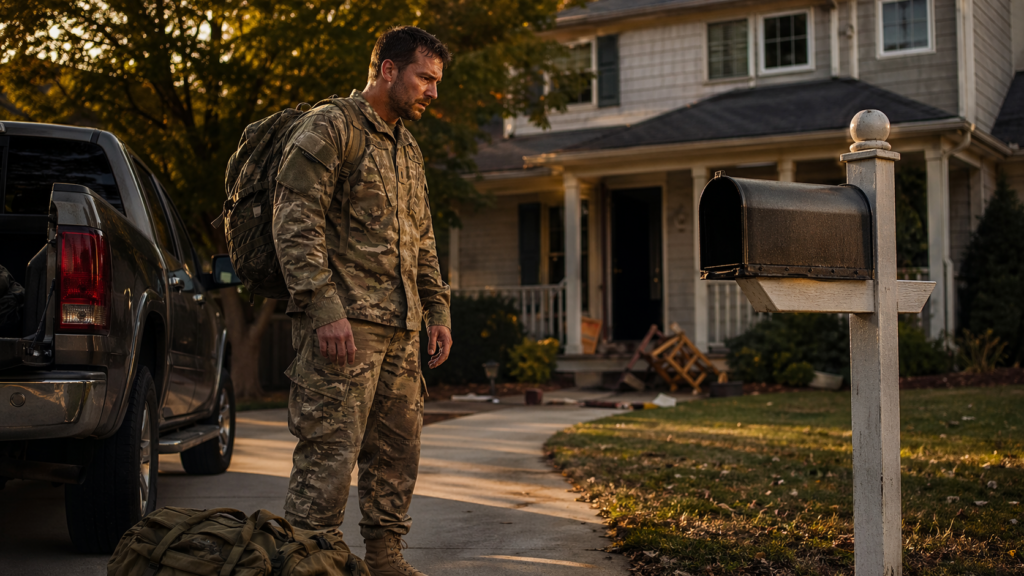
The house was there. The same pale gray siding. The same narrow porch with the white railing he had repainted three summers ago. The same maple tree near the sidewalk, its branches a little fuller now. The same driveway, though Mara’s car was parked farther to one side than usual.
Everything was familiar.
Yet something felt off.
He eased the truck to a stop near the curb instead of pulling straight in. His body had already started paying attention before his mind caught up. Soldiers noticed changes. Tiny shifts. What belonged. What did not. The brain learned those lessons hard and never quite let go of them.
Then his eyes found the mailbox.
A simple black metal box fixed to a weathered wooden post. He had installed it himself the month after they moved in, grumbling over the crooked placement until Mara came outside laughing and told him no one would ever notice.
He noticed now.
Not the box itself.
The label.
When he left, the side of the mailbox had read MERCER in white block letters. It had been one of those small proud domestic things that meant more than it should. Their name. Their home. Their life together, claimed in six neat letters.
Now the old label was gone.
In its place were two names in fresh white vinyl.
Mara Bell.
And under it, in slightly smaller letters:
Tanner Bell.
Eli stared so hard that for a second the letters seemed to blur.
Bell.
Mara’s maiden name.
And Tanner Bell.
He read it again, because the mind does strange things when it is trying to reject reality. Maybe he was exhausted. Maybe it said tenant, not Tanner. Maybe the sunlight was hitting it wrong.
But it did not change.
Tanner Bell.
His fingers tightened on the steering wheel.
He shut off the engine but did not move.
A strange hollowness opened inside him, a hollow so sudden and clean it felt almost physical, like an elevator dropping in his stomach. He sat there listening to the ticking engine and the rush of blood in his own ears.
Bell.
Why would Mara change the mailbox back to her maiden name?
Why would there be another Bell on it?
His first thought was practical, desperate. A relative? A cousin needing a place to stay? Her younger brother, maybe? But no—Mara did not have a brother. He knew every branch of her family tree. Her father had died years ago. Her mother lived in Arizona. She had one aunt in Missouri and an older half-sister she barely spoke to.
No Tanner.
His second thought was uglier, and his body rejected it so fast he actually said, “No,” out loud in the empty truck.
He looked at the house again, forcing himself to search for something reasonable.
The flower beds were different. The yellow mums Mara always planted by the porch had been replaced with low green shrubs edged in dark mulch. The old wicker chair where Lily used to sit and blow bubbles was gone. The red welcome mat with the faded blue stripe had been replaced by one that simply said HELLO in clean black letters.
The curtains in the front window were different too. He knew that because the old ones had tiny embroidered leaves Mara loved and he hated because they looked impossible to clean.
These were white and plain and expensive-looking.
The porch light fixture had been changed.
So had the brass number plate by the door.
No one thing was dramatic. Together, they felt devastating.
It was like walking into a room where all the furniture had been moved slightly while you were sleeping. Enough to make you trip over memory itself.
Eli opened the truck door and stepped out slowly.
The summer air was warm and heavy. Somewhere close by, someone was grilling. He smelled charcoal and cut grass and the faint sweetness of blooming jasmine from a neighbor’s fence. The normalcy of it all felt almost cruel. He stood with one boot on the curb and one in the street, staring at the house he had spent twelve months surviving for.
His duffel bag sat on the passenger seat where he had left it. He reached in and pulled it out, slinging it over one shoulder by instinct. The bag felt heavier than it had at the airport. He closed the door quietly, as if loud noise would make whatever was happening more real.
As he walked up the driveway, he noticed another detail.
A second pair of adult shoes by the front door through the screen.
Men’s shoes.
Not his style. Not his size. Brown casual loafers, left carelessly to one side, like they belonged.
He stopped.
For one suspended second, the whole world seemed to pull inward.
He was standing less than twenty feet from his front door, home after a year in uniform and sand and separation, and he was suddenly more afraid of what waited inside that house than he had been of anything he faced overseas.
Because over there, fear had shape.
Fear came from roads and rooftops and wrong movements and bad intel.
This was shapeless.
This was intimate.
This was the terror of realizing that pain had been sitting in your own living room while you were gone.
His phone buzzed in his pocket, startling him.
Nora.
He stared at the screen but did not answer. He could not bear her excitement in that moment. He could not bear to hear someone say, Are you there? Did they scream? Did Lily cry? How did the surprise go?
He silenced it and slid the phone back into his pocket.
Then he climbed the porch steps.
His hand hovered over the doorknob. For one breath, he actually considered walking away. Not forever. Just around the side of the house to look through a window first. Just back to the truck to think. Just anywhere that would delay the next ten seconds of his life.
But Lily might be inside.
That thought moved him.
Whatever else had changed, whatever waited beyond that door, his daughter was still his daughter.
He knocked once.
No answer.
He waited. Knocked again, louder.
Footsteps.
Not Lily’s light quick rhythm. Not Mara’s either.
These were slower. Heavier.
The door opened halfway.
A man stood there wearing a navy T-shirt and jeans, one hand still on the knob, like he had every right in the world to answer that door.
He was in his thirties, maybe a few years younger than Eli. Tall. Clean-shaven. Comfortable-looking in a way that made Eli’s skin crawl. Not handsome enough to matter, not threatening in any obvious way. That almost made it worse. He looked ordinary. Familiar. Like the sort of man neighbors would wave at and forget.
For one suspended second, the two of them simply stared at each other.
The man’s face changed first.
Confusion.
Recognition.
Then something that looked alarmingly close to guilt.
“Can I help you?” he asked, though his voice already suggested he knew exactly who Eli was.
Eli did not answer right away. His gaze flicked past the man’s shoulder into the house.
The entryway table was gone. The framed family photo that used to hang opposite the door had been replaced by a round mirror. The walls were a different color—soft beige instead of the pale blue Mara had chosen after weeks of debate. A pair of Lily’s sneakers was by the stairs, half untied.
She was here.
Eli looked back at the man.
“I live here,” he said.
The man’s throat moved as he swallowed.
For a second, neither of them spoke.
Then, from somewhere deeper in the house, Mara’s voice floated toward the front hall.
“Tanner, who is it?”
Tanner.
The name from the mailbox.
It hit Eli with a strange, flattening force. Not because he had not expected it by then, but because hearing it made the thing fully real. Tanner was not a misunderstanding. Tanner was not a contractor, not a cousin, not some temporary arrangement scribbled on a mailbox.
Tanner was a person inside his house.
Tanner opened his mouth, but before he could answer, Mara appeared at the end of the hallway.
She was carrying a folded basket of laundry.
She wore soft gray leggings and one of those loose cream sweaters she saved for weekends. Her hair was longer than when he left, pulled into a low messy knot. For one impossible half-second, Eli’s body reacted before his mind did. Relief. Recognition. Love. Home.
Then she saw him.
The basket slipped from her hands.
A small pink sock floated to the floor.
Mara’s face drained of color so quickly it frightened him. She stood frozen, one hand against the wall, eyes wide and unblinking, as if she had just seen someone she thought would never come back.
“Eli?”
He had imagined her saying his name a thousand times.
Never like that.
Not in joy.
Not in shock sharpened by fear.
He waited for her to run to him. He waited for confusion to clear and explanation to rush in. He waited for something—anything—that looked like the homecoming he had spent a year earning in his head.
Instead she looked at Tanner first.
Just for a second.
But it was enough.
In that second, Eli understood more than he wanted to.
“What is this?” he asked quietly.
Mara opened her mouth, closed it, then said the most painful possible thing.
“You weren’t supposed to be home until September.”
Not I missed you.
Not thank God.
Not Eli, listen.
Just that.
You weren’t supposed to be home.
He felt something inside him go still.
The hallway behind her shifted, and suddenly Lily appeared at the bottom of the stairs, holding a stuffed rabbit by one ear.
She had grown.
Even from across the room, he could see it instantly. Longer legs. Thinner face. Front teeth grown back in. But still Lily. Still his child.
She blinked at him once.
Then the rabbit dropped.
“Daddy!”
The sound of her voice broke something open in him.
She ran full speed, flying across the hall, and Eli dropped his duffel just in time to catch her as she threw herself into him. He lifted her off the floor and held her so tightly he had to force himself to ease up. She wrapped her arms around his neck and sobbed into his shoulder with the full-body honesty only children have.
“You came home,” she cried. “You came home, you came home, you came home.”
Eli buried his face in her hair and shut his eyes.
For that one moment, nothing else existed.
Not the man at the door.
Not Mara’s stricken face.
Not the mailbox.
Just his daughter, warm and real and shaking in his arms.
“I’m here, baby,” he whispered. “I’m here.”
When he finally looked up, Mara was crying too.
But she still had not moved toward him.
Tanner had stepped back into the entryway, awkward and silent, as if shrinking himself might help.
Lily pulled away enough to cup Eli’s face in both hands.
“You didn’t tell me,” she said, half laughing and half crying. “You said maybe after my birthday.”
“I know,” he said, his voice rough. “I wanted to surprise you.”
Then her expression changed.
Children notice tension long before adults think they do. Her smile faltered. Her eyes moved from his face to Mara’s, then to Tanner’s, then back again.
The room held its breath.
Eli set her down gently.
“Lily,” Mara said softly, “why don’t you go upstairs for a minute?”
“No.”
It was immediate. Firm. She moved closer to Eli, pressing against his side.
“Mara,” Eli said without taking his eyes off his daughter, “who is he?”
Mara wiped at her cheeks. “Can we please not do this here?”
“Here seems like exactly where it’s happening.”
Tanner shifted. “I should go.”
Eli turned to him.
“Yes,” he said.
Tanner looked at Mara as if waiting for her permission. That look nearly undid Eli. Whatever this was, however long it had been going on, it had lived in habits. In small glances. In routines. In the kind of quiet familiarity you do not build overnight.
Mara gave a tight nod.
Tanner grabbed a set of keys from the bowl by the door—his bowl, apparently, or one he used often enough to know without asking—and stepped past Eli onto the porch. He hesitated, maybe to say something, maybe to apologize, maybe to defend himself.
Eli’s expression must have warned him off.
The door shut behind Tanner, and the silence that followed was so deep Eli could hear Lily breathing.
Mara bent to pick up the spilled laundry with trembling hands. It was a useless gesture, something to do with her body when words refused to come.
“Mom,” Lily said, her voice small now, “why are you crying?”
Mara pressed a hand to her mouth.
Eli crouched so he was level with Lily. “Hey,” he said gently, brushing hair back from her face. “Can you do something for me?”
She nodded immediately.
“Can you go to your room for a few minutes and wait for me? I promise I’m not leaving.”
Her eyes searched his face. “Promise?”
“I promise.”
She looked at Mara, then back at Eli, and finally nodded. She picked up her rabbit and climbed the stairs slowly, turning once at the top as if checking to make sure he was still there.
He was.
Only after she disappeared did he stand.
Mara still would not fully meet his eyes.
The folded basket lay on its side between them like evidence.
“How long?” Eli asked.
She sank onto the bottom stair, her shoulders caving inward. “Eli—”
“How long?”
She looked up then, and he saw not cruelty but collapse. Shame. Fear. Exhaustion. It did not soften what was happening, but it made it harder in a different way.
“Six months,” she whispered.
He laughed once.
Not from humor. From disbelief so sharp it came out wrong.
“Six months.”
“I didn’t plan for any of this.”
“Nobody ever says they planned it.”
She flinched.
He turned away and walked two steps into the living room because staying still felt impossible. The couch was different too. Of course it was. The lamp was new. Lily’s drawings still sat on the refrigerator, visible through the archway to the kitchen, but even there he noticed some had been moved, rearranged, thinned out, as if pieces of his daughter’s life had been curated while he was gone.
He looked back at Mara.
“Who is he?”
“You saw him.”
“No. I saw a man answering my front door. I asked who he is.”
She drew in a shaky breath. “He’s… someone I met through the school fundraiser last fall. His son was in one of Lily’s after-school programs for a while.”
“You put his name on my mailbox.”
Her eyes squeezed shut.
That answer was answer enough.
He rubbed a hand over his face, suddenly exhausted in a way no flight had ever made him.
“Tell me the part I don’t know,” he said. “Because right now all I know is I came home to a stranger in my house and my name scraped off the place I paid for.”
Her head snapped up. “It’s not just your house.”
He stared at her.
There it was. The other wound. The one waiting beneath the obvious one.
“Wow,” he said softly. “That’s where we are?”
“You’re gone all the time, Eli.”
“And that changes my last name?”
Her face crumpled. “Don’t do that. Don’t make this simple.”
He almost shouted then. Almost. But Lily was upstairs.
“Simple?” he repeated. “You want simple? I came home to another man in my doorway.”
Mara stood up so quickly the laundry basket tipped again. “And I spent a year trying to keep this family standing while you were gone.”
“I was deployed.”
“I know where you were!”
The force in her voice startled both of them.
For a moment they just looked at each other, breathing hard.
Then Mara’s anger broke as fast as it had arrived, leaving something sadder behind.
“I know where you were,” she said again, more quietly. “That doesn’t mean I wasn’t here alone.”
Eli did not answer.
She pressed both hands to her forehead. “You think I don’t know what today looks like? You think I don’t understand how awful this is?”
“Then explain it.”
So she did.
Not all at once. Not cleanly. Truth rarely arrives that way.
It came in fragments, some spoken, some dragged out of silence by the pressure of his stare.
The first months after his deployment had been manageable. Busy, but manageable. Lily missed him terribly, but the calls helped. The routines held. Mara worked part-time at the dental office, managed the bills, kept the house going.
Then his father’s old truck needed expensive repairs.
Then Lily broke her wrist at recess and needed weeks of follow-up visits.
Then the military housing stipend paperwork was delayed because of an administrative issue tied to his reassignment, and money tightened in a way Mara had not told him fully because she “didn’t want to add stress.”
Eli closed his eyes at that. He had told her again and again: tell me everything. She had said she would.
She had not.
Then his communication had gotten worse. Not by choice, but reality rarely cares about intent. Calls dropped. Messages lagged. Days passed without contact. On one of Mara’s worst weeks, Lily got the flu, the washing machine flooded, and the bank called about a missed automatic payment Eli thought had already been handled before he left.
Tanner, according to Mara, had shown up like the answer to practical problems.
He was on the PTA. He knew a plumber. He offered to help fix the back gate. He was “good with paperwork.” He was nearby. Available. Present.
That last word lodged in Eli’s chest like shrapnel.
Present.
Mara said it with tears in her eyes, and somehow that made it worse, because it meant she knew exactly how deep the cut was.
“I wasn’t looking for anything,” she said. “I was trying to get through the days.”
Eli looked at her coldly. “So you replaced me with convenience.”
Her face tightened. “You think that’s fair?”
“I think it’s close.”
She turned away, arms wrapped around herself. “You don’t know what this year was like.”
He stared at her, stunned by the sentence.
“I don’t know what this year was like,” he repeated. “Mara, I slept with my boots on for half of it.”
“That’s not what I meant.”
“Then choose better words.”
Her eyes filled again.
He could have kept going. Part of him wanted to. But beneath the rage, something more complicated was forming—something heavy and reluctant and impossible to ignore.
Pain had lived in two places this year.
That did not make her choices acceptable.
But it did make them part of a bigger collapse.
“Did Lily know?” he asked.
Mara looked horrified. “Not like that.”
“Not like that isn’t an answer.”
“She knew Tanner was a friend.”
“A friend who leaves his shoes by the door and answers my house like he owns it.”
“He does not own anything.”
“But he belongs enough to open it.”
Mara had no answer.
That silence told him more than the words had.
He sank into the armchair by the window, suddenly unable to stand. The room felt unfamiliar around him. He noticed details in bursts—new throw pillows, a different rug, a shelf where his old framed service photo used to sit. He searched the room instinctively for signs of himself.
There were fewer than he expected.
A photo of him and Lily remained on the bookshelf. A ceramic mug Lily painted for Father’s Day sat near the kitchen sink. His old coat still hung in the hall closet when he checked later.
But his presence in the room felt reduced to artifacts.
Not a life. A memory.
“What about my daughter?” he asked finally.
Mara’s face changed at once. “What about her?”
“I’m asking what the plan was. Because apparently there was one.”
“There was no plan to erase you from Lily’s life.”
He nearly laughed again.
“My name was erased from the mailbox.”
“That was temporary.”
“There is another man’s name under yours.”
She covered her face. “I know how it looks.”
“It looks exactly like what it is.”
She looked up sharply. “No. It doesn’t.”
That stopped him.
“Then what is it?” he asked.
Her next words came slowly, painfully.
“It looks like I stopped loving you and built a new life while you were away.”
He waited.
“That isn’t what happened,” she said.
He should have felt relief. Instead he felt wary.
“Then tell me what did happen.”
And at last, the deeper truth began to surface.
The loneliness had not started with deployment.
That was only where it became impossible to ignore.
Long before he left, Mara said, they had already been thinning out around the edges. He had become quieter after his second overseas rotation years before. More guarded. More disciplined at home in ways that made the house feel orderly but not always warm. He loved them, she never doubted that, but he had learned how to compartmentalize so well that sometimes she felt like she was living beside a locked door.
He tried to defend himself. At first.
He worked. He provided. He came home. He coached Lily’s soccer team when he could. He fixed things. He handled what needed handling. He was not cruel. He was not reckless. He was not absent in the ways people usually meant.
But even as he listed his defense, he heard what was missing from it.
Presence of another kind.
Tenderness without urgency.
Conversation not about schedules, bills, or logistics.
The ability to sit still and be emotionally available after years of learning that survival often meant shutting certain rooms inside yourself.
Mara cried as she said she had been lonely while he was still in the house, and lonelier after he left.
“I didn’t wake up one day wanting another man,” she said. “I woke up every day trying not to fall apart.”
“And this helped?”
“For a little while, it felt like someone could see I was exhausted before I had to explain it.”
The honesty of that infuriated him because it was too human to dismiss.
He hated Tanner. He hated the mailbox. He hated the sight of another man in his doorway. But he could not deny what deployment asked of military families. It asked ordinary people to carry extraordinary weight for months on end and then pretend reintegration would happen naturally if everyone simply loved each other enough.
Love, he was learning, was not always the part that failed first.
By evening, Nora had arrived because he finally answered her frantic calls with four words: Come get Lily tonight.
She arrived ready to celebrate and stepped into the wreckage instead. One look at Eli’s face, one look at Mara’s, and all excitement drained out of her. She hugged Eli hard. Then Lily. Then, with the exhausted diplomacy of an older sister who knew when anger could wait, she took Lily for the night without asking too many questions in front of her.
Lily clung to Eli before leaving.
“You’re staying, right?”
He knelt and kissed her forehead. “I’m staying nearby tonight.”
“Here?”
He hesitated.
Mara looked down.
Eli swallowed. “Not here tonight, baby. But I’m not going far.”
“Can I see you tomorrow?”
“Yes.”
“Promise?”
“Promise.”
After Nora left with Lily, the house felt hollow.
Tanner did not return.
Eli and Mara sat at opposite ends of the dining table long after dark, the overhead light turned low, two people surrounded by the ruins of choices and years and things never fully said.
They talked until midnight.
Then until one.
Then until the words got quieter and more dangerous.
There had been no legal separation filed. No divorce papers. No official steps. But Mara admitted she had spoken with a lawyer once. Only once, she insisted. Mostly to understand options. Mostly because Tanner—helpful, present, practical Tanner—had suggested she protect herself financially “in case Eli changed after coming home.”
That cut deeper than even the affair.
Because it meant someone else had been narrating Eli’s return before it happened.
It meant his absence had left room not only for another relationship but for another interpretation of him.
A risk. A problem. A question mark.
“Did you believe that?” Eli asked.
Mara looked miserable. “I didn’t know what I believed.”
In the bedroom that had once been theirs, his side of the closet had been reduced to a narrow section. She had not thrown everything away, but she had compressed him. Folded him inward. Made room.
He took an overnight bag and left.
Not because he wanted to surrender the house.
Not because he was finished.
Because sleeping there that night would have destroyed something in him he might later need.
He checked into a motel ten minutes away.
It smelled faintly of bleach and old air conditioning. The bedspread was stiff. The ice machine outside his door rattled every hour. He sat on the edge of the bed still in his jeans and stared at the wall until dawn.
Homecoming, he thought.
Then he laughed quietly to himself in the dark and almost cried.
The next weeks were ugly.
Not dramatic in the loud cinematic way people imagine. Ugly in the administrative, exhausting, humiliating way real family breakdown often is.
There were meetings with lawyers.
There were conversations about custody spoken in voices too calm for the stakes involved.
There were questions about mortgage contributions, car payments, school enrollment, power of attorney forms, military benefits, and who had paid for what while he was gone.
There were neighbors pretending not to stare.
There were text messages from people saying, “I heard you were back—would love to catch up,” as if his life were not split open on the kitchen floor.
Tanner stayed away for several days, then reappeared once to collect a few things from the garage while Eli was there. That did not go well.
No fists were thrown. No threats. Eli was too controlled for that, and Tanner too cautious. But the air between them was acid.
Tanner tried once to say, “I didn’t mean for any of this to happen like this.”
Eli looked at him and said, “Nothing happened to you. You walked into it.”
Tanner had no good response.
Lily, meanwhile, became the center of every decision and the reason both adults learned to measure their damage.
Children know more than they say.
She did not ask directly whether her mother had done something wrong or whether her father had been replaced. Instead she asked questions that hurt more.
“Why can’t we all eat dinner together now?”
“Why did Mom cry in the kitchen when she thought I was upstairs?”
“Why does Aunt Nora keep talking in her quiet voice?”
“Did I do something?”
That last question nearly destroyed both of them.
Mara fell apart completely when Lily asked it.
Eli gathered his daughter into his arms and said with a steadiness he barely possessed, “No. Never. This is grown-up stuff, and none of it is because of you.”
He said it again and again over the months that followed.
Sometimes to Lily.
Sometimes to himself.
The legal side moved slower than emotion and faster than healing. Mara admitted the relationship with Tanner had ended within two weeks of Eli’s return. Not because Eli demanded it—though he had made his disgust clear—but because, under the pressure of reality, whatever had existed between Mara and Tanner began to look less like love and more like borrowed shelter.
He had been useful in the season Eli was absent.
But presence is not the same as permanence.
And secrecy is not strong enough to survive daylight.
Tanner had not wanted the scandal. He had not wanted court. He had not wanted to be the man known around school pickup as the reason a deployed soldier came home to his name missing from the mailbox. Whatever version of himself he had believed in before, it did not hold up well against public truth.
He drifted out almost as quietly as he had drifted in.
That did not solve anything.
By then the real damage had names and paperwork and memory.
Eli moved into a small rental townhouse on the other side of the school district line but arranged it so Lily could still keep her school. He bought secondhand furniture, unpacked his life into three rooms, and tried to make the place feel less temporary than it was.
On Lily’s first overnight there, she walked through each room solemnly, evaluating.
“This couch is scratchy,” she said.
“It is.”
“The fridge is loud.”
“It is.”
“The bathroom light is too bright.”
He nodded. “It is.”
She looked up at him, dead serious. “But you have my cereal.”
He smiled for the first time that whole day. “I do.”
“And my rabbit has a bed.”
He had set a folded blanket in the corner for the stuffed rabbit because he remembered she used to tuck it in.
She climbed onto the couch and leaned against him. “Then it’s okay.”
That became his new measure for survival.
Then it’s okay.
Not good. Not healed. Not fair.
Okay.
Months passed.
The divorce did not happen quickly because neither of them could decide whether they were ending something broken beyond repair or standing in the ashes of something they had failed to protect together.
They tried counseling.
That surprised everyone, maybe even them.
Nora called it brave. Eli called it responsible. Mara called it the least they owed Lily.
In those sessions, truths surfaced that had nothing to do with Tanner and everything to do with the years before him. Eli spoke, haltingly at first, about the emotional numbness he had mistaken for resilience. About the way military life had taught him to function under pressure while losing fluency in ordinary vulnerability. About returning from prior deployments and assuming that being physically home was the same as being relationally present.
Mara spoke about carrying the emotional weather of the house alone for too long. About becoming the default holder of needs, fears, schedules, and feelings until she stopped feeling like a wife and started feeling like a manager of everyone’s life, including her own loneliness.
None of that excused betrayal.
But it explained the terrain in which it grew.
Whether they could recover from it was another question.
Some couples cannot.
Some should not.
Trust, once fractured this way, does not mend because both people suddenly understand what went wrong. Understanding is not the same as safety.
There were good weeks.
Then terrible ones.
There were moments when Eli looked at Mara and felt only grief.
There were others when he saw the woman he had once laughed with in parking lots and grocery store aisles, the woman who had danced with him barefoot in the kitchen after Lily was born while the baby monitor crackled on the counter.
There were moments Mara looked at him and saw not a husband she had failed but a man she still loved in a way that no longer knew where to go.
For nearly a year, they lived in that difficult in-between.
Co-parenting first.
Truth-telling second.
No false promises.
No pretending.
Lily adapted better than either adult deserved, though not without scars. She drew more during that year than ever before. In some drawings there were still three people in front of one house. In others there were two houses and a road between them. In one, which Eli kept tucked inside a book, there was a mailbox with no names at all.
When he asked gently why she had left it blank, Lily shrugged.
“So nobody gets erased.”
It took everything in him not to cry in front of her.
The official divorce filing never happened.
That was the strangest part of the story, at least to people on the outside.
They came close more than once. Papers were drafted. Numbers were discussed. Boundaries were set. But each time they neared the point of final signature, some honest conversation interrupted the momentum.
Not romance.
Not denial.
Honesty.
The kind that had been missing when they were still married in the old way.
One rainy Tuesday after counseling, Mara said in the car outside the therapist’s office, “I don’t know if we can save our marriage.”
Eli stared through the windshield at the blurred parking lot lights. “Neither do I.”
“But I know I don’t want to keep lying about why we broke.”
He turned to look at her.
She went on, voice shaking. “It would be easier to make Tanner the whole story. Easier to make your deployment the whole story. Easier to make one villain and one victim. But that’s not true, and if we rebuild anything for Lily on a lie, it’ll collapse again.”
That was the moment he understood they might still have a future—not because the damage was small, but because she was finally willing to look at it without hiding.
Reconciliation, if it comes at all after betrayal, is rarely romantic at first.
It is often administrative. Humble. Unattractive.
It looks like honesty in a folding chair.
It looks like apology without defense.
It looks like changed patterns, observed over time.
It looks like refusing shortcuts.
For the next eight months, they did exactly that.
Eli stayed in his townhouse.
Mara stayed in the family home.
They did not resume pretending they were a normal couple.
They built something slower instead.
He showed up. Repeatedly. Predictably. Not just for Lily’s school events and dentist appointments, but emotionally. He answered hard questions in counseling instead of retreating behind silence. He spoke when speaking felt unnatural. He admitted fear instead of swallowing it.
Mara, for her part, ended all contact with Tanner completely and transparently. She gave Eli access to what he needed, not as punishment but as a way of acknowledging that trust had to be earned in visible ways now. She stopped rewriting history to make her loneliness look nobler than it had been and admitted the thrill, the escape, the selfish relief that Tanner had represented in the midst of genuine struggle.
It was brutal.
It was also real.
Lily noticed before anyone else that things were changing.
At her school winter concert, Eli and Mara sat beside each other for the first time in months without visible tension. Lily saw them and smiled so brightly from the risers that Mara had to look down at her hands.
Later, in the parking lot, Lily asked the question they both knew was coming.
“Are we a family again?”
Children ask impossible things with devastating simplicity.
Mara crouched in front of her. “We have always been a family.”
“That’s not what I mean.”
Eli knelt beside them.
“We’re trying to be a healthier one,” he said carefully.
Lily considered that. “Is that like when you fix a bone and it hurts first?”
He looked at Mara.
Then back at his daughter.
“Yeah,” he said. “Kind of exactly like that.”
The mailbox was changed again the following spring.
Not back to Mercer.
Not yet.
Mara removed every name entirely.
Just the house number remained.
Eli saw it during pickup one Friday afternoon and stood for a long moment at the end of the driveway, staring.
When Mara came outside, she saw where he was looking.
“I thought blank was better than wrong,” she said.
He nodded slowly.
“It is.”
Another six months passed before he moved back in.
Even then, it was gradual.
A drawer first.
Then his tools back into the garage.
Then shared dinners several nights a week that turned into conversations after Lily went to bed.
Then one evening, after Lily had fallen asleep on the couch between them during a movie, Mara looked at him over their daughter’s head and whispered, “I don’t want to build two half-lives if there’s still one honest one we could have.”
He did not answer immediately.
He looked at Lily, her cheek pressed against the blanket, one hand curled near her face.
Then he looked at Mara.
“Honest,” he said.
“That’s the only version I want,” she replied.
So he came back.
Not as a triumphant husband reclaiming what was his.
Not as a martyr rewarded for suffering.
Not as a man who had forgotten.
He came back as someone who knew exactly what had happened there and chose, with terrifying caution, to see whether love could be rebuilt with truth where illusion had failed.
It was not easy.
Some mornings the memory of Tanner answering that door came back so sharply Eli had to step outside to breathe.
Some nights Mara woke from dreams in which Eli came home again and again, each time seeing the mailbox for the first time.
Healing did not erase the scene.
It placed other scenes beside it.
Lily doing homework at the kitchen table while Eli cooked and Mara folded towels nearby.
A counseling anniversary where both of them admitted they were no longer attending because they were in crisis, but because they had learned not to wait for collapse before telling the truth.
Nora laughing in the backyard at a summer barbecue, shouting, “This family better never make me this stressed again.”
Lily getting a puppy at last and naming him Sarge because, she said, “He watches over the house.”
And yes, eventually, the mailbox.
Eli replaced it himself one cool Saturday morning while Lily handed him screws and Mara stood on the porch holding coffee. He leveled the post twice, even though nobody else would have noticed if it was slightly off.
When it came time for the name, he paused.
Mara walked down the steps.
“You should do it,” she said.
Together, they pressed the new white letters into place.
MERCER.
Just one name.
Their name.
Not because nothing had happened.
Because everything had.
Because names, like families, mean more when they survive being nearly lost.
Later that afternoon, Lily stood at the curb with the puppy on a leash too long for either of them.
She squinted at the mailbox and nodded with approval.
“There,” she said. “Now nobody gets erased.”
Eli looked at Mara.
Mara looked at him.
Neither of them trusted easy endings anymore, which may have been the most hopeful thing of all.
Marriage after betrayal is not a story everyone should continue. Sometimes leaving is the wisest and most merciful outcome. Sometimes home truly is gone. Sometimes what was broken cannot be rebuilt without breaking the people inside it all over again.
But sometimes the real story is not the betrayal alone.
Sometimes it is what the betrayal reveals.
The hidden loneliness.
The unspoken injuries.
The habits of silence mistaken for strength.
The distance that begins long before anyone can point to a single unforgivable act.
Eli would never say the missing name on the mailbox was the smallest pain of that day. It had been a precise and devastating wound. The kind that turns abstract fear into visible fact.
But over time, he came to understand that the mailbox had not erased him.
It had exposed the truth.
He had been disappearing from that home in slower ways long before someone peeled vinyl letters off black metal and replaced them with another man’s name.
Mara had been disappearing too, in her own way.
And Lily, as children often do, had felt the draft under every closed door.
The work of saving a family, when it can be saved at all, is not about pretending none of that happened.
It is about deciding whether everyone involved is finally willing to stop disappearing.
Years later, when people asked Eli what coming home from deployment was like, he usually gave them the simple version.
“Harder than I expected,” he would say.
If they knew him well, if they were close enough to hear the weight under the words, he might add a little more.
“I thought I was coming back to the life I left. But life doesn’t stay still just because you need it to.”
And if he was standing by the driveway when he said it, if the afternoon light hit just right and the mailbox sat where he could see it from the porch, he would sometimes glance toward it and smile with something older than happiness.
Relief, maybe.
Gratitude.
Humility.
The knowledge that home is not protected by sacrifice alone.
It is protected by truth, by presence, by the difficult courage of being known fully and staying anyway.
That was the lesson waiting behind the missing name.
Not the one he wanted.
The one he needed.
And every now and then, when Lily—older now, taller now, still capable of saying one perfect thing that cut straight to the center—ran out to get the mail, she would slap the side of the box lightly and call back toward the house, “Still there!”
Each time, Eli answered from wherever he was,
“Still here.”