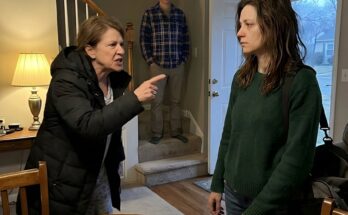
Twelve Days After Giving Birth, My Mother-in-Law Told Me I Didn’t Belong in the Family Photo
My husband looked away.
I didn’t cry.
I didn’t argue.
I simply reminded her whose house she was standing in.
The photographer had just raised her camera when my mother-in-law, Linda, looked straight at me and said, “You should step out of this one. It’s just for the real family.”
The room became silent in that uncomfortable way a room does when someone says something too hurtful for everyone to pretend they did not hear it.
My newborn son was asleep against my chest, wrapped in a pale blue blanket, his tiny face turned toward me, warm and trusting. We were standing in the living room of the house where I had brought him home only twelve days earlier. I was still tired, still healing, and still trying to understand how my body could feel so worn out and so full of love at the same time.
I waited for my husband to speak.
Daniel stood beside his father, one hand in his pocket, the other hanging uselessly at his side. He looked at his mother, then at the photographer, then at the floor.
He said nothing.
Linda gave me a tight smile, the kind people use when they want everyone watching to believe they are being reasonable.
“We’re not trying to upset you, honey,” she said. “We just want one nice picture with the immediate family.”
Immediate family.
I stared at her, and for one second, I honestly thought I had misunderstood.
I was the one caring for our baby in this house. I was the one feeding him, rocking him, and staying awake at two in the morning while Daniel slept through most of it. I was the one whose name was on the deed. My savings had covered the down payment. My credit had helped us qualify when Daniel’s business was struggling.
Yet there she was, treating me like a visitor in my own living room.
“Mom,” Daniel said softly.
But he did not say it like a man trying to stop something unfair. He said it like a man quietly hoping the problem would disappear on its own.
Linda sighed. “Don’t make a scene. Sarah can be in the next one.”
Sarah.
Not Mom.
Not Daniel’s wife.
Not the mother of the child in my arms.
Just Sarah.
Easy to leave out.
The photographer slowly lowered her camera. Daniel’s sister looked away. My father-in-law pretended to check his phone.
That was the moment something inside me became calm.
Not broken.
Not emotional.
Calm.
I stepped out of the frame exactly as Linda asked.
I even smiled.
She looked relieved, probably thinking she had won. Maybe she thought I was just one more exhausted new mother too tired to stand up for herself.
Daniel took his place beside her. The flash went off. They all smiled like they were posing for the perfect family picture.
Then I turned to the photographer and said calmly, “Could you take one of me and my son alone? In front of the fireplace?”
Linda blinked. “Excuse me?”
I adjusted my baby carefully in my arms and looked directly at her.
“Since we’re taking photos by family category,” I said, “let’s start with the owners of the house.”
Linda’s mouth opened, but no sound came out.
For the first time since she had walked into my house that afternoon with her pearl earrings, strong perfume, and carefully polished authority, she looked uncertain.
Not sorry.
Not ashamed.
Just uncertain, as if the floor beneath her had shifted slightly and she could not decide whether to step forward or step back.
The photographer glanced between us, clearly wishing she had chosen any other family to work with that day.
“Sure,” she said quietly. “In front of the fireplace?”
“Yes,” I answered. “Please.”
I walked past Linda without brushing against her. I did not move quickly. I did not storm away. I simply crossed the room with my son resting against my chest, his tiny mouth making soft sleeping movements against the edge of his blanket.
The fireplace mantel was decorated with eucalyptus garland and small white candles I had arranged that morning while Daniel slept in. Above it hung the painting I had bought three years earlier, before marriage, before pregnancy, before I knew how lonely a woman could feel inside a family full of people.
I stood there and turned toward the camera.
The photographer lifted her lens.
“Sarah,” Linda said sharply.
I did not look at her.
“Just a second,” I said.
The flash went off.
My son stirred, his little brow wrinkling. I kissed the top of his head and whispered, “It’s okay, Noah. Mommy’s got you.”
The photographer softened. “That was beautiful. Let me take one more.”
So she did.
One photo of me looking at the camera.
One photo of me looking down at my son.
One photo of his tiny hand curled around my finger.
With every click of the camera, the room grew heavier.
Behind me, I could feel Linda’s anger building. Daniel still said nothing. That silence had a shape now. I could feel it standing beside me. I could feel it settling into the walls of my home.
When the photographer lowered her camera, I turned around.
Linda had crossed her arms.
“That was unnecessary,” she said.
I smiled faintly. “So was asking a woman who just had a baby to step out of a family picture while she was holding the newborn.”
Her face flushed. “Don’t twist my words.”
“I didn’t have to.”
Daniel finally moved. He took one step toward me, then stopped.
“Sarah, can we just—”
“No,” I said.
The room went so quiet I could hear the baby breathing.
Daniel blinked. “No?”
“No,” I repeated calmly. “We are not going to smooth this over so everyone can pretend it didn’t happen.”
Linda let out a short laugh. “This is exactly what I meant. You always make things about yourself.”
I looked at her then.
Really looked at her.
There are moments when anger burns hot and reckless. But there are other moments when anger becomes cold and clear.
That was what I felt.
Not rage.
Clarity.
“You came into my home,” I said, “stood in my living room, in front of my husband, his family, and a stranger with a camera, and told me I wasn’t real family. You said that while I was holding my son.”
“Our grandson,” she snapped.
“My son,” I corrected. “Your grandson because he is my son.”
Daniel’s sister, Emily, shifted uncomfortably near the window. His father’s phone was still in his hand, but he was no longer looking at it.
Linda’s voice rose. “I was only asking for one picture.”
“No,” I said. “You were asking for a symbol. You wanted a picture where I didn’t exist.”
“That is ridiculous.”
“Is it?” I asked. “Because the picture you just took has my baby in it, my husband in it, my in-laws in it, my fireplace behind you, my furniture under you, my walls around you, and somehow I’m the only person who didn’t belong.”
Linda’s lips pressed together.
Daniel whispered, “Sarah, please.”
That word almost broke something in me.
Please.
Not “Mom, apologize.”
Not “Sarah is my wife.”
Not “She belongs here.”
Just please.
Please make this easier for me.
Please swallow it.
Please don’t force me to choose out loud when I already chose by staying quiet.
I turned to him.
“You looked away,” I said.
His face changed. Not much, but enough.
“Sarah—”
“No. You looked away.”
He swallowed. “I didn’t want to make it worse.”
“It was already worse.”
He ran a hand through his hair. “I was trying to keep the peace.”
I laughed once, softly, without humor.
“Whose peace, Daniel?”
He had no answer.
Linda seized the opening.
“This is between husband and wife. I won’t stand here and be disrespected.”
“You’re right,” I said. “You won’t.”
She straightened, thinking I was backing down.
I wasn’t.
I shifted Noah carefully in my arms, walked to the entry table, picked up Linda’s cream-colored coat, and held it out to her.
“You can leave now.”
For a moment, no one moved.
Linda stared at the coat as if it were something dirty.
“What did you just say to me?”
“I said you can leave now.”
Daniel’s head snapped up. “Sarah.”
I did not look at him.
“Your mother has made it clear that I’m not family. Visitors who are not family do not get to insult me in my own home and stay for cake.”
Linda looked at Daniel. “Are you hearing this?”
He looked trapped.
I almost felt sorry for him.
Almost.
Daniel’s father cleared his throat. “Maybe we should all cool down.”
“That sounds like a good idea,” I said, still holding the coat.
Emily grabbed her purse from the couch. “Mom, let’s go.”
Linda ignored her. She stared at Daniel like she could force him to stand up for her through sheer will.
“Are you going to let her kick your mother out?”
Daniel looked at me.
Then at his mother.
His silence answered before his mouth did.
“Sarah,” he said carefully, “maybe we should talk upstairs.”
I smiled then, and I think it scared him more than if I had shouted.
“No. We can talk right here. You had no problem letting me be embarrassed right here.”
Linda scoffed. “Embarrassed? Good grief, Sarah, you’re being dramatic.”
I took one step toward her.
“No, Linda. Dramatic is arranging a family photo in a house you didn’t buy, with a baby you didn’t carry, while trying to leave out the woman who did both.”
Her face turned red.
Daniel’s father stood. “Linda. Get your coat.”
That surprised all of us.
Linda turned on him. “Richard.”
He did not raise his voice.
“Enough.”
For the first time all afternoon, someone in Daniel’s family had used that word in the right direction.
Linda’s eyes narrowed, but she took the coat from my hand.
“This isn’t over,” she said.
I opened the front door.
“It is for today.”
She stepped onto the porch, stiff with anger. Emily followed, giving me a look I could not read. Richard paused near the door.
He looked at the baby, then at me.
“I’m sorry,” he said quietly.
It was not enough.
But it was something.
Then he left too.
The photographer stood near the fireplace, pale and frozen.
“I’m so sorry,” she whispered. “I can just send the pictures and—”
“You did nothing wrong,” I told her. “Please send me all of them.”
She nodded quickly, packed her bag, and left as if escaping the most uncomfortable photo session of her life.
When the door closed behind her, the house felt enormous.
Daniel and I stood alone in the living room with our sleeping son between us.
For weeks, I had imagined what motherhood would feel like. I had imagined exhaustion, fear, tenderness, milk-stained shirts, midnight feedings, and tiny socks disappearing in the laundry.
I had not imagined standing in my own house and realizing my husband was more afraid of disappointing his mother than of losing me.
Daniel took a step forward.
“Sarah,” he said.
I held up one hand.
“Don’t.”
His eyes were wet. “I froze.”
“No,” I said. “You chose.”
He flinched.
“That’s not fair.”
“Neither was what happened.”
“I know.”
“Do you?”
He rubbed both hands over his face. “Of course I do. It was awful. Mom was out of line.”
“Out of line?” I repeated. “A stranger cutting in front of you at the grocery store is out of line. Your mother told your wife she wasn’t real family while she was holding your newborn son.”
He looked down.
“I should have said something.”
“Yes.”
“I’m sorry.”
I wanted those words to matter.
I wanted them to matter so badly.
I wanted to collapse into him and believe that one apology could undo the sound of his silence. I wanted to be the kind of woman who could say, “It’s okay,” and mean it.
But I wasn’t.
Not anymore.
“Noah needs to eat,” I said.
Daniel looked up. “Can I—”
“No.”
I walked upstairs to the nursery and closed the door behind me.
I sat in the rocking chair beneath the soft yellow lamp and unbuttoned my blouse with shaking fingers. Noah woke just enough to feed, his tiny hand pressing against my skin.
Only then did I cry.
Not loudly.
Not dramatically.
Just silent tears falling onto my son’s blanket while he fed, warm and safe, unaware that the first family conflict of his life had just happened over whether his mother belonged in the picture.
Downstairs, I heard Daniel moving around.
A cabinet opening.
A chair scraping.
Then nothing.
My phone buzzed twenty minutes later.
A text from Emily.
I’m sorry about Mom. That was awful.
I stared at it.
Then another message came.
Daniel should’ve said something.
I closed my eyes.
When even his sister saw it, there was no room left for excuses.
I replied with only two words.
Thank you.
That evening, Daniel knocked gently on the nursery door.
“Can I come in?”
I had just put Noah down in his crib. His tiny arms were lifted beside his head, his mouth open in sleep.
I stepped into the hallway and closed the door behind me.
Daniel looked awful. His hair was messy from running his hands through it, his eyes red, his shoulders slumped.
“I called my mom,” he said.
My heart tightened. “And?”
“I told her she owed you an apology.”
I waited.
“She said you embarrassed her.”
I laughed under my breath.
Daniel winced. “I know.”
“No,” I said. “You don’t know. Because if you knew, you wouldn’t be standing here telling me what she said like it matters.”
He leaned against the wall. “She’s my mother.”
“And I’m your wife.”
“I know that.”
“Do you?”
He opened his mouth, then closed it.
I folded my arms carefully over my sore chest.
“Daniel, I need to ask you something, and I need you to be honest.”
“Okay.”
“When she said I should step out, did any part of you agree with her?”
His face twisted. “What? No.”
“Then why was it so hard to say?”
He looked away.
There it was again.
I nodded slowly. “Right.”
“No, Sarah, wait.” He reached for my hand, but I stepped back. “It’s not that I agreed with her. It’s just… you know how she is.”
I stared at him.
“I know how she is,” I said. “That’s exactly the problem. Everyone knows how she is, so everyone lets her be that way.”
He exhaled. “I grew up with this. You think I don’t know? If you push back, she gets upset. She cries. She makes everyone miserable for weeks. My dad shuts down. Emily leaves. And somehow I become the bad son.”
“So you decided I should become the bad wife instead.”
“No.”
“Yes.”
He looked hurt, but I could not comfort him for finally facing the result of his own silence.
“For years,” I said, “I have watched you shrink around her. I told myself it was complicated. I told myself family patterns are hard to break. I told myself you loved me in private, and maybe that could be enough while you learned how to love me in public.”
He looked at me with tears in his eyes.
“But today,” I continued, “I was holding our child, still healing, and you left me alone in a room full of your family.”
His voice cracked. “I’m sorry.”
“I believe you’re sorry.”
Relief flickered across his face.
“But I don’t know if you’re sorry enough to change.”
The relief disappeared.
For three days, the house became polite.
That was worse than fighting.
Daniel washed bottles. He changed diapers. He brought me water while I nursed. He asked if I needed anything, and I always said no, even when I did.
He slept in the guest room without protest after I placed his pillow and phone charger on the bed.
Linda did not apologize.
Instead, she posted the photo.
I saw it at 7:14 on Wednesday morning while Noah slept on my chest and the sun came weakly through the blinds.
There they were.
Linda seated in the middle of my couch, Daniel standing behind her, Richard on one side, Emily on the other, and my newborn son in Linda’s arms.
I had forgotten that after the first photo, Daniel had taken Noah from me for “just a second” when Linda insisted on holding him.
The caption read:
Three generations. My heart is full. Real family is everything.
Real family.
My body went cold.
There were comments already.
Beautiful family.
Linda, you look too young to be a grandmother!
Where’s the baby’s mama?
That last one was from Daniel’s aunt.
Linda had replied with a smiling emoji and nothing else.
Not “Taking the picture.”
Not “She’ll be in the next one.”
Nothing.
I took a screenshot.
Then another.
Then I sent them to Daniel.
He came upstairs two minutes later.
“I didn’t know she posted that,” he said.
I was sitting in bed, Noah against my shoulder, a burp cloth under his chin.
“But you knew the picture existed.”
Daniel looked at the screen. “The caption is bad.”
“The caption is honest.”
“No. It’s hurtful.”
“Hurtful words often reveal the truth.”
His jaw tightened. “I’ll tell her to take it down.”
“No.”
He blinked. “No?”
“No,” I said. “I want it to stay up.”
“Why?”
“Because I want everyone to see what she meant.”
He looked at me as if he did not understand.
So I opened my own page.
I posted the pictures the photographer had sent late the night before.
Me in front of the fireplace, holding Noah.
Me looking down at him.
His hand around my finger.
Then I wrote:
Twelve days postpartum. In my home. With my son. Exactly where I belong.
I did not mention Linda.
I did not mention Daniel.
I did not have to.
Within an hour, my phone was buzzing nonstop.
My sister called first.
“What happened?” she demanded.
The second I heard her voice, I broke.
Not the quiet crying from the nursery.
Not the contained tears of a woman trying not to disturb her baby.
I cried hard.
My sister, Rachel, listened while I told her everything. She did not interrupt once.
When I finished, she said, “Pack a bag.”
I laughed weakly. “For me or for him?”
“For whichever one of you has less claim to the house.”
That made me laugh for real, even through tears.
Then she said, “I’m serious, Sarah. You need support. I’m coming over.”
“You don’t have to.”
“I know. That’s why it’s called love.”
She arrived two hours later with groceries, coffee, and the expression of a woman fully prepared to defend her sister.
Daniel opened the door.
Rachel walked past him without greeting him.
“Where is she?”
“In the living room,” he said quietly.
Rachel found me on the couch with Noah asleep beside me in his bassinet.
She hugged me carefully, mindful of every sore part of me.
Then she turned to Daniel.
“I’m going to say this once,” she said. “Your mother is not welcome around my sister or this baby until Sarah says she is. Not you. Sarah.”
Daniel’s face hardened slightly. “This is between me and my wife.”
Rachel smiled.
It was not a warm smile.
“No, Daniel. It became a group issue when your mother posted my sister’s newborn under a caption about ‘real family.’”
He looked down.
Rachel stayed for six hours.
She cooked. She cleaned. She held Noah so I could shower without rushing. She changed the sheets on my bed and put fresh flowers on the nightstand because she said every woman who had recently created a human deserved flowers and a locked door.
Daniel tried to help, but Rachel moved around him like he was furniture.
That night, after she left, he found me in the kitchen.
“I took care of it,” he said.
I was rinsing pump parts at the sink.
“Took care of what?”
“The post. Mom deleted it.”
I shut off the water.
“Did she apologize?”
His silence answered.
I dried my hands slowly.
“Then you didn’t take care of it.”
He looked exhausted. “What do you want me to do, Sarah?”
I turned around.
“I want you to stop asking me to teach you how to be a husband.”
He stared at me.
“I want you to look at your wife and your child and understand, without a step-by-step guide, that protecting us is not optional. I want you to stop managing your mother’s emotions like they are weather patterns and start treating them like choices she makes. I want you to understand that peace built on my embarrassment is not peace. It is surrender.”
His eyes filled again.
“I’m trying.”
“No,” I said softly. “You’re reacting. Trying comes with a plan.”
He sat at the kitchen island and lowered his head into his hands.
For the first time, I saw not just the man who had failed me, but the boy who had been trained to disappear whenever his mother demanded the room.
I saw the years behind his silence.
The Sunday dinners where his father stared at his plate.
The birthdays where Linda cried because someone forgot to praise her enough.
The family vacations where everyone walked carefully around her moods.
I saw it.
But seeing it did not make it mine to fix.
“I made an appointment with a counselor,” he said suddenly.
I froze.
He looked up. “For myself. Friday morning.”
I did not know what to say.
“I also told my mother she can’t come over. Not until she apologizes to you directly and agrees not to post pictures of Noah without permission.”
My chest tightened.
“And?” I asked.
“She said I was being controlled.”
“Of course she did.”
“I told her if respecting my wife looks like being controlled, then maybe I should have been controlled sooner.”
I stared at him.
It was the first thing he had said that sounded like strength beginning to form.
I wanted to trust it.
But trust is not a door that swings open just because someone knocks once.
“That’s a start,” I said.
He nodded. “I know.”
The next two weeks were quiet in a different way.
Daniel went to counseling.
Linda sent long messages.
At first, they came to both of us.
I don’t know why you’re punishing me for wanting a picture with my grandson.
Then:
Sarah misunderstood me. I never said she wasn’t family.
Then:
Keeping a grandmother from her grandchild is hurtful.
Then, when neither of us responded:
Daniel, I hope you’re happy destroying your family.
Daniel showed me each message without defending her.
That mattered.
Not enough to erase the living room.
But enough to create a small crack in the wall between us.
At night, after Noah fell asleep, we talked.
Really talked.
Not about groceries, diapers, or pediatrician appointments.
About his childhood.
About my loneliness.
About the house.
That conversation came on a rainy Thursday when Noah was seven weeks old.
Daniel stood in the doorway of the bedroom while I folded tiny onesies.
“My mom thinks I bought this house,” he said.
I looked up slowly.
“What?”
He swallowed.
“She knows it’s ours, but I think she assumed… I don’t know. That I handled it.”
“You never corrected her?”
He looked ashamed. “Not clearly.”
My hands went still around a blue onesie.
“Daniel.”
“I know.”
“No,” I said. “You really don’t.”
“I didn’t lie exactly.”
I laughed, sharp and immediate.
“That is the sentence people use right before describing a lie.”
He sat on the edge of the bed.
“When we bought it, I told my parents we were closing on a house. Mom said she was proud of me. She said I was finally becoming the kind of man who could provide. I didn’t know how to say it was your savings, your credit, your planning. I felt embarrassed.”
I stared at the man I had married.
“You let your mother believe you provided this home because the truth hurt your pride?”
His face fell.
“Yes.”
The word landed between us like a stone.
There it was.
Not the whole wound, but a deeper one beneath it.
Linda had not created her entitlement from nothing.
Daniel had allowed it to grow through silence.
I stood and walked to the window.
Rain moved down the glass in crooked lines.
“All this time,” I said, “she treated me like I was living in your life because you let her believe that.”
“I didn’t think of it that way.”
“Because you didn’t have to. I was the one paying the emotional mortgage.”
He covered his face.
“I’m sorry.”
I was so tired of that sentence.
I turned around.
“Do you know why I put your name on the deed?”
He looked up.
“Because I trusted you,” I said. “Because I thought marriage meant building something together. Because I didn’t want you to feel like a guest in my house.”
His eyes filled.
“And you let your mother make me feel like a guest in mine.”
He cried then.
Quietly.
I did not comfort him.
The next morning, he called Linda on speakerphone.
I did not ask him to.
He came into the kitchen while I was making oatmeal and said, “You need to hear this.”
He dialed.
Linda answered on the second ring.
“Daniel, finally. Are you ready to stop this nonsense?”
Daniel closed his eyes.
“No, Mom. I’m calling to tell you the truth.”
“What truth?”
“The house is Sarah’s.”
Silence.
Then Linda laughed. “Don’t be ridiculous.”
“The down payment came from her savings. The mortgage approval came from her credit. Her salary carried us while my business was failing. My name is on the deed because she trusted me, not because I earned equal credit for it.”
My heart pounded so hard I had to grip the counter.
Linda’s voice sharpened. “Why would you embarrass yourself like this?”
“I’m not embarrassing myself. I’m correcting a lie.”
“You never lied to me.”
“I let you believe something that wasn’t true because it made me feel better. That was a lie.”
Another silence.
Then Linda said coldly, “I see what she’s done to you.”
Daniel’s jaw tightened.
“No. You don’t get to blame Sarah for my honesty.”
“She has turned you against your own mother.”
“No, Mom. You did that when you told my wife she wasn’t real family while standing in the home she created.”
“I wanted one photograph!”
“You wanted her erased.”
Linda gasped. “How dare you speak to me this way?”
Daniel looked at me.
His voice shook, but he did not stop.
“I should have spoken this way years ago.”
My eyes filled before I could stop them.
Linda began crying loudly.
“I sacrificed everything for you,” she said. “Everything. And now some woman—”
“My wife,” Daniel interrupted.
“She is tearing this family apart.”
“No,” he said. “The family is changing because I’m not letting you hurt her anymore.”
Linda’s crying stopped.
Her voice dropped low.
“If you choose her over your mother, don’t expect me to come running when she leaves you.”
Daniel closed his eyes.
“I already almost lost her because I kept choosing you.”
Then he hung up.
The kitchen was silent except for the oatmeal bubbling on the stove.
Daniel set the phone down.
His hands were shaking.
I wanted to go to him.
I didn’t.
But I did say, “Thank you.”
He looked at me like those two words were more than he deserved.
Maybe they were.
Healing did not come quickly.
I wish I could say that one phone call fixed everything.
That Daniel became brave overnight.
That Linda reflected, apologized, and arrived at our door with humility in her hands.
That is not what happened.
Linda escalated.
She called relatives. She cried. She told people I was emotional after childbirth. She suggested I was isolating Daniel. She said I was using the baby against her. She told anyone who would listen that I had kicked her out of the house for wanting a family picture.
Some believed her.
Some didn’t.
The surprising thing was how little I cared.
Motherhood had stripped me down to essentials.
Sleep.
Food.
Safety.
Love.
Truth.
I had no energy left for managing adults who preferred comfortable lies.
So when Daniel’s aunt messaged me saying, I hope you and Linda can work this out. Grandmothers are important, I replied:
So are mothers.
Then I put my phone down and took Noah for a walk.
Daniel kept going to counseling.
We started marriage counseling when Noah was ten weeks old.
The first session was difficult.
The therapist, a calm woman named Dr. Patel, asked Daniel what had happened.
He told the story.
Accurately.
No softening.
No “misunderstanding.”
No “everyone was emotional.”
He said, “My mother told my wife she wasn’t real family, and I didn’t defend her.”
Dr. Patel asked why.
Daniel stared at the carpet for a long time.
Then he said, “Because I was more afraid of my mother’s reaction than my wife’s pain.”
There are sentences that do not heal the wound but clean it.
That was one of them.
When it was my turn, I told Dr. Patel that I did not know how to feel safe with a man who loved me privately but left me standing alone publicly.
Daniel cried.
I cried too.
But this time, neither of us looked away.
A month passed.
Then two.
Linda did not see Noah.
She sent gifts.
I returned them.
She mailed a handwritten letter addressed only to Daniel.
He read it, then handed it to me.
It was six pages of blame disguised as heartbreak.
I did not finish it.
“What do you want to do?” I asked.
Daniel took it back and tore it in half.
That mattered too.
Slowly, the house changed.
Not in dramatic ways.
In small ones.
Daniel began correcting people.
When a neighbor congratulated him on “buying such a beautiful home,” he smiled and said, “Sarah made this happen. I was lucky she let me build a life here with her.”
When his cousin asked when Linda could meet Noah, Daniel answered, “When she apologizes and respects Sarah’s boundaries.”
When Emily came by, she hugged me first.
“I should have said something that day too,” she admitted while we sat at the kitchen table drinking tea.
I looked at her.
“Yes,” I said.
She nodded, accepting it.
“I’m sorry.”
I believed her.
Richard came by once, alone, carrying a small wooden rocking horse he had made in his workshop.
He stood awkwardly on the porch until I invited him in.
“I won’t stay long,” he said.
Noah was asleep in the bassinet.
Richard looked at him with such softness that my anger toward him shifted. It did not disappear, but it became more complicated.
“I should have stopped her sooner,” he said.
I did not rescue him from the silence.
He nodded, as if he knew he deserved it.
“I spent a long time thinking keeping quiet made things calmer,” he continued. “It didn’t. It just made Linda louder.”
I thought of Daniel.
“Yes,” I said. “It does that.”
Richard looked at me.
“I’m sorry, Sarah.”
This time, it felt like an apology.
Not enough to fix everything.
But enough to mark a door that might someday open.
Linda remained outside it.
When Noah was four months old, she finally requested to meet.
Not through Daniel.
Through me.
Her text arrived on a Tuesday afternoon.
Sarah, I would like to come see my grandson. I think enough time has passed.
I stared at the message.
Not “I’m sorry.”
Not “I was wrong.”
Just “enough time has passed,” as if time itself were an apology.
I showed Daniel.
He read it and sighed.
“What do you want to say?” he asked.
A year earlier, he would have said, “Maybe we should just let her come.”
A year earlier, I might have agreed to keep the peace.
But I was no longer sacrificing myself for a peace no one else protected.
I typed:
Enough time has passed for reflection. It has not produced an apology. Until you can acknowledge what you said, why it was wrong, and agree to respect me as Noah’s mother, there will be no visit.
She replied three minutes later.
I am sorry you feel hurt.
I showed Daniel.
He shook his head.
“Not an apology,” he said.
“No,” I agreed. “It isn’t.”
I did not respond.
That evening, Daniel took Noah after his bottle and walked him around the living room, humming off-key.
I watched them from the couch.
The same living room.
The same fireplace.
But something had changed.
Maybe not enough.
Maybe enough to continue.
I still had days when I looked at Daniel and saw him looking at the floor. Days when resentment rose in me without warning. Days when I wondered whether love could survive the memory of someone’s failure to stand beside you.
But then there were days when he stood between us and the world with a steadiness I had never seen in him before.
Healing was not forgetting.
It was watching what someone did with the memory.
Six months after the photo incident, the photographer emailed to ask if we wanted to book a holiday mini session.
She wrote carefully, politely, as if approaching a nervous animal.
I laughed when I saw it.
Daniel was sitting beside me on the couch.
“What?” he asked.
I turned the laptop toward him.
His face went pale, then embarrassed.
“We don’t have to,” he said quickly.
I looked toward the fireplace.
Noah was on a blanket on the floor, trying very hard to roll over and getting frustrated at his own arm for being in the way.
“Actually,” I said, “I think we should.”
Daniel studied me. “Are you sure?”
“Yes.”
So we booked it.
Not with Linda.
Not with Richard.
Not with Emily.
Just us.
The photographer arrived on a bright Sunday morning in November. She looked relieved when I opened the door smiling.
The house smelled like cinnamon rolls.
Noah, now chubby and bright-eyed, wore a green sweater and tiny socks that looked like bears.
Daniel wore the navy shirt I liked.
I wore a cream dress that made me feel soft and strong at the same time.
We stood in front of the fireplace.
The photographer lifted her camera.
Daniel looked at me before she took the picture.
“You belong here,” he said quietly.
My throat tightened.
“I know,” I answered.
And I did.
That was the difference.
The first time, I had needed to say it like a shield.
This time, I knew it like a fact.
The camera flashed.
Noah squealed and grabbed my hair.
Daniel laughed, and I laughed too, and the photographer captured that one.
The three of us imperfect, moving, real.
Later, when the gallery arrived, one photo stopped me.
In it, I was holding Noah on my hip. Daniel stood beside me, one hand resting gently on my back. He was not centered. He was not performing. He was looking at me, not the camera, with an expression I had once begged for without words.
Pride.
Not possession.
Not convenience.
Pride.
I printed that photo.
I framed it in simple black wood.
Then I hung it above the mantel, replacing the painting I had bought before everything.
A week before Christmas, a card arrived from Linda.
Daniel found it in the mailbox.
He brought it inside and handed it to me unopened.
“You can decide,” he said.
I looked at the envelope.
Her handwriting was elegant, controlled, familiar.
For a long moment, I felt the old pull.
The pressure to be gracious.
To make things easier.
To think of the baby, of the family, of the holidays.
To accept crumbs and call them a meal.
Then Noah laughed from his play mat, a bubbling sound that filled the room.
I opened the card.
Inside was a picture of a snowy church and one sentence written beneath the printed greeting.
I hope one day you can forgive me for whatever you think I did.
I read it twice.
Then I handed it to Daniel.
His jaw tightened.
“I’m sorry,” he said.
I walked to the fireplace, struck a match, and held the corner of the card to the flame.
Daniel watched silently as it caught.
The paper curled inward, darkening at the edges, the snowy church disappearing into ash.
I dropped it into the fireplace.
For once, letting something burn did not feel angry.
It felt clean.
Daniel came to stand beside me.
“What now?” he asked.
I looked at the framed photo above the mantel.
Our son.
Our home.
Our family.
“Now,” I said, “we have Christmas.”
And we did.
We made cinnamon rolls badly, burning the first batch and laughing through the second.
We dressed Noah in red pajamas.
Rachel came over with too many presents.
Emily visited the next day and brought a soft blue elephant.
Richard stopped by after New Year’s and left a handmade shelf for Noah’s books.
Linda did not come.
The world did not end.
Noah still laughed.
The house still stood.
The family that was willing to love us honestly remained.
The family that required me to disappear stayed outside.
Months later, when Noah turned one, we threw a small birthday party in the backyard.
There were balloons tied to the fence, cupcakes on the patio table, and a banner Rachel had made that said HAPPY BIRTHDAY, NOAH in crooked blue letters.
Daniel grilled.
Emily chased Noah across the grass.
Richard sat under the oak tree assembling a wooden toy truck he claimed was “simple” and then spent forty minutes fixing.
Near sunset, Daniel came up beside me while I watched Noah smash cake into his own hair.
“I got something for you,” he said.
I raised an eyebrow. “It’s not my birthday.”
“I know.”
He handed me a small envelope.
Inside was a folded legal document.
I read the first page.
Then the second.
My breath caught.
It was a postnuptial agreement, already drafted by his attorney, stating clearly that if our marriage ever ended, the house would remain mine. The equity tied to my original down payment and financial contributions would be protected.
He had signed his portion.
I looked up at him.
“I should have done it a long time ago,” he said. “You trusted me when I hadn’t earned it. I want to earn it now.”
For a moment, I could not speak.
“This doesn’t fix everything,” he added quickly.
“No,” I said. “It doesn’t.”
“But?”
I looked at the house. At the windows glowing gold in the evening light. At the door I had opened for people who loved me and closed against people who didn’t. At our son, shrieking with joy as frosting slid down his wrist.
“But it tells the truth,” I said.
Daniel nodded.
“That’s where I want to live now,” he said. “In the truth.”
I folded the papers carefully and held them against my chest.
Across the yard, Rachel caught my eye. She looked from the envelope to my face and mouthed, You okay?
I smiled.
Yes, I mouthed back.
And I was.
Not because everything was perfect.
Not because Linda had changed.
She hadn’t.
She sent one gift for Noah’s birthday, a silver picture frame engraved with Our Grandson.
No mention of me.
No apology.
No accountability.
I returned it.
This time, Daniel drove it to the post office himself.
That night, after the party ended and Noah finally fell asleep, I stood alone in the living room.
The house was messy.
Tissue paper on the floor.
A frosting stain on the rug.
Half-empty cups on the coffee table.
One blue balloon drifting tiredly near the ceiling.
The framed family photo hung above the fireplace.
I thought about the woman I had been a year earlier, standing in that same room, exhausted and healing, holding a newborn while someone told her she had no place.
I wished I could reach back through time and take her hand.
I would tell her: You are not too sensitive.
I would tell her: His silence is not your burden to excuse.
I would tell her: A family that only has room for you when you are useful is not a family. It is an audience.
Most of all, I would tell her: One day, you will stop asking where you belong.
Because you will build the answer yourself.
Daniel entered quietly behind me.
“Noah’s asleep,” he said.
I nodded.
He came to stand beside me, not touching me at first.
Waiting.
Letting me choose.
I reached for his hand.
He held it carefully.
For a while, we stood there together in front of the fireplace.
Then he said, “I still think about that day.”
“So do I.”
“I hate who I was in that moment.”
I looked at him.
“Good,” I said softly.
He gave a small, sad laugh. “Good?”
“Yes. Some things should hurt to remember. That’s how you know not to become that person again.”
He nodded.
Outside, the backyard lights swayed in the wind.
Inside, the house settled around us, warm and imperfect and ours in the ways that mattered most.
A year ago, Linda had tried to make a picture without me.
Now there was a new picture above the mantel.
And this one told the truth.
I was not standing outside the frame.
I was not waiting to be invited in.
I was the woman who had opened the door, held the baby, paid the bills, signed the papers, survived the silence, demanded the truth, and chosen what kind of family my son would grow up seeing.
Not a perfect family.
Not a painless one.
A real one.
And in the end, that was the only kind worth keeping.
The End.
- The Letter My Grandmother Left Before the Family Trust Burned Open
 PART 3 — COMPLETE ENDING Preston stood there with both hands gripping the back of the chair in front of him. For most of my life, my older brother had …
 - My Sister Called Me Legally Stupid, Then Her Lawyer Learned Who I Was
 PART 3 — COMPLETE ENDING The hearing did not last much longer after that. Blake Monroe stood behind his table with one hand resting on the back of his chair, …
 - My Mother Left Me Protection, Not Obligation
 PART 3 — COMPLETE ENDING By the time I reached Marianne Cole’s office, Ethan had called me eleven times. The first few calls came one after another, sharp and desperate, …
 - MY PARENTS KICKED MY 14-YEAR-OLD DAUGHTER OUT—THEN I CAME HOME WITH PROOF THE HOUSE WAS MINE
 PART 2 — FULL CONTINUATION WITH COMPLETE ENDING: My father stared at the first page like the words had rearranged themselves just to betray him. At first, his face held …
 - GRANDPA STOPPED EATING WHEN HE FOUND OUT I PAID RENT WHILE MY SISTER LIVED FREE
 Grandpa’s words stayed suspended over the Thanksgiving table like thunder waiting to break. Get your coat. You’re coming home with us. For a few seconds, no one moved. My nephews, …