Part 2
“My name is Gerald Maize,” he said.
His voice was calm and deep, the kind of voice that made you feel safe even when your whole world was falling apart.
I held the hospital blanket close to my chest, my voice barely above a whisper. “Who are you? Why are you here?”
Gerald looked down at his hands.
They were worker’s hands. Broad. Scarred. Thick-knuckled. The kind of hands that had built things, fixed things, and held life together when everything else wanted to fall apart.
For a moment, he said nothing.
Then he slowly reached inside the pocket of his worn gray jacket and pulled out a folded envelope. Its edges were soft from years of being opened and closed. He held it like it was something precious.
“I suppose,” he said quietly, “I’m the man who should have been here a long time ago.”
My heart monitor gave a small, uneven beep.
“What does that mean?” I asked.
His eyes lifted to mine. There was pain in them. Not the dramatic kind of pain my mother used when she wanted sympathy. This was older. Quieter. The kind of pain that had lived inside someone for years.
“It means your mother lied to both of us.”
A chill moved through me, even though the hospital room was warm.
I tried to sit up, but pain pulled across my stomach, and I gasped.
Gerald moved quickly, half rising from his chair.
“Don’t,” he said gently. “You’ve got stitches. Easy.”
I sank back against the pillow and breathed through the pain.
“What lie?” I whispered.
Gerald opened the envelope.
Inside was an old photograph.
The colors were faded by time. A young woman stood in front of a red pickup truck, wearing a yellow sundress and laughing in the sunlight. Beside her stood a younger Gerald, maybe twenty-seven, with dark hair and one arm around her waist.
The woman was my mother.
Not the polished Eleanor Crawford I knew. Not the pearl-wearing woman who smiled only when important people were watching. This woman looked alive. Happy. Free.
I stared at the photo until my eyes burned.
“That’s my mother,” I said.
Gerald nodded.
“And that was me, a very long time ago.”
I swallowed. “Were you… friends?”
A sad smile crossed his face.
“No, Holly. We were more than friends.”
The monitor beside me seemed louder.
Gerald took another paper from the envelope. It was a letter, written in old-fashioned, slanted handwriting.
“I loved Eleanor before she became Eleanor Crawford,” he said. “Back then, she was Ellie Hart. We were young, poor, and hopeful. We had a little rental house picked out near the lake. I had a job at the mill. She was taking classes at the community college. We were going to get married.”
He paused.
“Then her parents found out she was pregnant.”
The air left my lungs.
For several seconds, all I heard was the machine beside me.
Pregnant.
My mother.
Gerald.
I could not make the pieces fit.
Gerald’s voice grew rough.
“Her family hated me. They said I was beneath her. They said I would ruin her life. I had grease under my nails and no inheritance. Richard Crawford, on the other hand, had a family name, a business degree, and a father who owned half the real estate in town.”
“My father,” I said automatically.
Gerald’s jaw tightened.
“The man who raised you.”
The words landed heavily.
“I don’t understand,” I whispered.
“I didn’t either,” Gerald said. “Not for twenty-six years.”
He looked toward the window, where the morning light was turning the blinds silver.
“Ellie disappeared for three weeks. She wouldn’t answer my calls. She wouldn’t see me. Her mother told me she had gone to stay with relatives. Then one day, I got this.”
He handed me the letter.
My fingers trembled as I unfolded it.
Gerald,
I lost the baby.
Please do not contact me again. I cannot bear to be reminded of it.
Ellie.
That was all.
Three sentences.
Three sentences that had buried an entire life.
“I thought you were gone,” Gerald said, his voice breaking. “I thought my child was gone before I ever got to hold her.”
I looked up at him.
He was crying silently. Tears slipped down into the lines of his face and disappeared into his gray beard.
Something inside me broke open.
I had spent my whole life feeling like an unwanted guest in my own family. Like a chair pulled up to the table because someone had forgotten to remove it.
My sister, Claire, was celebrated for everything.
When Claire got good grades, there was cake.
When I won a writing contest, my mother said, “That’s nice, but don’t brag.”
When Claire made mistakes, everyone forgave her.
When I made mistakes, I was treated like a problem.
When Claire got pregnant, my parents filled their house with balloons, gifts, and excitement.
When my appendix ruptured, I became an inconvenience.
And now a stranger sat beside me with twenty-six years of grief in his hands, telling me that maybe I had not been unwanted after all.
Maybe I had been taken from someone who would have loved me.
“How did you know I was here?” I asked.
Gerald wiped his face with the back of his hand.
“That part still feels unreal. I almost didn’t come to the hospital that night. My friend Owen had surgery, and I stopped by to bring his wife coffee. I was near the nurses’ desk when I heard a woman raising her voice.”
“My mother.”
He nodded.
“She was dressed like she was going to a garden party. Pearls, pink coat, perfect hair. She kept saying, ‘My daughter exaggerates. She doesn’t need to stay. We have family obligations tomorrow.’ The nurse told her your appendix had ruptured and that you needed close care. Then your mother said…”
He stopped.
I already knew it would be something polished and cruel.
Gerald forced the words out.
“She said, ‘Holly has always known how to ruin important moments.’”
A tear slid down my cheek and into my hair.
I did not sob.
I was too tired for that.
“Then Dr. Reeves came out,” Gerald said. “He said your name. Holly Crawford.”
He looked at me with pain and wonder.
“I had not heard that first name in twenty-six years without feeling like something sharp was pressing under my ribs. Holly. That was the name Ellie and I chose together. She wanted something pretty because you were due in December. I wanted something strong enough to survive winter.”
I covered my mouth.
Gerald continued softly.
“I asked the nurse your birthday. She couldn’t tell me, of course. But your mother said it while arguing. December seventeenth. And I knew.”
My birthday.
December seventeenth.
Chosen.
Not random.
Chosen.
“Why didn’t you say anything to her?” I asked.
“I did.”
His expression changed. The warmth faded, replaced by something harder.
“I asked her if she remembered Gerald Maize.”
The room seemed smaller.
“What did she do?”
“She went pale. Then she told security I was bothering her.”
I almost laughed, but it came out as a dry cough that made my stitches ache.
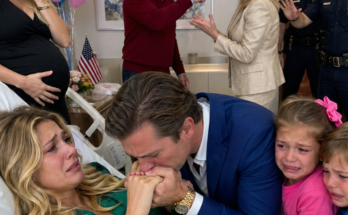
Gerald reached for the water cup and held the straw to my lips. It was such a simple, careful gesture.
So fatherly.
I drank and hated that I wanted to cry again.
“Dr. Reeves said you stopped her,” I said.
Gerald nodded. “She tried to sign discharge papers. She claimed she had authority as your mother. But you’re twenty-six. Unless you gave her legal power, she had nothing. She just spoke loudly enough that people started doubting themselves.”
“That’s her gift,” I whispered.
“So I stepped in. I told the doctor I would cover whatever needed covering. Private room, extended stay, medicine, follow-up care. I said no one was taking you anywhere unless you asked to go.”
I stared at him.
“But why would you pay for me? You didn’t even know for sure.”
Gerald leaned forward.
“No. I didn’t know for sure. But I knew this: either you were my daughter, or you were a young woman whose own mother was trying to pull her out of a hospital bed after she nearly lost her life. Either way, you needed someone standing there who was not willing to let that happen.”
For the first time since waking up, the tightness in my chest loosened.
Not completely.
But enough to breathe.
A nurse stepped inside with medicine. Her name badge read Maria. She smiled at Gerald first, then at me.
“How are we doing?”
I did not know how to answer.
Alive felt too small.
Broken felt too dramatic.
“Confused,” I said.
Maria smiled gently. “That’s fair. Pain?”
“Seven.”
“Let’s bring that down.”
As she adjusted my IV, Gerald stood.
“I should let you rest.”
Panic rose in me so quickly it surprised us both.
“Don’t go.”
The words came out before pride could stop them.
Gerald froze.
Then his whole face softened.
“I won’t go far.”
Maria glanced between us. “Visiting hours are flexible in this ward for immediate family.”
Immediate family.
I had spent my life being told family meant blood, duty, appearances, and silence.
But Gerald had protected me before he even had proof I belonged to him.
I turned to Maria.
“He can stay.”
Gerald sat down again.
And for the first time in my life, someone stayed because I asked.
My mother returned at noon.
I was asleep when she entered, but the sharp click of her heels woke me.
Some sounds carry memories. My mother’s footsteps were one of them. Growing up, I could tell by those clicks whether she was angry, disappointed, or preparing to act kind for an audience.
Today, the clicks were quick.
Angry.
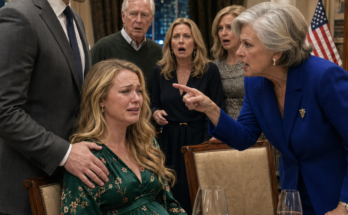
Eleanor Crawford stood in the doorway wearing a cream blouse, gold earrings, and the expression of a woman insulted by reality. Behind her was Richard, the man I had called Dad, tall and stiff with a coffee cup in his hand.
Beside them stood Claire, one hand on her pregnant belly.
Her hair was curled. Her nails were painted pale pink. She looked like her special day had been interrupted.
“Holly,” my mother said tightly. “You’re awake.”
Gerald stood slowly beside my bed.
My father saw him and frowned.
Claire looked between us. “Who is that?”
My mother’s mouth thinned.
“No one,” she snapped.
Gerald did not move.
I had never seen my mother truly afraid before. I had seen her irritated, offended, embarrassed, and furious. But fear was new.
It made her look smaller.
“He is not no one,” I said.
My voice was weak, but the room went still.
Mother’s eyes cut to me. “You need rest. We’ll discuss this when you’re thinking clearly.”
“I’m thinking clearly enough.”
Claire sighed. “Can we not do this right now? I have guests arriving tomorrow morning, and Mom has been upset all night.”
I looked at her.
“Upset?”
Claire blinked, annoyed. “Yes, Holly. This has been stressful for everyone.”
I laughed once.
It hurt so badly that tears filled my eyes.
Stressful.
For everyone.
I had nearly lost my life. My sister had been inconvenienced.
“Claire,” Gerald said quietly, “your sister nearly lost her life.”
Claire turned to him. “And you are?”
Before he could answer, my mother stepped forward.
“He is a man from my past who has no business here.”
Gerald looked at her.
“Eleanor.”
Just her name.
But the way he said it cracked something in her polished surface.
My father stiffened.
“Ellie,” Gerald said.
My mother flinched.
My father noticed.
“What did he call you?”
“No one calls me that anymore,” she snapped.
Gerald reached into his jacket and removed the photograph. He did not hand it to her. He simply held it up.
My father stared.
Claire leaned closer. “Mom? Is that you?”
My mother’s face changed.
For years, I had wondered what she would look like without control.
Now I knew.
“This is inappropriate,” she said. “Holly is medicated. You are taking advantage of her.”
“I’m telling her the truth,” Gerald replied.
My father’s voice lowered. “What truth?”
Mother spun toward him. “Richard, not here.”
“Oh, I think here is perfect,” I said.
Everyone looked at me.
My hands shook under the blanket, but anger was keeping me upright.
“You came here to have me released,” I said to my mother.
Her eyes flashed. “I came here to make sure you weren’t turning a minor issue into a spectacle.”
“My appendix ruptured. I was in critical condition. My heart stopped for a moment.”
“Doctors exaggerate to protect themselves.”
Dr. Reeves entered the room at that exact moment.
“No, Mrs. Crawford,” he said coldly. “We do not exaggerate that.”
My mother turned, startled.
Dr. Reeves stood in the doorway with Maria behind him.
“Holly Crawford was in critical condition,” he said. “She required emergency surgery, strong antibiotics, and immediate medical support. Any attempt to remove her from care would have put her in serious danger.”
My father looked shaken for the first time.
“Her heart stopped?” he asked.
My mother shot him a look. “Richard—”
“You said she was being dramatic.”
“I said she tends to be dramatic.”
“I nearly lost my life,” I said.
My father looked at me.
For one brief moment, I saw horror in his face. Maybe guilt. Maybe fear of judgment. With Richard Crawford, it was hard to tell.
Claire rubbed her belly.
“Okay, this is obviously serious, but the shower—”
“No,” I said.
The word cut through the room.
Claire’s mouth opened.
I had never interrupted her before.
No one in our family interrupted Claire.
So I did it again.
“No. You do not get to stand beside my hospital bed and mention your baby shower like it belongs in the same sentence as my heart stopping.”
Her face crumpled, but not with regret. With offense.
“I didn’t ask you to get sick!”
“And I didn’t ask you to care,” I said. “Clearly, that would have been too much.”
My mother stepped closer. “That is enough.”
Gerald moved between us.
He did not raise his voice. He simply placed himself in the space between my mother and me.
“No closer,” he said.
My mother stared at him.
“How dare you?”
“With twenty-six years of practice,” he replied.
Silence.
Then my father said, “Eleanor, who is this man?”
My mother pressed her lips together.
Gerald answered for her.
“My name is Gerald Maize. Before she married you, Eleanor and I were engaged. She was pregnant. She told me the baby was gone.”
My father went pale.
Claire whispered, “What?”
I watched my mother.
She did not deny it.
Not right away.
That was how I knew.
The truth had entered the room, and even Eleanor Crawford could not hide it fast enough.
My father’s coffee cup slipped from his hand and hit the floor.
“Pregnant,” he said.
Mother lifted her chin. “It was complicated.”
Gerald’s voice hardened. “You told me my child was gone.”
“I was nineteen!”
“You lied.”
“I did what I had to do.”
“For who?” I asked.
Her gaze snapped to me.
For a moment, the old instinct rose in me. Shrink. Apologize. Make her comfortable.
But I was connected to tubes. Cut open. Bruised from emergency care. My body had fought harder for me than my family had.
I owed her nothing.
“For who?” I repeated.
My mother’s expression twisted.
“For all of us,” she said. “You have no idea what it was like. My parents were threatening to disown me. Richard’s family would never have accepted me if they knew. Gerald had nothing. Was I supposed to throw my life away?”
Beneath her explanation was the answer to every question I had ever carried.
Why did she resent me?
Because I was proof.
Why did Richard keep his distance?
Because some part of him had always known.
Why did Claire receive tenderness while I received tolerance?
Because Claire belonged to the life my mother chose.
I belonged to the life she buried.
“You threw me away instead,” I said.
My mother’s eyes glistened, but I knew better than to trust tears.
“I raised you.”
“No,” I said. “You housed me.”
Richard made a broken sound.
Claire whispered, “Dad?”
He turned to my mother.
“Did you know?” he asked. “Did you know Holly wasn’t mine?”
My mother hesitated one second too long.
Richard stepped back.
“You told me she was premature.”
“She was premature.”
“By two months?”
“I did what was necessary.”
“For your reputation,” Gerald said.
My mother’s control finally broke.
“Yes,” she hissed. “For my reputation. For my future. For security. For a life better than fixing pipes and counting pennies.”
Gerald’s face went still.
Then he gave a small, sad nod.
“There she is,” he said.
Gerald turned away from her and looked at me.
“Holly, I don’t know what you want from here. I won’t force a place in your life. I won’t ask for anything you are not ready to give. But I would like your permission to request a DNA test.”
My throat tightened.
My whole life had been shaped by people making decisions around me, over me, and for me.
Gerald asked.
That mattered.
“Yes,” I said.
My mother laughed once, sharp and desperate.
“This is absurd. She’s barely conscious. You can’t trust anything she says.”
Dr. Reeves stepped forward.
“Mrs. Crawford, you need to leave.”
My mother turned on him. “Excuse me?”
“This is a recovery ward, not a courtroom. You are upsetting my patient. If Holly wants visitors, they stay. If she wants anyone removed, they leave.”
My mother looked at me.
There it was.
The old silent order.
Fix this, Holly.
Make me look good.
Make me feel powerful again.
I took a slow breath.
“I want her removed,” I said.
The room went silent.
My mother’s eyes widened.
“What did you say?”
I looked at Maria.
“I don’t want Eleanor Crawford in my room.”
Maria nodded. “Of course.”
My father stepped forward. “Holly—”
I looked at him.
For years, I had wanted him to choose me. Just once.
In that moment, I gave him the chance.
“You can stay,” I said quietly. “But only if you stop defending her.”
He looked at me.
Then at my mother.
My mother’s face sharpened. “Richard.”
That one word carried years of control.
My father closed his eyes.
Then he picked up his coat.
“I’ll drive Claire home,” he said.
Not “I’ll stay.”
Not “I’m sorry.”
Not “I should have answered the phone.”
Just another exit.
Claire stared at me. “This is unbelievable. You always have to make everything about you.”
I almost smiled.
“Not anymore.”
Security arrived.
My mother did not scream. That would have been too honest. Instead, she gathered her purse, smoothed her blouse, and walked out with icy dignity.
At the doorway, she turned back.
“You will regret this.”
Gerald stood beside my bed.
“No,” he said. “She won’t.”
And somehow, I believed him.
The DNA test took nine days.
In those nine days, Gerald came every morning with coffee he never drank and a book he never opened. He sat beside me while nurses checked my incision, while doctors changed my medicine, while my body relearned how to stay alive.
He did not ask me to call him Dad.
He did not ask me to forgive him for something he had not done.
He told me stories instead.
He told me about the red pickup truck in the photograph. He told me about the little house by the lake that he and my mother almost rented. He told me that he once bought a yellow crib from a yard sale and hid it in his friend’s garage because he wanted to surprise her.
“What happened to it?” I asked.
Gerald looked out the window.
“I kept it for two years after she said you were gone. Then I gave it to a shelter.”
My chest hurt in a place surgery had not touched.
On the fourth day, Gerald brought a small wooden box.
Inside were things he had saved for the child he thought he lost.
A tiny pair of knitted green booties.
A receipt for a music box.
A folded list of baby names.
Holly was circled.
Three times.
“You chose me,” I whispered.
Gerald’s eyes filled.
“Before I knew your face.”
When the DNA results came, we sat at his kitchen table staring at the envelope between us.
I opened it with shaking hands.
The paper was full of clinical language, but one line stood out.
Probability of paternity: 99.9998%.
Gerald made a sound I will never forget.
It was the sound of a man getting back something he had grieved for twenty-six years.
He pressed the paper to his chest.
“My daughter,” he whispered.
The word entered me gently.
Daughter.
Not burden.
Not problem.
Not too dramatic.
Daughter.
I cried then.
Not quiet, controlled tears.
I cried with my whole body.
Gerald wrapped his arms around me with careful tenderness.
And somehow, his gentleness was what finally broke me open.
My mother found out two days later.
Richard called.
I almost did not answer, but his name on the screen felt like a door I had not fully closed.
“Hello?”
Silence.
Then he said, “Holly.”
“Richard,” I said.
He noticed.
Not Dad.
“Your mother told me about the test.”
“Did she tell you the result?”
“Yes.”
Another silence.
“I didn’t know,” he said.
That was the closest he had come to an apology.
“I believe you.”
“She lied to me too.”
“Yes.”
“But I raised you.”
I closed my eyes.
“No,” I said softly. “You were in the house while I grew up.”
He said nothing.
“Do you remember my college graduation?” I asked. “You left early because Claire had a headache. She was hungover.”
Silence.
“Do you remember when I had pneumonia at sixteen and you and Mom went on vacation because the reservation was nonrefundable? Do you remember telling me I was too sensitive when Mom forgot my birthday dinner? Do you remember any moment where you protected me?”
His breathing changed.
Then he said something I never expected.
“I was a coward.”
I sat down.
Richard Crawford had never admitted weakness.
“I knew something was wrong,” he continued. “Not about the paternity. But the way she treated you. I told myself it was mother-daughter conflict. I told myself you were difficult. I told myself anything that let me keep the peace.”
“Peace for who?”
“For me,” he said.
The honesty hurt.
But it was something.
“What do you want, Richard?”
He was quiet for a long time.
“Your mother wants you to come to the house tomorrow.”
“Absolutely not.”
“She says if you don’t, she’ll come to Gerald’s.”
My blood went cold.
“She doesn’t know where I am.”
“Claire told her. She saw Gerald’s address on one of the hospital forms.”
I stood too fast, pain flashing through me.
“Why would Claire have access to that?”
“I don’t know.”
“Yes, you do. Because none of you understand boundaries.”
Richard sighed. “Holly, your mother is spiraling. She’s talking about lawyers, reputation, fraud—”
“Fraud?” I snapped. “She lied about my father for twenty-six years.”
“I know.”
“No. You all had twenty-six years to know me.”
My voice shook.
Gerald looked up from the garden outside and immediately stood.
Richard said, “I’m sorry.”
Two words.
Small.
Late.
Maybe real.
But sorry is not a bridge. It is only the first stone.
“I believe you,” I said. “But I’m not ready to forgive you.”
“I understand.”
Then he said, “Holly?”
“What?”
“You deserved better.”
My throat closed.
“Yes,” I said. “I did.”
Then I hung up.
My mother arrived the next morning at 9:17.
Of course she did.
She had always believed other people’s boundaries were locked doors waiting for the right performance.
Gerald and I were eating breakfast when a black sedan pulled into the driveway.
Eleanor stepped out wearing sunglasses, a navy dress, and the expression of a woman arriving at a negotiation she intended to win.
Claire climbed out of the passenger seat.
Pregnant. Angry. Hurt in the way people get hurt when they are no longer the center of the room.
Gerald set down his coffee.
“You don’t have to see them.”
I looked out the window.
Part of me still wanted to hide.
Another part of me stood up.
“No,” I said. “I need to.”
Gerald nodded.
“Then I’ll be right behind you.”
We stepped onto the porch.
My mother removed her sunglasses.
For one second, her eyes moved over the modest house, the chipped steps, the garden, the wind chimes. Her mouth tightened with old judgment.
Then she looked at me and arranged her face into sorrow.
“Holly.”
I did not answer.
Claire crossed her arms. “You look fine.”
Gerald’s jaw flexed, but he stayed silent.
My mother stepped closer.
“We need to speak privately.”
“No.”
“This is a family matter.”
I almost smiled.
“It is. That’s why Gerald stays.”
The name struck her.
Claire scoffed. “You’ve known him for five minutes.”
“And somehow he has done more for me in those five minutes than you have in twenty-six years.”
Claire’s face reddened.
Mother lifted one hand. “Enough. We are not here to trade insults.”
“Then why are you here?”
She inhaled slowly.
“I made mistakes.”
Gerald’s expression darkened.
“I was young,” she continued. “I was under pressure. My parents were controlling, and I had to make impossible choices. You cannot understand what it is like to be a young woman with no options.”
I stared at her.
There it was.
The tragedy of Eleanor Crawford, starring Eleanor Crawford.
“You had options,” I said. “You just didn’t like the cost.”
Her mouth trembled.
“I raised you.”
“You resented me.”
“I fed you. Clothed you. Sent you to school.”
“Those are responsibilities. Not love.”
Claire gasped.
I looked at her.
“And texting your sister that your baby shower matters more than emergency surgery is not love either.”
“I didn’t know you were that sick!”
“I said I was going to the ER.”
“You’re always intense.”
I laughed once.
There it was.
The family anthem.
Too dramatic.
Too sensitive.
Too intense.
Too much.
My mother’s voice sharpened. “You are not innocent in this, Holly. You have always had a talent for making people feel guilty.”
“No,” Gerald said.
One word.
Quiet.
Firm.
My mother looked at him.
He stepped down from the porch and stood beside me.
“No more,” he said. “You don’t get to come to my house and rewrite what you did.”
Her nostrils flared.
“Your house,” she said with contempt. “Yes. This is exactly the life I escaped.”
Gerald’s face did not change.
“You escaped love and called it ambition.”
My mother’s eyes filled with fury.
“You have no idea what I sacrificed.”
“You sacrificed Holly.”
The words landed simply.
My mother looked at me, and for the first time, I saw something behind the anger.
Not love.
Not remorse.
Recognition.
She knew he was right.
But knowing and admitting are different things.
Claire suddenly started crying.
“This is ruining everything,” she said. “My baby is supposed to be born into a happy family.”
For a second, I felt sorry for the child inside her.
“Then build one,” I said.
Claire blinked.
“What?”
“Build a happy family. Start by telling the truth. Start by not making your child earn affection. Start by not calling pain inconvenient.”
She looked away.
My mother stepped forward again.
“Holly, come home.”
The words stunned me.
Not because I wanted them.
Because she said them like a command, not an invitation.
Home.
The Crawford house had never been home. It had been a museum of Claire’s achievements and my failures.
“I am home,” I said.
Gerald looked at me.
His eyes shone.
My mother’s face hardened.
“So that’s it? You’ll throw us away for a stranger?”
I shook my head.
“No. You threw me away for a lie. I’m just refusing to crawl back into it.”
She stared at me.
Then her mask returned.
Cold.
Smooth.
Cruel.
“You think he wants you?” she said. “You think this touching little reunion will last? He wants the idea of a daughter. Not the reality. You are difficult, Holly. You are needy. You exhaust people. Eventually, he will see it too.”
For one heartbeat, I was ten years old again.
Standing in a hallway while my mother told me I was hard to love.
Then Gerald’s hand closed around mine.
Not gripping.
Grounding.
“I have seen enough,” he said.
My mother looked at our joined hands.
Something broke in her face.
She turned and put her sunglasses back on.
“Fine.”
Claire followed, still crying.
At the car, my mother paused.
“You will need us someday.”
I looked at her.
“No,” I said. “I needed you at 2:14 a.m.”
She had no answer.
The car backed out of the driveway and disappeared down the road.
The wind chimes sang softly above us.
My knees nearly gave out.
Gerald caught me before I fell.
“I’ve got you,” he said.
And he did.
Recovery was slow.
Not the pretty kind of slow.
The kind where I needed help showering. The kind where walking to the mailbox felt impossible. The kind where I cried because I dropped a spoon and could not bend down to pick it up.
Gerald never made me feel small.
When I apologized for needing help, he said, “That’s what help is for.”
When I cried from frustration, he said, “Your body fought a war. Let it limp home.”
When I worried I was becoming a burden, he looked genuinely offended.
“Burden is a word selfish people use when love asks them to carry something.”
His sister Ruth visited on Sundays.
She was sharp-eyed, silver-haired, and had the energy of a retired school principal who still scared grown men at grocery stores.
The first time she met me, she looked me over and said, “You’ve got his eyes.”
Gerald nearly choked on his coffee.
I smiled.
Ruth brought casseroles, gossip, and practical affection I did not know what to do with.
“Eat,” she ordered. “You’re too thin.”
I obeyed.
It was nice being cared for by someone whose concern did not have strings attached.
Weeks passed.
My incision healed into a pink line across my abdomen. My strength returned slowly. I found a therapist named Dr. Larkin, who specialized in family trauma and did not once tell me to forgive anyone just to keep the peace.
“Peace does not require access,” she said during our second session.
I wrote that down.
Gerald and I built routines.
Morning coffee on the porch.
Short walks to the corner and back.
Old movies on Friday nights.
He learned I hated peas, loved thunderstorms, and could not fold fitted sheets.
I learned he sang badly while washing dishes, read historical novels, and talked to his tomato plants like coworkers.
One afternoon, while sorting through the wooden box again, I found the receipt for the music box.
“Did you ever buy it?” I asked.
Gerald nodded.
“Still have it?”
He disappeared into the hallway and returned with a small object wrapped in cloth.
The music box was dark wood, with a tiny painted holly branch on the lid.
He wound it.
A soft melody filled the room.
“I bought it the day before I got Ellie’s letter,” he said.
He placed it in my hands.
“It was always yours.”
I held it to my chest.
For twenty-six years, my mother had hidden the truth from me.
But this little box had waited.
Love had waited.
Not perfectly.
Not soon enough.
But honestly.
And that mattered.
By August, I moved into my own apartment.
Ground floor.
Sunlit kitchen.
A balcony just big enough for two chairs and a pot of basil.
Gerald helped me carry boxes until Ruth scolded both of us and hired movers.
“You two are sentimental idiots,” she declared.
The first night in the apartment, Gerald brought over the music box.
“I thought you might want this here.”
I placed it on my bedside table.
Then I handed him a key.
He stared at it.
“What’s this?”
“For emergencies,” I said. “And tomatoes. And bad movie nights.”
His hand closed around the key.
“You sure?”
I smiled.
“Yes, Dad.”
The word came out before I could overthink it.
Gerald froze.
His eyes filled instantly.
I laughed through my own tears.
“You can breathe.”
He pulled me into a hug.
This time, I was healed enough that he did not have to be careful.
“Daughter,” he whispered.
And I felt the word settle into me like a seed finally finding soil.