Part 1
At my brother’s engagement party, his fiancée called me “bad luck.”
Then my seven-year-old daughter took the microphone and told the whole room the one truth nobody in my family had ever been brave enough to say.
My mother’s heels clicked across the ballroom floor like a countdown.
I saw her coming before she reached me.
Her face had that smooth, tight look she wore whenever she had already made up her mind and didn’t think anyone else deserved a discussion.
The ballroom was packed shoulder to shoulder, filled with warm golden lights, clinking glasses, soft music, and people leaning into each other with their best celebration smiles.
I had been trying to disappear for the last hour.
That may sound dramatic, but if you have ever been the person your family quietly blames without saying it directly, then you know exactly what I mean.
You learn how to stand near the back wall.
You learn how to smile with your lips while keeping your eyes lowered.
You learn how to make yourself useful without ever becoming noticeable.
My daughter, Ellie, was holding my hand and bouncing on the balls of her feet.
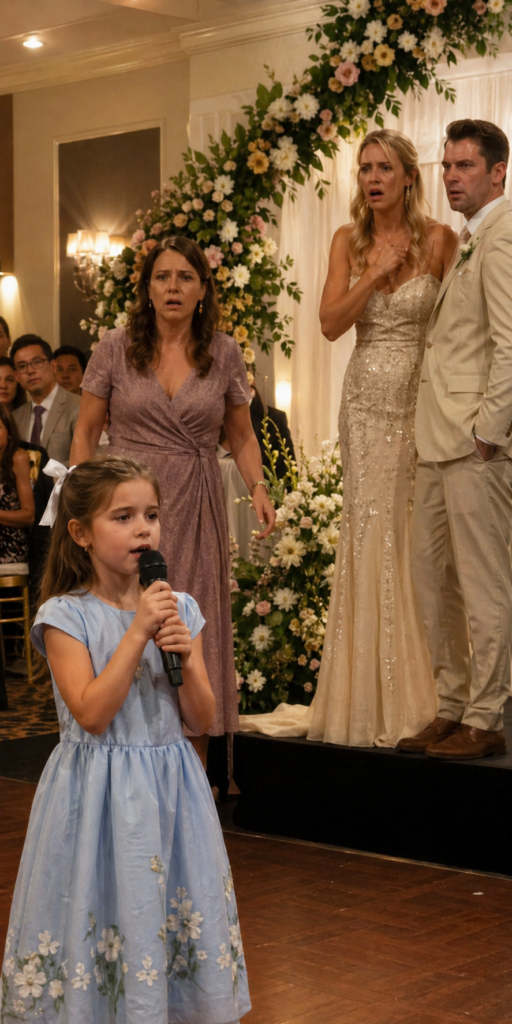
She was seven years old, wearing a pale blue dress with tiny white flowers stitched along the hem. Before we left home, she had spent twenty minutes asking if she looked “fancy enough for a real grown-up love party.”
When I told her she looked beautiful, she beamed like I had handed her the moon.
Now she kept pointing at everything.
The cake.
The fairy lights.
The giant flower arch behind the stage.
The crystal bowls of candy sitting on the tables.
Every few seconds she tugged my hand and whispered, “Mama, look,” as if she was afraid I might miss something magical.
But I was missing all of it.
My brother Luke stood near the center of the stage in a cream suit, smiling for photos with the kind of easy confidence that made strangers trust him right away.
He had our father’s shoulders and our mother’s eyes, which meant people noticed him the second he walked into a room.
Beside him stood Vanessa.
She was beautiful in the polished way magazines teach women to be beautiful. Her blonde hair was swept up just enough to look effortless, even though I knew it had probably taken two hours and a small army of hairpins. Her ivory dress was sleek and simple, and the ring on her finger flashed every time she lifted her hand.
Everyone kept saying they looked perfect together.
And from a distance, they did.
Up close, Vanessa had a way of looking at people like she was sorting them into piles.
Important.
Harmless.
Useful.
Forgettable.
When her eyes landed on me that night, I watched her expression change by half an inch.
That was all it took.
A tiny tightening around her mouth.
A quick glance at my dress, my shoes, my daughter.
Then she leaned toward my mother and whispered something in her ear.
I couldn’t hear the words.
I didn’t need to.
I saw my mother nod.
Not surprised.
Not offended.
Not even hesitant.
Just one small, neat nod—the kind she used to give when I was a child and she had already decided I wasn’t invited into the warm part of the family.
Then my mother walked toward me.
She stopped so close I could smell her perfume, something powdery and expensive and familiar enough to make my chest hurt.
Her voice was low when she spoke, almost gentle, which somehow made it worse.
“Nora,” she said, “when they call the family up in a little bit, stay back from the stage.”
For one second, I tried to find a softer explanation.
Maybe she meant there wouldn’t be enough room.
Maybe Vanessa wanted only parents and siblings.
Maybe there was a photographer’s plan.
Maybe—
“Vanessa doesn’t want any bad luck near her tonight.”
The sentence landed in my body before it landed in my mind.
I actually looked behind me, like maybe she was talking to someone else.
Then I looked back at her and found that flat, composed expression I knew too well.
She meant it.
Every word.
She had carried that sentence across the ballroom and set it down at my feet like I was something that needed to be moved out of the way.
“Bad luck?” I asked.
My voice came out thin.
Not angry.
Not even shocked.
Just small.
I hated that most of all.
My mother didn’t flinch.
“She’s nervous,” she said. “It’s her night. Let’s not make this harder than it needs to be.”
Harder.
I remember staring at her mouth while she spoke, because if I looked into her eyes, I thought I might break right there in front of everyone.
Around us, laughter kept rolling from table to table.
Someone near the cake applauded.
Silverware clinked.
A phone camera flashed.
The party kept moving.
The world did not stop when my mother told me I was something unlucky that needed to be managed.
That was the worst part.
Pain feels louder when nobody else seems to hear it.
“I’m his sister,” I said finally.
I don’t know why I said it like a question.
Maybe because the truth had started to feel fragile in that family.
Maybe because I had spent so many years being treated like an unfortunate footnote that even I had begun to wonder if I still counted as something central.
My mother gave me a look that belonged on a receptionist, not a parent.
“Tonight is not about you.”
Then she glanced down at Ellie.
“Keep her with you, please. We don’t need any surprises.”
She turned and walked away before I could answer.
Ellie looked up at me.
“Mama?”
I hadn’t realized I was holding my breath until that moment. I let it out too fast and crouched so I was eye level with her.
My knees felt weak.
My hands felt cold.
“What is it, baby?” I asked.
“Why did Grandma talk like that?”
Children hear tone before they understand content.
They can sense meanness even when adults wrap it in polite words.
Ellie’s face was pinched with confusion, and I tried to smooth it with a smile I did not feel.
“She’s stressed,” I said.
That was the lie I chose because it was easier than telling a seven-year-old the truth.
Easier than saying, Sometimes the people who should protect you decide you are easier to blame than life itself.
Ellie kept looking at me.
“But why do we have to stay away?”
I brushed a loose curl off her forehead and swallowed.
“Because sometimes grown-ups get things wrong.”
She thought about that.
Then, very quietly, she asked, “About you?”
There are questions that open old wounds with perfect precision.
That was one of them.
I stood back up too fast because if I stayed crouched another second, I was afraid my face would fold in front of her.
My throat burned.
My eyes felt hot.
I locked both of those things down the way I always did.
The room seemed to tilt.
I could feel it starting—that old unraveling inside me, the one that made me feel eight years old again, standing in a hallway while adults whispered as if I were too young to understand the shape of my own life.
People think family hurt gets easier because it is familiar.
That is not true.
Familiar pain does not get smaller.
You just get better at carrying it without dropping anything in public.
I took Ellie to the back of the room and sat her in a chair near one of the round tables with white tablecloths and floating candles in the center.
I told her to stay there for a second while I got her some water.
What I really needed was three seconds where nobody was looking at me.
At the drink station, my hands shook so badly I almost spilled water all over the stack of cocktail napkins.
An aunt I hadn’t seen in months smiled too brightly and asked, “You doing okay, honey?”
That voice.
That soft, stretched-out pity voice.
I wanted to say, No, actually, I am standing in a hotel ballroom while my own mother tells me I am not welcome near my brother because his fiancée thinks I carry sadness like perfume.
I wanted to say, When exactly did everyone decide this was normal?
Instead, I smiled and said, “Just warm in here.”
She nodded like that made sense and drifted away.
I brought Ellie her water.
She took it, but she wasn’t looking at the glass.
She was looking at the stage.
“Mom,” she whispered, because she called me both Mama and Mom depending on how serious the moment was, “that lady is not nice.”
I followed her eyes to Vanessa.
Vanessa was laughing now, one hand on Luke’s arm, looking every inch the beloved bride-to-be.
My mother stood beside her, glowing in a way I had not seen directed at me in years.
Maybe ever.
A photographer crouched low for a better angle.
Luke smiled into the crowd, and for one brief second his eyes found mine.
Then he looked away.
That hurt more than my mother.
Cruel people at least choose their cruelty.
Quiet people make you do the work of hurting yourself.
They leave just enough room for you to wonder if maybe you imagined it.
Maybe they didn’t see.
Maybe they meant to say something later.
Maybe they felt bad the whole time.
But he had heard.
I knew he had heard.
And still, he stood there.
I pressed my lips together and sat beside Ellie.
“We’re going to be okay,” I said.
It was not an answer to anything she had asked, which is how I knew I was starting to come apart.
The truth is, I was not new to being treated like a problem that needed careful handling.
I had been carrying that role so long it had shaped the inside of me.
It started when I was eight years old and my father never came home from work one rainy night in October.
He worked at a distribution warehouse outside Columbus and drove the same route home every evening. He always stopped at the gas station near the highway exit for a cup of bad coffee and sometimes a candy bar he claimed was not for us.
On the night of the accident, he never made it past the county line.
I don’t tell that story often.
Not because I don’t remember it.
Because I remember too much.
The sound my mother made when the doorbell rang after dark.
The way our neighbor Mrs. Kline took my shoulders and steered me into the kitchen like I was a guest in my own house.
The way Luke, who was four then, clung to my pajama shirt and cried because everyone else was crying.
Loss rearranges a house fast.
By morning, our living room had become a place where people sat too straight on the sofa and used hushed voices, paper plates, and words like tragic.
They brought casseroles and pound cake and floral napkins.
They patted our heads and told us to be strong.
And somewhere in the blur of all that, I heard somebody say it.
Maybe it was one of my father’s sisters.
Maybe it was a cousin.
I never knew for sure because the voice came from the dining room while I stood in the hallway with my arms wrapped around myself.
“He spoiled that girl rotten,” the woman whispered. “Always running back for her school projects, her dance things, her little emergencies. Some children have unfortunate timing.”
Unfortunate timing.
It wasn’t the exact phrase Vanessa used years later, but it slid into the same wound.
The grown-ups in my family never sat me down and directly blamed me for my father’s accident.
They didn’t need to.
Children learn from tone.
From glances.
From what nobody corrects.
My mother never corrected it.
That is the part I carried the longest.
Grief does strange things to people. I know that now as a grown woman. I know my mother lost the love of her life at thirty-six and woke up the next morning with two children, a mortgage, and a future she had not agreed to.
I know pain can turn a person cold in places they don’t even notice.
But knowing why someone hardened does not make their edges stop cutting you.
After my father died, my mother’s warmth toward me faded so slowly I almost convinced myself it was normal.
She still packed my lunches.
She still washed my clothes.
She still showed up at school events when she could.
But the softness was gone.
She stopped smoothing my hair before church.
Stopped calling me sweetheart.
Stopped reaching for me when something scared me.
Every kindness became practical, not tender.
Necessary, not loving.
With Luke, it was different.
Maybe because he was younger.
Maybe because he looked so much like our father that keeping him close felt like keeping something of Dad alive.
Whatever the reason, she lit up around him in ways the whole house noticed.
Luke got the real laugh.
The hand on the cheek.
The proud look at teacher conferences.
The extra slice of pie.
The “tell me everything” after a bad day.
He was not spoiled.
He was cherished.
And I was managed.
I don’t say that with bitterness toward him.
For a long time, Luke was the only gentle thing in that house.
He used to crawl into my bed after nightmares and ask me to make up stories where our father had secretly become an astronaut or a park ranger or the mayor of a ridiculous town where pancakes grew on trees.
I tied his shoes before school.
Helped him memorize spelling words.
Covered for him when he forgot to get a permission slip signed.
I was more sister than child before I was old enough to understand what that cost.
By high school, the story of me had settled in the family like dust.
Nora was sensitive.
Nora had always had a hard road.
Nora needed to be careful.
Nora attracted sadness.
Nobody said unlucky to my face then.
They didn’t have to.
Every concern carried the same message underneath it.
Be smaller.
Be quieter.
Don’t bring your weather in here.
I believed them longer than I want to admit.
I became the kind of girl who apologized when someone bumped into me.
The kind who hovered at the edge of group photos and then felt relieved when nobody asked where I was afterward.
The kind who mistook invisibility for peace because at least it kept the room steady.
I married young for that exact reason.
Ben worked with a friend of a friend at an insurance office downtown. He had kind eyes and a voice that made everything sound more certain than it was.
When he first started coming around, my mother approved in that cool, businesslike way she approved of anything that looked stable.
He brought flowers to my apartment.
He remembered tiny details.
He told me I deserved softness.
When you have gone hungry for tenderness long enough, even ordinary affection can look like rescue.
For a while, it was good.
We rented a little duplex with creaky floors and a postage-stamp kitchen. On Sundays, we made too much coffee, argued over crossword clues, and talked about baby names like it was the easiest thing in the world.
I thought maybe I had finally stepped out of the story my family wrote for me.
Then the pregnancies came.
And went.
I don’t need to dress that part up.
We wanted something, and then we had to learn how to want it quietly.
The losses were early and private, the kind that leave no casseroles at the door and no official language for grief.
Just a house that suddenly sounds too hollow.
Just two people trying not to say the wrong thing in it.
Ben changed after the second one.
Not cruel.
Not loud.
Just farther away every week, like he had boarded a train I wasn’t allowed to catch.
He stayed later at work.
Answered questions with shrugs.
Flinched when I cried—not because he was mean, but because he had no place to put my pain and no strength left for his own.
After the third loss, he sat on the edge of our bed one night with both hands clasped between his knees and said, “I don’t know how to help anymore.”
I said, “Then don’t help. Just stay.”
He looked at the carpet for a long time.
A month later, he moved out while I was at the grocery store.
Not dramatically.
Not with a fight.
Just boxes gone and a text that said, I’m sorry. I can’t keep living inside this sadness.
That message lived in my phone for almost two years.
Not because I was waiting for him to come back.
Because I wanted proof that even abandonment had happened quietly in my life, politely, without enough noise for anyone to call it cruelty.
When I told my mother the marriage was over, she sighed like a woman learning her flight had been delayed.
“Well,” she said, “some things aren’t meant to last.”
That was all.
No anger on my behalf.
No outrage.
No “How are you holding up?”
Just another entry in the family ledger under the column labeled Nora.
Then Ellie happened.
By then, I had stopped expecting miracles from my own life.
I was thirty, working part-time at a dental office front desk, trying to keep the lights on in a two-bedroom apartment over a florist shop, and doing my best not to let loneliness harden me into someone I didn’t recognize.
When I found out I was pregnant, I sat on the closed toilet lid with the test in my shaking hand and laughed first.
Not because it was funny.
Because fear and hope can look a lot alike when they hit all at once.
I spent the whole pregnancy half-braced for bad news.
Every milestone felt borrowed.
Every quiet afternoon made me nervous.
I didn’t buy a crib until I was seven months along because I was too afraid to trust joy in advance.
I folded tiny clothes with trembling hands.
I learned how to pray without promising anything.
Then Ellie arrived loud, angry, pink, and utterly certain of herself.
The nurse laid her on my chest, and I remember staring at that fierce little face thinking, So this is what it feels like when love doesn’t ask permission first.
She filled the room in seconds.
She filled me too.
Every cracked place in me lit up and said, Keep going.
My mother came to the hospital the next day.
She held Ellie for maybe five seconds.
Just long enough to notice the dark hair and strong lungs.
Then she handed her back and said, “I hope she grows up with steadier fortune than you had.”
I laughed because there was a nurse in the room and I had trained my body to perform ease in front of witnesses.
But later, when the room was dark and Ellie slept in the bassinet, I cried quietly into the blanket so nobody would come ask questions.
Still, I kept showing up to family things.
That is what gets me even now.
Despite all of it, I kept going.
Birthday dinners.
Graduations.
Thanksgiving.
Christmas Eve.
Luke’s promotion dinner.
Our cousin’s baby shower.
Every time, I told myself this one would be easier.
This one would be normal.
This one, maybe, we would just be a family.
And sometimes, for a few minutes, it almost was.
Luke would sit by me and ask about Ellie’s school projects.
Uncle Ray would bring lemon bars and talk to me like I was fully visible.
There would be ten whole minutes when nobody looked at me with caution or pity or that strange, strained brightness people use when they don’t know whether to treat you like a guest or a bruise.
Ten minutes can keep a person hoping for years.
That was why I came to the engagement party.
Luke had called two months earlier, breathless and smiling through the phone, to tell me Vanessa had said yes. He wanted a big family celebration before the wedding—something pretty and a little over the top, with a rented ballroom, catered food, and too many flowers.
He sounded happy.
Really happy.
I wanted to be there for that.
I spent a week looking for a dress that felt right.
Not too sad.
Not too bold.
Nice enough to show I cared, quiet enough not to invite commentary.
I bought Ellie new shoes and let her pick out a ribbon for her hair.
On the drive there, she asked if there would be dancing.
I said probably.
She asked if Uncle Luke would cry.
I said maybe.
She said, “If he cries, I won’t laugh at him. Unless it’s happy ugly crying.”
I laughed then.
A real laugh.
I wish I could bottle the version of me from that car ride—the one who still thought the night might hold something uncomplicated.
By the time the emcee tapped the microphone and announced they were about to start the ring presentation, I had almost convinced myself I could survive the humiliation and leave quietly.
That is how survival trains you.
It makes you ambitious in tiny, sad ways.
The stage glowed under strands of white lights. The floral arch looked soft and expensive and careful.
Family members began drifting forward in clusters, smoothing skirts, straightening jackets, preparing their camera smiles.
I stood up because everyone else stood up.
Then Vanessa saw me move.
I watched it happen from across the room.
Her eyes snapped to mine.
Her smile did not change, but something smug slid underneath it.
She leaned toward Luke and whispered.
He didn’t even look in my direction.
He just gave one small nod.
That nod broke something old in me.
Not loudly.
Not publicly.
More like a quiet shelf inside my chest finally giving way under weight it had carried too long.
I stopped where I was.
Heat spread up my neck.
My fingers went numb.
Ellie tugged my sleeve.
“Are we going?”
I bent toward her because my legs felt strange.
“We’re going to watch from here, sweetheart.”
Her eyebrows drew together.
“But all the family is going.”
I wanted so badly to protect her from the ugliness of adult hierarchy that I said the first soft thing I could find.
“Sometimes there isn’t room for everybody.”
She looked at the stage.
Then back at me.
Even at seven, she knew when a sentence was shaped like a cover-up.
“There’s room,” she said.
I swallowed hard.
There was, of course.
Plenty of room.
Room for cousins twice removed, an aunt’s new boyfriend, and the neighbor who had known Luke since Little League.
Just not room for me.
Guests gathered closer.
Phones lifted.
The photographer crouched.
The emcee laughed into the microphone about love, new beginnings, and how lucky Luke and Vanessa were to have so many people who cared.
Lucky.
That word again.
My mother floated up to the front in a silver dress and careful makeup, proud as a queen.
Uncle Ray stood off to one side, hands folded, watching everything with steady eyes.
He glanced back at me once.
There was apology in his face.
But not surprise.
That hurt too.
Nothing makes pain feel more permanent than realizing other people saw it coming.
I stood beside Ellie with my hands clasped so tightly my knuckles ached.
I tried not to cry.
Not because crying would have been weak.
But because I was tired of giving that family proof that I had one more feeling they would need to manage.
Ellie climbed onto her chair to get a better view.
Then she leaned down close to my ear and whispered, “Mom, that lady is mean.”
I closed my eyes for half a second.
“Ellie.”
“She is.”
“Honey, hush.”
“She said you’re bad luck.”
My eyes flew open.
I turned to her so fast the chair legs scraped.
“What?”
Ellie blinked, startled by the edge in my voice.
“I heard her,” she said, softer now. “When I was by the cake. She was talking to Grandma. She said she didn’t want you near the pictures because every big thing in your life turns sad.”
There are moments when your whole body becomes sensation.
I heard the air conditioner before I heard the room.
I felt my pulse in my teeth.
The back of my neck went cold.
Ellie kept talking, innocent and precise the way children are when they do not yet understand how adults bury things under performance.
“She also said Uncle Luke is a good match, and that love can come later if the life is nice enough.”
I stared at her.
The world around us narrowed into one tiny, terrible tunnel.
My daughter, in her blue dress, was calmly telling me she had overheard the bride-to-be reduce my brother to a convenient life and me to a walking warning sign.
I should have said, Stay here.
I should have said, We’re leaving.
I should have picked her up, walked straight out of that ballroom, and never looked back.
Instead, I made the mistake people like me always make.
I tried to contain the moment.
“Ellie,” I whispered, “you do not repeat that here. Do you understand me?”
Her little face changed.
It wasn’t defiance exactly.
It was hurt.
Confused hurt.
The kind that says, I told the truth, so why am I the problem?
She looked toward the stage again.
Then back at me.
And I saw something settle in her expression.
Not rebellion.
Conviction.
Children do not learn courage from lectures.
They learn it in the moment they realize the adults they love are being treated unfairly and nobody else is standing up.
Something in Ellie went still.
Then she slid off the chair.
“Ellie,” I said, reaching for her hand.
I missed.
She had already stepped between two tables and started walking toward the front of the room with a purpose that did not belong in such a small body.
I went after her immediately, whispering apologies as I squeezed between guests.
She wasn’t running.
That was what made it feel unreal.
She wasn’t a child darting into trouble.
She was moving like somebody had given her a job and she intended to finish it.
By the time I got around the third table, people were turning to watch.
A little girl in a blue dress on a mission has a way of pulling a whole room’s attention without trying.
Conversations thinned.
A few guests smiled, assuming she had been asked to hand over flowers or stand for a photo.
I knew better.
My heart pounded so hard it hurt.
“Ellie,” I whispered, as quietly as panic would allow. “Stop.”
She did not stop.
She reached the front of the stage and planted herself at the bottom step.
Luke looked down, confused.
Vanessa’s smile flickered.
My mother’s mouth tightened into a line so sharp it could have cut paper.
I was maybe ten feet away when Ellie climbed the step.
I started forward.
At the same moment, the emcee lowered his microphone to say something to Luke, and Ellie did the most impossible thing I have ever seen in my life.
She reached for the spare wireless microphone resting on the stand beside him, wrapped both hands around it, and lifted it toward her face.
Everything stopped.
The photographer froze mid-step.
A cousin near the front lowered her phone.
Even the sound system seemed to hum louder in the sudden quiet.
Vanessa took one quick step toward Ellie, then hesitated because half the room was already watching.
My daughter looked out at nearly a hundred people like she had every right to be there.
And for the first time that night, somebody in my family did.
“Can I say something?” she asked.
Her voice came through the speakers clear, bright, and impossibly calm.
A little nervous laughter rippled through the room—the kind adults use when they think a scene might still be turned into a cute story later.
Vanessa reached for the microphone with a strained smile.
“Oh, sweetheart, maybe not right now—”
Ellie shifted just enough to keep the microphone.
“My name is Ellie,” she said. “I’m seven. And I want to say something about my mom.”
I stopped breathing.
There are silences that feel empty.
This one did not.
This one felt packed full of every secret my family had ever kept.
Ellie stood there with her ribbon slipping loose and her tiny hands wrapped around a microphone that looked too big for her.
But her voice did not shake.
“You said my mom is bad luck,” she said, looking straight at Vanessa.
A gasp moved through the room like wind through leaves.
Vanessa’s face changed all at once.
Not embarrassed.
Not yet.
More like a woman who had just realized the private thing she tossed carelessly into the air had landed in the wrong ears and grown teeth.
Luke turned slowly toward her.
Ellie kept going.
“That’s not true. My mom is the best person I know. She makes pancakes shaped like moons when I’m sad. She reads the funny voices in books even when she’s tired. She works all day and still helps me study my spelling words. And she always lets other people have the last cookie, which I think is too nice.”
A few people made small sounds.
Not laughter.
Something softer.
Something aching.
My hand flew to my mouth.
I wanted to protect her.
I wanted to disappear.
I wanted to run to the stage and gather her up before the room could change her the way it had changed me.
But underneath all that panic was another feeling, fierce and bright and almost unbearable.
Pride.
Ellie turned more fully toward Vanessa.
“And you were mean about her,” she said. “You weren’t just nervous. You were mean.”
No one moved.
My mother stood frozen beside the floral arch, looking at Ellie the way people look at sudden weather.
Uncle Ray’s face had gone very still.
Luke stared at Vanessa with a kind of dawning horror.
Vanessa finally found her voice.
“She misunderstood,” she said too quickly. “She’s a child.”
Ellie frowned.
“I heard you fine.”
A couple of heads in the crowd dipped.
Not with shame exactly.
With that instinct adults have to avoid being seen witnessing the exact moment a truth leaves the safe zone.
Then Ellie said the sentence that changed everything.
“You also said Uncle Luke is a good match, and maybe love can come later if the life is nice enough.”
The room did not gasp this time.
It inhaled.
Every person in that ballroom seemed to draw breath at once and then hold it.
Vanessa’s face went pale under her makeup.
Luke looked like somebody had removed the floor from beneath him.
My mother stepped forward first.
“That is enough,” she said sharply. “Nora, come get your daughter.”
There it was.
The old reflex.
Contain the child.
Restore the picture.
Fold the truth back into the family and lock it where it belonged.
But before I could move, Uncle Ray clapped.
Once.
The sound cracked through the ballroom like a starter pistol.
Every head turned toward him.
He walked calmly to the edge of the stage, put one hand lightly on Ellie’s shoulder, and looked up at the adults around her.
“I think the little girl just said what the rest of us should have said a long time ago,” he said.
And that was when my brother finally looked at Vanessa and asked the question that made the entire ballroom go silent.
_______________________________________________________________________________
- The Letter My Grandmother Left Before the Family Trust Burned Open
 PART 3 — COMPLETE ENDING Preston stood there with both hands gripping the back of the chair in front of him. For most of my life, my older brother had …
 - My Sister Called Me Legally Stupid, Then Her Lawyer Learned Who I Was
 PART 3 — COMPLETE ENDING The hearing did not last much longer after that. Blake Monroe stood behind his table with one hand resting on the back of his chair, …
 - My Mother Left Me Protection, Not Obligation
 PART 3 — COMPLETE ENDING By the time I reached Marianne Cole’s office, Ethan had called me eleven times. The first few calls came one after another, sharp and desperate, …
 - MY PARENTS KICKED MY 14-YEAR-OLD DAUGHTER OUT—THEN I CAME HOME WITH PROOF THE HOUSE WAS MINE
 PART 2 — FULL CONTINUATION WITH COMPLETE ENDING: My father stared at the first page like the words had rearranged themselves just to betray him. At first, his face held …
 - GRANDPA STOPPED EATING WHEN HE FOUND OUT I PAID RENT WHILE MY SISTER LIVED FREE
 Grandpa’s words stayed suspended over the Thanksgiving table like thunder waiting to break. Get your coat. You’re coming home with us. For a few seconds, no one moved. My nephews, …