Part 2
The ballroom at the Grand Aurelia Hotel had been designed to impress people who believed they were impossible to impress.
Crystal chandeliers hung from the ceiling like frozen waterfalls. Gold-trimmed mirrors lined the walls. White roses filled tall glass vases on every table, and waiters moved silently between guests with silver trays balanced perfectly on their palms.
Executives laughed softly over champagne.
Investors leaned close to exchange private comments.
Board members sat near the front beneath the grand crest of Vanguard Dominion, unaware that the woman they had protected in silence for years was about to step into the light.
At the center of the room stood Adrian.
He looked exactly the way he had always dreamed of looking.
Expensive tuxedo.
Polished shoes.
Perfect hair.
A smile practiced in mirrors.
Vanessa stood beside him in a red designer gown, her hand resting lightly on his arm as if she had already claimed her place there.
She was beautiful, confident, and pleased with herself.
Adrian leaned down to whisper something into her ear, and she laughed.
It was the kind of laugh that made people around them glance over and wonder what secret they shared.
I stood at the entrance and watched them for three seconds.
Only three.
But in those three seconds, seven years passed through my mind.
The first apartment with leaking pipes.
The nights Adrian studied while I cleaned office buildings after midnight.
The day his exam fees were due and he sat at our kitchen table with his head in his hands, saying, “Maybe I should give up.”
I remembered walking into my bedroom, opening the small velvet box where my grandmother’s earrings rested, and selling them the next morning.
I told him I had found extra money from overtime.
He cried that night and promised he would never forget what I had done for him.
But people forget promises when success begins to feel like something they earned alone.
The music faded.
A strange silence moved through the ballroom, soft at first, then spreading table by table.
Conversations stopped.
Glasses paused halfway to lips.
Heads turned.
The first person to recognize me was not Adrian.
It was Harrison Blackwood.
He stood near the stage, tall and silver-haired, wearing a dark suit and the composed expression of a man who had spent his life managing powerful rooms.
For years, he had served my father.
After my parents passed, he served me—not as a servant, never that—but as a trusted adviser, protector, and keeper of promises.
He bowed his head.
Not deeply.
Not dramatically.
Just enough.
Enough for everyone important to notice.
Then the entire chairman’s table stood.
A ripple of confusion passed through the room.
Adrian’s smile stiffened.
Vanessa stopped laughing.
I walked forward.
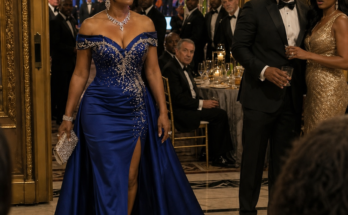
The silver Moreau gown moved around me like moonlight. It was not loud. It did not need to be. The diamonds at my throat caught the chandelier light, throwing small sparks across the marble floor.
I heard whispers.
“Who is she?”
“Is that Clara?”
“That can’t be his wife.”
“Why is Blackwood standing?”
Adrian took one step away from Vanessa.
His face had gone pale, though he tried to hide it.
For a moment, I saw him searching for an explanation. Maybe he thought I had borrowed the gown. Maybe he thought I had found a way to embarrass him. Maybe he thought, even then, that I was still the powerless woman he had left behind in a smoke-filled backyard.
His eyes moved from my face to the necklace, then to Harrison, then to the board members standing with solemn respect.
He swallowed.
“Clara?” he said.
His voice was small enough that only the people nearby heard it.
I did not answer him immediately.
I continued walking until I reached the front of the ballroom.
Harrison stepped forward and extended his hand.
“Madam Chairwoman,” he said clearly.
The words moved through the room like glass breaking.
Madam Chairwoman.
The orchestra members looked up from their instruments.
The directors exchanged startled glances.
Guests who had been smiling politely seconds before now stared openly.
Adrian froze.
Vanessa’s hand slipped from his arm.
I placed my hand in Harrison’s, and he escorted me to the stage.
Every step felt heavier than the last, not because I was afraid, but because I understood that once I reached that microphone, the life I had hidden would be gone forever.
The ordinary woman Adrian had believed he could discard would disappear.
In her place would stand Clara Vaughn, sole heiress of the Vaughn family, controlling shareholder of Vanguard Dominion, and hidden Chairwoman of the company that had just elevated him.
I reached the microphone.
Harrison stepped aside.
The room remained silent.
I looked out over the faces.
Some were curious.
Some were nervous.
Some were already beginning to understand.
Then I looked at Adrian.
His lips parted, but no words came out.
I smiled faintly.
Not warmly.
Not cruelly.
Just enough to let him know I had heard everything he said in the backyard.
“Good evening,” I said.
My voice carried clearly through the speakers.
“Many of you know me only through signatures, sealed board resolutions, and confidential correspondence. For years, I chose to remain outside the public eye while Vanguard Dominion expanded, restructured, and entered a new era of leadership.”
A few board members nodded.
Others lowered their eyes, already sensing that this speech would not be ceremonial.
“My father believed a company’s true character is not revealed by its quarterly reports,” I continued. “It is revealed by the people it rewards. By the values it protects. By the kind of ambition it allows to rise.”
Adrian’s jaw tightened.
Vanessa leaned closer to him and whispered, “What is happening?”
He did not answer.
He could not.
I rested both hands lightly on the podium.
“Tonight was meant to celebrate advancement,” I said. “And it still will. But first, there are truths that must be addressed.”
A soft murmur moved through the room.
I did not raise my voice.
I did not need to.
“For seven years, I lived quietly. I chose a simple life. I did not use my family name. I did not use this company’s influence for personal comfort. I wanted to know who would stand beside me without wealth, without title, without advantage.”
My eyes found Adrian again.
He stared at me with a look I had never seen before.
Fear.
Not fear of losing me.
Fear of losing everything attached to me.
“That decision taught me more than any board report ever could,” I said. “It taught me that some people value loyalty only when they are receiving it. It taught me that gratitude can disappear the moment pride enters the room. And it taught me that character matters most when a person believes no one powerful is watching.”
The ballroom was painfully still.
I saw Adrian’s hand twitch at his side.
He wanted to interrupt.
He wanted to control the story.
He always had.
But for the first time in seven years, the room was not his.
It was mine.
I turned slightly toward Harrison.
“Mr. Blackwood,” I said, “please proceed.”
Harrison stepped forward with a black leather folder.
His expression gave nothing away.
“Madam Chairwoman,” he said, “as requested, the board has reviewed all internal materials related to recent executive appointments, including recommendation files, financial approvals, conduct reports, and undisclosed relationship concerns.”
Adrian’s face changed.
Vanessa’s eyes widened.
I had known there was more than humiliation waiting beneath Adrian’s polished promotion.
I had suspected it for months.
Small things had changed.
His phone was always face down.
Late meetings appeared on no official calendars.
Expenses were marked under vague client categories.
A sudden closeness with Vanessa was dismissed as “networking.”
A promotion process had moved faster than policy allowed.
At first, I had not wanted to look.
That was the truth I hated most.
Part of me had avoided the evidence because evidence would make heartbreak official.
But when he burned that dress, when he told me security would remove me from a room my family built, he had forced my eyes open.
Harrison opened the folder.
“Preliminary review shows that Mr. Adrian Vaughn’s promotion recommendation included irregular endorsements from Director Marcus Ellery,” Harrison announced.
Vanessa’s father.
The director who had pushed Adrian’s promotion through.
A low murmur swept the room.
Director Ellery sat near the center table. His face turned a shade of gray that no lighting could soften.
Harrison continued.
“Further review shows that Director Ellery failed to disclose a personal conflict of interest involving his daughter, Ms. Vanessa Ellery, and Mr. Vaughn.”
Vanessa lifted her chin.
“This is ridiculous,” she said, loud enough to be heard.
Her voice trembled.
Adrian reached for her arm, but she pulled away.
I watched the movement carefully.
Even now, neither of them was thinking about loyalty.
They were calculating distance.
Harrison’s eyes moved briefly to Vanessa, then back to the folder.
“In addition,” he continued, “there are concerns regarding misuse of company resources, inappropriate influence over internal appointments, and expense accounts requiring immediate audit.”
The ballroom shifted.
This was no longer gossip.
This was corporate damage.
And in rooms like that, reputation could collapse faster than glass.
Adrian suddenly stepped forward.
“Clara,” he said, forcing a laugh that sounded painfully thin. “Whatever this is, we can discuss it privately.”
Privately.
The word almost made me smile.
He had not wanted privacy when he humiliated me in our backyard.
He had not wanted privacy when he told Vanessa she fit his image.
He had not wanted privacy when he planned to enter this ballroom with another woman on his arm while his wife sat at home with ashes where her dignity was supposed to be.
Now, with every important person watching, he wanted privacy.
I looked at him calmly.
“Mr. Vaughn,” I said.
His face flinched.
Not Adrian.
Not my husband.
Mr. Vaughn.
The distance was intentional, and he felt it.
“This is a company matter,” I said. “And you are standing in a company event, in front of the board, after accepting a title given under review.”
He opened his mouth, then closed it.
Vanessa whispered sharply, “Do something.”
He turned toward her, panic flashing across his face.
“What do you want me to do?” he hissed.
It was the first honest thing he had said all night.
I looked at Harrison.
“Continue.”
Harrison nodded.
“Pending full investigation, the board has authority to suspend executive appointment privileges and place any officer under administrative review.”
Adrian’s eyes snapped toward me.
“You can’t,” he said.
I tilted my head.
“I can.”
“You’re my wife.”
“That did not matter to you an hour ago.”
The words landed harder than I expected.
For the first time that night, something like shame crossed his face.
But it came too late.
Far too late.
Director Ellery stood abruptly.
“This is unnecessary,” he said. “Madam Chairwoman, with respect, this is clearly a personal matter being brought into corporate space.”
I turned toward him.
He was a heavyset man with a silver tie and the confidence of someone used to having others clean up his mistakes.
“With respect, Director Ellery,” I replied, “you helped promote a man connected personally to your daughter without proper disclosure. That makes it corporate.”
His mouth tightened.
“Those are serious accusations.”
“Yes,” I said. “Which is why they will be handled seriously.”
He looked around the room, searching for allies.
He found none willing to speak.
Powerful people are loyal to power until risk becomes visible.
Then loyalty becomes silence.
I looked back at Adrian.
He had begun to sweat.
A tiny bead slid down his temple, catching the light.
Seven years ago, I had watched that same man sit at a small kitchen table, exhausted and afraid, his future uncertain. I had loved him then. I had believed his tenderness was real.
Maybe it had been.
Or maybe hardship had only disguised his pride.
“Clara,” he said again, softer this time. “Please.”
That one word almost broke something in me.
Because once, I would have done anything for him.
Once, if Adrian had said please, I would have emptied my savings, sold another memory, taken another job, forgiven another insult.
But the woman who had lived that way was standing somewhere behind me now, fading like smoke.
I leaned toward the microphone.
“Mr. Adrian Vaughn,” I said, “effective immediately, your appointment as Vice President of Operations is suspended pending full board investigation.”
Gasps moved through the room.
Adrian took a step back as if the floor had shifted beneath him.
“Your access to executive systems will be paused. Your corporate accounts will be audited. Your communication with internal teams regarding operational matters will require oversight. You will receive formal notice through legal counsel.”
His face drained completely.
“Clara, you can’t do this to me.”
I looked at him for a long moment.
“I didn’t do this to you,” I said. “You did.”
Vanessa turned on him then.
“You told me she was nobody,” she snapped.
The room heard it.
Everyone heard it.
Adrian looked horrified.
“Vanessa—”
“No,” she said, stepping away from him. “You said she was just your wife. You said she had no family, no status, nothing.”
Just your wife.
I felt the words settle over me like dust.
That was what seven years had become in his mouth.
Just your wife.
The woman who cooked when he came home tired.
The woman who paid bills he never asked about.
The woman who learned to patch the same coat three winters in a row so he could afford professional review classes.
Just your wife.
I looked at Vanessa.
For the first time, I did not completely hate her.
She had been cruel in her own way, yes. She had enjoyed standing beside my husband too much. But Adrian had sold her a version of me designed to make betrayal feel elegant.
Still, she had chosen to believe him because believing him benefited her.
That was her responsibility.
Vanessa’s father stood frozen, his lips pressed together.
Harrison quietly signaled two members of security—not to create a scene, but to stand near the exits. The message was clear.
No one was above consequence tonight.
Adrian turned back to me.
His voice lowered into something desperate.
“Clara, I was angry. I didn’t mean what I said.”
The ballroom remained silent.
I almost laughed, but the sound would have hurt too much.
“You burned my dress.”
His eyes flickered.
“I made a mistake.”
“You told me I was an embarrassment.”
“I was under pressure.”
“You brought another woman to the gala.”
His mouth opened, but this time no excuse came quickly enough.
I continued, my voice steady.
“You warned me that security would remove me from a company event hosted by the company my family built.”
That sentence moved through the room with quiet force.
Adrian looked down.
For the first time, he had no performance left.
No charm.
No arrogance.
Only the truth.
He had not merely betrayed his wife.
He had misjudged the one person he should never have underestimated.
I stepped back from the podium.
“The board will continue formal proceedings in private,” I said to the room. “Tonight’s gala will proceed, but not as a celebration of empty advancement. It will continue as a reminder that leadership without character is not leadership at all.”
No one clapped at first.
Then one person did.
An elderly board member near the front, Mrs. Leighton, lifted her hands slowly and applauded.
Others followed.
Not loudly.
Not like a party.
But firmly.
A wave of quiet applause filled the room.
Adrian stood in the middle of it, embarrassed not by shouting, not by spectacle, but by truth.
And somehow, that was worse for him.
When I stepped down from the stage, Harrison moved beside me.
“Madam,” he said softly, “would you like the car brought around?”
I looked across the ballroom.
Adrian had not moved.
Vanessa had crossed to her father’s table, whispering urgently while Director Ellery wiped sweat from his forehead.
Guests were pretending not to stare while doing exactly that.
I should have felt victorious.
Part of me did.
But another part of me felt tired in a way diamonds could not hide.
“No,” I said. “Not yet.”
Harrison nodded.
I walked to a quieter balcony beyond the ballroom, where glass doors opened to the night air.
Outside, the city glittered below.
The music had resumed inside, softer now, strained. People would talk about this night for years. They would retell it with added drama, added lines, added expressions they had not seen.
But none of them would remember the smell of smoke in the backyard.
None of them would remember the feeling of watching the last dress you bought with hope turn to ash.
Only I would carry that.
I placed one hand on the cold stone railing.
For a moment, I was not Chairwoman Vaughn.
I was just Clara.
A woman who had loved badly.
A woman who had hidden too much.
A woman who had finally learned that humility and self-erasure were not the same thing.
Behind me, the glass door opened.
I did not turn around.
“Clara.”
Adrian.
His voice sounded smaller on the balcony than it had in the ballroom.
There were no chandeliers out here, no audience, no Vanessa, no stage.
Only city lights and the truth.
“You shouldn’t be here,” I said.
“I needed to talk to you.”
“You had seven years.”
He inhaled sharply.
“I know.”
The honesty of that surprised me enough that I turned.
Adrian stood a few feet away, his tuxedo still perfect, though his face was not. His eyes were red around the edges, and his confidence had finally cracked.
“I didn’t know,” he said.
“That I was Chairwoman?”
He looked down.
“Yes.”
I gave a small, sad smile.
“That is exactly the problem.”
He frowned.
“I don’t understand.”
“You should not have needed to know I had power to treat me with dignity.”
The words quieted him.
He looked past me toward the skyline.
“I was ashamed,” he admitted.
“Of me?”
His face twisted.
“Of where I came from. Of how hard it was. Of needing help. Of knowing that everyone in that room had always been ahead of me.”
“So you decided I should be beneath you.”
He closed his eyes.
“I convinced myself I deserved more.”
“And I was less.”
He did not answer.
He didn’t have to.
The silence said enough.
I studied him carefully.
This was the man I had once loved. The man whose favorite tea I still knew. The man who rubbed his left temple when stressed. The man who used to fall asleep with books open across his chest while I covered him with a blanket.
I wanted to see the old Adrian.
I searched for him.
But all I found was a stranger wearing familiar skin.
“I thought,” he said slowly, “if I looked successful enough, people would stop seeing what I used to be.”
“And what did you see when you looked at me?”
His eyes filled, though whether from regret or fear, I could not tell.
“A reminder.”
That answer hurt more than the insult.
Because it was honest.
I had reminded him of the years when he needed help. Of the small apartment. Of unpaid bills. Of his dependence. Of the woman who had seen him before he became impressive.
Instead of cherishing that, he had resented it.
I looked away.
“You should go inside,” I said.
“Clara, please. Don’t end our marriage like this.”
I turned back sharply.
“Our marriage did not end tonight.”
He flinched.
“It ended slowly. Every time you came home and looked through me. Every time you corrected how I spoke around your colleagues. Every time you introduced me as if I were an inconvenience. Every time you let me carry your life while you built a version of yourself that had no room for me.”
A tear slipped down his cheek.
I had rarely seen Adrian cry.
Once, the sight would have softened me instantly.
Tonight, I felt sadness.
But not surrender.
“I can change,” he said.
“Maybe.”
His eyes lifted with hope.
I let him have it for only a second.
“But not for me.”
The hope broke.
“You don’t mean that.”
“I do.”
He stepped closer.
“I love you.”
I shook my head slowly.
“No, Adrian. You loved being loved by me. You loved being supported by me. You loved having someone who forgave you before you even apologized. But love is not what you showed me tonight.”
He covered his mouth with one hand.
For the first time, he had no argument.
I reached into the small silver clutch my stylist had given me and removed a folded envelope.
His eyes dropped to it.
“What is that?”
“Something I should have given you months ago.”
I handed it to him.
His fingers trembled as he opened it.
The first page was enough.
A legal separation notice.
Not filed that morning.
Not created in anger after the dress.
Prepared weeks ago.
His face crumpled.
“You were already planning to leave?”
“I was planning to ask you to choose us,” I said. “One last time.”
He stared at me.
“I was going to talk to you after the gala. I was going to tell you I knew we were broken. I was going to ask if there was anything left worth saving.”
My voice softened despite myself.
“Then you burned my dress.”
He looked at the papers as if they were a sentence being passed.
“I’m sorry,” he whispered.
“I believe you are sorry tonight.”
His eyes lifted.
“But I don’t know if you are sorry for what you did, or sorry that I was not powerless when you did it.”
That question stayed between us.
He had no answer.
Inside the ballroom, applause rose faintly for some speaker who had been asked to continue the program. Life was moving forward without Adrian’s permission.
That, more than anything, seemed to frighten him.
“What happens to me now?” he asked.
The question was so honest, so stripped of pride, that I almost pitied him.
“The investigation will happen fairly,” I said. “If you misused company resources, you will answer for it. If your promotion was improperly influenced, it will be reversed. If you violated policy, the board will decide the consequences.”
“And us?”
I looked at the city.
“There is no us tonight.”
He covered his eyes.
I waited, not because I owed him comfort, but because seven years deserved a quiet ending.
Finally, he lowered his hand.
“Did you ever love me?”
The question nearly took my breath away.
I turned fully toward him.
“Yes,” I said. “More than you understood.”
His mouth trembled.
“And that was why,” I continued, “I stayed longer than I should have.”
He nodded slowly, like every word was landing where pride used to be.
Then he folded the papers carefully.
“I don’t know who I am without this job,” he said.
I looked at him sadly.
“Then maybe losing it is the first honest thing that has happened to you in years.”
He gave a broken laugh, but there was no humor in it.
Security appeared at the doorway, discreet and respectful.
Harrison stood behind them.
Adrian looked over his shoulder, then back at me.
“Are they here for me?”
“No,” I said. “They’re here for me.”
That seemed to hurt him most.
Because once, I had been the one waiting for him.
Now others waited for me.
I walked toward the door.
Before I passed him, he whispered, “Clara.”
I stopped.
He looked at me with a face stripped of performance.
“I should have been proud to stand beside you when you had nothing.”
I swallowed the tightness in my throat.
“Yes,” I said. “You should have.”
Then I walked back inside.
The rest of the night unfolded with quiet precision.
Director Ellery was asked to step away from the gala floor for a private emergency board session. Vanessa left shortly after, not with Adrian, but with her father’s legal assistant. She did not look at me again.
Adrian remained near the side wall for several minutes, reading the separation papers again and again as if the words might change.
They did not.
By midnight, Vanguard Dominion had released an internal notice.
Adrian Vaughn’s appointment as Vice President of Operations was suspended pending review.
Director Marcus Ellery was placed under board investigation for failure to disclose potential conflicts.
All executive promotions approved within the last quarter would be audited.
The public version used polished corporate language.
It spoke of integrity, transparency, accountability, and governance standards.
It did not mention a burned blue dress.
It did not mention a backyard.
It did not mention a wife crying beside a grill while her husband drove away with another woman waiting.
But I knew.
And Adrian knew.
Sometimes the smallest private cruelty opens the largest public truth.
The next morning, I returned to the house after spending the night at the Vaughn estate.
It felt strange walking through the front door.
The living room was exactly as I had left it. A cup in the sink. Adrian’s old textbooks still on the lower shelf because I had never been able to throw them away. A framed photo from our third anniversary sitting crooked on the mantel.
In the photo, we were both smiling.
I picked it up.
We looked young.
Hopeful.
Poor, yes.
Exhausted, yes.
But happy in a way money could not create.
For a long time, I stared at that version of us.
Then I placed the photo face down.
In the backyard, the grill still held ashes.
The blue dress was gone, reduced to black flakes and memory.
I stood before it in silence.
I thought I would cry again.
I didn’t.
Instead, I took a small glass jar from the kitchen and carefully collected a little of the ash.
Not because I wanted to remember the pain.
Because I wanted to remember the moment I stopped begging someone to see my worth.
A car door closed behind me.
Harrison stood near the driveway, carrying a folder.
“I apologize for arriving without notice,” he said.
“You never arrive without a reason.”
He smiled faintly.
“No, Madam.”
I gave him a tired look.
“Harrison.”
His expression softened.
“Clara.”
That one word nearly undid me.
Not Chairwoman.
Not Madam.
Just Clara.
He walked closer and handed me the folder.
“The emergency board has confirmed interim actions. Mr. Vaughn’s access has been fully suspended. Director Ellery is cooperating through counsel. Ms. Ellery has submitted a leave request.”
I opened the folder but barely read it.
“And Adrian?”
“He has requested a personal meeting.”
“No.”
“I assumed that would be your answer.”
I looked at him.
“Then why mention it?”
“Because one day, you may ask if he tried.”
I closed the folder.
That was Harrison. Always thinking two steps beyond the pain.
“Thank you.”
He nodded.
“There is something else.”
I looked up.
“The staff found a record of reimbursements tied to private dinners, luxury transportation, and several purchases labeled as client relations. Some appear connected to Ms. Ellery.”
I exhaled slowly.
“So it wasn’t just pride.”
“No,” Harrison said gently. “It appears not.”
I looked back at the ashes.
For some reason, that made everything easier.
Not less painful.
But clearer.
If Adrian had simply become arrogant, I might have spent years wondering if I could have saved him.
But dishonesty has a shape.
Once you see it, you stop mistaking it for confusion.
“Proceed with the audit,” I said.
“Yes.”
“And Harrison?”
“Yes?”
“Do not protect him because of me.”
His gaze remained steady.
“I never protect those who damage what you built.”
I looked at him for a long moment.
“My father trusted you.”
“He trusted you more.”
Those words settled somewhere deep.
For years, I had hidden from the legacy my father left me. I told myself it was because I wanted real love. But perhaps part of me had also been afraid of becoming the kind of powerful person others used for their own gain.
So I became small instead.
And Adrian had accepted my smallness because it served him.
That was the lesson.
Not that love was impossible.
Not that trust was foolish.
But that hiding your worth does not guarantee someone will love your heart.
Sometimes it only teaches them to underestimate it.
The separation became official quietly.
Adrian did not contest it at first.
Then, when the audit uncovered enough evidence to end his career at Vanguard Dominion, he changed.
He sent letters.
Then apologies.
Then explanations.
He claimed Vanessa had pressured him.
He claimed Director Ellery had manipulated the promotion.
He claimed he had been “confused” by ambition.
But every letter had the same missing piece.
He spoke often about what he had lost.
Rarely about what he had done.
That told me everything.
Three months later, I appeared publicly for the first time as Chairwoman of Vanguard Dominion.
Not at a gala.
Not in diamonds.
At a scholarship foundation event for working spouses and adult students who had sacrificed education, careers, and personal advancement to support someone else’s dream.
I created the fund in my grandmother’s name.
The first grant recipient was a woman named Maribel, who had cleaned hotel rooms for twelve years while supporting her husband and children. When she stood on stage to accept the award, her hands shook.
“I thought it was too late for me,” she said.
I stood and applauded until she smiled.
After the event, a reporter asked me why the foundation mattered so much.
I could have given a polished answer.
Instead, I told the truth.
“Because many people quietly build someone else’s future while forgetting they are allowed to have one too.”
The quote spread faster than I expected.
People wrote letters.
Women, men, parents, partners, siblings.
People who had been told they were too ordinary, too tired, too old, too plain, too unimportant.
People who had given everything and been made to feel like nothing.
Their stories filled my office for weeks.
I read every one.
Some nights, I cried over them.
But those tears did not feel like weakness.
They felt like recognition.
Six months after the gala, Adrian requested one final meeting through his lawyer.
I refused twice.
The third time, Harrison placed the letter on my desk and said nothing.
I looked at him.
“You think I should go?”
“I think you should do whatever gives you peace.”
“That is not an answer.”
“No,” he said. “It is permission.”
So I went.
Not to our old house.
Not to Vanguard.
A quiet café near the river, where tables were spaced far apart and no one cared who we were.
Adrian was already there when I arrived.
He looked different.
Thinner.
Older.
No expensive watch. No polished arrogance. Just a gray jacket, tired eyes, and two cups of untouched tea on the table.
He stood when he saw me.
“Clara.”
“Adrian.”
We sat.
For a while, neither of us spoke.
Then he pushed an envelope toward me.
“I signed everything,” he said.
I looked at it but did not touch it yet.
“No objections?”
“No.”
“Why?”
He looked down at his hands.
“Because fighting you would just be another way of taking from you.”
That was the first sentence he had said in months that sounded like growth.
I studied him.
“What do you want?”
“To apologize without asking for anything.”
I leaned back.
He took a breath.
“I was cruel to you because I hated the version of myself you had helped. You remembered me before the title. Before the suits. Before people opened doors for me. And instead of being grateful, I punished you for knowing the truth.”
His voice shook.
“I told myself I deserved a different life. But really, I wanted a life where no one could see what I owed.”
I said nothing.
He continued.
“What I did with Vanessa was wrong. What I allowed Director Ellery to do was wrong. What I did to your dress was…” He stopped, swallowing hard. “It was small and ugly and mean. I wanted to make you feel powerless because I felt powerful for the first time.”
The words sat between us.
They did not erase anything.
But they were finally true.
“I am sorry,” he said. “Not because I lost the job. Not because everyone found out. I am sorry because you loved me when I had nothing, and I made you feel like nothing once I had something.”
For a moment, I could not speak.
Outside, the river moved under the afternoon light.
I thought of the old Adrian.
The young man at the kitchen table.
The one I had loved.
Maybe he had existed.
Maybe this regret was real.
But not all real things are meant to return.
“I accept your apology,” I said.
His eyes filled.
“But I am not coming back.”
He nodded quickly, though pain crossed his face.
“I know.”
“I hope you become better,” I said. “But I cannot be the place where you practice becoming better.”
A tear slipped down his cheek.
“That’s fair.”
We sat there quietly.
Then he gave a small, broken smile.
“You look different.”
“I am different.”
“No,” he said softly. “I think you look like who you were always supposed to be.”
I looked away before he could see my eyes soften.
“Take care of yourself, Adrian.”
“You too, Clara.”
When I left the café, I did not look back.
That was how I knew it was truly over.
Not because I was angry.
Not because I wanted him destroyed.
But because I could finally walk away without needing him to understand the full weight of what he had lost.
A year after the gala, Vanguard Dominion changed more than people expected.
We restructured executive promotions.
We created independent ethics reviews.
We launched support programs for employees returning to education.
We funded career grants for spouses and caregivers.
We made quiet dignity part of company policy, not just a phrase for speeches.
Some board members resisted.
They said compassion had no place in corporate governance.
I reminded them that arrogance had nearly cost us far more.
They stopped resisting.
As for Adrian, I heard through formal channels that he left the city.
He did not regain his position.
He did not marry Vanessa.
Director Ellery resigned before the investigation reached its final public stage. Vanessa relocated overseas, according to someone who mentioned it at a charity dinner with the careful tone people use when discussing old scandals.
I did not celebrate any of it.
That surprised people.
Some expected me to be triumphant.
Some wanted a dramatic revenge story with a perfect final punishment.
But real life is quieter than that.
The truth was, Adrian had already lost the moment he looked at love and saw embarrassment.
Everything after that was paperwork.
The old house was eventually emptied.
I donated most of the furniture.
I kept only three things.
My grandmother’s recipe notebook.
A worn copy of Adrian’s old exam guide, not because I missed him, but because it reminded me how far I had carried someone before learning to carry myself.
And the small jar of ash from the blue dress.
I placed it in my office, inside a drawer no one else opened.
On difficult days, when a room full of powerful people tried to make me doubt my voice, I would open that drawer and look at the jar.
Not with sadness.
With clarity.
That ash reminded me that the world can take a symbol from you.
A dress.
A title.
A role.
A dream.
But it cannot take the truth of who you are unless you agree to disappear.
And I had disappeared long enough.
On the second anniversary of my public appointment, Vanguard Dominion held another gala at the Grand Aurelia Hotel.
This time, I arrived through the front doors without secrecy.
No hidden identity.
No trembling hands.
No husband waiting to be impressed by someone else.
Harrison walked beside me, older now but still steady.
The ballroom looked almost the same.
The chandeliers.
The flowers.
The polished marble.
But I was not the same woman who had once walked in with heartbreak beneath diamonds.
That night, a young employee approached me near the stage. She could not have been more than twenty-five. Her name tag read LINA.
“Madam Chairwoman,” she said nervously, “may I say something?”
“Of course.”
She clasped her hands together.
“My mother read your foundation speech,” she said. “She went back to school because of it. She said she spent too many years thinking her dreams were already over.”
My throat tightened.
“What is she studying?”
“Nursing.”
I smiled.
“That is wonderful.”
Lina’s eyes shone.
“She asked me to tell you thank you.”
For a moment, the entire ballroom blurred.
Not because of sadness.
Because something had come full circle.
The pain Adrian caused had not become my whole story.
It had become a doorway.
Through it, I found not only my own voice, but a way to help others find theirs.
When I stepped onto the stage that night, no one had to whisper who I was.
They knew.
I looked across the room and saw employees, board members, scholarship recipients, community partners, and families.
People who had built lives quietly.
People who deserved to be seen.
I placed my hands on the podium.
“Two years ago,” I began, “I stood in this ballroom at a moment when my private life and public responsibility collided. Many people remember that night as a scandal. I remember it as an awakening.”
The room was silent, but not tense.
Listening.
“I learned that dignity is not something another person grants you when they finally recognize your value. Dignity is something you must refuse to surrender, even when someone tries to convince you that you are small.”
Harrison watched from the side of the stage.
His eyes were softer than usual.
I continued.
“Some of us spend years supporting someone else’s dream. Some of us are told our sacrifices are expected, our loyalty is ordinary, our pain is inconvenient. But no one who loves you should need proof of your power before treating you with respect.”
A few people lowered their heads.
Others wiped their eyes.
I thought of the blue dress.
The smoke.
The ashes.
Then I smiled.
“Tonight, we celebrate not only success, but character. Not only advancement, but accountability. Not only leadership, but the quiet strength of those who built the foundation beneath it.”
The applause came slowly at first.
Then stronger.
This time, it did not feel like revenge.
It felt like release.
After the speech, I stepped out onto the same balcony where Adrian had begged me not to leave.
The city lights were unchanged.
But I was.
I no longer wondered if he regretted losing me.
I no longer measured justice by his suffering.
I no longer needed the world to know every detail of what he had done.
I knew.
That was enough.
Harrison joined me after a moment.
“A successful evening,” he said.
“Yes.”
“Your father would have been proud.”
I looked at the skyline.
For years, that sentence would have made me feel pressure.
Tonight, it felt like warmth.
“I hope so.”
“He would,” Harrison said firmly.
I smiled.
Below us, cars moved through the city like tiny streams of light.
Somewhere out there, women were walking home from long shifts. Men were sitting at kitchen tables wondering if their sacrifices mattered. Parents were folding laundry after midnight. Partners were hiding exhaustion behind smiles.
People giving everything quietly.
People hoping to be loved without needing to prove their worth.
I wished I could tell all of them what I had learned.
So I whispered it into the night instead.
“Never shrink yourself to make someone else feel tall.”
The wind carried the words away.
And for the first time in a long time, I felt completely free.
The End.