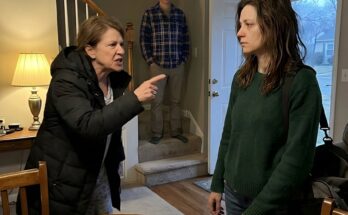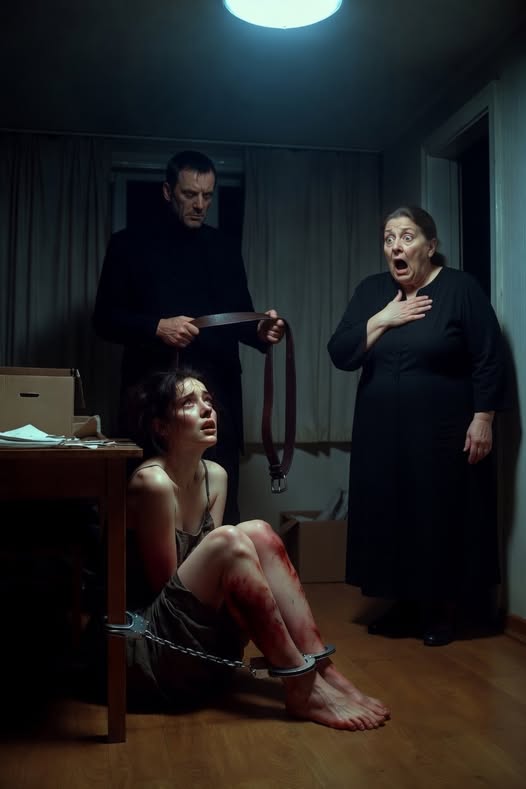
My daughter married a Korean man when she was only 21. She hasn’t been home for twelve years, but every year, without fail, she sends me $100,000.
This Christmas, I decided to visit her in secret.
But when I opened the door to her house… I froze in my tracks.
I’ll never forget that morning, standing in my small kitchen with a plane ticket trembling in my hands. My heart was beating in a strange, uneven rhythm.
Twelve years.
Exactly twelve years since my only daughter, Mary Lou, left home with her husband and moved to Korea.
Since then, she had not returned once.
But every year, exactly $100,000 arrived in my account. Not a penny less. Always with a short note:
“Mom, take care of yourself. I’m doing well.”
People in my neighborhood always said the same thing.
“Theresa, you’re so lucky. Your daughter is so good to you.”
“She married a wealthy man. You don’t have to worry anymore.”
“You must be proud.”
I always smiled when they said that.
But only a mother knows the quiet pain of receiving money from a child you can no longer hold.
A full bank account does not warm an empty dining chair. A beautiful house does not replace the sound of your daughter’s footsteps coming through the door. And no amount of money can stop a mother from wondering why her child says she is “doing well” but never comes home.
My name is Theresa. I am 63 years old.
I was widowed young, and I raised Mary Lou on my own. She was my only child, my whole world. She was smart, gentle, and beautiful in a way that made people turn their heads without meaning to. Everyone said she would have a wonderful life.
And maybe, from the outside, she did.
At 21, Mary Lou met Kang Jun, a Korean man almost twenty years older than her. I was worried from the beginning. Not because he was Korean. It had nothing to do with that. It was the age difference. It was the way he seemed so polished, so serious, so far away from the life my daughter knew.
And most of all, it was because he wanted to take her across the world.
I told Mary Lou I didn’t feel comfortable.
She held my hands and said, “Mom, I know what I’m doing.”
But her eyes were stubborn.
She had always been a soft girl with a strong heart. Once she made a decision, it was almost impossible to move her.
In the end, I gave in.
The wedding was simple. Too simple, maybe. There was no big celebration, no long planning, no warm family gathering like I had once imagined for my daughter. Within less than a month, she was leaving for Korea with her husband.
At the airport, she hugged me so tightly I could barely breathe.
She cried into my shoulder.
I cried too, but I tried to hide it because I wanted to be strong for her.
“I’ll come back, Mom,” she whispered.
I believed her.
I thought she would return after a year or two. Maybe she would bring children. Maybe we would laugh about how scared I had been. Maybe she would tell me I worried too much.
But one year passed.
Then two.
Then three.
By the fifth year, I stopped asking when she was coming home because every time I asked, her voice changed.
Only the money kept coming.
Every year, the same amount.
Every year, the same short note.
“Mom, take care of yourself. I’m doing well.”
That word “well” began to haunt me.
If she was really doing well, why did she never visit?
If she was happy, why did her eyes look so far away during the one video call we had?
She was still beautiful on the screen, but something was different. Her smile came too quickly and disappeared too fast. Her eyes kept shifting, as if someone might walk into the room at any moment.
When I asked, “Mary, why don’t you come home even for a few days?”
She went quiet.
Then she said, “I’m just very busy with work, Mom.”
I wanted to ask more.
I wanted to say, “Are you safe? Are you happy? Is your husband kind to you?”
But I didn’t.
Sometimes a mother becomes a coward because she is afraid of hearing the truth.
So I stayed quiet.
Years passed. My hair turned gray. The house where I raised Mary Lou became nicer because of the money she sent. I repaired the roof. I replaced the old stove. I even bought a better sofa because my neighbors kept telling me I deserved comfort.
But comfort is strange when you are alone.
Every Christmas, I still set a place for her at the table.
Some years, I cooked her favorite pot roast and stood over the stove watching the steam rise while tears slipped down my face.
I would sit across from her empty chair and pretend, just for a moment, that she might walk through the door.
Then Christmas would pass.
And I would tell myself again, “Maybe next year.”
But twelve years is a long time to wait.
That year, something inside me finally broke.
I decided I would go to Korea and see my daughter with my own eyes.
I didn’t tell her.
Maybe I was afraid she would stop me. Maybe I was afraid she would say she was too busy again. Or maybe deep down, I already knew something was wrong, and I needed to reach her before it was too late.
For a 63-year-old woman who had never been on a plane and had never left the country, it was a frightening decision.
I asked a kind neighbor to help me buy the ticket and prepare my documents. When the day came, I carried a small suitcase, Mary Lou’s old childhood photo, and a heart full of fear.
The flight felt endless.
My hands gripped the armrests until my fingers turned pale.
When I arrived in Korea, everything overwhelmed me—the crowds, the signs I could not read, the language I did not understand. I showed the taxi driver the address Mary Lou had given me years ago and prayed silently the whole way there.
The house was in a quiet neighborhood.
It was a two-story home, neat and expensive-looking, with a tidy garden and a front gate that was not locked.
I rang the bell.
No answer.
I waited and rang again.
Still nothing.
“Mary?” I called softly.
Only silence came back.
The gate opened easily, so I stepped inside. The garden was too quiet. No voices. No music. No sound of a television. No sign of a family living there.
My heart began to beat faster.
I walked to the front door, reached for the handle, and found it unlocked.
For a moment, I stood there, breathing hard.
Then I pushed the door open.
And froze.
The living room was spacious and spotless, but it felt lifeless. Everything was perfectly arranged, like a showroom no one was allowed to touch. There were no shoes by the door. No jackets hanging near the entrance. No smell of food, coffee, or perfume.
Nothing that felt like my daughter.
“Mary?” I called again.
No answer.
The flowers on the table were plastic. Cold. Perfect. Empty.
I moved toward the kitchen.
It was so clean it looked unused. The refrigerator held only a few bottles of water and some fruit that had already started to wither.
My chest tightened.
This was not a home.
This was a place pretending to be one.
Slowly, I went upstairs.
There were three doors.
The first room had one bed, perfectly made. The closet was full of women’s clothing, but there was not a single piece of men’s clothing inside. No tie. No shirt. No shoes. Nothing that belonged to Kang Jun.
The second room looked like an office, but even that felt untouched. No family photos. No personal items. No proof that a husband and wife had built a life there.
Then I opened the last door.
My knees almost gave out.
The room was filled with boxes.
Some were sealed.
Some were open.
And inside them were stacks of cash.
American dollars.
I reached out and touched one bundle with shaking fingers.
“What is this?” I whispered.
Mary Lou had sent me $100,000 every year. I knew that. But there was far more money in that room than I could understand.
Where was it coming from?
Why was it hidden here?
And why did my daughter never tell me?
At that moment, I heard a door open downstairs.
Soft footsteps moved across the floor.
My heart felt like it was about to jump out of my chest.
Then someone called out from below.
“Hello?”
It was not Mary Lou’s voice.