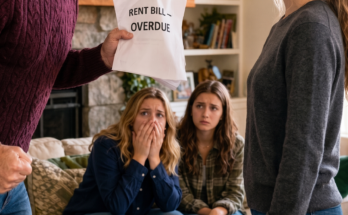
The woman stood near the doorway, staring at me like she had just seen someone from a story she never expected to become real.
“You’re her mother?” she asked again, slowly.
My throat tightened.
“Yes,” I said. “I’m Theresa. Mary Lou is my daughter. Where is she? And who are you?”
The woman hesitated. Her eyes moved toward the stairs behind me, toward the room filled with boxes of cash.
Then she lowered her voice.
“My name is Hana,” she said. “Please… sit down. There are things you need to understand.”
“I don’t want to sit,” I snapped, though my whole body was shaking. “I want to see my daughter.”
Hana swallowed.
“You can’t.”
Those two words shattered something inside me.
“What do you mean I can’t?” My voice rose through the empty house. “Where is she?”
Hana looked away.
For the first time since I entered that house, I was truly afraid.
She gestured toward the couch. I wanted to refuse, but my legs had gone weak. I sat because I had no strength left to stand.
Hana sat across from me, twisting her fingers together.
“Mary Lou didn’t marry Kang Jun for love,” she said quietly.
I stared at her.
“What?”
“She married him because she had no real choice.”
“No,” I said at once. “That’s not true. She told me she loved him. She told me she knew what she was doing.”
Hana’s eyes filled with sadness.
“She told you what she was allowed to tell you.”
The room seemed to grow colder.
Hana continued carefully, as though each word could hurt me.
“Kang Jun was involved in businesses most people never saw clearly. On the outside, he looked respectable. He had money, connections, a beautiful house, and people who treated him like he was important. When Mary came here, she thought she was stepping into a normal marriage.”
I remembered the spotless kitchen.
The empty rooms.
The plastic flowers.
“But it wasn’t normal,” Hana said. “Nothing in this house was normal.”
I could barely breathe.
“The money she sent you…” Hana paused. “It did not come from the life she wanted. It came from the life she was trapped inside.”
I gripped the edge of the couch.
“What are you saying?”
“That money was part of what she was forced to manage,” Hana said. “Transfers. Cash movements. Things that were meant to look clean from the outside.”
My stomach turned.
“No,” I whispered. “My daughter would never choose something like that.”
“She didn’t choose it,” Hana said quickly. “That is what you need to understand. She tried to leave more than once.”
My eyes burned.
“And what happened?”
Hana lowered her gaze.
“That was when everything changed.”
A terrible silence filled the room.
I heard my own breathing, shaky and uneven.
“Where is she?” I asked again, but this time my voice was barely a whisper.
Hana reached slowly into her pocket and took out her phone.
She tapped the screen, then turned it toward me.
It was a photo.
At first, my mind refused to understand what I was seeing.
Then my heart recognized her.
Mary Lou.
My daughter.
But she was not the bright, beautiful girl I had watched walk through airport security twelve years earlier.
Her face was thinner. Her eyes looked tired in a way no sleep could fix. Her hair was tied back simply. Behind her were metal bars.
I pressed my hand over my mouth.
“No,” I breathed. “No… that can’t be my Mary.”
But it was.
Even through the exhaustion in her face, I knew my child.
“She is alive,” Hana said softly. “But she is not free.”
The room blurred around me.
I don’t remember standing up.
I don’t remember reaching for the phone.
All I remember is the sound of my own voice breaking as I whispered her name.
“Mary…”
My fingers trembled so badly that Hana gently steadied the phone in my hands.
“She was taken into custody three years ago,” Hana explained. “There was an investigation. Authorities had been watching Kang Jun’s operations for a long time. When they finally moved in, Mary was caught in the middle of everything.”
“Then why didn’t anyone tell me?” I cried. “Why didn’t she call me? Why did she let me sit alone for three years thinking she was busy?”
Hana’s face twisted with pain.
“She tried.”
That stopped me.
“She tried?” I whispered.
Hana nodded. “But every call was monitored. Every message was watched. If she said too much, it could have made things worse for her. And for you.”
For me.
The realization struck me so hard I nearly sank back into the couch.
“That’s why she always wrote the same thing,” I said, tears spilling down my face. “That’s why she only said, ‘I’m doing well.’”
Hana nodded.
“She was protecting you.”
Protecting me.
For twelve years, I had believed my daughter had chosen distance over home. I had believed she was too busy, too comfortable, maybe even too proud to return.
But all that time, she had been sending me the only message she could safely send.
Not because she had forgotten me.
Because she loved me.
“And the money?” I asked, my voice hollow.
Hana looked toward the stairs.
“The money continued even after she was taken away.”
My heart clenched.
“What do you mean?”
“Kang Jun didn’t want anyone asking questions,” Hana said. “If the money suddenly stopped, you might have come here sooner. You might have called people. You might have drawn attention.”
I closed my eyes.
“So he kept sending it,” I whispered. “Pretending she was still living normally.”
Hana nodded.
Every dollar.
Every Christmas.
Every empty chair.
Every meal I had eaten alone while telling myself my daughter was too busy to come home.
It had all been part of a lie designed to keep me away.
“I should have come sooner,” I sobbed. “I should have listened to my heart.”
Hana moved closer and placed a hand over mine.
“It is not your fault,” she said gently. “Mary talked about you all the time.”
I looked up through my tears.
“You knew her?”
Hana nodded. “I worked in Kang Jun’s household. Not proudly. I was trapped in my own way. But Mary was kind to me when no one else was. She trusted me.”
“Does she know I’m here?” I asked.
“No,” Hana said. “But I think she should.”
My heart began to pound.
“Can I see her?”
Hana hesitated. Then she nodded slowly.
“I can try. Visits are limited and strict. But I know where she is.”
I grabbed her hand.
“Please,” I begged. “Please take me to my daughter.”
That afternoon, Hana made phone calls, spoke to people I could not understand, and helped me prepare what I needed. By the next morning, she took me to a gray building outside the city.
My legs shook as we entered.
There were forms. Questions. Waiting.
Every minute felt like an hour.
Then a guard led me down a hallway and opened a door.
There was a small visiting room with a glass divider.
I stood there, gripping my purse, unable to breathe.
Then the opposite door opened.
And my daughter walked in.
Mary Lou stopped the moment she saw me.
Her lips parted.
For one second, neither of us moved.
Then she lifted both hands to her mouth and began to cry.
“Mom…”
I pressed my palm against the glass.
“Mary…”
She rushed forward and placed her hand on the other side of the glass, exactly where mine was.
Twelve years disappeared in one broken breath.
She was older. Thinner. Wounded in ways I could not see. But she was still my little girl.
“I’m sorry,” she sobbed. “Mom, I’m so sorry.”
“No,” I said, crying so hard I could barely speak. “Don’t you apologize to me. I came to take you home.”
Her face crumpled.
“You shouldn’t have come,” she whispered. “I didn’t want you involved.”
“I am your mother,” I said. “I was involved from the day you were born.”
She cried harder then.
For the short time we had, Mary told me the truth.
Kang Jun had been charming at first. He made her believe she was loved, protected, and chosen. But once she arrived in Korea, the doors around her began to close. Slowly, he controlled where she went, who she spoke to, and what she could say.
At first, she didn’t understand the papers he asked her to sign or the accounts he asked her to manage. Then, by the time she understood, her name was already attached to things she had never wanted.
The yearly money was her way of keeping me safe and comfortable, but also her way of proving she was still alive.
“I thought if I kept sending it, you would not worry too much,” she said. “I thought I was protecting you.”
I shook my head, tears falling freely.
“All I ever wanted was you.”
Mary closed her eyes.
“I know that now.”
When the visit ended, I felt as if I were losing her all over again. But this time, I did not leave helpless.
I stayed in Korea.
I used part of the money Mary had sent me to hire a proper lawyer. Hana gave a statement. She handed over records she had hidden for years—messages, account notes, names, dates, proof that Mary had been forced into a role she never chose.
It was not simple.
It was not fast.
There were days when I felt too old, too tired, and too small in a country where I barely understood the language.
But every time I wanted to give up, I remembered Mary Lou’s hand pressed against mine through the glass.
So I kept going.
Months passed.
The truth slowly came forward.
Kang Jun’s polished life began to fall apart. The money hidden in the house was seized. The people who had helped him protect his secrets began to speak when they realized the walls around him were breaking.
Mary’s case was reviewed.
The evidence showed that she had not been the person behind the scheme. She had been controlled, used, and kept silent. She still had to answer questions. She still carried the weight of what had happened around her. But for the first time in years, someone listened to her as a woman who had been trapped—not as the person who created the trap.
The day Mary Lou was released, it was raining.
I stood outside with an umbrella in both hands because I was shaking too badly to hold one properly.
When the doors opened, she stepped out slowly.
For a moment, she just stood there, looking at the sky as if she had forgotten what freedom felt like.
Then she saw me.
This time, there was no glass between us.
I dropped the umbrella and opened my arms.
Mary ran to me.
She collapsed against my chest like the 21-year-old girl who had cried at the airport all those years ago.
“Mom,” she sobbed. “I want to go home.”
I held her as tightly as my old arms allowed.
“We are going home,” I whispered. “Together.”
Before we left Korea, Mary made one request.
She wanted to return to the house one final time.
The authorities had already taken what they needed. The beautiful, empty house looked even colder than before. The plastic flowers were still on the table. The upstairs room was empty now, the boxes gone, the floor bare.
Mary stood in the doorway and stared at the room for a long time.
“I hated this house,” she said quietly. “But I also thought I would never leave it.”
I reached for her hand.
“You did leave it.”
She looked at me with tears in her eyes.
“Because you came.”
I shook my head.
“No, Mary. Because you survived long enough for me to find you.”
When we returned home, the neighbors came out to stare. Some had questions. Some whispered, just as they always had.
But I no longer cared what anyone thought.
For the first time in twelve years, my daughter walked through my front door.
She stood in the living room and looked around at the house her money had helped repair. Then she saw the dining table.
Two plates.
Two sets of silverware.
A clean napkin folded neatly beside the chair I had kept for her every Christmas.
Mary covered her mouth and cried.
“You kept a place for me,” she whispered.
“Every year,” I said.
That night, I cooked her favorite pot roast.
This time, I did not cry into the gravy because I was alone.
I cried because the chair across from me was finally filled.
Mary did not heal overnight. No one does after years of silence and fear. Some mornings, she woke up frightened. Some evenings, she sat quietly by the window, lost in memories she was not ready to share.
But slowly, life returned.
She helped me in the garden. She learned to laugh again. She started writing down her story, not because she wanted pity, but because she wanted other women to understand that a beautiful life from the outside can hide a painful truth inside.
As for the money, we did not keep what was tied to Kang Jun’s wrongdoing. With the lawyer’s help, we returned what needed to be returned and kept only what was legally cleared for Mary. We chose peace over comfort built on fear.
Our house became simple again.
But it was warm.
And every Christmas after that, I still set two places at the table.
Only now, one chair was no longer empty.
For twelve years, I thought my daughter’s money was proof that she had forgotten how to come home.
But I was wrong.
It was her quiet way of saying, “Mom, I’m still here.”
And when I finally listened to the ache in my heart, I found her.
Not untouched.
Not unchanged.
But alive.
And home.
For me, that was more than enough.