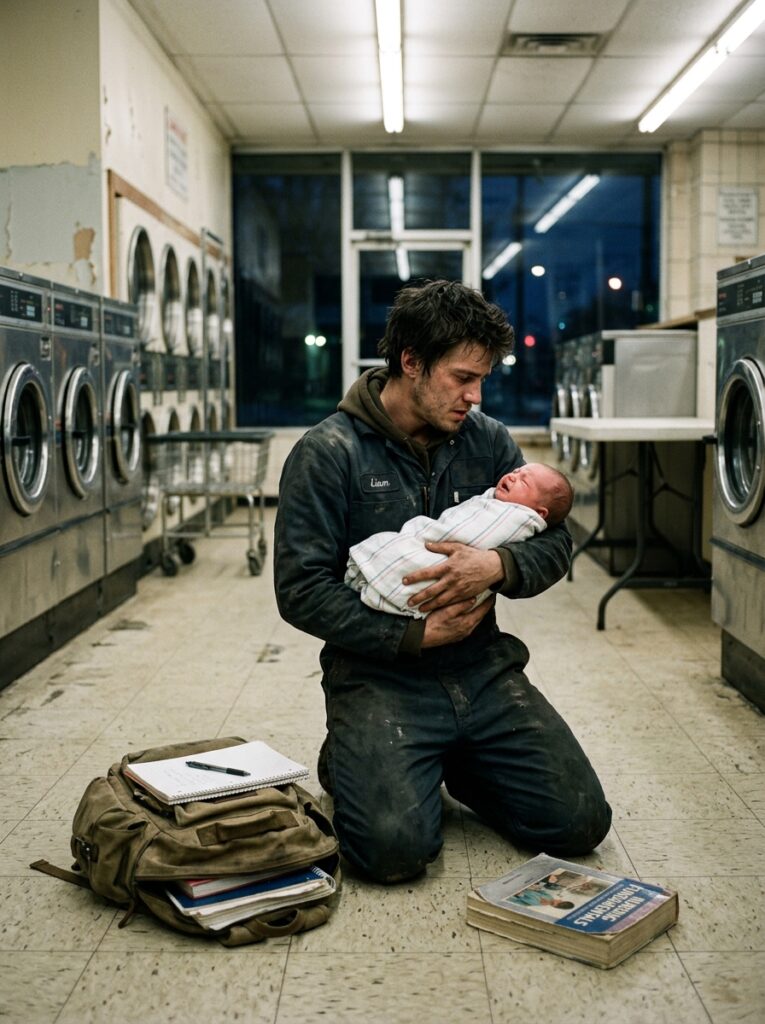
I almost called emergency services on a tattooed teenager holding a crying baby in a deserted laundromat at one in the morning.
Then his backpack ripped open.
And what spilled across the floor made my heart sink with shame.
My thumb hovered over my phone screen, damp with nervous sweat. My heart was beating so hard it felt like it was trapped inside my chest. I had backed myself into the narrow space between two humming dryers, trying to stay hidden.
Moments earlier, the glass door of the laundromat had swung open hard, and he had rushed inside.
He looked about nineteen. His arms were covered in dark tattoos that reached up toward his neck. His clothes were worn, his eyes were red with exhaustion, and he kept looking over his shoulder like someone was following him.
Pressed awkwardly against his chest was a tiny baby girl, red-faced and crying with everything she had.
I was sixty-eight years old, a retired middle school teacher from Ohio. I had spent forty years reading children, parents, and trouble before it even spoke. Or at least, I thought I had.
Every instinct in me whispered that something was wrong.
Did he take that baby from someone?
Was he running from trouble?
Was the child safe?
The laundromat was empty except for the two of us. The fluorescent lights buzzed overhead. The washing machines turned slowly. The baby’s cries echoed off the tiled walls until the whole room felt sharp with panic.
“Please stop crying,” the boy muttered, his voice breaking. “Please, Emma. Please, just stop.”
He set a plastic laundry basket down too hard on the folding table, and I flinched.
My fingers typed the numbers before I could think.
9 – 1 – 1.
I was sure I was about to save a child.
Then his backpack slid off his shoulder. The zipper finally gave way, and the whole bag dropped open on the floor.
Books, papers, and cards spilled across the scuffed linoleum.
I expected to see something frightening.
Instead, a large hardcover textbook landed near my feet.
The cover read: Fundamentals of Pediatric Nursing.
Colorful handwritten flashcards scattered everywhere. Some had notes about infant care. Others had medical terms, diagrams, and reminders written in careful handwriting.
The boy stared at the mess.
Then his whole body seemed to collapse.
He dropped to his knees in the middle of the laundromat, pulled the crying baby close, buried his face in her blanket, and began to cry.
Not quietly.
Not dramatically.
But like someone who had reached the very last piece of strength inside him.
“I can’t do it,” he choked. “I’m so tired, Emma. Daddy is so tired.”
My thumb slipped away from the call button.
A wave of shame moved through me so fast it stole my breath.
I stepped out from behind the dryers.
The boy looked up and immediately pulled the baby tighter against him, fear flashing across his face.
“I’m sorry,” he said quickly. “I’ll keep her quiet. I just needed to wash my work uniforms. We don’t have hot water at the apartment right now.”
His hands were trembling.
So was my voice when I said, “Let me hold her.”
He stared at me, unsure.
“I’m a retired teacher,” I said gently. “And a mother. You need a moment to breathe.”
For a few seconds, he didn’t move. Then, slowly, he handed the baby to me.
She was warm, damp with tears, and exhausted. I placed her against my shoulder, rubbed her back, and began to sway the way my body still remembered after all these years.
Within moments, her screams softened into tiny hiccups.
The boy watched like he was witnessing a miracle.
His name was Jackson.
He was nineteen.
And over the next hour, while we loaded his clothes into the machines, his story came out in pieces.
He worked evening shifts at a shipping warehouse, lifting boxes until midnight. At eight every morning, he attended community college classes because he was trying to become a nurse.
Three months earlier, his girlfriend, Rachel, had left him alone with their baby daughter, Emma.
He had no family nearby. No savings. No real support. A neighbor watched Emma during his shifts, but she charged by the hour. After rent, food, and childcare, Jackson said he sometimes had less than twenty dollars left for the week.
“I sleep in my car between classes,” he admitted, staring at the spinning laundry. “Not always. Just when I’m too tired to drive home and back.”
He looked down at his tattooed hands.
“People see me and think the worst,” he said quietly. “They cross the street. They lock their doors. They look at me like I’m going to hurt someone. I just want to give my daughter a good life.”
I stood beside him, listening to the machines turn.
And I felt very small.
I had been widowed for six years. My own children lived three states away. My house was clean, quiet, and painfully empty.
My washing machine had broken that morning, which was the only reason I was in that laundromat at one in the morning.
For years, I had complained about loneliness. I had sat inside my silent house and wondered why the world had forgotten older people like me.
And yet, when someone drowning had appeared right in front of me, I almost called for help against him instead of offering help to him.
All because I didn’t like the way he looked.
When Jackson’s clothes were finally dry, he packed them into his basket. I walked over and placed my hand gently over his.
“Jackson,” I said, “I have a big house. It’s clean. It’s safe. And it’s far too quiet.”
He looked confused.
“You bring Emma to me,” I told him. “When you have work. When you need to study. When you need to sleep. You bring her to my house.”
He shook his head immediately.
“I can’t pay you, ma’am.”
“I don’t want your money,” I said. “I want to hear a child laugh in my living room again. And I want you to pass your nursing exams.”
His face crumpled.
He didn’t speak.
He simply stepped forward and hugged me like a boy who had been holding himself together for too long.
That was how Jackson and Emma came into my life.
Over the next two years, my quiet house became loud again.
There were toys in the living room, bottles in the sink, cartoon songs playing in the background, and tiny socks hiding under the sofa cushions.
Jackson worked. Studied. Passed exams. Failed one test and passed the next. He kept going even when his eyes were heavy and his hands shook from lack of sleep.
I watched Emma three days a week and sometimes more.
She called me “Nana Martha” before she could say my whole name.
Last month, I sat in the front row of a crowded auditorium with Emma bouncing on my lap as Jackson walked across the stage in blue scrubs to receive his nursing pin.
He was no longer the frantic boy from the laundromat.
He was a father.
A nurse.
A man who had survived more than most people knew.
I thought that was the ending.
I thought the hardest part of his life was behind him.
Then, one Sunday afternoon, the woman who had left them stood on my porch holding a white envelope.
“Please don’t shut the door,” she said.
Her voice was thin and shaking.
I froze with one hand on the door.
Inside, Emma was sitting on my rug, feeding plastic peas to a stuffed rabbit. Jackson was in my kitchen washing dinner plates, humming softly like a man who had finally learned peace.
And there, on my porch, stood Rachel.
I knew her only from one old photo Jackson kept in Emma’s baby book. In that picture, she had been pale and tired in a hospital bed, holding newborn Emma against her chest.
The woman in front of me looked older now. Thinner. Her coat was too light for the cold, and her hands trembled around the envelope.
“I know I don’t deserve to be here,” she whispered. “But I need to see my daughter.”
My first instinct was not kindness.
That still shames me.
After everything I had learned from Jackson, after nearly judging him so wrongly, I still felt the same old instinct rise in me.
Protect what I love.
And what I loved was inside my house, wearing yellow socks and calling my sofa a mountain.
I stepped outside and pulled the door nearly closed behind me.
“You need to leave,” I said.
Rachel flinched.
“I’m not here to cause trouble.”
“You already caused plenty.”
Her eyes filled quietly.
“I know,” she said. “I know what I did.”
From inside, Emma laughed.
“Daddy! Bunny ate all the peas!”
Jackson laughed too.
That sound stopped Rachel cold.
Her face changed.
It wasn’t jealousy.
It was grief.
The kind people carry when they realize life continued without them.
“Is that her?” Rachel asked.
I gripped the doorknob.
“No.”
It was a foolish lie. We both knew it.
Rachel lowered her head.
“I’m not asking to take her today,” she said. “I’m asking for a chance to do this right.”
Then she placed the envelope on the porch rail.
“I filed for a hearing.”
My stomach dropped.
“A hearing?”
“I’m her mother.”
The words came out of me before I could stop them.
“A mother stays.”
Rachel’s face crumpled.
For one second, I saw the terrified young woman she must have been when she walked away. Not a monster. Not a villain. Just someone who made a terrible choice and had lived long enough to be haunted by it.
But compassion did not erase the truth.
Jackson had stayed.
He had worked nights, studied mornings, slept in his car, washed uniforms at one in the morning, and held his crying baby when no one else was there.
He had been the one people judged.
He had been the one who never left.
Then the door opened behind me.
“Martha?” Jackson asked.
He saw Rachel.
A plate slipped from his wet hand and shattered on the kitchen floor.
Nobody moved.
Rachel covered her mouth.
“Jack,” she whispered.
Jackson stared at her like a ghost had learned how to knock.
“What are you doing here?”
“I just wanted to talk.”
“You don’t get to just want things now.”
She nodded quickly.
“I know.”
His voice was calm, but too calm.
“I called you for three months,” he said. “Morning and night. I sent pictures. I left messages. I begged you to tell me you were alive.”
“I heard them,” she whispered.
That hurt him more than silence.
“You heard them?”
She nodded, crying now.
“I couldn’t answer.”
He stepped closer, pain breaking through his face.
“I was nineteen, Rachel. I had a newborn. No family. No money. No sleep. I thought something happened to you.”
“I’m sorry.”
Emma appeared behind his legs then, gripping his scrub pants with both hands.
“Daddy?”
Jackson immediately lifted her into his arms.
His whole expression softened.
That was what fatherhood had done to him. It had made him tired and frightened, but also gentle in places the world had never been gentle with him.
Rachel made a small broken sound.
Emma looked at her curiously.
“Why is that lady sad?”
No one answered.
Rachel took one small step forward.
Jackson stepped back.
“Don’t.”
She stopped immediately.
“I won’t touch her unless you say I can.”
“You don’t get near her.”
“Jack, please.”
“No,” he said, his voice shaking now. “You don’t get to disappear for two years and then show up at Nana Martha’s house with papers like you misplaced something.”
Rachel wiped her cheeks.
“I have a job now. I have an apartment. I’ve been seeing a counselor. I have proof that I’m stable.”
“Proof?” Jackson repeated bitterly. “There’s proof inside this house. Every bottle I washed. Every fever I sat through. Every class I almost failed because I was working nights. Every time she cried for a mother she didn’t remember.”
Rachel looked down.
“I deserve that.”
“This isn’t about what you deserve,” Jackson said. “It’s about what she deserves.”
The porch went silent.
Rachel nodded slowly.
“You’re right.”
Then she looked at Emma for only a second.
“I’m not asking her to love me today,” she said. “I’m asking for the chance to earn whatever place is safe for her.”
Jackson didn’t answer.
Rachel placed the envelope in his hand.
“I’ll be at the hearing. I won’t lie. I won’t fight dirty. I just needed you to know I’m not who I was when I left.”
“You don’t get to decide that,” Jackson said.
“No,” she whispered. “I guess I don’t.”
Then she walked back to her car and drove away.
Jackson stood on the porch until her taillights disappeared.
Then he handed Emma to me, walked into my downstairs bathroom, shut the door, and got sick.
That night, Emma slept in my guest room because Jackson couldn’t bring himself to take her back to their apartment.
He sat at my kitchen table until after midnight, staring at the unopened envelope.
“I hate her,” he said.
“I know.”
“I hate her for leaving.”
“Yes.”
“I hate her for coming back clean and rested and prepared while I had to crawl through those years on my hands and knees.”
“Yes.”
Then his voice broke.
“And I hate myself because part of me was glad she was alive.”
That broke my heart most of all.
Because under anger, there is often another wound.
The wound of still loving someone who left.
I reached across the table and covered his hand.
“You’re allowed to feel all of it,” I said.
“What am I supposed to do?”
I wanted to give him an easy answer. Teachers like answers. Rules. Lessons. Steps.
But life was not a classroom.
So I said the only honest thing I had.
“You protect Emma. Not your pride. Not your anger. Not Rachel’s guilt. Emma.”
He looked away.
“What if protecting her means keeping Rachel away forever?”
“Then that’s what you do.”
“And what if protecting her means letting Rachel back in?”
I had no easy answer for that.
The hearing came three weeks later.
A counselor explained that the court might consider gradual supervised visits because Rachel was Emma’s biological mother and had no record of harming her.
Jackson was furious.
“So leaving doesn’t count?” he asked me later.
“Leaving hurt,” I said.
“I know. But they said the court looks at whether a relationship can be safe now, not only whether someone failed before.”
I didn’t like it.
Not because it was unreasonable.
Because it was.
And reasonable things can feel cruel when your heart is on trial.
The first supervised visit happened in a family services office downtown. A plain room. A small table. Crayons. Two squeaky chairs.
Jackson asked me to wait in the hallway.
Rachel arrived early.
She carried no big gifts, no balloons, no attempt to buy love. Just a coloring book and crackers.
She knelt down when she saw Emma.
“Hi, Emma,” she said gently. “My name is Rachel.”
Emma hid her face in Jackson’s neck.
Jackson crouched in front of her.
“I’ll be right outside,” he promised.
“With Nana?”
“Yes,” I said. “Daddy and Nana will be right outside.”
Emma looked at Rachel.
“Is she my friend?”
Jackson closed his eyes for half a second.
When he opened them, they were wet.
“She wants to be,” he said.
That answer cost him something.
I saw it.
Rachel saw it too.
Emma took one step into the room, then another.
The door closed.
For thirty minutes, Jackson paced. Sat. Stood. Almost pressed his ear to the door, then stepped back.
No crying came from inside.
Once, Emma laughed.
Jackson’s face twisted like the sound both hurt and healed him.
When the door opened, Emma ran straight into his arms.
“Daddy! Rachel colored a duck green!”
Rachel came out behind her.
She didn’t ask for more time. She didn’t ask for a hug.
She only said, “Thank you.”
Jackson didn’t answer.
But he nodded once.
That tiny nod was not forgiveness.
It was discipline.
The visits continued.
Thirty minutes became an hour. An hour became two. Always supervised. Always documented. Always careful.
People had opinions, of course.
Mrs. Whitaker from two streets over cornered me in the grocery store.
“I heard the mother came back,” she said. “She shouldn’t be allowed near that child.”
I placed two cans of soup in my basket.
“Do you know the details?”
“I know enough.”
I almost laughed.
That might be the most dangerous sentence in the world.
I know enough.
I had known enough once, too.
Enough to almost press call on a terrified teenager who needed help.
“I’m not saying what Rachel did was right,” Mrs. Whitaker continued. “But people like that don’t change.”
People like that.
There it was again.
The small fence we build around our fear.
A month earlier, I might have agreed. But now I had watched Rachel sit on a beige carpet and let Emma cover her hand in green crayon. I had watched her leave every visit crying in her car, but never in front of Emma. I had watched Jackson learn to say, “Next Thursday at four,” without his voice breaking.
“I think people can change,” I said carefully. “But trust has to be earned slowly.”
The hardest day came in March.
Rachel requested one unsupervised visit.
Not overnight. Not custody. Just ninety minutes at the public library.
Jackson came to my house after work, looking shattered.
“I said no,” he told me. “Then Emma cried.”
“Why?”
His voice went thin.
“She said Rachel promised to show her how to make cinnamon pancakes.”
He pressed his hands together like he was praying.
“She likes her,” he whispered. “She doesn’t remember being left. She just sees a woman who colors ducks green and knows songs I don’t know.”
His eyes filled.
“I thought I was protecting her from Rachel. What if I’m protecting myself from Emma loving someone else?”
I hated that question because it was brave.
“Jackson,” I said softly, “love is not a pie. It doesn’t run out because someone else gets a slice.”
He let out a broken laugh.
“That sounds like something from your classroom wall.”
“It probably was.”
Then the laugh became tears.
“I gave her everything I had.”
“I know.”
“What if it still isn’t enough?”
I put my arm around him.
“That child reaches for you in her sleep. You are enough. You were enough before anyone else came back. You will be enough after.”
The first unsupervised visit took place at the town library.
Rachel arrived early and chose a table in clear view of the front desk.
Jackson noticed.
So did I.
Emma took Rachel’s hand and walked toward the children’s room.
Jackson and I sat in his parked car for ninety minutes.
He gripped the steering wheel the whole time.
“What if she calls her Mom someday?” he asked.
“She might.”
His jaw tightened.
“What do I do?”
“You breathe.”
“That’s your advice?”
“It’s the only thing that works every time.”
At exactly ninety minutes, Rachel walked Emma back to the car.
Emma wore a paper crown.
“Nana! Daddy! I made a duck queen!”
Jackson lifted her and looked her over, as if checking for invisible bruises.
“Did you have fun?”
“Yes! Rachel reads funny.”
Rachel handed Jackson a sheet of paper.
“What’s this?” he asked.
“What we did,” she said. “Times. Snack. Bathroom break. She bumped her knee on a chair at 10:42 but didn’t cry. I wrote it down.”
Jackson stared at the paper.
It was exactly what he would have done.
Maybe that was why it hurt.
“Thank you,” he said quietly.
Rachel’s eyes filled.
“You’re welcome.”
Spring became summer.
The visits grew, but never quickly.
Jackson kept boundaries like fence posts.
Rachel respected every one.
If Emma asked whether she could sleep over someday, Rachel said, “That is something your daddy and I will talk about when everyone is ready.”
If she was going to be five minutes late, she called ten minutes early.
If Emma called her “my Rachel,” Rachel cried later in her car, never in front of the child.
And Jackson changed too.
Slowly.
Painfully.
He stopped crossing his arms at every handoff. He stopped checking Emma’s backpack like a detective. He stopped saying Rachel’s name like it tasted bitter.
One evening, he arrived at my house and found Rachel on my porch.
She had dropped off Emma’s sunhat, and I had invited her to sit for iced tea.
When Jackson saw her, Rachel stood quickly.
“I was just leaving.”
Emma ran past him.
“Daddy! Rachel and Nana both like lemon cookies!”
Jackson looked at me.
I prepared myself for anger.
Instead, he sighed.
“Everybody likes lemon cookies, Bug.”
Rachel laughed softly.
For a moment, they looked like two people remembering that before pain, there had once been ordinary things between them.
Cookies.
Jokes.
A baby name chosen in a hospital room.
A life that cracked open, but had not disappeared completely.
Then August came.
Jackson was offered a full-time position at Maple Creek Children’s Clinic.
Day shift. Benefits. Steady hours.
The kind of job he had once studied for under laundromat lights while Emma cried in his arms.
He was happy for about ten minutes.
Then he realized the job required six weeks of training in another city, Monday through Friday.
Emma could stay with me.
That was the obvious plan.
The safe plan.
Then Rachel asked quietly, “Could I help?”
The room went still.
“I’m not asking to replace Martha,” she said quickly. “I just mean maybe one afternoon a week. Preschool pickup if needed. Dinner at Martha’s house. Whatever helps.”
Jackson said nothing.
Rachel nodded.
“Forget I asked.”
But Emma looked up from her coloring.
“Can Rachel pick me up with Nana?”
Jackson looked at his daughter.
The room held its breath.
“Maybe,” he said.
It was the bravest maybe I had ever heard.
During those six weeks, we made a schedule.
I kept Emma most days. Rachel helped on Tuesdays with pickup and dinner at my house. Jackson called every night. Not once did he miss a call.
One evening, Emma got a fever while Rachel was with me.
Rachel reached for her, then stopped.
“May I?”
That question mattered.
She was still asking.
Still respecting the lines.
I nodded.
Rachel held Emma gently while I called Jackson.
He answered immediately.
“What happened?”
“Low fever,” I said. “She’s okay. I’m here. Rachel is here.”
Silence.
Then he said, “Put me on speaker.”
Rachel’s face went pale.
“Jack,” she said carefully, “her temperature is 100.8. She drank water. No rash. Breathing is normal. She’s sleepy but responsive. I wrote down the time.”
Jackson was quiet.
Then he said, “Good.”
One word.
Good.
From him, it was a medal.
The next day, Jackson came home and went straight to Emma, who was wrapped in a blanket on my sofa.
She threw herself into his arms.
He held her for a long time.
Then he looked at Rachel standing near the kitchen.
“Thank you,” he said.
Rachel’s eyes filled.
“You’re welcome.”
It was not a restored family.
Not exactly.
It was something new.
Built from wreckage, boundaries, patience, and a little girl too young to understand how many adults were trying to become better for her.
At the end of September, Jackson started his new job.
The clinic hosted a small welcome breakfast. I went because Emma insisted I wear my “fancy Nana necklace.”
Rachel came too.
Jackson had invited her himself.
“She should see it,” he told me. “She knew me before I thought I could do anything.”
During the breakfast, his supervisor asked him to say a few words.
Jackson looked terrified.
Public speaking was not his gift.
But he stood.
“I became a nurse,” he began, “because when my daughter was born, I realized I didn’t know how to keep anything alive except myself. And some days, barely that.”
A soft laugh moved through the room.
He looked at Emma.
“Then people helped me. One person especially.”
His eyes found mine.
“She saw me at my worst and chose not to believe the easiest story about me.”
My throat tightened.
“She taught me that care is not just a feeling. It is a decision you keep making when it is inconvenient, uncomfortable, and sometimes unfair.”
Then his eyes moved briefly to Rachel.
“I’ve also learned that people are more than the day they failed. That doesn’t mean trust is automatic. It means growth has to be allowed to prove itself.”
Rachel covered her mouth.
I reached for her hand without thinking.
Jackson looked back at the room.
“I want to be that kind of nurse. The kind who looks twice. The kind who asks one more question before assuming the worst. The kind who remembers that everyone who walks through the door is carrying a story I don’t know yet.”
The room erupted in applause.
Emma clapped the loudest.
“That’s my daddy!” she shouted.
Six months later, Emma had her fourth birthday party in my backyard.
There were paper lanterns in the trees, a homemade cake on the picnic table, and children running through the grass with sticky hands.
Jackson wore jeans and a clean shirt, his tattoos visible in the sun, no longer something he tried to hide.
Rachel helped Emma place candles on the cake.
I watched from the porch.
My porch.
The one that had once held only silence, plants, and grief.
Now there were little shoes by the door, crayon marks on the coffee table, and a plastic dinosaur in my birdbath.
When it was time for cake, Emma stood between Jackson and Rachel.
Jackson lit the candles. Rachel shielded the flame from the wind. I stood behind Emma with my hands on her shoulders.
Four candles flickered.
Four years of life.
Two years of absence.
Two years of repair.
One little girl surrounded by adults who had all learned, in different ways, to put down their pride.
“Make a wish,” Jackson said.
Emma squeezed her eyes shut and blew out the candles.
Later, Rachel found me near the kitchen sink.
“I wanted to tell you something,” she said.
I turned off the faucet.
“Emma asked if she could call me Mom someday.”
My chest tightened.
“What did you say?”
“I told her she could call me Rachel as long as she wanted. Or Mom someday if it felt right. Or both. Or neither.”
I nodded slowly.
“That was a good answer.”
Rachel swallowed.
“She also asked if Nana is family.”
My throat closed.
“I told her yes,” Rachel said. “I told her family is who stays. And who comes back correctly when they were wrong. And who loves you without making you choose.”
For a long moment, I couldn’t speak.
Then I said, “That was also a good answer.”
That evening, after everyone left, Jackson and I sat on the porch.
The yard was full of paper cups and tired balloons. Emma slept upstairs in the room she still called “my Nana room.”
“Did we do the right thing?” Jackson asked.
I smiled.
“You’re asking me now?”
“I’m serious.”
“So am I.”
He looked toward the dark yard.
“Sometimes I still get angry.”
“You probably always will, a little.”
“Is that bad?”
“No. It means it mattered.”
He nodded.
“Sometimes Emma reaches for Rachel and it stings. Then five minutes later she reaches for me, and I feel foolish for being scared.”
“You’re not foolish.”
He was quiet for a while.
“I thought forgiveness would feel clean.”
I laughed softly.
“No. Forgiveness is usually sticky. Like birthday cake on a doorknob.”
He smiled.
“That’s disgusting.”
“That’s life.”
Then he looked at me.
“That night at the laundromat,” he said, “if you had called, I don’t think I would have survived losing her.”
My heart clenched.
“I know.”
“I used to think about that a lot.”
“I did too.”
“Do you still?”
I watched a moth circle the porch light.
“Yes,” I said. “But not the same way. At first, I thought about it with shame. Now I think about it as a warning.”
“A warning?”
“That one frightened moment can make you forget someone’s humanity. And one merciful moment can give it back.”
Jackson reached over and took my hand.
His tattooed fingers wrapped around my wrinkled ones.
“You gave me more than babysitting,” he said.
I looked at our joined hands.
“You gave me more than noise in my house.”
From upstairs, Emma called softly in her sleep.
“Daddy?”
Jackson was on his feet instantly.
Some things had not changed.
Some things never should.
He went inside, taking the stairs two at a time.
A moment later, I heard his low voice.
“I’m here, Bug.”
Then Emma mumbled, “Nana too?”
Jackson called down, “Nana too.”
I climbed the stairs slowly.
Emma was half-asleep, hair spread across her pillow. She reached one hand for Jackson and one for me.
A child can do that.
Love more than one person.
Need more than one heart.
Build a family out of whoever keeps showing up.
I sat on one side of the bed. Jackson sat on the other. Emma sighed, safe between us.
And I thought of Rachel, alone in her apartment perhaps, learning the slower ache of earning back what she had once abandoned.
I thought of Jackson, who had learned that strength was not keeping everyone out.
I thought of myself, an old widow who once believed her life had narrowed to silence and broken appliances.
We had all been wrong.
The world had not ended in that laundromat.
In many ways, it had begun there.
Not neatly.
Not easily.
Not without anger, fear, or consequences.
But grace rarely enters as a shining miracle.
Sometimes it comes as a tired teenager on a dirty floor.
As a baby who will not stop crying.
As a woman with papers on your porch.
As a choice you do not want to make, but make anyway because a child deserves more than your pain.
People may argue about stories like ours.
Some will say Rachel should never have been allowed back. Some will say every parent deserves a second chance. Some will say Jackson was too forgiving. Some will say I had no right to judge anyone after what I almost did.
Maybe all of them are partly right.
But I know this.
A child is not a trophy for the person who suffered most.
A child is not a punishment for the person who failed.
A child is a living soul who deserves safety, truth, patience, and as much steady love as the adults around her can learn to give.
That night, Emma fell back asleep holding both our hands.
Jackson looked across the bed at me.
His eyes were tired.
But peaceful.
“She’s okay,” he whispered.
I nodded.
“She is.”
And downstairs, in the quiet house that was no longer quiet, the last birthday balloon drifted slowly across the living room floor.
Not forgotten.
Not lost.
Just moving gently through a home that had somehow made room for everyone willing to stay.
━━━━━━━━━━━━━━━━━━━━━━━━━━━━━━━━━━━━━━