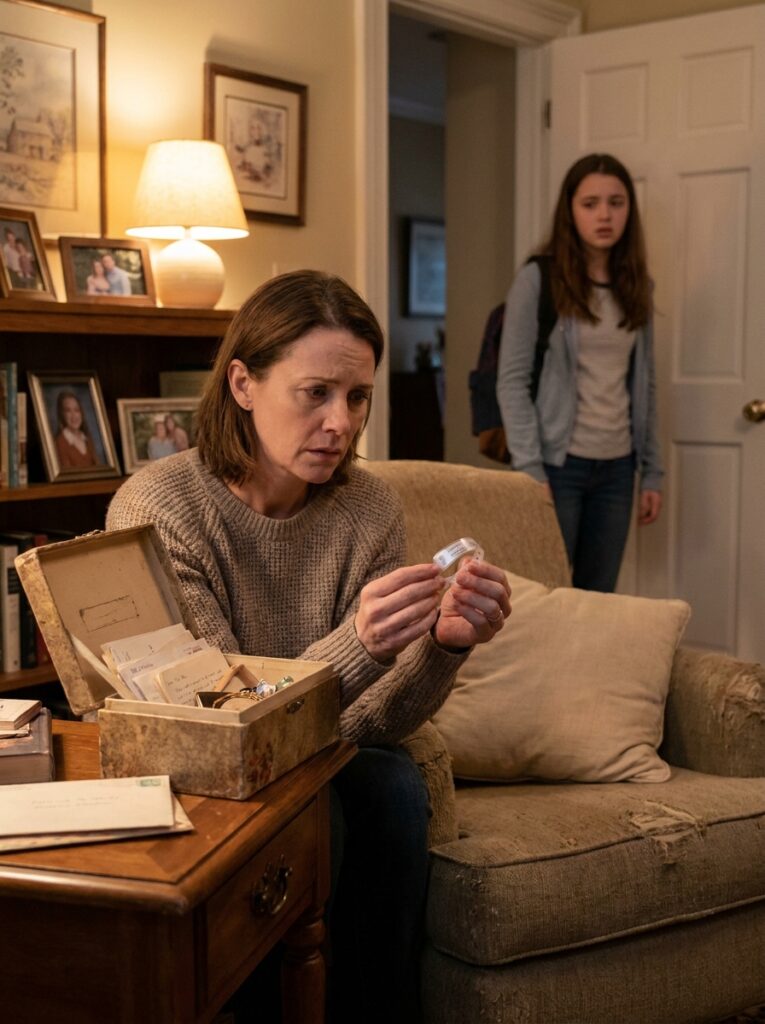
Mara Whitfield found the bracelet on a rainy Thursday afternoon, tucked beneath a yellowed baby blanket and a stack of birthday cards she had been too sentimental to throw away.
For eighteen years, the cedar keepsake box had sat untouched on the highest shelf of her bedroom closet. It smelled faintly of lavender, old paper, and time. Mara had always told herself she would organize it one day. One day when life slowed down. One day when the memories did not feel so fragile.
That day had finally come because her daughter, Lily, was graduating from high school in two weeks.
The living room was scattered with photo albums, loose pictures, old school drawings, and ribbons from childhood dance recitals. Mara had promised to make a slideshow for Lily’s graduation party, something sweet and emotional that would make everyone cry in the best way.
She smiled as she pulled out Lily’s first pair of socks, so small they barely covered Mara’s palm.
“My goodness,” she whispered. “You were tiny.”
Outside, rain tapped gently against the window. The house was quiet except for the hum of the dryer and the occasional creak of old floorboards.
Mara reached deeper into the box and lifted out the soft pink hospital hat Lily had worn in the newborn photo. Beneath it was a clear plastic bracelet, curled into a small circle.
She had seen it before, years ago. Maybe many times. But she had never really looked at it.
This time, for some reason, she did.
The print had faded, but it was still readable.
Baby Girl Bennett.
Mara blinked.
She brought it closer to the window, thinking the light was playing tricks on her.
But the name remained.
Baby Girl Bennett.
Not Whitfield.
Not Lily.
Not theirs.
For a moment, Mara simply stared at it. Then she gave a nervous little laugh.
“That’s strange,” she murmured.
Hospitals made mistakes with paperwork all the time, didn’t they? A bracelet could have been placed in the wrong discharge packet. Maybe a nurse accidentally handed her the bracelet from another baby. Maybe she had picked it up from a table without noticing.
But then her eyes dropped to the date printed below the name.
June 14.
The day Lily was born.
Her breath caught.
Same date. Same hospital. Same maternity wing.
Mara sat slowly on the edge of the couch.
The bracelet felt heavier than it should have.
A memory stirred in the back of her mind, one she had not thought about in years.
The night Lily was born had been chaotic. Mara had gone into labor during a storm. The hospital had been short-staffed. There had been a power flicker, alarms in the hallway, nurses rushing between rooms. Mara remembered being exhausted, frightened, and overwhelmed.
She remembered holding Lily only briefly before the nurse said the baby needed to be checked.
“Just routine,” the nurse had said kindly. “We’ll bring her right back.”
But Lily had not come right back.
It had taken hours.
At the time, Mara had been too tired to question it. Her husband, Daniel, had been pacing the room, calling relatives, trying to stay calm. His mother, Evelyn Whitfield, had arrived before dawn and immediately started giving instructions to everyone as if she owned the hospital.
When the nurse finally returned with the baby, Mara had cried from relief.
“She’s perfect,” Daniel had whispered.
And she was.
Lily was perfect.
Mara pressed the bracelet between her fingers until the plastic edge dug into her skin.
Footsteps sounded in the hallway.
“Mom?”
Mara quickly tried to slip the bracelet beneath the blanket, but Lily was already standing in the doorway.
At eighteen, Lily was tall and graceful, with dark curls, olive skin, and deep brown eyes that always seemed to notice more than people expected. Mara had fair skin, blue eyes, and straight auburn hair. Daniel had sandy blond hair and gray eyes. Their relatives all had some version of the same pale Whitfield coloring.
Lily had never looked like them.
People had mentioned it for years.
“She must take after some distant relative.”
“Genes are funny.”
“What a beautiful surprise in the family tree.”
Mara had always smiled politely and let the comments pass.
But Lily had heard them too.
Now she held a stack of old family photos in both hands. Her expression was serious, almost wounded.
“Mom,” she said quietly, “why do I look nothing like anyone in this family?”
Mara’s mouth opened, but no sound came out.
Lily’s eyes moved to the bracelet in her hand.
“What is that?”
Mara looked down.
For one foolish second, she thought about lying. She could say it was nothing. She could put it away. She could protect the life they knew for just one more day.
But Lily stepped closer.
“Mom.”
Mara swallowed. “It’s your hospital bracelet.”
Lily’s brows drew together. “Then why do you look scared?”
Mara slowly handed it to her.
Lily read the name.
Her face changed.
“Baby Girl Bennett,” she whispered.
“It may be a mistake,” Mara said quickly. “It’s probably just a hospital paperwork mistake.”
Lily looked up at her. “But it has my birthday.”
“I know.”
“And the same hospital?”
Mara nodded, tears already blurring her eyes.
Lily sat down across from her, still holding the bracelet like it might break.
For a long moment, neither of them spoke.
Then Lily asked the question Mara was terrified to hear.
“Am I your daughter?”
Mara moved so fast the photo albums slid from her lap.
“Yes,” she said, kneeling in front of Lily. “Yes. You are my daughter. You are my heart. You are the baby I rocked through every fever, every nightmare, every hard day. Nothing changes that.”
Lily’s eyes filled with tears. “That’s not what I mean.”
“I know,” Mara whispered.
Lily looked again at the bracelet. “We have to find out.”
Mara wanted to say no. She wanted to bury the bracelet back in the box and return to planning a graduation party. She wanted to keep making sandwiches, folding laundry, and arguing with Lily about leaving shoes by the door.
But a mother knows when her child needs the truth.
Even when that truth may break her.
That evening, Mara showed Daniel the bracelet.
He stared at it for a long time.
“That can’t be right,” he said.
His voice was calm, but his hand shook when he set the bracelet on the kitchen table.
Lily sat between them, arms wrapped around herself.
“Do you remember anything strange from the hospital?” she asked.
Daniel rubbed both hands over his face. “It was a storm. Everything was strange.”
Mara turned to him. “Your mother was there.”
Daniel stiffened.
“She was always there,” he said.
Mara hesitated. “Do you remember how she kept asking the nurses questions? How she kept disappearing down the hallway?”
Daniel looked away.
“Daniel.”
He sighed. “My mother was controlling. That doesn’t mean she had anything to do with this.”
“I’m not saying she did. But she knew something.”
Lily looked between them. “Why would Grandma know anything?”
Mara’s stomach tightened.
Evelyn Whitfield had passed away six years earlier, and even in death, she still seemed to occupy the corners of the family. She had been elegant, demanding, and impossible to please. She adored the Whitfield name and cared deeply about appearances.
From the day Lily came home, Evelyn had acted strangely around her.
She brought gifts, yes. She attended birthdays, yes. But there was always a distance in her affection, a carefulness, as if she were watching something unfold that only she understood.
When Lily was five, she once asked Evelyn, “Grandma, do I look like Daddy?”
Evelyn had gone pale.
Then she forced a smile and said, “You look like a child who was meant to be loved.”
At the time, Mara thought it was poetic.
Now, the words felt like a warning.
The next morning, Mara called the hospital.
After three transfers and a long hold, she was told that records from eighteen years ago were archived and difficult to access. She filed a formal request. Daniel called a lawyer friend. Lily searched online for the Bennett family.
By midnight, they had found one possibility.
A woman named Clara Bennett had given birth to a baby girl at the same hospital on the same day.
There was an old local announcement in a newspaper archive:
Clara and James Bennett welcome daughter Rose Marie Bennett, born June 14.
Rose.
Mara stared at the name until the letters blurred.
Lily sat beside her at the kitchen table.
“Rose Bennett,” Lily whispered. “Do you think she…”
She could not finish.
Mara took her hand. “We don’t know anything yet.”
But the next clue came from a place Mara never expected.
Daniel found it in his mother’s old desk.
After Evelyn died, most of her belongings had been packed away in Daniel’s childhood home, which they had never fully cleaned out. The bracelet pushed him to go there alone, though Mara and Lily insisted on coming with him.
The house smelled of dust and lemon polish. Evelyn’s bedroom looked almost untouched, as if she might return at any moment and complain about someone opening her drawers.
In the bottom drawer of her writing desk, beneath old church bulletins and insurance papers, Lily found a sealed envelope.
On the front, written in Evelyn’s sharp handwriting, were four words:
For when truth arrives.
Daniel went still.
Mara’s heart pounded.
Lily handed the envelope to her father. “Open it.”
Daniel stared at it. “I don’t know if I can.”
Lily’s voice trembled. “I need you to.”
He opened it carefully.
Inside was a letter and a small black-and-white photograph of two newborn babies lying side by side in hospital blankets.
Daniel began reading silently, but after the first few lines, he sank into the chair.
Mara took the letter from him with shaking hands.
It was addressed to Daniel.
“My son,
If you are reading this, then the secret I should have told has finally found its way into the light.
On the night Lily was born, the hospital made a terrible mistake.
Two baby girls were taken from the nursery during a power disruption and returned to the wrong bassinets. I saw the bracelet. I noticed the name. I knew something was wrong before your wife was discharged.
I told myself I was protecting the family. I told myself no one would believe me. I told myself the other mother looked too fragile, and Mara had already fallen in love with the baby in her arms.
But the truth is uglier than that.
I was afraid.
Afraid of scandal. Afraid of losing face. Afraid that our family would be talked about. So I stayed quiet.
Years later, I tried to find the Bennett family. I learned their daughter, Rose, had grown up loved. I convinced myself that both girls had good homes, and that disturbing the truth would only cause pain.
That was cowardice dressed as kindness.
Lily deserves the truth. So does Rose.
Please forgive me for what I stole from all of you.”
Mara lowered the letter.
The room was silent except for Lily’s soft crying.
Daniel covered his face.
“My mother knew,” he whispered. “She knew the whole time.”
Mara felt anger rise so sharply she had to grip the desk.
For eighteen years, Lily had asked quiet questions with her eyes.
For eighteen years, another family had looked at a daughter and perhaps wondered the same thing.
All because one woman had decided that silence was easier than truth.
Lily stood suddenly. “I want to find Rose.”
No one argued.
It took three days.
Daniel’s lawyer friend helped them reach out carefully. The hospital, now facing a serious records issue, became more cooperative once both families’ names were involved. A social worker contacted the Bennetts first.
For Mara, those three days felt longer than eighteen years.
She barely slept. She watched Lily move around the house like someone trying not to fall apart. Sometimes Lily wanted to talk. Sometimes she shut herself in her room. Sometimes she came downstairs and curled beside Mara on the couch like she had when she was little.
“Are you afraid I’ll leave?” Lily asked one night.
Mara’s heart cracked.
“Yes,” she admitted. “But more than that, I’m afraid you’ll feel like your whole life was a lie.”
Lily rested her head on Mara’s shoulder.
“It wasn’t,” she said. “You loved me. That part was real.”
Mara closed her eyes and held her.
On the fourth day, Clara Bennett called.
Mara answered in the kitchen, her hands so nervous she almost dropped the phone.
“Hello?” she said.
There was a pause.
Then a woman’s voice said, “Is this Mara Whitfield?”
“Yes.”
“This is Clara Bennett.”
Mara gripped the counter.
Neither woman spoke for a few seconds.
Then Clara gave a broken little laugh. “I don’t know what to say.”
“Neither do I,” Mara whispered.
Clara began to cry softly. “My daughter Rose… she has your eyes.”
Mara pressed a hand over her mouth.
“And Lily has yours,” she said.
That truth, spoken so gently, undid them both.
They agreed to meet at a quiet park halfway between their homes. Not at anyone’s house. Not at the hospital. Somewhere open, peaceful, and neutral.
Lily spent an hour choosing what to wear, then changed into jeans and a soft blue sweater because, as she said, “I don’t want to look like I’m trying too hard.”
Mara brushed a curl away from her face.
“You look like you,” she said.
At the park, the Bennetts were already waiting near a wooden bench beneath a maple tree.
Clara Bennett was a warm-looking woman with dark curls streaked with gray and the same deep brown eyes Lily had. Beside her stood James, quiet and broad-shouldered, holding his wife’s hand.
And then Mara saw Rose.
Rose Bennett was eighteen, with fair skin, auburn hair, and blue eyes.
Mara’s eyes.
Daniel’s chin.
The Whitfield face, softened into a shy young woman standing with strangers who were not really strangers at all.
For a moment, both families simply stared.
No one rushed forward. No one knew the rules for a moment like that.
Then Clara took one step toward Lily.
“Hi,” she said, voice breaking.
Lily wiped her cheeks. “Hi.”
Rose looked at Mara.
“You’re Mara?” she asked.
Mara nodded. “Yes.”
Rose gave a small, trembling smile. “I guess I look like you.”
Mara laughed and cried at the same time. “Yes, sweetheart. You do.”
The word sweetheart slipped out before she could stop it. She feared it might be too much.
But Rose’s eyes filled with tears.
Lily turned to Clara. Clara opened her arms slowly, silently asking permission. Lily stepped into them.
Mara watched the woman who had given birth to Lily hold her for the first time in eighteen years.
It hurt.
Of course it hurt.
But it was not the kind of hurt that destroyed. It was the kind that made room for something honest.
Then Rose came to Mara.
Mara did not grab her. She waited.
Rose whispered, “Can I hug you?”
Mara opened her arms.
The moment Rose leaned into her, Mara felt a grief she had never known existed. Not because she loved Lily less, but because she suddenly understood there had always been another daughter somewhere in the world.
A daughter she had not rocked to sleep.
A daughter whose first steps she had missed.
A daughter whose birthdays had been celebrated by another mother who loved her just as fiercely.
“I’m sorry,” Mara whispered.
Rose shook her head against her shoulder. “It wasn’t your fault.”
The families sat together for hours.
They shared stories carefully at first, then more freely.
Rose loved painting, hated peas, and cried at old movies. Lily loved music, stayed up too late reading mystery novels, and had Clara’s habit of twisting a napkin when nervous.
Clara had kept Rose’s baby bracelet too.
It said:
Baby Girl Whitfield.
When she showed it to Mara, they both sat in silence, looking at the two tiny pieces of plastic that had quietly carried the truth for eighteen years.
The hospital later confirmed what Evelyn’s letter had revealed. During the storm, a temporary identification error occurred in the maternity ward. The mistake was noticed by at least one staff member but never properly documented. By the time records were reviewed years later, the nurse involved had retired, and the case had been buried under old paperwork and silence.
There were legal meetings. Apologies. Counseling sessions. Hard conversations that left everyone emotionally exhausted.
But the hardest part was not the paperwork.
The hardest part was learning how to become something no one had a name for.
Lily did not stop being Mara’s daughter.
Rose did not stop being Clara’s daughter.
No one switched homes. No one packed bags. No one erased eighteen years of bedtime stories, school lunches, scraped knees, family vacations, or whispered prayers.
Instead, they built something wider.
At first, the girls met for coffee once a week. Then dinner with both families. Then birthdays. Then holidays.
The first Thanksgiving together was awkward and beautiful. Daniel burned the rolls. James told a terrible joke that made Lily laugh so hard she cried. Rose helped Mara in the kitchen and asked about her grandmother, while Lily sat with Clara on the porch learning about the Bennett side of her history.
There was pain, yes.
Sometimes Lily still cried after visits, overwhelmed by everything she had gained and lost at the same time. Sometimes Mara felt jealous when Lily and Clara shared a look that belonged to blood. Sometimes Clara admitted she struggled watching Rose laugh with Mara in a way that felt too natural.
But they kept choosing honesty.
One evening, months after the bracelet was found, Lily came into Mara’s bedroom while Mara was placing the keepsake box back on the shelf.
“Don’t hide it away,” Lily said.
Mara turned. “The box?”
Lily nodded.
Mara looked down at the hospital bracelet resting inside.
“I thought it might hurt you to see it.”
“It does,” Lily said softly. “But it also tells the truth.”
Mara sat on the bed. Lily sat beside her.
“I used to think looking different meant I didn’t belong,” Lily said. “Now I think maybe belonging is bigger than looking alike.”
Mara took her hand. “You have always belonged to me.”
“I know,” Lily whispered. “And now I belong to them too.”
Mara smiled through tears. “Lucky them.”
Lily leaned her head against her mother’s shoulder.
A week later, at Lily and Rose’s graduation celebration, both families gathered in the Whitfield backyard under strings of warm lights.
There were two cakes.
Two sets of baby photos.
Two mothers trying not to cry every five minutes.
Near the end of the evening, Lily stood beside Rose and raised a glass of lemonade.
“I used to think my story started with a mistake,” Lily said, looking around at the people who loved her. “But now I think it started with two families who were handed the wrong names and still gave the right love.”
Everyone grew quiet.
Rose reached for her hand.
Lily continued, “We lost years of truth. But we didn’t lose love. And now we get to choose what happens next.”
Mara looked at Clara.
Clara was crying too.
Across the yard, Daniel stood near James, both men pretending not to be emotional and failing badly.
Later that night, after everyone left, Mara found Lily standing alone in the living room, looking at the graduation slideshow still paused on the television.
It showed baby Lily asleep in Mara’s arms.
The old pink hat on her head.
The wrong bracelet hidden beneath the blanket.
Mara came beside her.
“Are you okay?” she asked.
Lily nodded slowly.
“I think so.”
Then she looked at Mara and smiled.
“Mom?”
“Yes?”
“I’m glad you found it.”
Mara’s throat tightened.
“So am I.”
Lily wrapped her arms around her.
And in that quiet embrace, Mara finally understood something.
The bracelet had carried the wrong name.
But the love had never been wrong.