After Grandma passed away, the house did not feel empty all at once.
At first, people filled it.
There were casseroles on the counter, flowers on the dining table, cousins sleeping on air mattresses, neighbors stopping by with soft voices and careful hugs. Everyone spoke about Grandma as if she had only stepped into another room.
“She made the best lemon cake.”
“She never forgot a birthday.”
“She loved that garden more than anyone I knew.”
Grandpa sat through all of it in the armchair by the front window, wearing his brown sweater and staring at the driveway.
His name was Thomas Reed, but no one in the family ever called him Thomas. To us, he was Grandpa. To Grandma, he had been Tommy.
Before she passed, Grandma called him that even when she was tired.
“Tommy, don’t forget to water my roses.”
“Tommy, stop eating cookies before dinner.”
“Tommy, come sit with me.”
And he always did.
They had been married for fifty-four years. I had never known one without the other. They moved around each other like music. She would reach for a cup before asking, and he would already be handing it to her. He would start a story, forget a detail, and she would finish it from the kitchen.
When she was gone, Grandpa did not cry in front of us.
That almost made it worse.
He simply went quiet.
Not peaceful quiet. Not calm quiet. A silence that felt heavy, like an old door that had been locked for too long.
My mother, Elaine, moved into the house for a few weeks to help him. My uncle Robert came by every evening. I stayed most nights too, partly because I loved Grandpa, and partly because I was worried about my mother. She looked like a little girl again whenever she walked past Grandma’s bedroom.
The first strange thing happened four nights after the funeral.
I was asleep on the couch downstairs when I heard footsteps above me.
Slow.
Careful.
I checked my phone.
2:13 AM.
At first, I thought Grandpa was going to the bathroom. He had been restless since Grandma’s passing. But the footsteps did not move toward his bathroom. They crossed the hallway, paused, then continued to the far end of the house.
Toward the nursery.
I sat up.
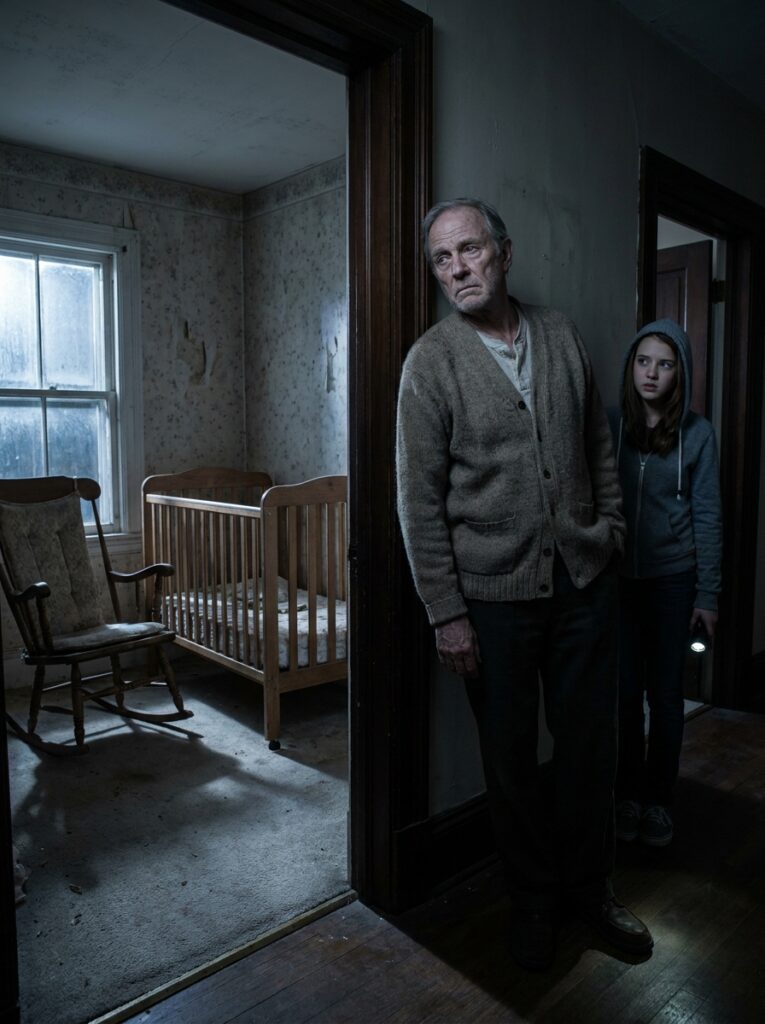
The nursery had always been the strangest room in my grandparents’ home. It was at the end of the upstairs hallway, past the linen closet and the small window that overlooked the backyard. The door was usually closed. When I was a child, I used to think it was a room for storage, but one summer when I was eight, I opened it and found something frozen in time.
Faded yellow wallpaper with tiny ducks.
A white crib covered with a sheet.
A wooden rocking chair.
A small dresser with cloud-shaped knobs.
A mobile with soft little stars hanging above the crib.
It did not look like a storage room.
It looked like someone had prepared it for a baby, then closed the door and never returned.
When I asked Grandma about it, her smile disappeared so quickly I almost thought I had imagined it.
“That room is just old things, Clara,” she said. “Don’t play in there.”
So I never did.
No one did.
The next morning, I mentioned the footsteps to Mom.
She stiffened while pouring coffee.
“Grandpa was up?”
“I think so. He went to the nursery.”
The coffee overflowed slightly before she pulled the cup away.
“Maybe you heard wrong.”
“Maybe.”
But I hadn’t.
Two nights later, my younger brother Daniel came to stay. He was twenty-two but still had the habit of whispering scary things like we were children hiding under blankets.
At breakfast, he leaned across the table and said, “Do you know Grandpa gets up every night?”
Mom looked at him sharply.
“Daniel.”
“What? He does. I saw him. Exactly 2:13. He walked to the nursery.”
My uncle Robert lowered his fork.
“The nursery?”
Grandpa sat at the table with us, but he did not react. He only looked down at the toast he had not touched.
Mom forced a laugh that sounded nothing like her.
“He’s grieving. People do unusual things when they’re grieving.”
Uncle Robert turned toward Grandpa.
“Dad? Are you all right at night?”
Grandpa slowly lifted his eyes.
For a second, I thought he might answer. But he only said, “I’m fine.”
His voice sounded like paper.
That was all.
But after that morning, the house changed again.
Not because Grandpa kept going to the nursery.
Because everyone now knew.
And no one wanted to ask why.
Every night, the same thing happened.
At exactly 2:13 AM, Grandpa’s door opened.
He walked down the hallway in his slippers. The floorboards made the same soft complaints under his feet. He entered the nursery, closed the door almost all the way, and stayed there for around twenty minutes.
Then he returned to bed.
During the day, he barely spoke.
He sat with Grandma’s cardigan folded across his lap. Sometimes he rubbed the sleeve between his fingers. Sometimes he stared at the garden where her roses had started to bend without her care.
One afternoon, I found him in the kitchen holding a mug.
“Grandpa,” I said gently, “do you want tea?”
He looked at me, but not really at me. It was like he was listening to something far away.
“She used to hum in the mornings,” he said.
I nodded, afraid to move too quickly.
“Grandma?”
“She thought I didn’t notice.” His lips trembled faintly. “Always the same song.”
“What song?”
He closed his eyes.
“I can’t remember anymore.”
The pain in his voice made my chest ache.
I touched his arm.
“Maybe it will come back.”
He looked toward the hallway.
“Some things don’t come back, Clara.”
That evening, Mom and Uncle Robert argued in the dining room while Daniel and I pretended not to listen.
“He needs help,” Robert said. “This isn’t normal.”
“He just lost his wife,” Mom replied.
“He goes into an empty nursery every night at the exact same time. That doesn’t concern you?”
“Of course it concerns me.”
“Then ask him.”
Mom’s voice dropped. “You ask him.”
Silence followed.
Then Uncle Robert said, “You know why I don’t like that room.”
My mother’s chair scraped against the floor.
“Don’t.”
“I was five, Elaine, but I remember things.”
“You remember feelings, not facts.”
“I remember Mom crying in there.”
Mom said nothing.
Daniel glanced at me from across the room.
My whole body went still.
Grandma crying in the nursery?
That room had never been explained to us. We had all accepted it the way families accept locked cabinets, missing photographs, and certain names that never get spoken at dinner.
But now the silence around it felt less like privacy.
It felt like a wall.
That night, I could not sleep.
Rain tapped softly against the windows. The old house groaned in the wind. Daniel had gone home, Mom was in the guest room, and Uncle Robert had left after another tense conversation.
At 2:10 AM, I sat up in bed.
My heart was already beating fast.
I told myself not to do it. Grandpa deserved his privacy. Grief was not a mystery for me to solve.
But then I thought of his face in the kitchen.
Some things don’t come back, Clara.
At 2:13 AM, his bedroom door opened.
I slipped out of bed and stood in the shadow near the top of the stairs.
Grandpa came into the hallway wearing his robe. In one hand, he held a small wooden box. I had seen it before on Grandma’s dresser. It was dark cherry wood with a tiny brass latch.
He walked slowly to the nursery.
The door opened with a soft sigh.
He stepped inside.
This time, he did not close it completely.
A narrow line of warm light spilled into the hallway.
I moved closer.
Every step felt wrong. Every breath sounded too loud.
When I reached the door, I looked through the crack.
Grandpa was sitting in the rocking chair.
The sheet had been pulled off the crib. The old mobile turned slightly above it, though there was no breeze. The room smelled faintly of dust, lavender, and time.
Grandpa opened the wooden box and took out something small.
A baby shoe.
White. Soft. Yellowed with age.
He held it in both hands as if it were made of glass.
Then he began to speak.
“I’m sorry, Lily,” he whispered.
My stomach tightened.
Lily?
I had never heard that name in our family.
Grandpa’s shoulders shook, but he still did not cry loudly.
“Your mama came to you at this hour,” he said. “Every night. Even after you were gone.”
Gone.
I covered my mouth.
He reached into the box again and pulled out a folded piece of paper.
“I told her we had to keep living,” he whispered. “I thought I was helping. I thought if I packed your things away, if I stopped saying your name, she would heal.”
His voice broke.
“But I was wrong.”
I stepped backward and the floor creaked.
Grandpa’s head turned.
For one second, we stared at each other through the crack in the door.
I wanted to run. I wanted to apologize. Instead, I pushed the door open.
“Grandpa,” I whispered, “who is Lily?”
He looked smaller than I had ever seen him.
The baby shoe rested in his palm.
For a long moment, he said nothing.
Then he looked at the crib.
“Your aunt,” he said.
The word moved through me like cold water.
“My aunt?”
He nodded slowly.
“Your mother and Robert had a sister.”
I stepped into the room.
The air felt different inside, almost sacred.
Grandpa looked down at the wooden box.
“Her name was Lily Grace Reed. She was born between Elaine and Robert. She lived for four months.”
I sat carefully on the edge of the small dresser bench.
“No one ever told us.”
“No.” His mouth tightened. “We didn’t tell anyone much. Not after.”
“What happened?”
Grandpa looked at me quickly, and I saw fear there, old fear.
“Nothing dramatic,” he said. “Nothing like people imagine. She was born with a weak heart. The doctors warned us. Your grandma still believed love could convince the world to be kind.”
He gave a faint, broken smile.
“She spent every night in this room. Lily had trouble settling. But at 2:13 every morning, she would finally sleep. Your grandma said that was Lily’s minute. Her little peace.”
I looked at the crib, at the tiny stars hanging above it.
“So after Lily passed…”
“Your grandma kept coming in here at 2:13,” Grandpa said. “Every night. For months. She would sit in this chair and hold that shoe. Sometimes she sang. Sometimes she just rocked.”
His eyes filled at last.
“I didn’t know how to help her. I was young. Proud. Scared. I had two small children who needed breakfast and clean clothes and bedtime stories. I thought grief was something you had to shut away before it swallowed the whole house.”
He unfolded the paper in his hand.
“So one day, while she was visiting her sister, I packed most of Lily’s things into boxes. I told myself I was saving your grandma. When she came home and saw the room half-empty, she didn’t shout. She didn’t blame me.”
His voice became barely audible.
“She just stopped singing.”
I looked at the paper.
“What is that?”
“A letter,” he said. “From your grandma.”
He handed it to me.
My hands trembled as I unfolded it.
The handwriting was Grandma’s. Soft, rounded, familiar from birthday cards and recipe notes.
Tommy,
If you find this after I am gone, please don’t be angry that I kept it from you.
I forgave you years ago for packing away Lily’s things. I know you were trying to protect me. But I need you to know something.
I never needed you to erase her.
I needed you to remember her with me.
Every night at 2:13, I still woke up. Even after I stopped walking to the nursery. Even after Elaine and Robert grew up. Even after the wallpaper faded and the world moved on.
I woke up because a mother’s heart keeps certain times.
I didn’t speak of Lily because I thought it hurt you. You didn’t speak of her because you thought it hurt me.
So we loved each other for fifty-four years while standing on opposite sides of the same quiet sorrow.
Tommy, after I’m gone, please open the nursery.
Say her name.
Tell the children.
Let Lily belong to the family again.
And when you hear the old song in your mind, don’t be afraid of it.
It was never only a song of grief.
It was also love.
Your girl,
Margaret
By the time I finished reading, tears blurred the words.
Grandpa was looking at the crib.
“She left it in the box,” he said. “I found it the night after the funeral. I hadn’t opened that box in years.”
“And that’s why you come here every night?”
He nodded.
“She asked me to say her name.”
His face crumpled.
“But I didn’t know how to tell your mother. Or Robert. I waited too long. Then I waited longer. That’s what silence does. It makes cowards out of people who only meant to survive.”
I reached for his hand.
“Grandpa, Mom needs to know.”
His fingers were cold.
“She was so little when it happened. Elaine was three. Robert was only a baby. We told ourselves they wouldn’t remember.”
“But Uncle Robert remembers Grandma crying.”
Grandpa closed his eyes.
“I know.”
The next morning, I told Mom I needed to speak with her and Uncle Robert together.
Grandpa sat at the dining table while I placed the wooden box in the center.
Mom stared at it.
“That was Mom’s.”
Grandpa nodded.
Uncle Robert folded his arms, already defensive.
“What is going on?”
Grandpa tried to speak, but the words failed him.
So I said gently, “There was a baby named Lily.”
Mom’s face changed first with confusion, then disbelief.
“What?”
Grandpa’s voice came out rough.
“Your sister.”
The room went completely still.
Uncle Robert sat down slowly.
Mom shook her head.
“No. No, I would know.”
“You were very young,” Grandpa said.
“I would know if I had a sister.”
“You did,” he whispered. “Her name was Lily Grace.”
Mom looked at him as if he had opened a door beneath her feet.
“Why didn’t you tell us?”
Grandpa pressed both hands flat on the table.
“Because I made a mistake. And then your mother and I kept making it together.”
He told them everything.
Not quickly. Not cleanly.
He stopped often. He cried twice. Mom cried almost the whole time. Uncle Robert stared at the floor, jaw tight, until Grandpa mentioned Grandma sitting in the nursery at 2:13.
Then Robert covered his face.
“I remember that sound,” he said.
Mom turned to him.
“What sound?”
“The rocking chair.” His voice shook. “I thought it was a dream.”
Grandpa nodded.
“It wasn’t.”
Mom picked up the baby shoe from the box. She held it in her palm and began to cry in a way I had never heard from her before. Not loud. Not dramatic. Just deep.
“She was my sister,” she whispered.
“Yes,” Grandpa said. “And your mother wanted her remembered.”
For the next few days, the house became full again, but differently this time.
Not with neighbors and casseroles.
With questions.
Mom wanted to know what Lily looked like. Grandpa found one photograph tucked inside Grandma’s old Bible. A tiny baby wrapped in a pale blanket, her eyes closed, Grandma smiling down at her with tired, radiant love.
Uncle Robert asked where she was buried. Grandpa took us to a quiet corner of the cemetery, not far from Grandma’s new grave. The small stone had weathered over the years, but the name was still there.
Lily Grace Reed.
Beloved daughter.
For forty-one years, most of the family had walked through life without knowing she had existed. Yet there she was, in stone, in paper, in a baby shoe, in the hour of 2:13 AM.
The following Sunday, Mom cleaned the nursery.
Not to erase it.
To restore it.
We opened the curtains. Dust floated through the sunlight like tiny pieces of the past. Daniel carefully wiped the mobile. Uncle Robert tightened the screws on the rocking chair. Mom folded the old blanket and placed it across the crib rail.
Grandpa stood in the doorway, watching.
For the first time since Grandma’s passing, he looked less haunted.
Mom walked to him and took his hand.
“I wish you had told us sooner,” she said.
“I know.”
“I’m angry.”
“I know.”
“But I’m not only angry.”
He looked at her, tears gathering again.
She squeezed his hand.
“I’m sad with you.”
That sentence broke something open in him.
He pulled her into his arms and cried like a man who had spent half his life holding back an ocean.
That night, no one went to bed early.
We gathered in the nursery before midnight, five adults sitting awkwardly among tiny furniture and old memories. Grandpa held Grandma’s letter. Mom held Lily’s photo. Uncle Robert sat in the rocking chair for a while, moving gently back and forth.
At 2:13 AM, we were all awake.
No one spoke at first.
Then Grandpa cleared his throat.
“Her name was Lily Grace Reed,” he said. “She was here. She was loved. And she belongs to us.”
Mom began to hum.
Grandpa’s eyes widened.
“What is it?” I whispered.
He looked at Mom as if he had seen light return to a dark window.
“That song,” he said.
Mom blinked through tears.
“I don’t know why I know it.”
Grandpa smiled, truly smiled, for the first time since Grandma passed.
“Your mother used to hum it.”
Mom’s voice trembled, but she kept humming.
Softly, Grandpa joined her.
Then Uncle Robert.
Then Daniel.
Then me.
It was not perfect. We missed notes. We laughed through tears. But the room no longer felt abandoned.
It felt remembered.
In the weeks that followed, Grandpa changed slowly.
He still missed Grandma. That kind of love does not disappear because a secret is revealed. Some mornings, he still reached for the second coffee cup. Some evenings, he still paused before calling her name.
But he began to speak again.
He told stories about Grandma as a young mother. About how she painted the nursery herself, getting yellow paint in her hair. About how she insisted Lily liked the duck wallpaper. About how Lily would quiet down whenever Elaine toddled into the room and babbled at her crib.
Mom listened to every word.
Uncle Robert came by more often.
Daniel, who had always avoided emotional family conversations, asked Grandpa to record some memories on his phone so “we don’t lose anything else.”
One afternoon, Mom brought a small frame and placed Lily’s photo on the mantel beside Grandma’s.
Grandpa stared at it for a long time.
Then he nodded.
“That’s where she should have been all along.”
The nursery door stayed open after that.
Not every day. Not for visitors who would not understand. But for us.
It became a room where the family could sit when missing Grandma felt too heavy. Sometimes Mom went there alone. Sometimes Grandpa sat in the rocking chair with the window open, letting the breeze move the old mobile.
He no longer went there secretly at 2:13 AM.
He did not need to.
The secret had been carried into the light.
On Grandma’s birthday that year, we gathered in the garden. Her roses had bloomed late, but beautifully. Grandpa stood between Mom and Uncle Robert, holding a small envelope.
Inside was a copy of Grandma’s letter.
“I spent many years thinking silence protected this family,” he said. “But silence only made the love harder to find.”
He looked at each of us.
“Your grandmother understood that before I did.”
Mom wiped her eyes.
Grandpa placed one white rose beneath Grandma’s favorite bush and another beside a small garden stone we had made for Lily.
It read:
Lily Grace
Always part of our family
As the sun lowered behind the house, Grandpa began humming that old song again.
This time, he remembered every note.
And for the first time since Grandma passed, the house did not feel empty.
It felt full of everyone who had ever loved there.
Even the ones we were only just learning how to remember.