“My dad said he’d be back in half an hour…
and it’s already been four days.”
The little girl’s voice reached the emergency line like a broken thread, barely louder than the rain tapping against the tin roofs of Los Fresnos, a small neighborhood on the outskirts of Puebla.
Night-shift operator Rodrigo Salas sat straighter in his chair.
For a moment, all he could hear was the rain, a weak breath, and the soft sound of a child trying very hard not to cry.
“What’s your name, sweetheart?” he asked gently.
“Lupita,” she whispered. “I’m seven.”
Rodrigo looked at the screen.
The call came from a small house on Jacarandas Street, one of those narrow streets where everyone knew who bought bread in the morning, who argued at night, and who struggled to pay rent by the end of the month.
A place where people noticed everything.
But too often, no one wanted to get involved.
“Lupita,” Rodrigo said carefully, “are you alone?”
There was silence.
Then a small sob.
“Yes.”
Rodrigo felt something tighten in his chest.
“My dad went to get medicine and food,” she said. “He told me he would come back quickly. But he didn’t come back. My tummy hurts a lot.”
Rodrigo’s fingers moved quickly across the keyboard as he signaled the nearest patrol unit.
“When was the last time you ate, Lupita?”
“I don’t know,” she answered. “There was soup in a pot, but it smelled bad. I drank water from the tap.”
She paused.
“I gave some to Pancho too.”
“Who is Pancho?”
“My stuffed puppy.”
Rodrigo closed his eyes for half a second.
Then he spoke again, calm and steady.
“Lupita, listen to me. An officer is coming to help you. Her name is Mariana. She is very kind. Do not hang up, okay?”
“Will she be mad?”
“No, sweetheart. Nobody is mad at you.”
Another pause.
Then, in a trembling whisper, Lupita said something that made Rodrigo’s blood run cold.
“My dad says it’s love… but it hurt.”
Rodrigo froze.
“What hurts, Lupita?”
“My tummy,” she said quickly. “And when he holds me tight because he’s scared. He says love means not letting go.”
Rodrigo could hear the confusion in her voice.
Not accusation.
Not anger.
Just a child trying to explain pain with the few words she had been given.
“Lupita,” Rodrigo said, forcing himself to stay calm, “you are very brave. Officer Mariana is almost there.”
When Officer Mariana Torres arrived on Jacarandas Street, the neighborhood was already half-awake.
Rain fell hard over the uneven road. Water rushed along the curb. A few curtains shifted behind windows.
The house was small, painted a tired yellow, with a cracked gate and a single dim light flickering inside.
Mariana knocked gently.
“Lupita? My name is Mariana. I’m here to help you.”
For several seconds, nothing happened.
Then the curtain moved.
The door opened just a little.
One large, frightened eye appeared between the wood and the frame.
“Are you going to scold me?” the girl whispered.
Mariana crouched down immediately.
“No, my love,” she said softly. “No one is going to scold you.”
The door opened wider.
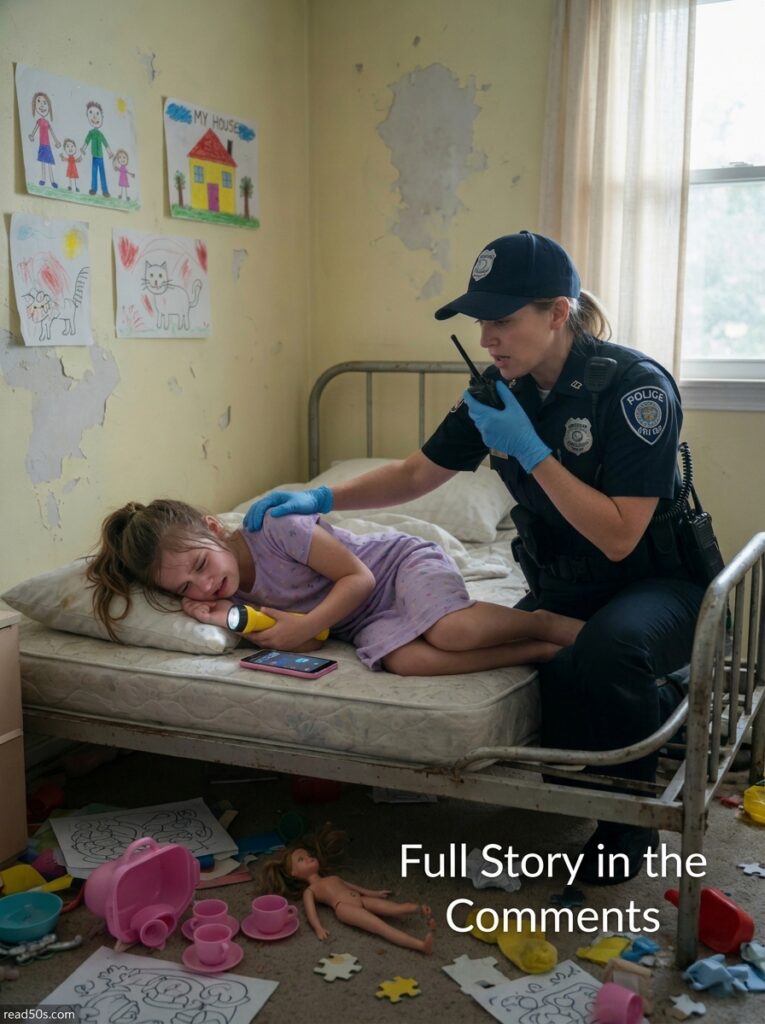
Lupita stood barefoot on the cold floor, wearing one of her father’s oversized T-shirts. Her hair was tangled. Her lips were dry. Her small arms looked too thin.
But what Mariana noticed first was the way the child held her stomach.
Carefully.
Protectively.
As if even standing hurt.
Mariana swallowed the emotion rising in her throat and stepped inside.
The house was almost dark.
A small pot sat on the stove. The refrigerator was nearly empty. On the table was a folded grocery list written in a man’s rushed handwriting:
rice
chicken
electrolyte drink
Lupita’s medicine
Beside the phone lay another paper.
Appointment with Dr. Mercado. Urgent.
Mariana looked around.
There were no signs of a party. No signs of carelessness. No open bottles. No messy chaos.
Only signs of a father who had been trying to get help.
“Where is your dad, Lupita?” Mariana asked.
“He went to buy the things,” Lupita said. “He said I had to stay inside. He said he loved me more than anything.”
Her voice cracked.
“He told me not to open the door unless it was someone safe.”
“And you waited?”
Lupita nodded.
“I waited and waited. The sun came back many times.”
Mariana gently reached for the girl.
“Come here, sweetheart.”
But the moment Lupita tried to take a step, her eyes rolled back and her small body went limp.
Mariana caught her before she hit the floor.
“Central,” she said into her radio, her voice sharp now. “Minor unconscious. Possible severe dehydration. Send medical assistance immediately.”
Outside, neighbors began opening doors.
Doña Graciela from across the street wrapped her shawl around her shoulders and whispered loudly enough for everyone to hear.
“I knew Samuel couldn’t handle being a single father.”
Another neighbor shook his head.
“That poor child. He left her.”
Someone else already had a phone raised, recording the ambulance lights as they flashed against the wet street.
Mariana carried Lupita out carefully.
“Put the phones down,” she said firmly.
But people kept whispering.
By the time the ambulance pulled away, the first video was already on Facebook.
Single father disappears for four days and leaves little daughter alone.
Within an hour, Samuel’s name was spreading across the neighborhood like smoke.
Monster.
Careless.
Unfit father.
Poor girl.
But Mariana had seen the house.
She had seen the list.
She had seen the urgent doctor’s note.
And something deep inside her told her this was not the story people wanted it to be.
At the hospital, doctors moved quickly.
Lupita was weak, dehydrated, and frightened, but she was alive. Her stomach pain was caused by an infection that had become worse without medicine.
Mariana stayed near the door while a nurse gently cleaned Lupita’s face and gave her fluids.
The girl opened her eyes after a while.
“Where’s my dad?” she whispered.
Mariana pulled a chair close.
“We’re looking for him.”
“People think he left me?”
Mariana hesitated.
Lupita’s eyes filled with tears.
“He didn’t leave me,” she said. “He promised he would come back.”
Mariana touched her hand.
“Tell me about your dad.”
Lupita looked down at Pancho, the stuffed puppy Mariana had brought from the house.
“My mom went away when I was little,” she said. “Dad says she had a heart that wanted a different road. He never says bad things about her.”
Mariana listened quietly.
“He works fixing roofs and painting houses. Sometimes he comes home very tired. But he still makes me soup. Even when his hands hurt.”
Her voice grew smaller.
“When I got sick, he cried in the kitchen because he didn’t have enough money for all the medicine. He thought I didn’t see him, but I did.”
Mariana’s throat tightened.
“Did your dad ever scare you?”
Lupita shook her head immediately.
“No. Only when he hugged me too hard.”
“Too hard?”
“When I cried from my tummy, he held me and said, ‘Stay with me, Lupita. Please stay with me.’ He said it was love. But it hurt because my tummy hurt.”
Mariana understood then.
The sentence that had sounded terrifying on the phone had come from a sick child who did not know how to explain fear, pain, and a father’s desperate love.
That same night, Mariana requested access to street cameras, nearby store footage, and witness statements.
Rodrigo, the operator, stayed past his shift helping trace the timeline.
Samuel Herrera had left his house four days earlier at 6:12 p.m.
A small corner store camera showed him buying bread, rice, and an electrolyte drink.
The pharmacist remembered him too.
“He was worried,” the pharmacist said. “He kept asking if the medicine would work fast. He said his daughter had not been eating.”
Samuel had paid with coins.
Then he had stepped back into the rain.
After that, the trail seemed to disappear.
Until Mariana noticed something on the footage from a mechanic shop two blocks away.
At 6:43 p.m., Samuel appeared again.
He was walking fast, carrying a plastic bag.
Then he stopped.
An elderly man had slipped near the flooded curb.
Without hesitation, Samuel put the bag down and rushed to help him.
A passing delivery truck splashed water across the camera lens, blurring the next few seconds.
When the image cleared, Samuel was helping the man stand.
Then both of them looked toward the street.
A small white car had stalled in deep water near the underpass.
A woman stood beside it, waving for help.
The next camera was farther away, grainy and dark.
But it showed Samuel running toward the flooded underpass.
Then nothing.
Mariana’s stomach sank.
The rain that night had been heavier than people remembered. Several streets had flooded. Traffic reports mentioned blocked drains and emergency calls from the lower part of Los Fresnos.
But no one had connected Samuel to any of it.
Because while he was missing, people had already decided what kind of man he was.
By morning, the search moved to the canal near the underpass.
Neighbors gathered at a distance, quieter now.
Doña Graciela stood with her arms folded, her face pale.
The same people who had posted angry comments now watched officers search the muddy edges of the canal.
Hours passed.
Then one of the officers found a torn grocery bag caught in a fence.
Inside were soaked papers, a half-damaged medicine box, and a small receipt from the pharmacy.
Samuel’s receipt.
Mariana closed her eyes.
A little farther down, they found his backpack.
Inside was a plastic folder wrapped in two grocery bags to keep it dry.
There were documents.
Medical notes.
A letter from a clinic.
And an envelope with Lupita’s name written on it.
Mariana did not open the envelope there.
She already knew the truth was going to hurt.
Later that afternoon, Samuel Herrera was found near an old drainage path beyond the canal.
He had not run away.
He had not forgotten his daughter.
He had never stopped trying to get home.
The investigation showed that Samuel had helped the elderly man, then tried to help the woman near the stalled car. In the confusion of the storm, he had been swept off balance by the rushing water near the underpass.
By the time anyone understood what had happened, it was too late.
For four days, the neighborhood had judged him.
For four days, his daughter had waited.
For four days, the internet had turned a loving father into a villain.
When Mariana returned to the hospital, Lupita was sitting up in bed, still weak, but awake.
Pancho rested under her arm.
She looked toward the door.
“Did you find my dad?”
Mariana stood still for a moment.
There was no easy way to say it.
No safe sentence.
No gentle version of a truth that would change a child’s life.
So she walked closer, sat beside the bed, and took Lupita’s small hand.
“We found him, sweetheart.”
Lupita’s eyes brightened for one second.
Then she saw Mariana’s face.
Her smile disappeared.
“My dad can’t come home, can he?”
Mariana’s eyes filled with tears.
“No, my love. He can’t.”
Lupita made no sound at first.
She simply looked down at Pancho.
Then she pressed the stuffed puppy against her chest and whispered, “But he promised.”
Mariana hugged her carefully.
This time, Lupita did not say it hurt.
She just cried into Mariana’s uniform until the nurse had to turn away.
Later, when Lupita was calmer, Mariana showed her the envelope.
“Your dad had this with him.”
Lupita stared at her name.
The handwriting was shaky, but familiar.
Mariana opened it and read softly.
My Lupita,
If you are reading this, it means I was more scared than I wanted you to know.
The doctor says we need to do more tests, and I know you are tired of hospitals. I am tired too. But I promise you, my little star, I am going to do everything I can to make you better.
You once asked me why I hug you so tightly when you cry.
It is because I am afraid the world will take you from me.
But I know sometimes my hugs hurt your tummy, and I am sorry.
Love should never hurt you, Lupita.
Love should protect you.
If I ever hold you too tightly, you can tell me, “Easy, Dad,” and I will let go.
You are not a burden.
You are not trouble.
You are my reason for waking up every morning.
I am going to buy your medicine and food now.
I will be back soon.
I love you more than all the rain, all the stars, and all the roads that lead home.
Dad
By the time Mariana finished reading, even the nurse was crying.
Lupita pressed the letter to her heart.
“He didn’t leave me,” she whispered.
“No,” Mariana said. “He didn’t.”
Word spread through Los Fresnos by evening.
But this time, the videos were different.
The same neighbors who had accused Samuel began deleting their posts.
Some wrote apologies.
Most were too ashamed to look at one another.
Doña Graciela came to the hospital the next day with a bag of clean clothes for Lupita and tears running down her face.
“I am sorry,” she said, voice trembling. “I spoke without knowing.”
Lupita looked at her quietly.
“My dad said people say things when they are scared,” she replied.
Doña Graciela covered her mouth and cried harder.
Samuel’s small funeral was held three days later under a cloudy sky.
The neighborhood came.
Not because they deserved to stand there, but because they needed to face what their judgment had done.
The elderly man Samuel helped came with his grandson.
The woman from the stalled car came too. She could barely speak as she placed white flowers beside his photo.
“He stopped for me,” she whispered. “He didn’t even know me.”
Lupita sat in the front row beside Mariana.
She wore a clean blue dress and held Pancho in her lap.
When the priest finished speaking, Mariana helped Lupita stand.
The little girl walked to her father’s photo.
For a moment, she only stared at him.
Then she placed his letter beside the flowers.
“You came back,” she whispered. “Just not the way you promised.”
Everyone heard it.
And the whole neighborhood fell silent.
After the funeral, something changed on Jacarandas Street.
Not all at once.
Not perfectly.
But enough to matter.
The neighbors repaired Samuel’s front door. Someone painted the gate. The pharmacist paid for Lupita’s remaining medicine. Dr. Mercado arranged follow-up care. Rodrigo visited once with a small stuffed dog collar for Pancho.
And Mariana, who had no children of her own, found herself visiting Lupita more and more.
At first, she told herself it was because of the case.
Then because Lupita needed someone.
Then because she did.
Months later, after paperwork, family searches, and careful decisions made by people who truly wanted what was best for the child, Lupita moved into Mariana’s home.
She still missed her father every day.
Some nights, she cried quietly into Pancho’s fur.
But she also learned to laugh again.
She learned that love could be gentle.
That a home could be safe.
That people could make mistakes and still try to repair them.
On the first anniversary of Samuel’s passing, the neighborhood placed a small sign near the underpass.
In memory of Samuel Herrera, a father who ran into the rain to help others and never stopped trying to return to his daughter.
Lupita stood in front of it holding Mariana’s hand.
“Do you think he knows I’m okay?” she asked.
Mariana squeezed her fingers.
“I think he knows.”
Lupita looked up at the sky.
A soft rain had begun to fall.
Not heavy like that terrible night.
Just gentle.
Almost like a whisper.
She reached into her pocket and pulled out her father’s letter, now folded carefully in plastic.
Then she smiled through her tears.
“My dad said love protects you,” she said.
Mariana nodded.
“Yes, sweetheart.”
Lupita leaned into her side.
“And now I know what he meant.”
━━━━━━━━━━━━━━━━━━━━━━━━━━━━━━━━━━━━━━