At 65 years old, Margaret Hale saw two bold lines on a pregnancy test.
For several seconds, she simply stood in the bathroom, staring at it.
The window was open behind her. Morning light fell across the sink. Somewhere outside, a neighbor’s dog barked, and a delivery truck rattled down the street.
But Margaret heard none of it.
Her hand trembled.
Then she took another test.
And another.
By noon, five tests lay on the counter, each one showing the same thing.
Two lines.
Pregnant.
Margaret sat on the edge of the bathtub and covered her mouth with both hands.
Then she cried.
Not a soft cry.
Not a polite tear.
She cried the way a person cries when a door they believed had been closed forever suddenly opens.
“It’s a miracle,” she whispered.
For most of her life, Margaret had wanted to be a mother.
She had imagined small shoes by the door, bedtime stories, school drawings on the refrigerator, birthday candles, and sleepy little arms wrapped around her neck.
But life had given her a different path.
Long years of infertility.
Appointments that ended with careful faces and painful words.
Treatments that drained her savings and left her body exhausted.
Doctors who eventually told her, as gently as they could, that she needed to accept the truth.
It would not happen.
Her husband, Daniel, had held her through those years.
He had loved her through every disappointment.
But Daniel had passed away six years earlier, taking with him the quiet dream they had once shared.
After his funeral, Margaret closed the nursery door in her mind.
She gave away the baby blanket she had bought at thirty-two.
She stopped pausing near children’s clothing in stores.
She stopped wondering what their child might have looked like.
Or at least, she told herself she had.
Then, at 65, the impossible seemed to happen.
When she told her younger sister Ruth, the room went silent.
“Margaret,” Ruth said carefully, “are you sure?”
Margaret placed the tests on the kitchen table.
Ruth stared at them.
Then she looked at Margaret’s face and softened.
“Oh, Maggie…”
Margaret smiled through tears.
“I know what you’re thinking.”
“I’m worried.”
“I am too,” Margaret admitted. “But I’m also happy.”
Within days, Margaret saw a doctor.
Then another.
The first doctor was cautious.
The second was concerned.
The third advised more testing.
“Pregnancy at your age is extremely high risk,” one physician told her. “We need to be very careful.”
Margaret nodded at everything.
She agreed to appointments.
She took vitamins.
She followed instructions.
But every night, she lay in bed with one hand on her stomach and whispered to the life she believed was growing inside her.
“You came late,” she would say softly, “but I waited for you.”
As the weeks passed, her belly grew.
At first, it was slight.
Then unmistakable.
Neighbors began noticing.
Some congratulated her with wide eyes and uncertain smiles.
Others whispered when she passed.
At the grocery store, a woman stared at her stomach so long that Margaret finally turned and said, “Yes, I know. I’m old enough to be a grandmother.”
The woman turned red and hurried away.
Margaret laughed about it later, but deep down, the judgment hurt.
Still, she kept going.
She painted the old spare room a soft yellow.
She bought tiny clothes.
She placed a rocking chair by the window.
She found Daniel’s old sweater in a box and folded it carefully over the chair, imagining that one day she might tell the child about the father who had wanted them so badly.
Ruth visited every weekend.
Sometimes she smiled.
Sometimes Margaret caught her crying quietly in the kitchen.
“You don’t believe this is real,” Margaret said one afternoon.
Ruth looked at her sister for a long moment.
“I believe you want it to be real.”
Margaret flinched.
“That isn’t the same thing.”
“No,” Ruth said gently. “It isn’t.”
They did not speak for nearly an hour after that.
But when Ruth left, she kissed Margaret’s forehead and said, “I’m with you. Whatever happens.”
By the seventh month, Margaret moved slowly.
Her back ached.
Her ankles swelled.
She slept in short, uncomfortable stretches.
But she never complained for long.
Every pain became proof.
Every movement became hope.
She believed she could feel the baby shift inside her.
At night, she read children’s books aloud.
She called the baby “little star.”
Nine months passed faster than she expected.
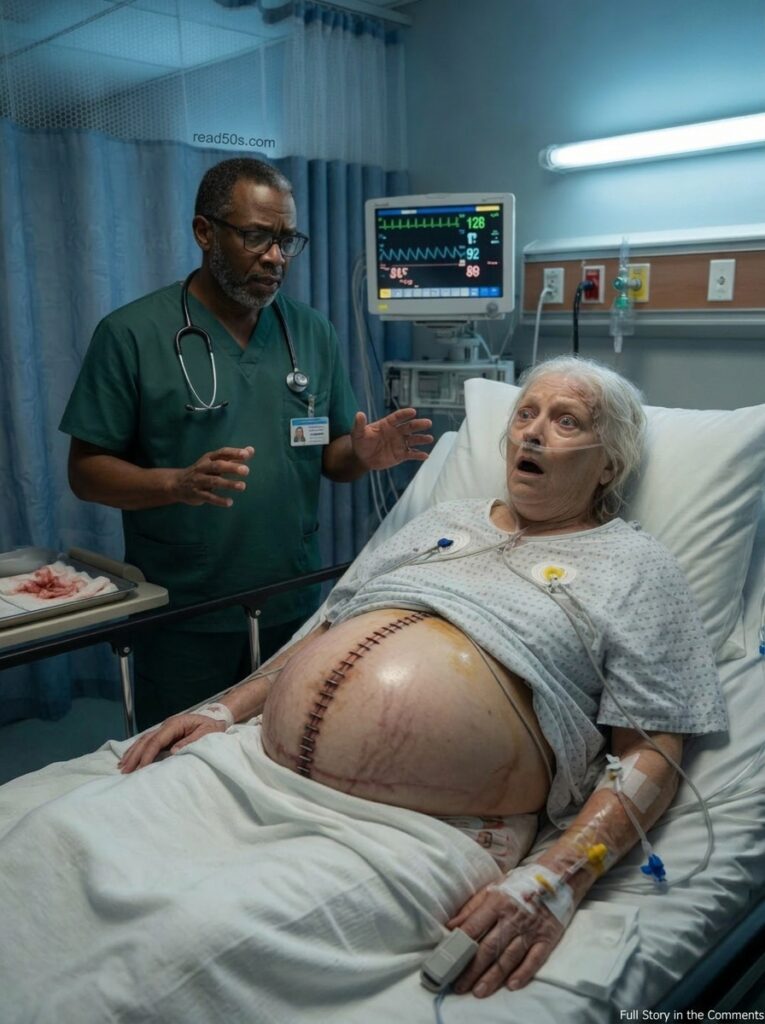
Then one cold evening, Margaret woke with sharp pressure in her abdomen.
She sat up, breathing hard.
The clock beside her bed read 3:18 a.m.
Her hands went to her stomach.
“Is it time?” she whispered.
By morning, the discomfort had become strong enough that Ruth drove her to the hospital.
Margaret held her abdomen all the way there.
Despite the pain, she smiled when they reached the maternity entrance.
“Doctor,” she said when the young physician entered the room, “I think the time has come.”
Dr. Evan Miller looked younger than Margaret expected.
Too young, she thought, to be the person standing between her and the moment she had waited for all her life.
He checked her chart.
Then he looked at her.
Then at her stomach.
His smile faded slightly.
“Mrs. Hale, I’m going to examine you.”
“Of course.”
He asked her a few questions.
When did the pain start?
Had there been bleeding?
Had she felt movement?
Who had managed her care?
Margaret answered as calmly as she could.
But the more she spoke, the more serious his face became.
He examined her.
Then suddenly stopped.
His eyes moved to the monitor.
Then to the chart.
Then back to her.
The room changed.
Margaret felt it before anyone said a word.
Dr. Miller called for a colleague.
Then another.
They stepped behind the curtain and spoke in low voices.
For a few seconds, no one in the room moved, and the machines beside Margaret sounded louder than before.
She looked from one white coat to another, trying to understand the silence gathering around her like a cold sheet.
The young doctor lowered his eyes, then looked at the older physician beside him, as if asking permission to speak.
Margaret tightened both hands around the metal rail of the bed.
She felt the child inside her shift.
Or she believed she did.
“What do you mean?” she asked, though no one had explained anything yet.
Her voice sounded smaller than she expected.
The older doctor pulled the curtain farther around the bed, even though no one nearby could hear clearly.
His face was kind.
That frightened her more than if he had looked rushed or annoyed.
“Mrs. Hale,” he said softly, “we need to run another scan before we do anything else.”
Margaret stared at him, waiting for words like normal, safe, baby, soon.
Words that belonged to the life she had imagined.
Instead, the doctor only touched the edge of her chart and avoided looking at her stomach for too long.
A nurse named Ellen came closer and placed one warm hand over Margaret’s knuckles.
Not on her belly.
On her hand.
That was when Margaret began to shake.
“What is happening?” she whispered.
Dr. Miller swallowed.
“Your body is showing signs that led you to believe you were pregnant. But based on the examination, something is not matching a normal delivery.”
Ruth stood near the wall, her face pale.
Margaret looked at her sister.
“No,” Margaret said. “No, I felt the baby move.”
Ellen squeezed her hand.
“I know,” the nurse said gently.
The scan came quickly.
Too quickly.
The room filled with quiet urgency.
Margaret stared at the ceiling while cold gel touched her skin. She watched the doctor’s face instead of the screen.
At first, his expression was focused.
Then confused.
Then deeply concerned.
The older physician leaned closer.
Dr. Miller adjusted the probe.
No heartbeat sound filled the room.
No tiny form appeared on the screen.
Only shadows.
Masses.
Fluid.
A silence so heavy it seemed to press against Margaret’s chest.
Finally, the older doctor spoke.
“Mrs. Hale, I’m very sorry. There is no baby.”
Margaret turned her head slowly.
The words did not enter her all at once.
They arrived piece by piece.
There.
Is.
No.
Baby.
“No,” she said.
Her voice was quiet.
Then stronger.
“No, that’s not true.”
Ruth covered her mouth.
Margaret tried to sit up, but pain pulled her back against the pillow.
“I took tests,” she said. “Five tests. The doctors said—my stomach grew. I felt movement. I bought clothes. I talked to the baby.”
“I know,” the older doctor said. “And I’m so sorry.”
Margaret looked at the screen.
“What is inside me?”
The room went still.
Dr. Miller answered carefully.
“There is a large abdominal mass. It appears to be producing hormones that can mimic pregnancy symptoms. That may be why your tests were positive and why your body changed the way it did.”
Margaret stared at him.
A mass.
Not a child.
Not her miracle.
Not the little star she had whispered to each night.
Ruth came to the bed and began crying.
Margaret did not cry.
Not yet.
She only looked down at her swollen abdomen, at the place where she had placed so much hope, and felt something inside her collapse.
The older doctor spoke again.
“We need to act quickly. The mass is causing pressure and internal complications. We need to take you into surgery.”
“Surgery?” Margaret repeated.
“Yes.”
“Will I survive?”
The question left the room colder than before.
Dr. Miller looked at her directly this time.
“We are going to do everything we can.”
Margaret closed her eyes.
In the darkness behind them, she saw the yellow nursery.
The tiny clothes.
Daniel’s sweater over the rocking chair.
Her own hands folding sleeves that had never held arms.
When she opened her eyes, tears finally spilled down her cheeks.
“I told everyone I was having a baby.”
Ruth bent over her and pressed her forehead against Margaret’s hand.
“You told everyone you had hope,” Ruth whispered. “There is no shame in that.”
Margaret shook her head.
“I talked to it.”
Ellen wiped a tear from her own cheek.
“Sometimes the heart speaks where it hurts most,” she said.
Before they wheeled Margaret away, Ruth asked to speak with her alone.
The doctors stepped out.
For a moment, the room was quiet except for the steady beep of the monitor.
Ruth took Margaret’s face gently between her hands.
“Maggie, listen to me. You are not foolish. You are not embarrassing. You are not broken because you hoped.”
Margaret’s lips trembled.
“I wanted to be someone’s mother.”
Ruth’s tears fell freely now.
“You have been mothering people your whole life. Me. My boys. Every child in the neighborhood who came to your porch for cookies. But I know that doesn’t erase what you wanted.”
Margaret looked toward the door.
“What if I don’t wake up?”
Ruth shook her head hard.
“You will.”
“But if I don’t…”
“Don’t.”
“If I don’t,” Margaret insisted, “don’t let people laugh at me.”
Ruth broke.
“No one who loves you would ever laugh.”
Margaret’s voice became softer.
“And the room?”
“The nursery?”
Margaret nodded.
Ruth held her hand.
“We’ll decide together when you come home.”
Margaret managed the faintest smile.
“When I come home.”
The surgery lasted hours.
Ruth waited in the hallway with Margaret’s sweater in her lap.
She prayed.
She paced.
She called no one until she had news.
At 6:42 p.m., Dr. Miller came out.
His hair was flattened by the surgical cap.
His eyes were tired.
Ruth stood so fast the chair scraped the floor.
“She’s alive,” he said first.
Ruth covered her face and sobbed.
“She’s stable,” he continued. “The surgery was difficult, but we removed the mass. We’ll need to wait for more testing, and recovery will take time. But she made it through.”
For the first time that day, Ruth breathed.
When Margaret woke, everything hurt.
Her throat was dry.
Her abdomen was bandaged.
The room was dim.
Ruth sat beside her, holding her hand.
“No baby?” Margaret whispered, though she already knew.
Ruth shook her head gently.
“No baby.”
Margaret stared at the ceiling.
For a while, she said nothing.
Then she whispered, “I named the baby in my mind.”
Ruth leaned closer.
“What name?”
“Grace.”
Ruth smiled through tears.
“That’s a beautiful name.”
Margaret closed her eyes.
“I suppose grace came differently.”
Days passed.
The hospital room became Margaret’s world.
Nurses came and went.
Doctors explained what had happened in gentle, careful language. The mass had affected her hormones. Her body had responded as if it were carrying life. Her mind had built a dream around signs that seemed impossible to ignore.
No one blamed her.
No one mocked her.
But Margaret still felt exposed.
The story had already spread among relatives and neighbors.
Some sent flowers.
Some sent awkward messages.
A few sent cruel comments hidden behind phrases like “How could she believe that at her age?”
Ruth deleted those before Margaret could see them.
But Margaret knew.
People always talked.
One afternoon, Dr. Miller came to check on her.
He seemed hesitant.
“I owe you an apology,” he said.
Margaret turned her head.
“For what?”
“For how I reacted when you arrived. I was shocked, and I asked what your doctor was thinking. That was not the care you deserved in that moment.”
Margaret studied his face.
“You thought I was ridiculous.”
“No,” he said. “I thought someone had failed you. And I still believe your symptoms should have been investigated more carefully.”
Margaret looked toward the window.
“Maybe I failed myself too. I wanted it so badly that I believed everything.”
Dr. Miller pulled a chair closer.
“Hope is not a failure, Mrs. Hale.”
She looked at him, surprised.
He continued.
“Your body gave you signs. Your heart gave those signs meaning. That does not make you foolish. It makes you human.”
Margaret’s eyes filled again.
“I had a nursery.”
“Then it was a room made with love,” he said.
After two weeks, Margaret went home.
Ruth drove her.
The yellow nursery waited at the end of the hall.
For three days, Margaret did not open the door.
She slept in the living room recliner, took her medication, and walked slowly around the house holding the wall for support.
On the fourth morning, she stood in front of the nursery door.
Ruth stood behind her.
“You don’t have to,” Ruth said.
Margaret nodded.
“I know.”
Then she opened it.
Sunlight poured across the yellow walls.
The rocking chair sat by the window.
Daniel’s sweater was still folded over the back.
Tiny clothes lay in neat stacks.
Margaret walked inside slowly.
She touched the crib.
Then the blanket.
Then the little yellow outfit she had folded again and again.
Finally, she sat in the rocking chair and held Daniel’s sweater against her chest.
Ruth began crying at the doorway.
Margaret looked around the room for a long time.
Then she said, “I don’t want this room to stay empty.”
Ruth wiped her cheeks.
“What do you mean?”
Margaret looked at the shelves of children’s books she had collected.
“I spent my whole life waiting for a child to come into my home,” she said. “Maybe I was looking at it too narrowly.”
In the months that followed, Margaret healed slowly.
Her body regained strength.
Her scar softened.
Her grief changed shape, though it never fully disappeared.
She started by donating the baby clothes to a shelter for young mothers.
Not all at once.
One box at a time.
She kept the silver rattle Daniel had bought years ago.
She kept one yellow blanket.
And she kept the name Grace.
Then she turned the nursery into something new.
A reading room for children in the neighborhood.
Every Saturday afternoon, she opened her front door.
Children came with their parents, then without them as the parents learned to trust the gentle woman in the yellow room.
Margaret read stories.
She served cocoa.
She helped with homework.
She kept a basket of warm socks by the door in winter.
At first, she sat carefully, one hand near her healing scar.
Then, week by week, her laughter returned.
The room filled with noise.
Small shoes by the door.
Drawings on the wall.
Birthday cupcakes.
Bedtime stories read before sunset.
Not motherhood in the way she had imagined.
But love, still.
One year after the hospital, Ruth found Margaret in the yellow room surrounded by children making paper butterflies.
A little boy named Aaron sat beside her, leaning against her arm while she helped him spell the word “courage.”
Ruth watched from the doorway.
Margaret looked up and smiled.
Later, when the children had gone home, Ruth said, “This room feels alive.”
Margaret nodded.
“It does.”
“Do you still think about Grace?”
“Every day.”
Ruth sat beside her.
Margaret touched the yellow blanket folded in the basket.
“For nine months, I thought I was waiting for one child,” she said softly. “Maybe I was being prepared to open my heart again.”
Ruth leaned her head on her sister’s shoulder.
Outside, children’s laughter echoed down the street.
Margaret closed her eyes and listened.
Once, she had believed her miracle would arrive in a hospital room.
In a tiny cry.
In a blanket wrapped around new life.
Instead, her miracle came through survival.
Through truth.
Through a doctor brave enough to say what was real.
Through a sister who stayed.
Through a yellow room that refused to remain empty.
And through children who knocked on her door every Saturday, calling her Miss Margaret, running into the place she had built from the pieces of a dream that did not come true.
She never became a mother in the way she had prayed for all those years.
But she became something real.
Something needed.
Something full of love.
And when people asked why she kept the yellow room open, Margaret always smiled and gave the same answer.
“Because love waited a long time inside this house,” she said. “It deserved somewhere to go.”
━━━━━━━━━━━━━━━━━━━━━━━━━━━━━━━━━━━━━━