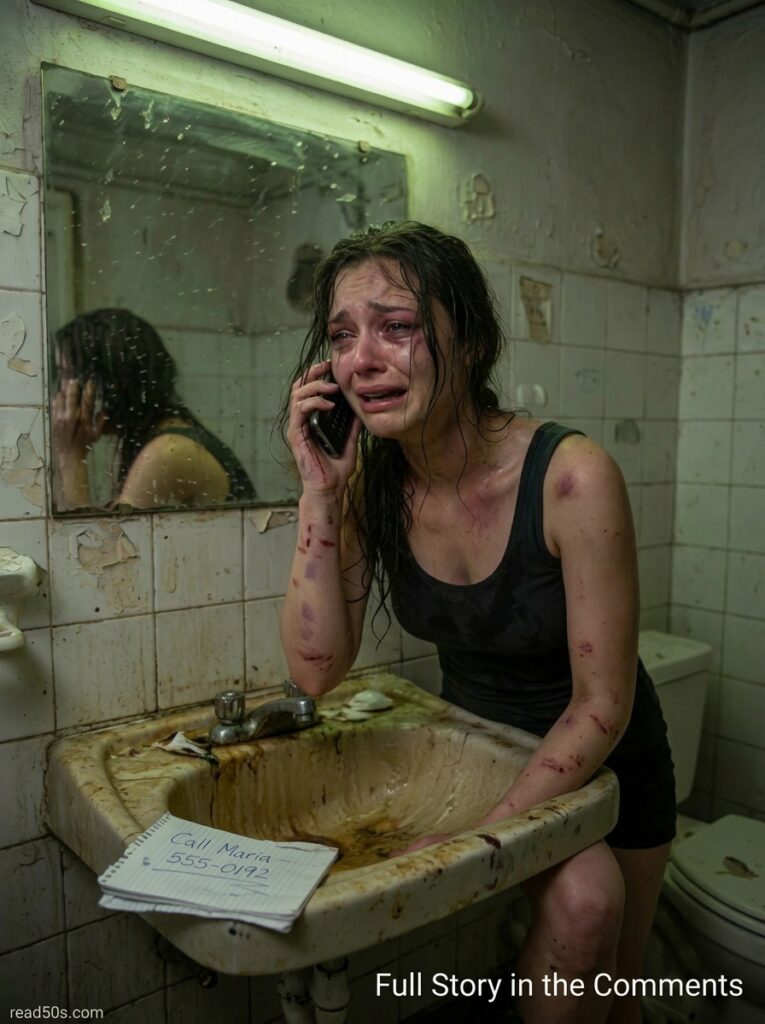
“Can you come save me?”
The words barely left Lena’s lips.
They were small.
Broken.
Almost swallowed by the sound of her husband pounding on the bathroom door.
But those five words set something unstoppable into motion.
Something Victor never saw coming.
The phone trembled in Lena’s hand as she pressed it harder against her ear. Her breath came in shallow, uneven pulls, each inhale sharp enough to make her ribs tighten.
Her left arm hung uselessly at her side.
The pain was so intense that it had become distant, almost unreal, as if her body had stopped trying to explain it to her.
Just minutes earlier, Victor had grabbed her wrist during another argument.
Another accusation.
Another night when his voice filled the apartment and made the walls feel smaller.
He had squeezed until she cried out.
Then he twisted harder.
Lena heard the sound before she understood it.
A sharp crack.
Then fire shot up her arm.
Victor had not flinched.
He had only stared at her with that cold, satisfied look she had learned to fear.
Then he walked away to pour himself another drink, as if he had only knocked over a chair.
Five years.
Five years of learning how to stay quiet.
How to make herself small.
How to apologize for things she had not done.
How to hide bruises beneath long sleeves and smiles beneath exhaustion.
Five years of telling herself tomorrow might be calmer.
Tomorrow he might be sorry.
Tomorrow she might find the courage to leave.
But that night, something broke that was not just bone.
Something inside Lena finally refused to stay silent.
She had locked herself in the bathroom and slid down against the cold tile. Her good hand searched through her purse until her fingers found the card.
Thick.
Black.
Expensive.
Nothing on it but a name and a number stamped in gold.
Adrian Voss.
Everyone in the city knew that name.
People did not say it loudly.
They did not joke about it.
They lowered their voices.
Some called him a businessman.
Some called him dangerous.
Some said he had friends in places most people were afraid to name.
But one thing everyone agreed on was simple:
Adrian Voss was not a man you called unless you were ready for your life to change.
Lena had hidden the card for months.
Inside a folded receipt.
Behind the lining of her purse.
Under a loose tile once, when Victor had searched her things.
She had moved it again and again, guarding it like a secret she was too afraid to use.
Because Adrian Voss did not know her.
Not really.
They had spoken once.
Only once.
It happened months earlier, during Lena’s late shift at Maribel’s Diner, a small place near the old train station where the coffee was strong, the lights were yellow, and the waitresses learned how to smile even when their feet hurt.
Adrian had come in after midnight with three men.
They did not laugh loudly.
They did not look around too much.
They sat in the corner booth like men who noticed everything without turning their heads.
Adrian had worn a dark coat and no expression.
The whole diner had grown quieter when he walked in.
Lena remembered carrying coffee to his table with both hands, because she was already shaking that night. Victor had called her seventeen times during her shift. Each message worse than the last.
Where are you?
Who are you talking to?
Don’t make me come there.
Her hands trembled so badly that coffee spilled near Adrian’s table.
She had expected anger.
A raised voice.
Maybe worse.
But Adrian had looked up at her.
Not annoyed.
Not cruel.
Only aware.
“It’s fine,” he said calmly.
His voice carried no warmth, but also no threat.
That was what made her look at him.
Most men like him made people afraid.
Adrian seemed to understand fear without enjoying it.
Lena had apologized anyway.
“I’m sorry. I’ll clean it.”
“You’re hurt,” he said.
She froze.
“I’m fine.”
His eyes moved briefly to the yellowing mark near her wrist, mostly hidden by her sleeve.
He did not ask a question.
He simply said, “People who are fine don’t look at doors like they’re waiting for someone to come through them.”
Lena had no answer.
When Adrian left, the card had been under the bill.
On the back, written in black ink, were six words.
If you ever need help.
She had stared at those words a hundred times after that.
Sometimes at two in the morning.
Sometimes while sitting in the bathroom with the shower running so Victor could not hear her cry.
Sometimes after work, when she counted tips and wondered how far a bus ticket could take her.
But she never called.
Until now.
A crash shook the bathroom door.
“Lena!” Victor shouted from the other side, his voice rough and slurred. “Open this door!”
She flinched, biting back a cry as the vibration sent pain through her injured arm.
The handle jerked.
“Who are you calling?” he shouted. “You think anyone’s coming to help you?”
Lena looked down at the black card on the sink.
Her hands shook as she dialed.
Each number felt heavier than the last.
What was she doing?
Adrian Voss owed her nothing.
She was just a waitress who had spilled coffee near his table.
The line rang once.
Twice.
Three times.
Her heart pounded so hard she thought she might faint.
Then the call clicked.
“Talk.”
The voice was deep.
Controlled.
Dangerous in a way that did not need to prove itself.
Lena’s throat tightened.
“I don’t know if you remember me,” she whispered. “I’m Lena. From Maribel’s Diner.”
There was a pause.
Not confused.
Listening.
“The coffee,” he said.
Tears rushed into her eyes.
He remembered.
“My husband…” She swallowed hard. “He hurt me. I think my arm is broken. I’m locked in the bathroom. He’s outside the door.”
For one second, there was no sound.
Then Adrian’s voice changed.
Not louder.
Lower.
“Address.”
Lena gave it.
Her voice shook so badly she had to repeat the apartment number twice.
“Stay on the phone,” Adrian said. “Do not open that door.”
Victor struck the door again.
The wood cracked near the hinge.
Lena gasped.
Adrian heard it.
“How much time?” he asked.
“I don’t know.”
“Is there a window?”
“Small. Too high.”
“Can you move?”
“No. My arm—”
“Listen to me, Lena,” Adrian said, and his voice became the only steady thing in the room. “You are not going to apologize to him. You are not going to explain. You are not going to believe anything he says through that door. You are going to sit with your back against the tub and keep breathing until help arrives.”
Help.
The word sounded impossible.
Victor laughed from the hallway.
“Whoever you called isn’t coming,” he said. “Nobody gets involved in this.”
Lena pressed the phone tighter to her ear.
Adrian’s voice came through, quiet and certain.
“I heard him.”
Then, away from the phone, she heard him speak to someone else.
“Car. Now. And call medical.”
Victor kicked the door.
A piece of cheap wood splintered inward.
Lena covered her mouth.
“I’m scared,” she whispered.
“I know,” Adrian said.
“He’ll be worse if he knows I called you.”
“No,” Adrian replied. “He will be finished.”
The words were calm.
That made them more frightening.
But for the first time in years, Lena felt fear moving in a direction that was not aimed at her.
Victor’s voice softened suddenly.
“Lena,” he called through the door. “Come on. Don’t do this. I didn’t mean it.”
She closed her eyes.
She knew this voice.
The apology voice.
The come-out-and-we’ll-talk voice.
The voice that always arrived after the damage was done.
“I love you,” Victor said. “You know I love you.”
Lena looked at her injured arm.
At the red marks on her skin.
At the cracked tile beneath her bare feet.
And something clear rose inside her.
“No,” she whispered.
Adrian heard.
“What did you say?”
Lena swallowed.
“I said no.”
A pause.
Then Adrian said, “Good.”
Victor’s tone changed instantly.
“You think you can leave me?” he shouted. “After everything I did for you?”
Lena’s tears fell silently now.
Everything he did for her.
He had taken her paycheck.
Stopped her from seeing friends.
Made her quit school.
Called her useless, then blamed her for being afraid.
He had made the apartment feel like a locked room, even when the door was open.
The bathroom door shook again.
Then another sound cut through the hallway.
Brakes outside.
Car doors.
Heavy footsteps on the stairs.
Victor stopped.
“What the—”
Someone knocked on the apartment door.
Not softly.
Three firm strikes.
Victor moved away from the bathroom.
Lena could hear him stumbling toward the front room.
“Who is it?” he barked.
A calm voice answered.
“Open the door, Victor.”
Lena stopped breathing.
She knew that voice.
Adrian.
Victor laughed once, but it came out thin.
“You got the wrong apartment.”
“No,” Adrian said. “I don’t.”
For a moment, there was only silence.
Then the apartment door opened.
Lena could not see what happened next.
She heard Victor begin to speak with false confidence.
Then she heard him stop.
Because Adrian Voss had not come alone.
Several men entered, but there was no chaos.
No shouting.
No wild threats.
Only the controlled quiet of people who knew exactly why they were there.
Adrian’s voice came again.
“Where is she?”
Victor tried to laugh.
“My wife is fine.”
“She called me from behind that bathroom door.”
“She gets dramatic.”
Lena felt cold.
Even now, he was trying to erase her.
Adrian did not raise his voice.
“Move.”
“I said she’s fine.”
Then another voice spoke.
“Police are on the way.”
Victor went silent.
Lena’s eyes widened.
Police?
Adrian had called them?
She had imagined men like him solved things in shadows.
But Adrian Voss had brought light.
Sirens sounded faintly in the distance.
Victor panicked.
“You called police?” he snapped. “You think I’m scared of police?”
Adrian’s voice remained flat.
“You should be scared of what they’ll find.”
The bathroom door shook once more, but this time from the outside, gently.
“Lena,” Adrian said. “It’s me. Can you unlock it?”
Her good hand trembled around the knob.
For one terrible second, she could not move.
Her body had learned too well that opening doors brought danger.
Then Adrian spoke again.
“Take your time.”
That sentence broke her more than any shout could have.
Take your time.
No one had said that to her in years.
She turned the lock.
The door opened.
Adrian stood there in a dark coat, his expression controlled, but his eyes changed when he saw her.
Her wet hair clung to her face.
Her arm hung badly.
Her lip was split.
Bruises marked her skin.
She was barefoot on cold tile, holding a phone like a lifeline.
Behind Adrian, Victor stood near the living room wall, held back by two of Adrian’s men. They had not hurt him. They had only stopped him from coming closer.
Lena’s knees weakened.
Adrian stepped forward, slowly enough not to frighten her.
“May I?” he asked, holding out his coat.
She nodded.
He wrapped it around her shoulders.
Not like ownership.
Like shelter.
Victor exploded.
“She’s my wife!”
Adrian turned his head.
“No,” he said. “She is a person.”
The words landed with such force that even Victor seemed stunned.
Paramedics arrived first.
Then police.
Officer Maria Santos stepped into the apartment, assessed the room, and went directly to Lena.
“Ma’am, you’re safe right now,” she said. “Can you tell me what happened?”
Lena looked at Victor.
He glared at her.
The old fear rose automatically.
The fear that said: stay quiet.
The fear that said: this will get worse.
The fear that had kept her trapped for five years.
Then she felt Adrian’s coat around her shoulders.
She saw Officer Santos watching her, patient and steady.
She heard the paramedic say softly, “We need to treat that arm.”
Lena took a breath.
And for the first time, she told the truth.
“He hurt me,” she said. “Tonight. And before tonight.”
Victor shouted over her.
“She’s lying!”
Officer Santos lifted one hand.
“Sir, stop talking.”
“She called criminals into my house!”
Adrian’s face did not move.
Officer Santos looked at him.
“You Adrian Voss?”
“I am.”
“You called this in?”
“Yes.”
“You witnessed anything?”
“I heard enough on the phone. So did my driver. The call is recorded on my car system.”
Victor’s face changed.
Lena turned toward Adrian.
“You recorded it?”
Adrian looked at her.
“For your protection.”
Officer Santos nodded once.
“We’ll need that.”
“You’ll have it.”
The police searched the apartment with Lena’s permission.
They found old photos she had taken but never shown anyone.
Medical papers she had hidden.
A journal under the mattress.
A second phone Victor had taken from her months earlier.
They found her passport in his locked drawer.
They found envelopes of her tips.
Money she had earned and never been allowed to keep.
Each item came out like a piece of a life she had almost lost.
Victor was taken away that night.
He shouted until the elevator doors closed.
Then, finally, the apartment was quiet.
Lena sat on the stretcher while a paramedic stabilized her arm.
Adrian stood several feet away, giving her space.
She looked at him through tears.
“Why did you come?”
He did not answer quickly.
When he did, his voice was quieter than before.
“Because someone should have come sooner.”
Lena looked down.
“I was afraid to call.”
“I know.”
“You don’t know me.”
“I know enough.”
At the hospital, doctors confirmed her arm was broken. She had other injuries too, some old, some new.
The staff spoke gently.
A social worker came.
Officer Santos took her statement.
For hours, Lena answered questions while exhaustion pulled at her.
Every time she thought she could not say another word, she remembered the bathroom door.
The black card.
The voice that had said, “Take your time.”
Near dawn, Officer Santos returned.
“Your husband is in custody,” she said. “There will be an emergency protective order. He cannot come near you.”
Lena nodded, but fear still tightened her throat.
“He always comes back.”
Officer Santos sat beside the bed.
“Not this time without consequences.”
Adrian had waited in the hallway.
Lena did not know why.
Men like him had places to be, power to manage, enemies to watch.
But he stayed.
When the nurse finally allowed a visitor, Adrian stepped inside with coffee in one hand and a paper bag in the other.
“Maribel’s,” he said.
Despite everything, Lena almost smiled.
“You went to the diner?”
“I sent someone.”
Inside the bag was toast, eggs, and a slice of chocolate cake.
“My favorite,” Lena whispered.
“I asked.”
She looked up.
“Who?”
“The cook. Rosa.”
At the mention of Rosa, Lena’s face crumpled.
Rosa had been telling her for months to leave. Rosa had slipped the shelter hotline into her apron pocket. Rosa had offered her couch twice.
Lena had refused both times.
“I thought everyone would get tired of me,” Lena said.
Adrian’s jaw tightened.
“People who care about you don’t get tired of wanting you safe.”
For a while, neither spoke.
Then Lena said, “Everyone says you’re dangerous.”
Adrian looked at the floor.
“They’re not wrong.”
She studied him.
“Then why did you call the police?”
His eyes returned to hers.
“Because saving someone is not the same as owning what happens next.”
Lena did not understand at first.
He continued.
“If I handled it my way, your husband would become the center of the story. I wanted the record to show the truth. I wanted your voice to matter.”
No one had ever said that to her before.
Your voice matters.
The days after that were not easy.
Leaving was not one door closing and another opening into sunlight.
It was paperwork.
Pain medication.
Court dates.
Panic attacks.
A shelter room with a narrow bed.
Nights when Lena woke up convinced Victor was in the hallway.
Mornings when she almost called him because fear had trained her to seek permission from the person who had hurt her.
But every time she reached for the old life, someone from the new one was there.
Rosa brought clothes.
Officer Santos explained each step.
The hospital social worker helped her apply for assistance.
Adrian arranged a lawyer but made sure the lawyer spoke directly to Lena, not over her.
When she thanked him, he said only, “You decide everything.”
That became the hardest part.
Deciding.
For five years, Lena had not chosen her clothes without criticism.
Had not chosen dinner without fear.
Had not chosen who to call.
Now people kept asking her what she wanted.
At first, she did not know.
Then, slowly, answers came.
She wanted her own phone.
Her own bank account.
A room with a lock only she controlled.
A job where Victor could not appear outside the window.
She wanted to sleep without listening for footsteps.
She wanted to stop flinching when someone raised a hand too quickly.
She wanted to become herself again.
Three weeks later, Lena returned to Maribel’s Diner.
Not to work.
Not yet.
Just to see if she could stand inside without breaking.
The bell above the door rang.
Everyone turned.
Rosa came from behind the counter and hugged her so carefully that Lena began crying before she could say hello.
The cook came out with pancakes.
The regulars clapped softly.
Not loudly.
Not in a way that made her feel exposed.
Just enough to say: We are glad you are here.
Lena sat in the corner booth.
The same booth where Adrian had once left the black card.
Rosa slid coffee in front of her.
“Decaf,” she said. “Doctor’s orders.”
Lena laughed for the first time in weeks.
It sounded strange.
Rusty.
But real.
Adrian came in ten minutes later.
This time, no men followed him.
No dark cloud moved with him.
He simply stood near the door and looked at Lena, waiting to see if she wanted him closer.
She nodded.
He sat across from her.
“I have something for you,” he said.
He placed another card on the table.
Lena stiffened.
It was white this time.
Not black.
Not gold.
Plain.
On it was a phone number and three words.
For legal help.
Lena looked at him.
“No favors with strings?”
“No strings.”
“Why?”
Adrian leaned back.
“Because someone once helped my sister when I wasn’t there.”
Lena’s expression softened.
“What happened to her?”
His face went still.
“She survived,” he said. “But she had to do the hardest part herself.”
“What was the hardest part?”
“Believing she deserved a different life.”
Lena looked out the diner window.
Traffic moved beyond the glass.
The world had continued the whole time she had been trapped.
That made her sad.
But it also made her hopeful.
Maybe the world could continue with her in it differently.
Months passed.
Victor’s case moved forward.
The recordings, medical records, hidden documents, and Lena’s testimony made it harder for him to twist the story.
There were days she felt strong.
There were days she felt like the bathroom door was still shaking.
But she kept going.
One small decision at a time.
She moved into a studio apartment above a bakery.
It had peeling paint, a noisy radiator, and a window that looked at a brick wall.
To Lena, it felt like a palace.
Because it was hers.
The first night, she placed a chair under the doorknob out of habit.
The second night, she did it again.
By the tenth night, she only checked the lock twice.
By the thirtieth, she slept through until morning.
Her arm healed slowly.
The doctor said she might feel stiffness for a long time.
Lena did not mind.
Every ache reminded her that her body had survived.
When she returned to work, Maribel’s gave her shorter shifts at first.
Rosa guarded her like a lion.
The regulars tipped too much and pretended not to.
Adrian came in sometimes, always sitting where she could see him, never asking for more than coffee.
One night, near closing, Lena brought him the check.
He looked at it and then at her.
“You changed your hair,” he said.
Lena touched the short ends near her chin.
“I wanted to look different.”
“You do.”
“Good different?”
“Free different.”
She looked down quickly, but she was smiling.
A year after the night in the bathroom, Lena stood outside the courthouse with Officer Santos beside her.
The legal process was finally over.
Victor had been held accountable.
Protective orders remained in place.
Lena’s testimony had been heard.
Not dismissed.
Not minimized.
Heard.
She stepped into the sunlight, breathing like someone learning how to use her lungs again.
Adrian waited near the steps, hands in his coat pockets.
He did not approach until she did.
“It’s done,” she said.
He nodded.
“You did that.”
“I was terrified.”
“You did it terrified.”
She laughed softly.
“That counts?”
“That counts more.”
Lena reached into her purse and pulled out the old black card.
The edges were worn now.
For months, she had kept it like a symbol.
A lifeline.
A reminder of the night she chose to live.
She handed it back to him.
Adrian looked at it, then at her.
“You don’t need it?”
Lena shook her head.
“I needed it then. I’m grateful. But I don’t want my courage to live on a card anymore.”
For the first time since she had known him, Adrian smiled.
A small smile.
Almost hidden.
But real.
“What will you do now?” he asked.
Lena looked across the street.
At people walking.
Cars passing.
The ordinary world waiting.
“I’m going back to work,” she said. “Then I’m applying for night classes.”
“What will you study?”
She took a deep breath.
“Counseling. Maybe social work. I don’t know yet. I just know I want to help women believe the door can open.”
Adrian nodded.
“That sounds like you.”
Lena looked at him.
“You barely know me.”
“I know enough.”
This time, the words did not make her feel small.
They made her feel seen.
That evening, Lena returned to her little apartment above the bakery.
She made tea.
Opened the window.
Listened to the city below.
For the first time in years, no one asked where she had been.
No one checked her phone.
No one raised his voice in the next room.
Her arm still ached when it rained.
Her heart still raced when footsteps paused outside her door.
Healing was not magic.
It was not instant.
But it was happening.
On her kitchen table lay a new notebook.
On the first page, Lena had written a sentence in blue ink.
The night I asked someone to save me was the night I began saving myself.
She read it twice.
Then she closed the notebook, turned off the light, and went to bed without placing a chair under the door.
Outside, the city moved on.
Inside, Lena slept.
Safe.
Whole enough.
And finally, free.
━━━━━━━━━━━━━━━━━━━━━━━━━━━━━━━━━━━━━━