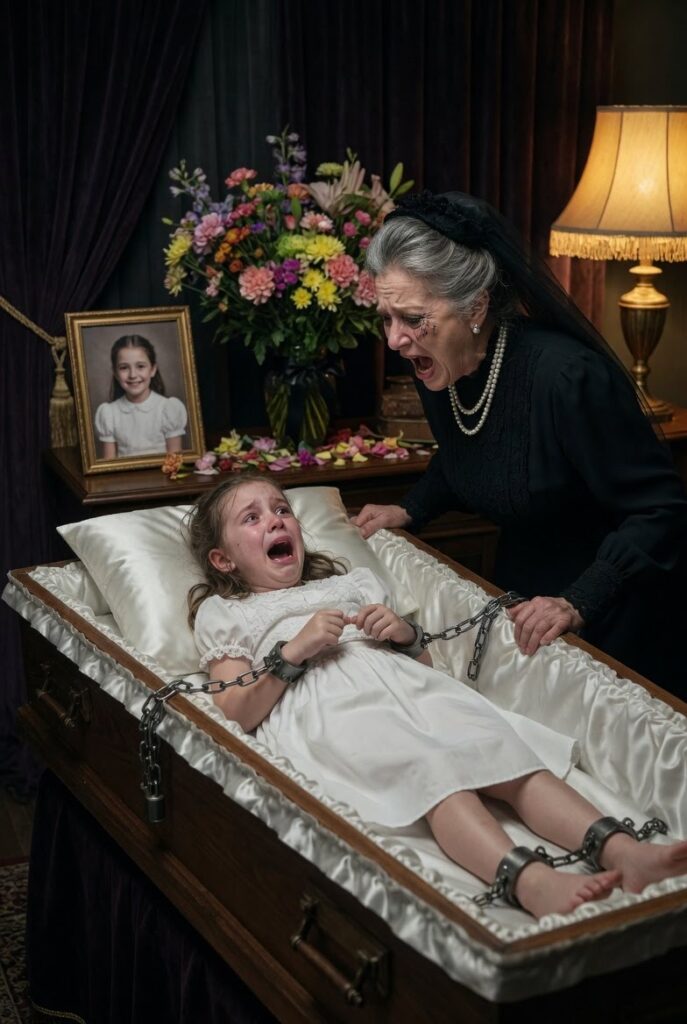
The night before Olivia’s funeral, Estela opened her granddaughter’s coffin.
She expected grief.
She expected silence.
She expected the cold, final stillness every grandmother fears but no grandmother should ever have to face.
Instead, she heard breathing.
For one impossible second, Estela could not move.
The room was dim, heavy with flowers, black curtains, and the soft yellow light of an old lamp near the wall. A framed photo of Olivia smiled from a small table beside the coffin, surrounded by petals and sympathy cards.
In the picture, Olivia was wearing a white dress and smiling like the world had never frightened her.
Inside the coffin, she wore another white dress.
But this Olivia was pale.
Terrified.
Trembling.
Her lips were dry. Her eyes were half-open. Her small chest rose and fell in shallow movements beneath the satin.
Estela stared until the truth struck her body like lightning.
Olivia was alive.
“My love…” Estela whispered.
Her knees nearly gave out, but she grabbed the edge of the coffin and forced herself to stay standing.
Then Olivia’s eyes moved.
Not much.
Just enough.
Enough to break Estela’s heart open.
“Grandma?” the little girl breathed.
Estela covered her mouth to stop herself from crying out.
“I’m here,” she whispered quickly. “I’m here, my child.”
Olivia’s small hands trembled at her sides, but they did not rise.
That was when Estela saw why.
Thin metal restraints had been attached to the satin lining, hidden beneath the soft folds of Olivia’s funeral dress. Her wrists were held down. Her ankles too. The white fabric covered most of it, exactly the way someone had intended.
Estela’s fingers shook as she touched Olivia’s wrist.
The skin there was red and marked.
Olivia winced.
That tiny movement shattered any last hope that this was some terrible mistake.
Everything her son Tomás and his wife Sara had told the doctor, the neighbors, the priest, and the funeral home was a lie.
Olivia had never been gone.
She had been hidden.
“My love, I’m going to get you out,” Estela whispered, though her own voice barely obeyed her.
Olivia stared at her with exhausted fear, the kind of fear that looked too old for a six-year-old’s face.
“I was good,” the child murmured. “I didn’t say a word.”
Estela froze.
She had lived long enough to recognize a sentence that carried more pain than a child could explain.
“I know,” Estela said, forcing her voice to stay soft. “You did nothing wrong.”
Olivia’s eyes filled with tears.
“They said I had to stay quiet.”
Estela’s hands moved faster.
She tried to loosen the restraints, but small padlocks held them in place.
Padlocks.
That detail struck harder than any scream could have.
This was not confusion.
Not a rushed mistake.
Not a medical misunderstanding.
It was a plan.
Estela stopped pulling and began searching.
The pillow.
The sheet.
The satin lining.
The inner edge of the coffin.
Her breathing became rough as her fingers moved along the fabric. Then, under a folded seam near Olivia’s shoulder, she felt tape.
She pulled it loose.
A small silver key fell into her palm.
For one second, Estela stared at it.
Someone had hidden the key where no grieving grandmother was supposed to look.
Then she unlocked the first restraint.
The second.
The third.
The fourth.
Olivia did not cry when Estela lifted her from the coffin.
She only made a broken little sound and clung to her grandmother’s neck like a child who no longer believed safety could last.
She weighed too little.
Her forehead burned with fever.
Her legs were cold.
A dark mark crossed one ankle, partly hidden by her sock.
Estela wrapped her in the black cardigan she had left near the window.
“We’re leaving,” she whispered.
Olivia gripped her tighter.
“They told me if I cried, it would make everything worse.”
Estela closed her eyes for half a second.
When she opened them, she was no longer only a grieving grandmother.
She was the only wall standing between Olivia and the people who had placed her inside that coffin.
Then the front door opened downstairs.
Estela froze.
Tomás’s voice rose from the entryway, calm and distracted, speaking on the phone as if he were handling an ordinary inconvenience.
Not the fact that his daughter had been lying alive in a coffin.
Estela clutched Olivia to her chest and looked around the room.
Her purse was beside the flower table.
Her cell phone was inside it.
Too far.
The main stairs were too exposed.
Then she remembered the old back hallway.
The narrow winter hallway that connected the sitting room to the laundry room and the side service staircase. Sara hated that part of the house. She always said it felt old and heavy.
That meant Tomás rarely used it now.
Estela moved quickly.
Every floorboard felt too loud.
Every breath from Olivia felt too fragile.
She slipped through the side hallway, down the narrow stairs, and into the laundry room.
The room smelled of detergent, dust, and folded towels.
Estela sat Olivia on a basket of clean laundry and looked at the wall.
The old landline was still there.
Sara had tried to remove it many times because she hated visible wires.
Now, that ugly old phone became the most beautiful thing Estela had ever seen.
She grabbed the receiver and dialed 911 with fingers that barely obeyed her.
When the operator answered, Estela did not scream.
She did not waste time.
“My granddaughter is alive,” she said. “She was placed inside a coffin. She was restrained. She is injured. My son and daughter-in-law are still in the house. We are in immediate danger.”
The operator’s voice changed.
“Is the child breathing?”
“Yes,” Estela said. “She’s breathing. Please hurry.”
“Stay on the line. Officers and medical help are on the way.”
Upstairs, Tomás called her name.
“Mom?”
Estela’s heart hammered.
He must have seen the open coffin.
Olivia began shaking violently.
Estela pulled her close just as footsteps came down the hallway.
The laundry room doorknob moved.
“Mom?” Tomás said from the other side.
His voice was close now.
There was no panic in it yet.
Only suspicion.
Maybe he still thought Estela had fainted.
Maybe he thought he would find her overwhelmed, confused, easy to control.
For one terrible second, an old part of Estela wanted to believe there might still be an explanation that could save her son from what she already knew.
Then Olivia buried her face in Estela’s neck.
“Don’t let Dad bring me back.”
Something inside Estela hardened forever.
She locked the door.
“Open the door,” Tomás ordered.
He no longer sounded like a worried son.
He sounded like a man used to being obeyed.
The doorknob rattled harder.
“I called the police,” Estela said.
Silence.
Not shock.
Calculation.
“Mom,” Tomás said in a lower voice. “You’re confused. Olivia is very sick. You don’t understand what happened.”
“I found her restrained inside a coffin.”
His breathing changed.
Not with horror.
With anger.
Then Sara’s voice appeared in the hallway.
“What did you do?” she asked. “What happened?”
Tomás answered too quietly for Estela to hear.
Sara’s footsteps rushed closer.
“No,” Sara whispered. “No, no, no…”
The operator was still on the line.
Estela held Olivia and nodded silently to every instruction.
Keep the door locked.
Stay away from the doorway.
Keep the child awake if possible.
Tell us if breathing changes.
Then Sara said something that slipped under the door like a blade.
“She wasn’t supposed to wake up.”
Tomás hissed, “Be quiet.”
Estela’s stomach turned cold.
In the distance, sirens began to wail.
Olivia lifted her face, her breathing shallow.
“I don’t have normal sleepiness,” she whispered. “I have pinprick sleep.”
Estela looked down at her.
“What do you mean, my love?”
Olivia’s eyelids fluttered.
“Mommy said it helps me stay still. She gives it with the little needle. She said if I sleep right, everyone will be happy.”
Estela nearly stopped breathing.
She looked at Olivia’s arms, then her legs. Beneath the faint marks and scratches, she saw tiny dots she had mistaken for insect bites days earlier.
Pinprick sleep.
A child’s words for something no child should ever know.
Outside the door, Tomás lowered his voice.
“Mom, open the door before this gets worse.”
“It is already worse,” Estela said.
Sara began crying, but it did not sound like grief.
It sounded like fear of being caught.
“You don’t understand,” Sara said. “We were drowning. The bills, the doctors, the appointments, the attention she needed every single day—”
“She is a child,” Estela said.
“She was ruining everything!” Sara snapped.
The hallway went silent.
Even Tomás said nothing.
Olivia whimpered.
Estela pressed a kiss to the child’s hair.
“You are not ruining anything,” she whispered. “You hear me? You are loved.”
The front door burst open.
“Police!”
Tomás stepped away from the laundry room door.
Sara began talking too fast.
“Officer, thank God. My mother-in-law is confused. She has taken the child, and Olivia has a serious medical condition—”
“Step back,” a firm voice ordered.
“This is a family matter,” Tomás said.
“No,” the officer replied. “This is now an emergency investigation.”
Estela heard boots in the hallway.
Then a woman’s voice came close to the door.
“Ma’am, my name is Officer Marisol Vega. We received your call. Are you inside with the child?”
“Yes,” Estela said.
“Is she breathing?”
“Yes.”
“Can you unlock the door slowly?”
Estela looked at Olivia.
The little girl’s fingers were wrapped around the cardigan so tightly her knuckles had turned pale.
“It’s the police,” Estela whispered. “I won’t let anyone take you back.”
Olivia nodded weakly.
Estela unlocked the door.
Officer Vega stood there with two paramedics behind her.
The moment she saw Olivia, her face changed.
Not dramatically.
Not loudly.
But all the kindness disappeared from the edges, replaced by a professional stillness that told Estela the officer understood.
The paramedics moved quickly.
They wrapped Olivia in a thermal blanket and checked her breathing, pulse, temperature, and pupils.
One of them noticed the marks on her wrists and ankles.
He looked at Officer Vega.
She looked at Tomás and Sara.
Neither of them spoke.
Olivia reached for Estela when the paramedics lifted her.
“Grandma,” she cried.
“I’m coming with you,” Estela said immediately.
Tomás tried to step forward.
“She’s my daughter.”
Officer Vega moved between them.
“You are not going near her.”
Tomás’s face twisted.
“You have no right.”
Officer Vega’s voice stayed calm.
“Actually, I do.”
Sara covered her mouth, sobbing now.
Tomás pointed at Estela.
“She’s old. She doesn’t understand. Olivia has episodes. She says things. She gets confused.”
Estela turned toward him.
For the first time in her life, she looked at her son and felt no need to protect his image.
“She said, ‘Don’t let Dad bring me back.’”
Tomás went pale.
Officer Vega heard it.
So did the paramedics.
So did the 911 operator still listening through the receiver.
Outside, neighbors had begun gathering near the gate. Some had come earlier to offer condolences. Now they watched as the child they believed would be buried in the morning was carried out alive.
The ambulance lights flashed red against the black curtains.
Sara whispered, “This isn’t what it looks like.”
Officer Vega answered, “Then you can explain it at the station.”
At the hospital, Olivia was taken into emergency care.
Estela sat in a plastic chair with her cardigan still missing and her hands covered in the child’s warmth.
Doctors asked questions.
Police asked questions.
A child protection worker arrived with kind eyes and a notebook she did not open until Olivia was stable.
The first doctor came out after nearly an hour.
“Her condition is serious, but she’s alive,” he said. “She appears to have been given medication that kept her deeply sedated. She is dehydrated, feverish, and frightened. But she is responding.”
Estela pressed both hands to her face.
“Can I see her?”
“Soon.”
“Please. She’ll be scared.”
The doctor looked at the officer.
Officer Vega nodded.
When Estela entered the room, Olivia looked impossibly small in the hospital bed. Wires connected her to monitors. A blanket covered her up to her chin.
But her eyes were open.
“Grandma?”
Estela went to her side.
“I’m here.”
“Are they mad?”
The question broke Estela more than any scream could have.
“No, my love. No one is mad at you.”
“I didn’t stay asleep.”
“That is why you’re here,” Estela said, taking her tiny hand. “That is why you are safe.”
Olivia stared at her for a long time.
“Do I have to go home?”
“No.”
“Promise?”
Estela leaned close.
“I promise.”
The next morning, the funeral was canceled.
The black curtains came down.
The flowers were removed.
The small framed photo of Olivia was taken from the memorial table and placed in Estela’s purse.
Police searched the house.
They found medical supplies hidden in a locked cabinet.
They found messages between Tomás and Sara discussing money, stress, and “making it look peaceful.”
They found receipts.
They found instructions printed from websites.
They found the hidden key tape still stuck beneath the coffin lining.
They found enough evidence to turn whispers into charges.
For two days, the police said very little publicly.
The neighborhood had already heard too much.
A child carried alive from her own wake.
A grandmother with shaking hands.
Parents taken away in separate cars.
People who had brought flowers now stood outside their homes whispering in disbelief.
On the third day, Officer Vega returned to the hospital with a detective.
Estela was beside Olivia’s bed, reading a children’s book in a voice that trembled only when Olivia looked away.
The detective asked to speak privately.
Estela stepped into the hallway.
“Your son and daughter-in-law are in custody,” he said. “The investigation is expanding. We believe they planned this carefully.”
Estela gripped the rail along the wall.
“Why?”
The detective’s face was tired.
“Financial pressure. Resentment. Insurance questions. Medical care they no longer wanted to manage. We are still confirming everything.”
Estela closed her eyes.
Tomás had once been a little boy who cried when a bird fell from its nest.
She remembered kissing his scraped knees.
She remembered teaching him to pray.
She remembered believing goodness, once planted in a child, would always survive.
But some truths arrive like storms.
They do not care what memories they destroy.
“What happens to Olivia?” she asked.
“For now, protective custody. But we will recommend placement with a safe relative.”
Estela opened her eyes.
“Me.”
The detective looked at her gently.
“You understand this will be difficult.”
“I opened the coffin,” she said. “I am not closing any door on her now.”
That evening, Olivia woke from a nightmare crying, “I was good. I was quiet.”
Estela climbed carefully into the hospital bed beside her despite the nurse warning her about the wires.
“I know,” Estela whispered, holding her gently. “But you don’t have to be quiet anymore.”
“They said quiet girls are loved.”
Estela’s tears fell into Olivia’s hair.
“No. Loved girls are heard.”
Olivia did not understand all at once.
Healing rarely begins with understanding.
Sometimes it begins with someone staying.
Days turned into weeks.
Olivia recovered slowly.
Her fever lowered.
The medication left her system.
The marks on her wrists faded from red to purple, then yellow, then almost gone.
But the fear stayed longer.
She startled when doors clicked.
She cried when nurses dimmed the lights.
She refused white dresses.
When a hospital volunteer brought a doll in a white gown, Olivia turned her face to the wall and would not speak for an hour.
Estela learned quickly.
No closed doors.
No white nightgowns.
No saying “be good” when what she meant was “be safe.”
The first time Olivia laughed again, it was because Officer Vega accidentally spilled hot chocolate on her own notebook.
The laugh was tiny.
Almost afraid of itself.
But it was real.
Everyone in the room froze for half a second.
Then Estela cried so hard Olivia began giggling at her too.
After three weeks, Olivia was released from the hospital into Estela’s care.
The house felt different when they arrived.
Not the old house where the coffin had been.
Estela refused to take her back there.
Instead, they moved into Estela’s small apartment on the second floor of a quiet building with blue curtains, potted basil on the windowsill, and a hallway full of neighbors who minded their business unless help was needed.
Olivia chose her own bedroom color.
Lavender.
“Not yellow?” Estela asked, because Olivia had loved yellow before.
Olivia shook her head.
“Lavender feels soft.”
So Estela painted the room lavender.
Badly.
With streaks.
And one patch near the closet darker than the rest.
Olivia declared it perfect.
At night, Estela left the door open and the hallway light on.
Some nights Olivia slept.
Some nights she woke crying.
Some nights she asked the same question again and again.
“Can they bring me back?”
And every time, Estela answered, “No.”
The court process was painful.
Tomás tried to blame Sara.
Sara tried to blame Tomás.
Both tried to make themselves sound desperate rather than cruel.
But the evidence spoke.
The recordings.
The 911 call.
The hidden supplies.
The key.
Olivia’s own careful words, spoken later to a child specialist with Estela nearby.
“I was told to stay quiet.”
“I was told it was like a long sleep.”
“I heard Grandma.”
“I wanted Grandma.”
Those words did what adults sometimes fail to do.
They told the truth without decoration.
Months later, Estela received legal guardianship.
On the day the papers were signed, Olivia wore lavender shoes and a blue sweater with butterflies on it.
Officer Vega came to the courthouse.
So did the 911 operator, a woman named Daniela, who cried when Olivia gave her a drawing.
The picture showed a little girl standing outside a box with wings growing from her back.
At the bottom, in uneven letters, Olivia had written:
I woke up.
Daniela pressed the paper to her chest.
“You certainly did,” she whispered.
Life after that was not perfect.
It was morning oatmeal.
Therapy appointments.
School meetings.
Nightmares.
Soft blankets.
Small victories.
It was Olivia learning she could say no.
It was Estela learning to answer questions she wished Olivia never had to ask.
It was birthdays without Tomás.
Holidays without pretending.
A future built from broken pieces, slowly, carefully, honestly.
One year after that night, Estela opened a wooden memory box and took out the framed photo that had once stood beside the coffin.
Olivia sat beside her on the couch.
“That was from before,” Olivia said.
“Yes.”
“I look happy.”
“You were happy.”
Olivia touched the frame.
“Was I gone?”
Estela shook her head.
“No, my love. You were never gone.”
Olivia thought about that.
Then she whispered, “I was waiting.”
Estela pulled her close.
“I know.”
“For you.”
Estela closed her eyes.
“And I came.”
That evening, they planted lavender outside the apartment building.
Officer Vega came by after her shift and helped dig the holes.
Daniela sent a small wind chime shaped like a butterfly.
When the wind moved, the chime made a soft, clear sound.
Olivia stood in the fading light, listening.
“Grandma?”
“Yes?”
“Can I wear a white dress again someday?”
Estela’s throat tightened.
“Only if you want to.”
Olivia nodded slowly.
“Maybe when I’m bigger.”
“Then when you’re bigger.”
Olivia leaned against her.
“But not in a box.”
Estela wrapped both arms around her.
“Never in a box.”
The child smiled.
Small.
Real.
Alive.
And Estela knew that the world had changed forever the night she lifted that coffin lid.
Her son had told lies.
Sara had helped build them.
Neighbors had believed them.
A funeral had almost buried the truth.
But love noticed one breath.
One trembling hand.
One granddaughter who was still fighting to be found.
And because Estela listened, Olivia did not become a photograph on a memorial table.
She became a little girl in lavender shoes.
A girl who learned to laugh again.
A girl who grew brave enough to sleep with the door open instead of fearing the dark.
A girl who one day drew a butterfly with wings so wide they filled the whole page.
At the bottom, she wrote one sentence.
Grandma opened the lid, and I came home.
━━━━━━━━━━━━━━━━━━━━━━━━━━━━━━━━━━━━━━