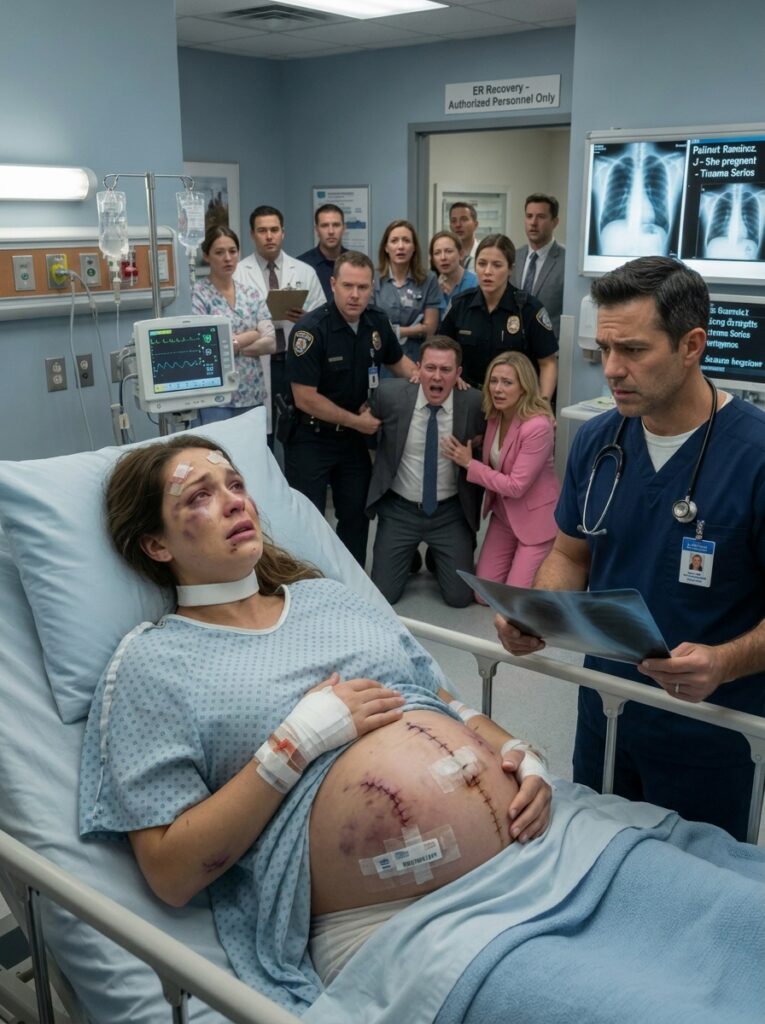
The moment I opened my eyes, my husband was crying beautifully.
Not honestly.
Beautifully.
His face hovered above mine beneath the harsh hospital lights, twisted into a performance so perfect that any stranger might have believed he was a heartbroken man terrified of losing his family.
“My pregnant wife fell down the stairs,” Julian said, gripping my hand tightly enough to make pain shoot through my wrist. “She’s five months along. She’s always been clumsy. Please, doctor, you have to save her and our baby.”
I couldn’t speak.
Every breath felt heavy. My side burned. My body felt like it had been dropped into a place between waking and fading. Instinctively, my hands curled over my swollen belly, as if I could shield my child from the room, from the lights, from him.
Somewhere nearby, a monitor beeped steadily.
Julian leaned closer, his tears disappearing the second the nurse turned away.
“Remember,” he whispered. “Stairs.”
That was our marriage in one word.
Stairs.
Doors I had “walked into.” Cabinets I had “bumped.” Floors I had “slipped” on. Every injury came with a ready-made story, and every story came with Julian’s warm smile and polished voice.
At home, he controlled everything.
My phone. My clothes. My bank card. My schedule. Even the volume of my voice.
He called it love.
His mother, Eleanor, called it discipline.
“You’re incredibly lucky he keeps you around,” Eleanor once told me while sipping tea in my kitchen. “Especially now that you’re carrying his heir. A fragile woman like you would be nothing alone.”
Fragile.
That word followed me like a chain.
Julian believed it. Eleanor enjoyed it. His wealthy friends accepted it. To them, I was the quiet wife who looked down too much, the nervous woman who no longer worked, the expectant mother who seemed to jump whenever keys turned in the front door.
They never saw who I had been before him.
Before Julian, I had been a senior forensic accountant.
I knew how to follow hidden money. I knew how to read altered dates, missing signatures, and accounts designed to look clean from the outside. I understood patience. I understood patterns. Most of all, I understood that every lie leaves a mark somewhere.
Julian had convinced people I was too anxious to work.
Too anxious.
Not too clever.
Not too observant.
Not too patient.
A doctor stepped into the room. He was in his mid-forties, with calm eyes and a badge clipped neatly to his coat.
Dr. Samuel Hayes.
Julian rushed toward him as if they were both men fighting the same tragedy.
“Doctor, thank God. She fell. Is the baby okay?”
Dr. Hayes did not look at Julian first.
He looked at Julian’s hand clamped around my wrist.
Then at the fading bruise above my collarbone.
Then at the small marks on my arm.
Then at my face.
His expression changed by one quiet inch.
Julian didn’t notice.
“She just needs rest,” Julian said smoothly. “Hospitals make her prenatal anxiety worse. I’ll take her home as soon as possible.”
Dr. Hayes looked directly at him.
“No,” he said.
Julian blinked. “Excuse me?”
Dr. Hayes turned to the nurse.
“Begin an emergency medical hold. Lock the doors. Call security. Then call the police.”
Julian’s tears stopped.
And for the first time in seven years, I smiled.
Not because I was safe yet.
But because someone had finally looked past the story he told and seen the truth underneath it.
Julian’s face changed so quickly it almost frightened me more than his anger ever had. The grieving husband disappeared. In his place stood the man I knew from behind closed doors — cold, furious, and offended that anyone had dared to question him.
“This is ridiculous,” he said. “My wife needs me.”
Dr. Hayes stepped between us.
“Your wife needs medical care,” he said. “And she needs space.”
Julian laughed once, sharp and empty. “You don’t understand. She gets confused. She exaggerates. She’s been unstable since the pregnancy.”
My fingers found the gold locket at my throat.
The necklace was heavy, vintage, and beautiful in the old-fashioned way expensive things sometimes are. Julian had given it to me after our first prenatal appointment, fastening it around my neck in front of the mirror.
“A family piece,” he had said. “Wear it always. It makes you look like you belong.”
I had hated it from the moment it touched my skin.
It felt like a collar.
But Julian had made one mistake.
He thought I only knew numbers.
He forgot that evidence could be hidden anywhere.
Months earlier, after one of Eleanor’s visits, I found the locket open on my dresser. Julian had been searching through my things again. Something inside me finally stopped shaking long enough to think.
The locket was old, but the inside had been hollowed and altered. It was meant for a tiny photo, maybe a lock of hair. Instead, I used it for something Julian would never suspect.
A micro storage chip.
At first, I only saved documents.
Bank records. Property transfers. Messages Julian sent after he lost control, then deleted. Audio clips recorded when he thought I was too afraid to keep proof. Photos of my injuries with dates. Notes from every doctor visit where I had been too scared to say the truth.
Then I found something bigger.
Julian’s family business was not as clean as it looked.
Behind the charity dinners, private clubs, and carefully photographed smiles, money was moving through accounts that should not have existed. Payments were being disguised. Company funds were being redirected. Eleanor’s name appeared again and again, always one step away from the official paperwork, always close enough to know.
I had spent seven years being called fragile while quietly building the one thing Julian feared most.
A record.
A map of the truth.
Security arrived before the police. Julian tried to walk past them, but Dr. Hayes lifted one hand.
“You need to wait outside.”
“My wife is not staying here without me.”
“She is,” Dr. Hayes said.
Julian looked at me then. Really looked.
His eyes dropped to my hand around the locket.
For the first time, fear moved across his face.
“What did you do?” he asked softly.
I was still too weak to answer.
But I didn’t need to.
The police arrived twenty minutes later.
Two officers came in quietly, one staying near the door while the other spoke first to Dr. Hayes and the nurses. Julian returned to crying, but it no longer worked. His tears had become too late, too perfect, too rehearsed.
When an officer asked me if I felt safe going home with him, the room became silent.
Julian stared at me.
For seven years, that stare had been enough.
It had kept me quiet at dinner parties. Quiet in doctors’ offices. Quiet when neighbors asked if everything was okay. Quiet when Eleanor smiled at me like she already owned my child’s future.
But that day, beneath hospital lights, with my baby’s heartbeat filling the room, I finally understood something.
Silence had protected him.
Not me.
I swallowed through the dryness in my throat.
“No,” I whispered.
Julian’s face hardened.
“She’s confused,” he snapped. “She’s medicated. You can’t take her word seriously.”
Dr. Hayes turned to the officer.
“She was alert when she answered.”
The officer nodded and looked back at me.
“Do you want to make a statement?”
My hands shook as I unclasped the locket.
Julian lunged forward.
Security caught him before he reached me.
The room exploded with movement — voices, footsteps, Julian shouting that the necklace was his property, Eleanor’s property, family property. But Dr. Hayes stayed beside me, steady as stone.
I held the locket out to the officer.
“There’s a storage chip inside,” I whispered. “It has everything.”
The officer took it carefully.
Julian stopped shouting.
That silence told them more than his tears ever had.
By morning, Eleanor arrived at the hospital dressed like she was attending a board meeting instead of visiting her injured daughter-in-law. Her coat was cream-colored. Her pearls were perfect. Her expression was not worried.
It was annoyed.
She tried to walk straight into my room, but the officer outside stopped her.
“I’m his mother,” she said, as if that explained everything.
“You’re not on the approved list.”
Her eyes moved past him and found me through the open crack of the door.
For once, I did not look away.
Later, I learned that Eleanor had spent the first hour demanding to speak with “someone in charge.” By noon, she was calling attorneys. By evening, she was calling people who stopped taking her calls after they heard what the police had found.
The evidence in the locket did not just tell my story.
It told theirs.
Julian’s messages. Eleanor’s instructions. Financial records. Transfers hidden under project names. A folder labeled “medical,” where Julian had kept notes about how to make me look unstable if I ever tried to leave.
That folder made even the officer go quiet.
The investigation moved quickly after that.
Because wealthy families can hide many things, but they cannot hide from paper trails forever — not when someone has spent years following every number.
I stayed in the hospital for several days.
Dr. Hayes checked on me often, not with pity, but with respect. He never pushed me to speak before I was ready. He never called me fragile. When I cried, he did not treat my tears like weakness.
“You protected yourself for a long time,” he told me once. “And you protected your child.”
No one had ever said it that way before.
I had always felt ashamed of how long it took me to speak.
But he helped me understand that surviving is not the same as surrendering.
When I was released, I did not go home.
A victim advocate helped me move into a safe apartment under a new security arrangement. The police escorted me to collect what I needed. I remember walking through that house one last time, past the polished floors and expensive furniture, past the kitchen where Eleanor had called me nothing, past the staircase Julian had tried to turn into the final chapter of my life.
I did not take much.
Some clothes. My old accounting certificates. A framed photo of my parents. The baby blanket I had hidden in the back of the closet because Julian said yellow was too plain for his heir.
His heir.
I placed my hand on my belly and whispered, “You are not anyone’s heir. You are my child.”
Weeks passed.
Then months.
Julian’s case became larger than anyone expected. The truth about what he had done inside our home opened the door. The truth about what his family had done inside their company kept it open.
Eleanor tried to claim she knew nothing.
But numbers have a memory.
So do emails.
So do people who stop being afraid.
Several employees came forward after the investigation began. A driver. A bookkeeper. A former assistant. Each had seen a piece of the puzzle. Alone, their stories had seemed too small to matter. Together, they formed a wall Julian and Eleanor could not smile their way through.
I gave my statement from a quiet room with an advocate beside me and a recorder on the table.
This time, when I spoke, no one interrupted.
No one corrected me.
No one told me I was confused.
When I finished, the detective closed the file slowly and said, “You were very brave.”
I thought of all the nights I had not felt brave.
All the nights I had hidden in bathrooms, memorized passwords, copied files with shaking hands, and waited for the moment when the truth would matter.
Maybe bravery did not always feel like fire.
Maybe sometimes it felt like fear, carrying itself forward one breath at a time.
Three months later, I gave birth to my daughter.
I named her Grace.
She arrived on a rainy morning, small and strong, with a cry that filled the room like a promise. When the nurse placed her against my chest, I held her and wept harder than I had in the hospital after the stairs.
Not from fear this time.
From freedom.
Julian was not there.
Eleanor was not there.
No one stood over me claiming ownership of her future.
It was just me, my daughter, and the first peaceful silence I had known in years.
The legal process continued, but I no longer measured my life by Julian’s anger. I measured it in small, ordinary miracles.
Grace sleeping with one hand curled under her cheek.
Coffee cooling beside my laptop.
My name on a new bank account.
My phone with no one checking it.
The first time I laughed without looking toward the door.
Eventually, the court granted me full protection and custody. Julian faced consequences for what he had done to me, and separate charges followed the financial investigation. Eleanor’s perfect reputation cracked in public, not because I destroyed it, but because the truth finally reached daylight.
I went back to work part-time at first, helping a nonprofit trace financial misconduct for women rebuilding their lives after unsafe homes.
The first case file I opened made my hands tremble.
The second made me angry.
By the third, I remembered who I was.
One afternoon, nearly a year after the hospital, I found the gold locket in a sealed evidence bag returned by the authorities. The chain was tangled, the metal scratched, the hinge slightly bent from all the times I had opened it in secret.
I held it for a long time.
Once, it had felt like a collar.
Then it became a hiding place.
Then it became a key.
I thought about throwing it away. Instead, I placed it in a small box at the back of my closet — not as a memory of Julian, but as proof of the woman who had survived him.
That evening, Grace woke from her nap just as the sun filled our apartment with soft gold light. I lifted her into my arms and stood by the window, watching the city move below us.
For years, people had called me fragile.
But fragile things break without purpose.
I had bent.
I had hidden.
I had waited.
And when the moment came, I had opened my hand and given the truth to someone who would finally listen.
Grace pressed her tiny palm against my chest, right where the locket used to rest.
I smiled and kissed the top of her head.
The house was gone. The fear was gone. The lies were gone.
And for the first time in seven years, no one was telling me what story to tell.
So I told my daughter the only one that mattered.
“We are safe now.”
━━━━━━━━━━━━━━━━━━━━━━━━━━━━━━━━━━━━━━