The sliding doors of St. Mary’s Hospital in Cleveland, Ohio, opened with a sharp metallic sigh just after midnight.
Cold rain blew in with the smell of wet pavement, gasoline, and fear.
Dr. Emily Carter was supposed to be leaving.
Her shift had already stretched past what felt human. She had treated a construction worker with a deep hand injury, a toddler burning with fever, an elderly man with chest pain, and a young mother who could not stop crying even after the test results came back normal.
The emergency room had its usual midnight rhythm.
Vending machines humming.
Fluorescent lights buzzing.
A half-empty paper cup of coffee cooling at the nurses’ station.
Then the doors opened.
Not normally.
Not slowly.
Panicked.
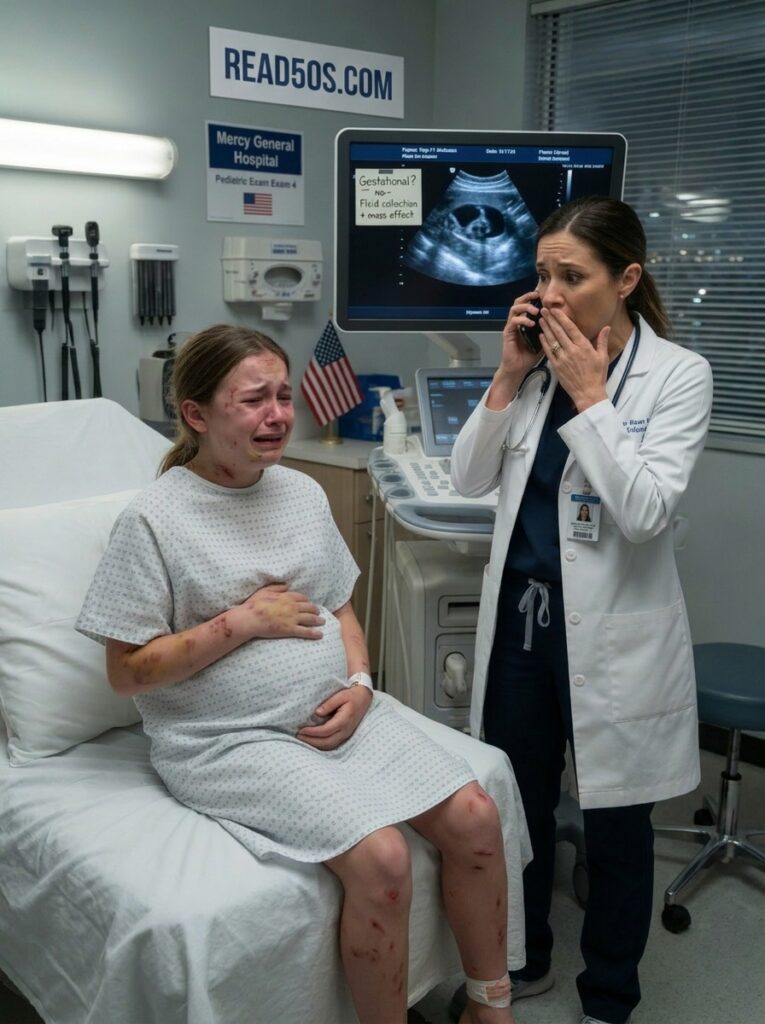
A girl stood just inside the entrance, one arm wrapped around her stomach, bent forward as if pain had folded her in half. Her oversized sweatshirt swallowed her thin frame. Her sneakers were untied. Rainwater dripped from the ends of her hair. Her eyes moved across the room like she was searching for help and danger at the same time.
She looked no older than thirteen.
“Please,” the girl whispered.
Then her knees buckled.
A nurse rushed forward with a wheelchair. Another called for assistance. Dr. Carter dropped her bag so quickly it hit the floor with a dull thud.
“Sweetheart, can you hear me?” Emily asked, crouching in front of her.
The girl nodded faintly.
“What’s your name?”
Her lips trembled before the words came out.
“Lily,” she whispered. “Lily Thompson.”
“Okay, Lily. I’m Dr. Carter. You’re safe here. We’re going to help you.”
At the word safe, Lily’s face twisted.
Not with relief.
With pain.
As if safety was something she remembered from a long time ago, before someone taught her not to trust it.
They wheeled her into an examination room. Monitors blinked awake. A blood pressure cuff tightened around her small arm. Her pulse was racing. Her breathing came in shallow, careful bursts, like every inhale had to pass through a locked door.
“Where is your parent or guardian?” a nurse asked gently.
Lily’s fingers tightened around the blanket they had placed over her lap.
“My mom doesn’t know I came.”
The room went still in a way only hospital rooms can.
Machines kept beeping. Shoes still moved outside the door. Somewhere down the hall, a phone rang twice before someone answered.
But inside that room, every adult understood that one sentence had changed the night.
“How did you get here?” Emily asked.
“I walked part of the way,” Lily whispered. “Then a woman at a gas station called a ride for me.”
No one rushed her.
No one looked away.
Dr. Carter pulled up a stool and sat close enough for Lily to know she was listening, but not so close that she felt trapped.
“Can you show me where it hurts?”
Lily placed a trembling hand low on her abdomen.
“Here. It keeps cramping. And my back hurts.”
“How long has this been happening?”
“A while.”
“A few hours?”
Lily looked down.
“Longer.”
“A few days?”
Silence.
Emily had spent years in emergency medicine. She knew pain. She knew fear. She knew the difference between a child afraid of a symptom and a child afraid of what might happen if someone discovered the truth.
“Did you fall?” Emily asked softly. “Did someone hurt you?”
Lily’s eyes shot toward the door.
“No.”
Too fast.
Too practiced.
Emily felt something cold settle beneath her ribs.
For one sharp second, she wanted to stand, lock the door, and demand every name Lily had been taught to protect. But anger would not help this child. Pressure would not help her either.
Children who had been frightened into silence did not give the truth all at once.
They gave it in pieces.
So Emily kept her voice calm.
The exam continued carefully. Fever. Nausea. Dizziness. Food. Pain. Sleep. Home. School. Lily answered some questions and swallowed the rest.
Every time footsteps passed the door, her shoulders lifted toward her ears.
Then Emily noticed it.
The slight swelling.
Not obvious enough for someone in the waiting room to see.
Not enough for a stranger to stare.
But enough for a doctor.
Enough to change everything.
Emily glanced at the nurse, then back at Lily.
“Lily,” she said, her voice even softer now, “has anyone explained to you what might be happening with your body?”
Lily stared at the blanket.
Her voice was barely there.
“I thought if I didn’t say it, maybe it wasn’t real.”
The nurse beside the monitor froze for half a second.
Emily’s jaw tightened until it ached. Rage came first, hot and useless. Then it turned cold — the kind of cold that made a doctor precise.
She did not ask her next question like an accusation.
She asked it like a hand reaching across a dark room.
“Lily, are you afraid to go home tonight?”
The girl’s fingers curled into the blanket until her knuckles turned white.
“My mom said hospitals ask too many questions,” Lily whispered. “She said if I ever told, everything would be my fault.”
There it was.
Not a full explanation.
A warning.
Emily stood slowly. Across the room, the nurse’s eyes met hers. No drama. No speech. Just the silent understanding of people trained to recognize when a child had walked into the only place left that might believe her.
Emily reached for the phone.
Her hand trembled only once.
Then Dr. Carter made the call.
She spoke to the hospital triage coordinator first, choosing her words carefully.
“Possible pediatric endangerment. Patient is a minor presenting with abdominal pain, physical distress, and significant fear of returning home. Begin child protection protocol immediately. Notify social services and hospital security.”
The coordinator paused for only a fraction of a second.
Then the system began moving.
A social worker was called.
A pediatric specialist was paged.
Security was placed near the emergency entrance.
A quiet note was added to Lily’s file: no visitors without approval.
Emily returned the phone to its cradle and turned back to the girl on the bed.
Lily watched her with wide eyes.
“What happens now?” she asked.
Emily sat beside her again.
“Now we make sure you are safe here tonight,” she said. “No matter who comes through those doors.”
Lily did not cry.
Not yet.
She simply stared at Emily as if trying to decide whether those words were real.
Fifteen minutes later, the hospital social worker arrived.
Her name was Denise Grant, and she had the steady, gentle presence of someone who had spent years sitting beside frightened children without demanding they trust her too quickly.
Denise introduced herself, then asked Lily if she wanted water.
Lily nodded.
It was a small thing, but Emily noticed how Lily watched the cup after Denise handed it to her, as if she expected someone to take it away.
The pediatric specialist arrived soon after. His face darkened slightly as he reviewed the preliminary notes, but when he turned to Lily, his expression softened.
“We’re going to run a few tests,” he told her. “Nothing happens without someone explaining it to you first.”
Lily’s mouth trembled.
“Am I in trouble?”
“No,” Emily said immediately. “You are not in trouble.”
“But my mom said—”
“Your mom is not here right now,” Denise said gently. “And right now, this room is about you.”
That was when Lily finally cried.
Not loudly.
Not dramatically.
Her face crumpled, and the tears slid down silently, the kind of tears that looked as though they had been waiting too long for permission.
Emily placed a tissue in her hand.
Lily held it, but did not use it.
“My stomach hurt for days,” she whispered. “I told her. She said not to make things worse.”
Denise leaned forward slightly.
“What did she mean by worse?”
Lily shook her head.
Emily did not push.
The tests began. Bloodwork. Imaging. Monitoring. Every step was explained carefully. Emily stayed in the room whenever she could, even as the rest of the ER kept pulling at her.
The results came back in pieces.
And each piece made the night heavier.
Lily’s body was under serious strain. She needed care immediately. She was not safe to leave. And whatever had happened before she arrived at St. Mary’s had gone unreported for far too long.
At 1:12 a.m., the front desk called back to the exam room.
A woman had arrived demanding to see Lily.
Lily heard the message from the hallway.
Her face drained of color.
“She’s here,” she whispered.
Emily moved to the door.
“Who?”
“My mom.”
Denise stepped closer to the bed.
“Lily, do you want to see her?”
The answer came without hesitation.
“No.”
Emily nodded once and went to the nurses’ station.
A woman in a soaked gray coat stood near the entrance, her hair pulled back too tightly, her hands moving restlessly around the strap of her purse.
“I’m Karen Thompson,” she said before Emily could speak. “My daughter is here. She ran off. She’s dramatic. I need to take her home.”
Emily kept her face calm.
“Lily is receiving medical care. She cannot be discharged at this time.”
Karen’s eyes sharpened.
“I’m her mother.”
“I understand.”
“Then bring her to me.”
“That won’t be possible right now.”
Karen’s voice lowered. “You people have no idea what she’s like. She makes up stories. She wants attention. She’s been difficult lately.”
Behind Emily, security shifted closer.
Karen saw him.
Her expression changed from worry to calculation.
“Did she say something?” Karen asked.
Emily did not answer that.
“She is safe and being treated. A social worker is involved.”
Karen’s face went pale.
Only for a moment.
Then she laughed.
“This is insane. She is thirteen. She doesn’t know what she’s talking about.”
Emily felt the cold precision return.
“That is exactly why professionals need to speak with her.”
Karen’s mouth tightened.
“I want to see my daughter.”
Denise appeared beside Emily.
“Not until Lily agrees,” she said.
Karen stared at both of them.
Then she leaned slightly forward and said something that made Emily’s blood turn cold.
“You’re making a mistake. You have no idea who you’re protecting her from.”
It was not a mother’s fear.
It was a warning.
Security escorted Karen to a waiting area away from the pediatric rooms. Law enforcement arrived soon afterward.
By then, Lily had curled onto her side, exhausted by pain and terror. Emily sat beside her while Denise asked questions in a voice so gentle it barely disturbed the machines.
Piece by piece, the truth emerged.
Lily had not been running from one bad night.
She had been living inside a carefully maintained silence.
There was a man connected to the family — someone trusted, someone familiar, someone no child should ever have had to fear. Lily had tried to tell her mother months earlier that she did not feel safe around him.
Her mother had told her to stop lying.
Then she had told her to stop talking.
Then she had told her that if anyone found out, everything would be Lily’s fault.
Lily believed her.
For months, she carried fear alone.
Then the pain became too much to hide.
That night, when Karen refused to take her to the hospital, Lily waited until the house was quiet, put on her sweatshirt, and walked into the rain.
She did not know how far St. Mary’s was.
She only knew hospitals had doctors.
And doctors were supposed to help.
At a gas station several miles away, a woman noticed Lily standing near the door, shaking and pale. She asked if Lily needed help.
Lily said only one sentence.
“I need to go to the hospital, but please don’t call my mom.”
The woman did not ask for details.
She called a ride, gave Lily cash for it, and watched until the car pulled away.
Later, that woman would tell investigators, “I knew something was wrong. I just didn’t know how wrong.”
By morning, the case had reached child protective services, law enforcement, hospital administration, and the district attorney’s office.
Emily had been awake for nearly twenty-four hours.
She had not gone home.
She could not.
At 6:40 a.m., Lily was moved to a protected pediatric unit. A nurse brought her clean socks and a soft blue blanket from the donations closet. Denise stayed beside her through the transfer.
Before leaving the ER, Lily looked back at Emily.
“Are they mad?” she asked.
“Who?”
“My mom. Everyone.”
Emily walked to her bedside.
“Lily, what happened is not your fault.”
The girl blinked.
Emily repeated it.
“Not one part of it.”
Lily’s face twisted again, but this time the pain looked different.
Like a locked door opening.
The investigation that followed shook more than one family.
Karen Thompson was questioned for failing to protect her daughter and for trying to keep her away from medical care. At first, she denied everything. She said Lily was troubled. She said Lily had misunderstood. She said the hospital had overreacted.
But texts were found.
Voicemails.
Deleted messages.
School absences.
A neighbor who had heard arguments.
A teacher who had noticed Lily falling asleep in class and wearing oversized clothes even in warm weather.
A counselor who had tried to call home and never received a response.
The story widened in painful circles.
Everyone had seen a piece.
No one had seen the whole.
Until Lily walked into the ER at midnight.
The man Lily had feared was arrested after investigators gathered enough evidence. Karen faced legal consequences as well, not because she had failed to understand one moment, but because she had repeatedly chosen silence when her child needed protection.
The news eventually reached the public, though Lily’s identity remained protected. The hospital did not release her name. Neither did Dr. Carter.
But people still talked.
Some argued about what the system should have caught sooner. Some asked why schools, neighbors, and family members had missed the signs. Some blamed everyone except the child.
Emily hated that most of all.
Because Lily had done the bravest thing a frightened child could do.
She had asked for help.
And when a child asks for help, the first job of every adult is to listen.
Weeks later, Emily received a card through hospital administration.
There was no return address.
Only a small drawing of a girl standing under an umbrella in the rain, with a hospital building in the distance.
Inside, in careful handwriting, were five words:
Thank you for believing me.
Emily sat in the staff room and cried for the first time since that night.
Months passed.
Lily was placed with a safe foster family while long-term arrangements were reviewed. She received medical care, counseling, tutoring, and something she had not had in a long time — adults who did not punish her for telling the truth.
Healing did not happen quickly.
Some days Lily would not speak.
Some days she asked the same question over and over.
“Am I safe?”
And every time, someone answered.
“Yes.”
Not because the world had become perfect.
But because she was no longer alone inside it.
Dr. Carter continued working nights at St. Mary’s. The ER remained the ER — loud, unpredictable, full of fear and pain and people arriving on the worst nights of their lives.
But after Lily, something changed.
The hospital reviewed its child safeguarding procedures. Training expanded. Response times were studied. Staff were reminded that fear often enters through sliding doors wearing oversized clothes and untied sneakers.
Emily kept a copy of Lily’s thank-you card inside her locker.
On the nights when exhaustion made her feel hollow, she opened it and looked at the drawing.
A girl in the rain.
A hospital in the distance.
A path between them.
One year later, Emily was leaving another long shift when she saw Denise Grant waiting near the nurses’ station.
“There’s someone who asked if she could see you,” Denise said.
Emily followed her to a quiet family room.
A teenage girl stood by the window, taller than Emily remembered, wearing a yellow sweater and clean white sneakers tied in perfect bows.
For a second, Emily only saw the child who had collapsed under the emergency room lights.
Then Lily turned around.
She looked nervous, but steady.
“Hi, Dr. Carter.”
Emily smiled gently.
“Hi, Lily.”
Lily held a small paper bag in both hands.
“I made something for you.”
Inside was a bracelet made of blue and white beads. At the center was a tiny silver charm shaped like an umbrella.
Emily touched it carefully.
“It’s beautiful.”
Lily looked down, embarrassed.
“My counselor says I’m allowed to remember the bad night without living in it forever.”
Emily felt her throat tighten.
“She sounds very wise.”
Lily nodded.
“I still get scared sometimes. But not every day now.”
“That’s a big thing.”
“It feels big.”
“It is.”
Lily looked toward the hallway, then back at Emily.
“I used to think nobody would believe me unless I could explain everything perfectly,” she said. “But you believed me when I could barely talk.”
Emily shook her head softly.
“You told me enough.”
Lily’s eyes filled with tears, but she smiled through them.
“I want to be a nurse someday.”
Emily had to look away for a moment.
When she turned back, Lily was still standing there, small and strong, no longer folded in half by pain.
A survivor.
A child who had found the strength to walk through rain toward help.
A girl whose life had changed because one doctor picked up the phone — and because, for once, the adults on the other end listened.
That night, after Lily left, Emily went back to the ER entrance.
The sliding doors opened and closed.
Rain tapped softly against the glass.
The world outside was dark, but not empty.
Somewhere, someone might still be walking toward help.
And Emily knew exactly what she would do when they arrived.
She would listen.
She would believe.
And she would make the call.
━━━━━━━━━━━━━━━━━━━━━━━━━━━━━━━━━━━━━━