The rain had been falling for hours when Lily Holloway walked into the emergency room with her mother beside her and her broken arm held carefully against her chest.
The hospital lobby smelled like floor cleaner, wet jackets, and coffee that had been sitting too long. Fluorescent lights buzzed overhead. Somewhere down the hall, a monitor beeped in a steady rhythm.
At sixteen, Lily already knew how to read adults before they spoke.
She knew when a nurse was tired.
She knew when a teacher was suspicious.
And she knew when her mother, Karen, was rehearsing a lie in her head.
Karen stepped to the intake desk with her purse tucked beneath one arm and her daughter trembling beside her.
“My daughter fell down the stairs,” she said.
Her voice was calm.
Almost too calm.
The intake nurse looked up, then looked at Lily.
Lily sat down slowly in the plastic chair beside the desk, her face pale, her lips pressed together to keep from making any sound. Her right arm throbbed so badly that every heartbeat seemed to move through the break.
Karen filled out the hospital intake form with neat letters.
Name: Lily Holloway.
Age: 16.
Cause of injury: Fell down stairs.
The story might have passed if the broken arm had been the only injury.
But Lily’s cheek was swollen. One sleeve hid old bruises. And beneath the collar of her damp hoodie were faint marks around her neck that no staircase could explain.
Lily kept her eyes on the floor.
She had learned years earlier that fear was easier to survive when no one saw it.
But that night, someone did.
Dr. Nathan Wells had been working the late shift for twelve hours. He had treated feverish children, a man with chest pain, an elderly woman who had slipped in her kitchen, and two teenagers who had argued with a skateboard and lost.
When he first stepped into Lily’s exam room, he carried the tired patience of a doctor who had seen too much but still cared enough to look closely.
Karen stood beside the bed, arms folded.
Lily sat on the edge of the paper-covered mattress, cradling her arm against her body.
Dr. Wells glanced at the intake sheet.
“Fell down the stairs?” he asked gently.
Karen answered before Lily could open her mouth.
“Yes. She’s clumsy. She wasn’t watching where she was going.”
Lily’s stomach tightened.
She had heard that word so many times it no longer sounded like an insult.
Clumsy.
Careless.
Dramatic.
Difficult.
Anything except the truth.
Dr. Wells looked at Lily, not Karen.
“Lily,” he said, “can you tell me what happened?”
Her mouth went dry.
Karen’s eyes moved toward her, sharp and warning.
Lily swallowed.
“I fell,” she whispered.
Dr. Wells did not react immediately.
He nodded once, then pulled on gloves and examined her arm. His hands were careful, professional, and steady. When he lightly touched near the break, Lily bit down on a cry.
“We’ll get imaging done,” he said. “It does look fractured.”
Karen sighed as though inconvenienced.
“I told her not to run in the house.”
Lily said nothing.
Then Dr. Wells tilted Lily’s chin slightly to examine her face.
His expression changed.
Only for half a second.
But Lily saw it.
Doctors noticed things most people missed.
He saw the swollen cheek.
He saw the split at the corner of her lip.
He saw the faded yellow bruise near her jawline.
Then his gaze moved lower.
To her neck.
His hand stilled.
Karen saw him looking and quickly stepped closer.
“She bruises easily,” she said.
Dr. Wells did not answer.
He gently lifted Lily’s sleeve to check circulation in her wrist and saw the older marks along her forearm.
Lily’s eyes filled with tears.
Not because of the pain.
Because for the first time in a long time, someone was seeing more than Karen’s story.
Dr. Wells straightened.
“I’m going to step out for a moment,” he said calmly. “We’ll get X-ray ready.”
Karen’s face tightened.
“Is something wrong?”
“I just need to check on the imaging order.”
He walked out of the room, closed the door behind him, and turned left instead of right.
Then he called 911.
That was the night everything Richard Holloway had built around himself began to fall apart.
To everyone outside their home, Richard was charming.
Friendly smile.
Loud laugh.
Strong handshake.
The kind of man who helped neighbors carry lumber, waved from the driveway, and made people feel foolish for ever doubting him.
He knew how to perform kindness in public.
At church picnics, he carried coolers.
At school events, he shook hands with teachers.
At neighborhood barbecues, he laughed loudly and called Lily “kiddo” while squeezing her shoulder just hard enough to remind her that his kindness ended the moment they got home.
Inside the house, Richard was different.
He drank too much. He blamed everyone for his failures. He turned ordinary mistakes into excuses to frighten Lily.
A plate left in the sink could become a shouting match.
A quiet answer could become a punishment.
Looking at him too long was disrespect.
Not looking at him was disrespect.
Speaking was disrespect.
Silence was disrespect.
“You always act like you don’t respect me,” he would say, rolling up his sleeves.
Lily learned to make herself small.
She learned the safest routes through the house.
She learned which floorboards creaked.
She learned how to breathe quietly when Richard was in a bad mood.
And she learned the most painful lesson of all: sometimes the person who should protect you chooses peace over truth.
Her mother, Karen, never stopped him.
Afterward, Karen would stand trembling in the doorway and whisper the same useless sentence every time.
“You know how he is, Lily. Don’t upset him.”
As if Lily controlled the storms inside that house.
As if she could prevent Richard’s anger by washing dishes faster, standing straighter, smiling softer, speaking less, disappearing more.
For years, Lily believed her mother was afraid.
Then, slowly, she realized Karen was afraid — but she was also choosing the lie because the lie was easier to live inside.
Karen told herself Richard was under pressure.
She told neighbors Lily was clumsy.
She told teachers teenage girls exaggerated.
She told herself the family would be fine if everyone just stayed quiet.
But Lily had stopped believing survival and silence were the same thing.
Seven months before that hospital night, she began documenting everything.
She used an old phone Richard thought no longer worked.
The screen was cracked. The battery barely lasted an hour. But it had a camera, a voice recorder, and enough storage for the truth.
Lily hid it inside a torn stuffed bear at the back of her closet.
She took photos with dates.
She recorded shouting through her bedroom door.
She wrote down times, rooms, and injuries in a spiral notebook tucked into the lining of her backpack.
At 11:18 p.m. on March 6, she saved one of the first recordings.
At 6:42 the next morning, she photographed the bruise across her ribs before school.
At 8:05 p.m. on April 14, she wrote: He said no one would believe me because he is respected and I am just a dramatic kid.
At 9:31 p.m. on May 2, she recorded Richard laughing after she dropped a glass and begged him not to come closer.
She did not know exactly what she would do with the evidence.
She only knew that someday someone might ask for proof.
And she could not afford to have nothing but her word against Richard’s smile.
That final night began with headlights crossing the living room blinds.
Richard came in angry after losing another construction deal. His boots left wet prints near the door, and bourbon sharpened the air around him.
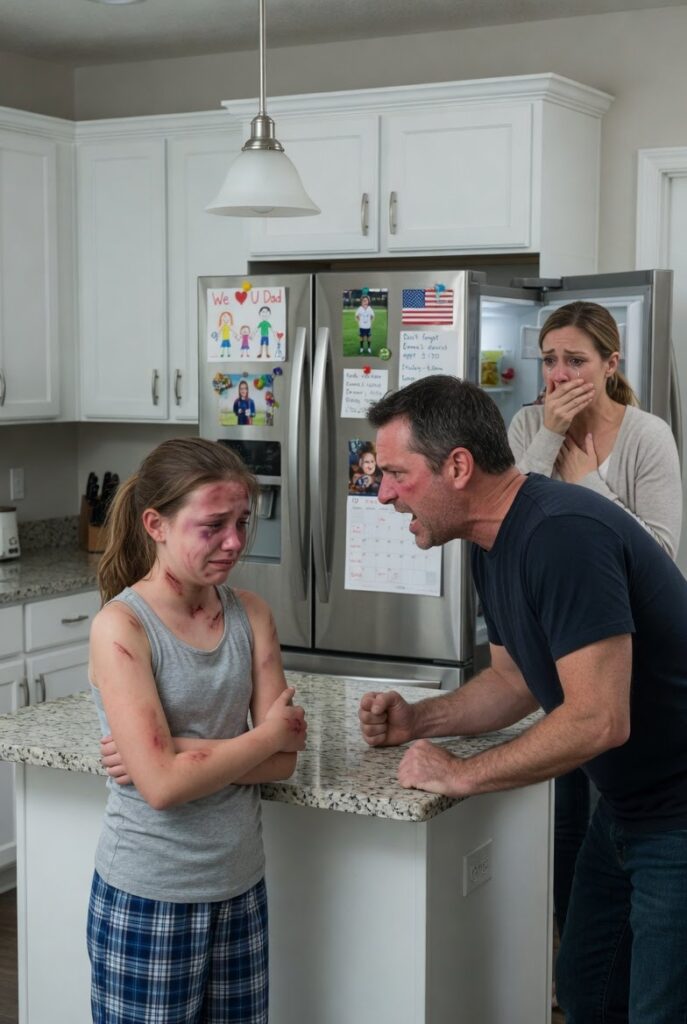
Lily was washing dishes when he entered the kitchen.
The faucet was running.
A plate slipped slightly in her hands.
Her mother stood near the hallway, already tense, already watching.
“Look at me when I’m talking to you,” Richard said.
Lily turned a second too late.
His hand struck her face hard enough to make her stumble against the counter. Pain flashed across her cheek, and the taste of blood filled her mouth.
Richard laughed.
“You still awake?” he mocked.
Karen stepped into the kitchen, pale and shaking.
“Richard,” she whispered. “Please stop.”
He looked at Karen and smiled coldly.
“You hear that, Lily? Your mommy thinks I’m being unfair.”
Lily backed away, but there was nowhere to go.
The sink was behind her.
Richard was in front of her.
Karen was by the doorway, doing what she always did — watching fearfully, but not moving.
Then Richard grabbed Lily’s wrist.
She tried to pull away.
He twisted harder.
There was a sharp crack.
The sound cut through the kitchen like glass breaking.
Lily screamed.
Pain shot through her arm so violently that her knees nearly gave out. Her forearm bent at an unnatural angle, and her fingers trembled uncontrollably.
For one second, even Richard looked startled.
Then his face hardened again.
Karen finally moved.
But she did not run to hold Lily.
She picked up her purse.
“We’re going to the hospital,” she said flatly. “And you fell down the stairs.”
Lily stared at her mother through tears.
“Mom…”
Karen’s eyes filled, but her voice stayed low.
“Please, Lily. Just say it.”
Richard stepped close enough for Lily to smell the alcohol on his breath.
“Say it exactly right,” he whispered.
Lily held her broken arm against her chest and nodded.
But inside, beneath the terror and pain, one small part of her remained clear.
Richard did not know about the old phone.
He did not know she had recorded part of what happened before the break.
He did not know the notebook was still inside her backpack.
And he did not know that hospitals had people trained to see what families tried to hide.
At St. Anne’s Emergency Department, Karen kept repeating the same story.
“She slipped down the stairs.”
“She’s always been clumsy.”
“It happened so fast.”
The nurse listened, but her eyes kept returning to Lily.
Then Dr. Wells walked in.
And everything changed.
After he called 911, he returned to the room with the same calm expression. He did not alarm Karen. He did not confront her. He ordered the X-ray, asked a nurse to stay close, and gently told Karen that hospital policy required him to speak to Lily alone for part of the examination.
Karen stiffened.
“I’m her mother. I should stay.”
Dr. Wells kept his voice even.
“I understand. But I need to ask every patient certain questions privately.”
Karen looked toward Lily.
Lily looked down.
A nurse stepped beside Karen and said politely, “You can wait just outside. We’ll call you back in shortly.”
Karen hesitated, then left.
The moment the door closed, Lily’s breathing changed.
Dr. Wells pulled a stool near the bed but did not crowd her.
“Lily,” he said softly, “you are not in trouble.”
Tears slipped down her face.
“I did fall,” she whispered automatically.
Dr. Wells nodded as if he understood the reflex.
“Sometimes people say that because they are scared.”
Lily’s mouth trembled.
He continued gently.
“I saw the marks on your neck. I saw the older bruises. Your arm injury does not fully match the story I was given.”
Lily stared at him.
Her voice was almost silent.
“If I tell you, he’ll come here.”
Dr. Wells leaned closer, his tone steady.
“Help is already on the way.”
Those words broke something open.
Lily began to cry so hard she could barely breathe.
The nurse took her hand.
For several minutes, no one rushed her.
Then Lily whispered, “My stepfather did this.”
Dr. Wells nodded.
“Has he hurt you before?”
Lily closed her eyes.
“Yes.”
“Do you feel safe going home?”
“No.”
The answer came out before fear could stop it.
The nurse squeezed her hand.
“You did the right thing,” she said.
Lily shook her head.
“My mom will say I’m lying.”
Dr. Wells asked carefully, “Is there anyone else you trust? A teacher? Relative? Friend’s parent?”
Lily thought of Mrs. Alvarez, her English teacher, who had once kept her after class and asked if everything was all right at home.
Lily had lied then.
“I have a teacher,” she said. “Mrs. Alvarez.”
“Good,” Dr. Wells said. “We’ll make sure the right people are contacted.”
Then Lily remembered her backpack.
“My notebook,” she whispered.
The nurse looked at her.
“What notebook?”
“In my backpack. In the car. I wrote things down.”
Dr. Wells’s expression sharpened, but his voice stayed calm.
“Okay. We’ll tell the officers.”
Twenty minutes later, two police officers arrived, followed by a child protective services worker named Ms. Rowan.
Karen was in the hallway, arguing quietly with a nurse.
“This is unnecessary,” Karen said. “She fell. My daughter is dramatic when she’s in pain.”
Then she saw the officers.
Her face went white.
Inside the exam room, Lily heard her mother’s voice rise.
“No. No, you don’t understand. My husband is a good man.”
Officer Grant stepped into Lily’s room a few minutes later. He was middle-aged, with tired eyes and a careful voice.
“Lily,” he said, “we’re here to help. You don’t have to say everything at once.”
But Lily knew this might be her only chance.
She told them about the old phone.
The notebook.
The recordings.
The photos.
The dates.
The hiding place.
Karen stood outside the room, crying now, but Lily did not stop.
For the first time, the truth had left her mouth and entered the world.
Officers went to the Holloway house that night.
Richard answered the door wearing a clean shirt and a concerned expression.
He had already prepared himself.
“My stepdaughter fell,” he said, shaking his head. “She’s always been careless. Karen worries too much.”
But then the officers asked about Lily’s backpack.
Richard’s face changed.
Just slightly.
They found the spiral notebook inside the lining exactly where Lily said it would be.
They found the old phone hidden inside the stuffed bear.
They found recordings.
Photos.
Dates.
A record of seven months that Richard had never imagined existed.
His public smile could not explain that.
By morning, Richard Holloway was no longer the friendly neighbor everyone trusted.
He was a man facing questions he could not laugh away.
Karen returned to the hospital before sunrise. She looked smaller than Lily had ever seen her. Her eyes were swollen from crying, and her hands shook around a paper cup of coffee.
Ms. Rowan stood near the door.
Lily lay in bed with her arm stabilized, exhausted but awake.
Karen stepped closer.
“Lily,” she whispered. “I’m sorry.”
Lily looked at her mother for a long time.
For years, those words were all she had wanted.
But now that they had arrived, they felt too small for everything they had to carry.
“You lied for him,” Lily said.
Karen’s face crumpled.
“I was scared.”
“I was scared too.”
The room went silent.
Karen covered her mouth.
Lily’s voice trembled, but she kept going.
“You were supposed to be scared for me.”
Karen began to sob.
“I know.”
But knowing did not undo anything.
That was the hardest truth of all.
Lily loved her mother.
But love did not erase the nights Karen had looked away.
Love did not erase the hospital lie.
Love did not mean Lily had to return to a house where fear had lived longer than she had.
Ms. Rowan explained that Lily would not be going home with Karen that morning. Not until the investigation was complete. Not until a safe plan was made.
Karen nodded through tears.
For once, she did not argue.
Lily was placed temporarily with her aunt, Karen’s older sister, Diane, who had lived two towns away and had been pushed out of the family years earlier because Richard said she was “too opinionated.”
When Diane arrived at the hospital, she took one look at Lily and covered her mouth.
Then she walked to the bed, sat carefully beside her, and said the words Lily had needed for years.
“I believe you.”
Lily broke down then.
Not because she was weak.
Because someone finally said it without hesitation.
The weeks that followed were difficult.
Her arm healed slowly.
Her sleep came in pieces.
Certain sounds made her flinch: boots on wood, doors closing too hard, a man laughing from another room.
But Diane’s house was quiet.
There were no slammed cabinets.
No whiskey smell in the hallway.
No footsteps stopping outside her bedroom door.
Just a yellow kitchen, a cat named Milo, and an aunt who knocked before entering.
At first, Lily apologized for everything.
For spilling water.
For taking too long in the bathroom.
For eating the last banana.
For crying.
Diane never scolded her.
Each time, she would say, “You’re allowed to take up space here.”
Lily did not believe it at first.
Then, slowly, she began to.
The case moved forward.
Dr. Wells’s report became important. So did the photographs taken at the hospital. So did the old phone, the notebook, and the recordings.
Richard tried to deny everything.
Then he tried to blame stress.
Then he said Lily exaggerated.
Then he suggested Karen was unstable.
But evidence has a way of standing still while lies keep changing.
The more Richard talked, the clearer the pattern became.
Neighbors who had once praised him began remembering things.
The way Lily never came outside anymore.
The way Karen always looked nervous when Richard raised his voice.
The way loud sounds sometimes came from the house late at night.
Mrs. Alvarez, Lily’s English teacher, gave a statement too. She admitted she had been worried for months but had never been able to get Lily to open up.
“I should have done more,” she said, crying.
Lily heard about that later and felt a strange ache in her chest.
So many adults had almost seen.
Almost asked.
Almost stepped closer.
But almost had not saved her.
Dr. Wells had.
Not because he was a hero trying to be dramatic.
But because he noticed.
He paid attention.
He did not accept a lie just because an adult spoke it calmly.
Months later, Lily saw him again at a follow-up appointment.
Her cast had been removed. Her arm was stiff but healing. Faint scars remained, but the swelling was gone.
Dr. Wells entered the room with a small smile.
“How’s the arm?” he asked.
“Better,” Lily said.
“And how are you?”
The question was simple.
But Lily knew he meant more than her arm.
She looked down at her hands.
“I’m still scared sometimes.”
“That makes sense,” he said.
“But I’m not there anymore.”
His smile softened.
“No. You’re not.”
Lily swallowed.
“Thank you for calling.”
Dr. Wells was quiet for a moment.
“I’m glad you’re safe.”
Before she left, Lily reached into her backpack and pulled out a folded piece of paper.
It was a letter she had written three times before getting it right.
She handed it to him quickly, embarrassed.
He accepted it with both hands.
After she left, he opened it in the hallway.
Dr. Wells,
You were the first person who looked at me and knew the story didn’t make sense.
You didn’t make me prove I was worth saving.
You just believed something was wrong and helped me.
I used to think adults only helped when it was easy.
You helped when it was hard.
Thank you for giving me a chance to live a different life.
Lily
Dr. Wells folded the letter carefully and stood there for a long moment.
In his career, he had received cards from grateful patients.
But this one stayed with him.
Because sometimes saving a life was not only about medicine.
Sometimes it was about listening to the silence between words.
A year later, Lily stood in a courtroom with Diane beside her and Mrs. Alvarez sitting behind her for support.
Karen was there too.
She had entered counseling, separated herself from Richard, and agreed to supervised family therapy with Lily only when Lily was ready.
Their relationship was not magically repaired.
Some things cannot be fixed with one apology.
But Karen had finally stopped defending the man who had nearly destroyed her daughter.
When Lily gave her statement, her voice shook.
But she did not stop.
She spoke about fear.
About silence.
About the way Richard smiled in public.
About the way her mother’s lie in the hospital had nearly buried the truth again.
And then she spoke about the evidence.
The notebook.
The phone.
The dates.
The doctor who noticed.
The call that changed everything.
Richard sat at the defense table, no longer smiling.
For years, he had believed Lily’s fear was his protection.
But Lily’s fear had become a record.
And that record had become her way out.
When the hearing ended, Lily walked out of the courthouse into clear afternoon light.
Diane placed a hand on her shoulder.
“You did it,” she said.
Lily breathed in slowly.
The air felt different.
Not perfect.
Not easy.
But open.
Karen approached carefully from a few feet away.
“Lily,” she said, voice breaking. “I know I don’t deserve it, but I hope one day you can let me prove I can be better.”
Lily looked at her mother.
She saw the guilt.
The regret.
The fear.
But this time, Lily did not rush to comfort her.
That was new.
That was healing too.
“I don’t know yet,” Lily said honestly.
Karen nodded, crying quietly.
“That’s fair.”
Lily turned back toward Diane’s car.
For the first time, she understood that forgiveness, if it ever came, did not have to be quick. It did not have to be forced. And it did not have to come before safety.
That evening, Diane made soup, and Milo the cat slept beside Lily on the couch.
Lily sat by the window with her healed arm resting in her lap.
Rain began to fall again, soft against the glass.
For a moment, the sound pulled her back to that night — the kitchen, the broken arm, her mother’s lie, Richard’s warning breath near her face.
Then she looked around.
At the warm lamp.
At Diane humming in the kitchen.
At her backpack leaning safely by the door.
At the phone on the table, charged and real and no longer hidden.
Lily was not in that house anymore.
Richard’s voice was not in the hallway.
No one was telling her to say she fell.
No one was asking her to protect a lie.
She pressed her fingers gently against the place where the cast had been and whispered to herself, “I got out.”
It was not the end of pain.
But it was the beginning of freedom.
And sometimes, that is where a life truly starts again.
With a doctor who looks twice.
With evidence hidden in a backpack.
With one brave sentence spoken through fear.
And with a sixteen-year-old girl finally learning that the truth, once spoken, can open a door no monster can close again.
━━━━━━━━━━━━━━━━━━━━━━━━━━━━━━━━━━━━━━