CONTINUES….
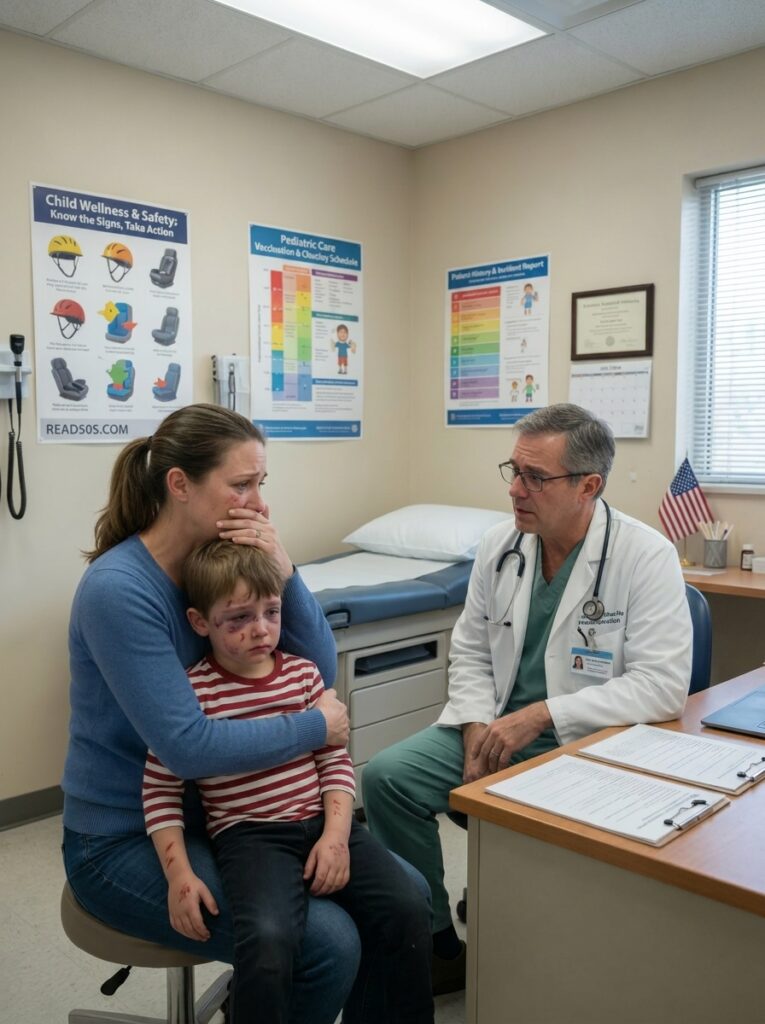
Dr. Reeves did not open the door.
He did not let Daniel back into the room.
Instead, he picked up the pen from the floor and placed it on the table near Noah, far enough that my son did not feel forced to take it.
Then he looked at me.
“Mrs. Carter,” he said quietly, “I need you to listen very carefully. From this moment on, we move slowly. We do not confront your husband in the hallway. We do not accuse him where your son can hear it. We keep Noah calm, and we keep him safe.”
Safe.
That word should have belonged to home.
It should have belonged to bedtime stories, warm blankets, small sneakers by the door, and a father’s arms.
Instead, it sat in that exam room like evidence.
I looked at Noah.
His little face was pale. His eyes were fixed on the door. His whole body seemed to be listening for Daniel’s footsteps.
I wanted to run to him.
I wanted to hold him and say I was sorry a thousand times.
But I was terrified that if I moved too fast, he would disappear back into that silence.
So I lowered myself to the floor a few feet away from him.
“Noah,” I whispered, my voice shaking, “Mama is here.”
His eyes moved to mine.
Only for a second.
But it was enough to undo me.
“I’m not leaving,” I said. “No matter what anyone told you. I am not leaving you.”
His bottom lip trembled.
He did not speak.
But he reached for the pen again.
This time, Dr. Reeves turned the clipboard slightly so Noah could write without showing the hallway.
Noah pressed the pen to the paper.
His letters were uneven.
Some were backwards.
Some were barely more than lines.
But the meaning was clear.
Daddy said quiet boys keep Mama.
I read the sentence once.
Then again.
My body went numb.
Dr. Reeves’s jaw tightened, but his voice stayed gentle.
“Noah,” he said, “did someone tell you Mama would go away if you talked?”
Noah nodded.
A tiny, careful nod.
“Did someone tell you that more than one time?”
Another nod.
My chest hurt so badly I could barely breathe.
The nurse quietly stepped out through a side door I had not noticed before. A minute later, she returned with another woman from the clinic. They spoke softly near the corner. I caught only a few words.
Protocol.
Safety.
Child protection.
Daniel was still in the hallway.
Waiting.
Watching.
I could feel him there like weather pressing against the walls.
My phone buzzed in Dr. Reeves’s hand.
Daniel again.
The screen lit up with his name.
Then a message appeared.
Why is the door closed?
Another one followed.
Open the door.
Then:
I need to see my son.
Noah saw the screen from across the room.
His small hands flew back to his mouth.
That was when I finally understood something I should have seen long before.
Noah was not silent because he had no words.
Noah was silent because someone had made words feel unsafe.
And somehow, while I was loving him, worrying over him, taking him to appointments, reading books, filling out forms, and crying in parking lots after every unclear diagnosis, Daniel had been standing beside me, making sure the truth never reached me.
Dr. Reeves turned the phone face down.
“We are going to call for assistance,” he said. “You do not need to handle this alone.”
My first instinct was shame.
Heavy, sick shame.
How had I missed it?
How had I slept beside a man who had placed that kind of fear inside our child?
How had I mistaken Noah’s silence for illness when his eyes had been telling me the truth every day?
Dr. Reeves seemed to read the guilt on my face.
“Mrs. Carter,” he said firmly, “children often hide fear to protect the parent they love most. This is not your failure. The important thing is what you do now.”
What you do now.
Those words saved me from falling apart.
Because falling apart was a luxury I did not have yet.
I crawled closer to Noah, still slowly, still careful.
This time, he did not move away.
I held out my hand.
He looked at it for a long moment.
Then he placed his tiny fingers inside mine.
It was the smallest gesture.
But it felt like the first door opening.
Outside, Daniel knocked.
Not loudly.
Just twice.
Controlled.
Polite.
The way he did everything when people were watching.
“Emily?” he called through the door. “What’s going on?”
Noah squeezed my hand so tightly his nails pressed into my skin.
Dr. Reeves answered, calm and professional.
“We need a few more minutes.”
Daniel laughed once.
It was a short sound with no humor in it.
“With my wife and son?”
“With my patient,” Dr. Reeves said.
There was silence.
Then Daniel’s voice lowered.
“Emily, open the door.”
I had heard that tone before.
Not often.
Never in public.
But I knew it.
It was the voice that made me apologize when I had done nothing wrong.
The voice that made me second-guess my own memory.
The voice that made the air in our house feel smaller.
I looked at Noah.
And for the first time, I wondered how many times he had heard that voice when I was not in the room.
The clinic staff moved quickly after that.
A security officer came to the hallway.
Another doctor joined Dr. Reeves.
Someone contacted the proper authorities.
Daniel’s knocking stopped once he realized other people were involved.
Through the small window, I saw his face change.
The concern vanished.
What replaced it was calculation.
He stepped back from the door, adjusted his jacket, and smiled at someone I could not see.
That smile chilled me more than anger would have.
When the door finally opened, Daniel tried to walk in.
The security officer stepped in front of him.
“Sir, we need you to remain in the waiting area.”
Daniel looked past him at me.
“Emily,” he said softly, almost tenderly, “come here. You’re upset. They’re confusing you.”
For five years, that voice had worked on me.
It made me doubt myself.
It made me explain away little things.
Why Noah hid behind me when Daniel entered a room.
Why he never reached for his father unless Daniel reached first.
Why Daniel insisted on being at every appointment.
Why Noah’s eyes always searched my face like he was trying to warn me without words.
But this time, Daniel’s voice did not pull me toward him.
It pushed me closer to my son.
“No,” I said.
It was one syllable.
It was not loud.
But it changed everything.
Daniel blinked.
“What did you say?”
I stood with Noah behind me, his small hand still locked in mine.
“I said no.”
His eyes moved to Noah.
For one terrifying second, my son stopped breathing.
Daniel smiled again.
“Buddy,” he said, “come here.”
Noah did not move.
Daniel’s smile tightened.
“Noah.”
My little boy shook so hard I felt it through his fingers.
Then, from behind my leg, he whispered:
“No.”
The room went still.
Daniel’s face changed so quickly that everyone saw it.
Not enough to be dramatic.
Not enough for strangers to call it proof.
But enough.
Enough for me.
Enough for Dr. Reeves.
Enough for the officer in the hallway to step closer.
Daniel looked at me, and in his eyes I saw the truth he had hidden behind fatherly concern and appointment folders.
He was not shocked that Noah could speak.
He was shocked that Noah had spoken where someone could hear him.
The next few hours blurred.
There were questions.
Gentle ones for Noah.
Hard ones for me.
A child advocate arrived with a calm voice and kind eyes. She explained every step before it happened. She never touched Noah without asking. She let him answer by pointing, nodding, writing, or whispering.
And piece by piece, the story came out.
Not all at once.
Not cleanly.
Children do not tell pain like adults do.
They tell it in fragments.
A sentence on paper.
A nod.
A whispered memory.
A drawing of a door.
Daniel had told Noah that if he talked, I would go away.
He told him doctors would take him from me.
He told him that quiet boys were loved and noisy boys ruined families.
He never needed to say much at once.
Just enough.
Often enough.
At the right age.
In the right tone.
Until my little boy believed silence was the price of keeping his mother.
When I heard that, something inside me broke so deeply it became steady.
I stopped crying.
I stopped shaking.
I looked at Noah, sitting with a blanket around his shoulders, and I made the only promise that mattered.
“You never have to stay silent to keep me,” I said. “You never had to earn my love. You already had all of it.”
Noah stared at me.
His eyes filled with tears.
Then he whispered the word I had waited five years to hear.
“Mama.”
I covered my mouth.
Not because I wanted him to stop.
Because if I made one sound, I thought my heart might break open in front of everyone.
He said it again, smaller this time.
“Mama.”
I dropped to my knees and opened my arms.
He came to me slowly, then all at once, pressing his face into my shoulder like he had been running toward me for years.
I held him while he cried.
Not loudly.
Not freely yet.
But enough.
Enough to be a beginning.
Daniel was not allowed to come home with us that day.
The clinic helped me contact my sister, Rebecca, who arrived in Boston within two hours with red eyes, a furious heart, and enough love to carry both of us when my own body felt empty.
We did not go back to the apartment that night.
We went to a hotel first.
Then to Rebecca’s house.
The next morning, with an officer present, I returned to collect Noah’s clothes, his stuffed dinosaur, his favorite blue cup, and the folder of medical records that suddenly looked less like a search for answers and more like proof of how carefully Daniel had controlled the story.
Daniel tried calling.
Then texting.
Then apologizing.
Then blaming me.
Then blaming stress.
Then saying Dr. Reeves had misunderstood.
Then saying Noah was confused.
But Noah was not confused.
For the first time, I was not confused either.
The legal process took time.
Real life does not wrap pain neatly in one day.
There were interviews, court dates, temporary orders, counseling appointments, and nights when Noah woke up sweating and reached for my hand before he remembered where he was.
But slowly, the world became larger for him.
At first, he only whispered in private.
One-word answers.
Juice.
Blue.
Mama.
No.
Then two words.
Stay here.
Light on.
Don’t go.
Every word felt like a tiny bird landing in my palm.
Fragile.
Alive.
Unbelievable.
Dr. Reeves stayed involved through the transition. He helped us find a child therapist who specialized in children who had learned fear before language could fully protect them.
She never pushed Noah to speak.
That was important.
She told me, “His voice belongs to him. Our job is to make the world safe enough for him to choose when to use it.”
So that was what we did.
We made safety boring.
Predictable.
Ordinary.
Breakfast at the same time.
Bedtime with the same story.
Doors left cracked open.
No sudden shouting.
No forced answers.
No one speaking for him unless he asked.
Rebecca’s house became our soft landing place. Her golden retriever, Max, became Noah’s first real friend there.
Max did not ask questions.
Max did not care if Noah spoke.
He just rested his head on Noah’s lap and waited.
One afternoon, about three months after the appointment, I stood in the kitchen making soup while Noah sat on the floor beside Max, lining up toy cars.
Rebecca was folding laundry at the table.
The house was quiet in a warm way, not an afraid way.
Then Noah looked at Max and said clearly, “You’re a good dog.”
The spoon slipped from my hand into the pot.
Rebecca froze with a towel in her hands.
Noah looked up, startled by our silence.
I forced myself to smile through tears.
“Yes,” I said gently. “He is.”
Noah looked back at Max.
Then he added, “He listens.”
Rebecca turned away and wiped her eyes with the towel.
I did not rush to praise him too loudly.
I had learned that sometimes healing needs room more than applause.
But that night, after Noah fell asleep with Max curled beside his bed, I went into the hallway and cried until my sister found me.
“Do you think he’ll be okay?” I asked her.
Rebecca held me the way I had held Noah.
“I think he already started,” she said.
She was right.
Healing did not mean forgetting.
It did not mean Noah suddenly became loud or fearless.
It meant he learned that fear was not in charge anymore.
It meant he could say “no” and still be loved.
It meant he could ask for the light to stay on without someone calling him difficult.
It meant he could laugh without checking the doorway first.
Six months after that day in Dr. Reeves’s office, Noah started kindergarten.
On the first morning, he wore a blue backpack almost bigger than his whole body. He held my hand outside the classroom door and stared at the children inside.
The teacher, Mrs. Alvarez, knelt to his level.
“Good morning, Noah,” she said. “You can wave, nod, whisper, or speak. Whatever feels okay today.”
Noah looked at me.
I squeezed his hand.
“You choose,” I whispered.
For a moment, he said nothing.
Then he lifted his small hand and waved.
Mrs. Alvarez smiled like that was more than enough.
I kissed the top of his head and stood to leave, even though every part of me wanted to stay.
Before I reached the hallway, I heard him.
Softly.
Clearly.
“Bye, Mama.”
I turned around.
He was still standing by the door, one hand gripping his backpack strap, eyes wide like he had surprised himself.
I smiled through tears.
“Bye, sweetheart,” I said. “I’ll be right here after school.”
And I was.
Every day.
Daniel’s consequences came through the proper channels, slowly but firmly. There were restrictions, evaluations, and a long record built from medical notes, testimony, messages, and Noah’s own careful disclosures.
I will not pretend justice healed everything.
It did not.
But distance helped.
Truth helped.
Safety helped.
And over time, Noah’s voice became part of our home.
Not constant.
Not forced.
But real.
He sang half a song while brushing his teeth.
He asked for pancakes on a rainy Sunday.
He told Rebecca that her soup needed more noodles.
He laughed at Max when the dog sneezed himself awake.
And one night, almost a year after the appointment, I tucked him into bed and reached for the lamp.
“Light on or off?” I asked.
He thought about it.
Then he said, “Off.”
I paused.
“Are you sure?”
He nodded.
Then, after a second, he added, “Door open.”
“Always,” I said.
I left the door halfway open and sat beside him in the dark.
For a while, we listened to the soft sounds of the house.
The heater.
The distant traffic.
Max breathing on the rug.
Then Noah turned toward me.
“Mama?”
My heart still reacted every time he said it.
“Yes, baby?”
“Was I bad?”
The question was so quiet I almost missed it.
I moved closer, careful not to let my pain become louder than his.
“No,” I said. “Never.”
“But I didn’t talk.”
I brushed his hair back from his forehead.
“You were trying to stay safe,” I said. “That is not being bad. That is being brave.”
He was quiet for a long time.
Then he whispered, “I wanted to.”
“I know.”
“I wanted to say Mama.”
The tears came before I could stop them, but I kept my voice steady.
“You can say it now whenever you want.”
He reached for my hand under the blanket.
“Mama,” he said.
I kissed his fingers.
“I’m here.”
He closed his eyes.
And for the first time in his life, my son fell asleep in the dark without covering his mouth.
That was when I understood the truth completely.
Noah’s first miracle was not that he spoke.
It was that he survived years of silence and still trusted love enough to try again.
And my miracle was not hearing his voice once.
It was earning the right to hear it every day after.
THE END.
- THEY LAUGHED WHEN MY SISTER RIPPED MY DAUGHTER’S LEG BRACE OFF —
 THEY LAUGHED WHEN MY SISTER RIPPED MY DAUGHTER’S LEG BRACE OFF — UNTIL HER SURGEON WALKED IN AND EXPOSED EVERYTHING Continue … Dr. Caldwell did not raise his voice. That …
 - PREGNANT WIFE MADE ONE CALL AFTER HER SISTER PUSHED HER DOWNSTAIRS
 Continue… For the first time that afternoon, my mother truly looked afraid. Not because I was bleeding. Not because her unborn grandson might be in danger. Because someone outside that …
 - GRANDMA SHAVED LEO’S CURLS BEHIND HIS MOM’S BACK. THEN SUNDAY DINNER EXPOSED THE TRUTH
 Continue… Sunday dinner at Brenda’s house smelled like roast beef, rosemary, and the kind of family tension everyone pretends is normal because the table has been set nicely. The whole …
 - HER DAUGHTER WORE A SWEATER IN THE HEAT, THEN THE BRUISES SPOKE
 Continue… Nathan did not answer. That was answer enough. For one long second, I listened to the silence on the other end of the phone. My husband. The man who …
 - MY SON CALLED FROM HOME. THEN MY BROTHER BROKE DOWN THE DOOR
 Continue… The sound of Marcus shouting my son’s name nearly tore the steering wheel from my hands. “Marcus!” I yelled. “What do you see?” There was a crash. Then another. …