Daniel’s fingers closed around the phone.
For the first time since I had known him, the smoothness cracked.
Not completely.
Men like Daniel do not collapse all at once.
They fracture in private first, then pretend the sound came from someone else.
“This is absurd,” he said. “She’s medicated. She doesn’t know what she’s saying.”
Anna’s voice was barely more than breath.
“I’m not medicated enough to forget.”
The hallway went silent.
Ellis moved closer to the bed, careful not to block her view of me.
“Anna,” he said gently, “are you saying there is evidence on that phone?”
She nodded once.
Pain crossed her face.
“Yes.”
Daniel lifted the phone slightly.
“This is my property.”
A security officer stepped forward.
“No, sir. If that device contains evidence related to an injury investigation, you need to hand it over.”
Daniel looked at me.
His eyes were no longer amused.
They were sharp now.
Threatening.
“You’re making a terrible mistake, Margaret.”
I smiled faintly.
That was the first time he looked truly afraid.
Because I was not afraid of him.
Not anymore.
“No,” I said. “The terrible mistake was believing my daughter would never speak.”
Daniel turned toward the exit.
The second security officer blocked him.
“Sir,” he said, “do not leave.”
Daniel’s voice rose.
“I came here to help my wife.”
Anna flinched again.
This time, everyone saw it.
The social worker stepped closer to her bed.
“Anna,” she asked softly, “do you feel safe with him in the room?”
Anna closed her eyes.
For one second, I thought she had gone back inside the place fear builds when the world becomes too dangerous.
Then she opened her good eye and looked directly at Daniel.
“No.”
One word.
Soft.
Shaking.
But final.
Security escorted Daniel away from the trauma bay while Ellis contacted the police.
Daniel did not shout until he reached the double doors.
Then the mask finally fell.
“You’ll regret this!” he yelled. “All of you!”
The doors closed.
And my daughter began to cry.
Not loudly.
Not dramatically.
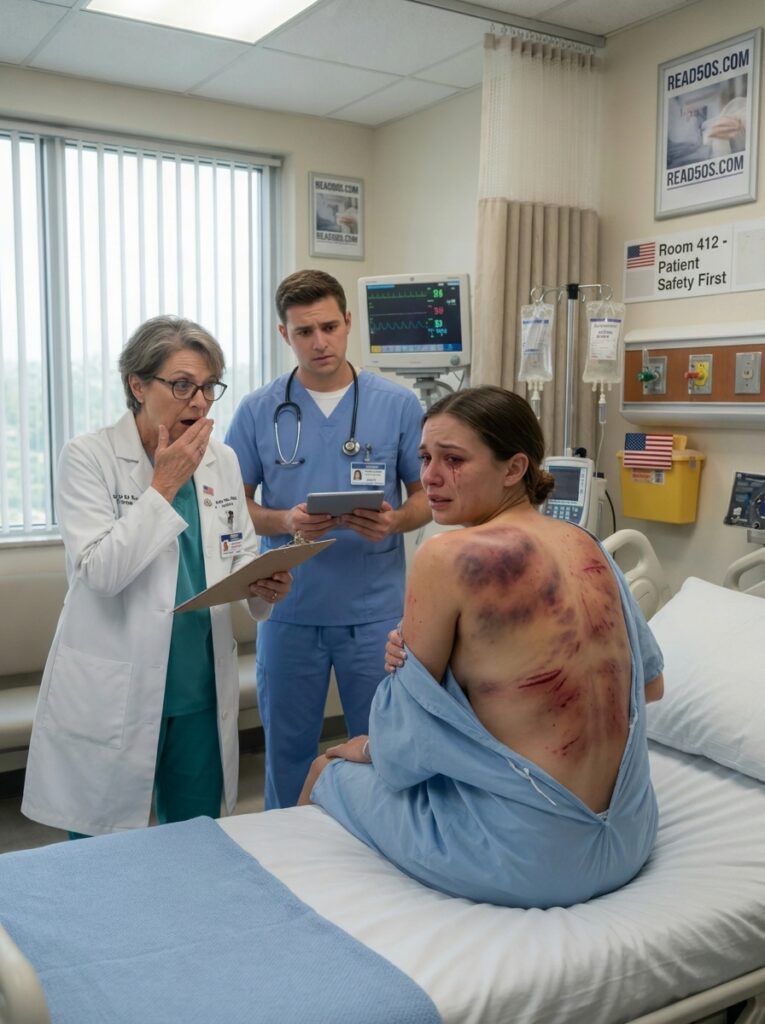
Just a broken, silent shaking that moved through her entire body while she tried not to disturb the injuries on her back.
I sat beside the bed and held the hand Daniel had not broken.
“I’m here,” I whispered.
Anna looked like a child again.
“Mom,” she said, “I tried to leave.”
“I know.”
“You don’t know everything.”
“I don’t need to know everything tonight.”
She shook her head slightly.
“You need to know the phone.”
A police officer arrived twenty minutes later with a female detective named Harris.
Daniel’s phone had been secured by hospital security before police took possession of it. He had protested, threatened legal action, and claimed his wife was unstable.
But the phone was no longer in his hand.
That mattered.
Detective Harris came into the room quietly, without the heavy boots and loud voice I had expected.
She introduced herself to Anna first, not to me.
That mattered too.
“I’m not here to force you to talk,” she said. “But if you want to tell me what’s on the phone, I’ll listen.”
Anna stared at the blanket.
“He records after,” she whispered.
Detective Harris’s face did not change, but her pen stopped moving for half a second.
“After what?”
Anna swallowed.
“After he hurts me. He makes me say I fell. He says if I can say it on video, then no one can call me a liar later because I already said it myself.”
The nurse beside the monitor turned away.
Ellis closed his eyes.
My hands went cold.
Anna continued.
“There’s a hidden folder. He thinks I don’t know the passcode, but I watched him once in the mirror. I wrote it down and hid it behind the bathroom vent.”
“You remembered it?” Detective Harris asked.
Anna nodded.
Then she whispered the numbers.
The officer standing near the door wrote them down.
Daniel had carried the proof of his own cruelty because arrogance made him careless.
He had believed control was the same as intelligence.
He had believed fear was permanent.
He had believed wrong.
The police reviewed enough of the phone that night to move quickly.
I did not watch the videos.
I refused.
Not because I was weak.
Because my daughter was not evidence to me.
She was Anna.
The little girl who once slept with both hands under her cheek.
The teenager who cried when her father died.
The woman who had sat at my dinner table three hours earlier moving peas around her plate while her husband explained her exhaustion to me.
Detective Harris watched what she needed to watch.
When she came back, her expression was different.
Not shocked.
Resolved.
“That phone contains material we can use,” she said. “More than one incident. Dates. Times. His voice. Her statements.”
Anna closed her eyes.
“He made me say I was clumsy.”
“I know,” the detective said.
“He said no one would believe me.”
Detective Harris looked at Daniel’s phone sealed in the evidence bag.
“They will now.”
By dawn, Daniel had been taken into custody.
He tried to charm the officers at first.
Then he claimed Anna had injured herself.
Then he said the videos were “private marital issues.”
Then he accused me of manipulating her.
Men like Daniel often keep several lies ready, like clean shirts in a drawer.
They change into whichever one seems most useful.
But this time, the body map was time-stamped.
The photos were clear.
The hospital staff had witnessed his behavior.
Anna’s statement was documented.
And the phone had more truth than he could talk over.
When sunrise touched the hospital windows, Anna was moved to a private room under protective status.
The hospital placed an alert on her chart.
No visitors without her approval.
No phone calls transferred from Daniel.
No discharge to anyone but Anna’s chosen contact.
She chose me.
The nurse asked gently, “Are you sure?”
Anna looked at me.
For a second, I saw the shame rise in her face.
Not shame for what Daniel had done.
That shame was his.
But the shame people feel when they realize how long they have been surviving something they were told was normal.
Then she nodded.
“My mother,” she said.
I stepped into the hallway and finally let my knees weaken.
Ellis found me beside the vending machine, one hand braced against the wall.
“You held together well,” he said.
I laughed once.
It sounded empty.
“No. I postponed falling apart.”
He stood beside me.
We had lost patients together.
Saved patients together.
Made impossible decisions under fluorescent lights together.
But nothing in forty years of surgery had prepared me for seeing my daughter’s pain and knowing I had once served dinner to the man who caused it.
“I gave him a key,” I said.
Ellis did not answer too quickly.
That was why I trusted him.
Then he said, “He is responsible for what he did with the door you opened.”
I wanted that to be enough.
It was not.
But it was something to hold.
Over the next few days, Anna told the truth in pieces.
That is how truth comes out when someone has been trained to hide it.
Not as one clean story.
As fragments.
The first time he grabbed her arm.
The first apology.
The flowers.
The tears.
The way he cried harder than she did.
The first time he took her phone “for her own good.”
The first winter she wore long sleeves indoors.
The first dinner where I noticed she kept looking at him before answering.
The first time he told her, “Your mother is old. Don’t stress her with your drama.”
That sentence cut me deeply.
Because it had worked.
Anna had protected me from the truth while Daniel used my age as a wall between us.
“I thought you couldn’t handle it,” Anna whispered.
I sat beside her bed.
“I held hearts in my hands for forty years,” I said. “But you are right. This hurt more.”
Her face crumpled.
“I’m sorry.”
“No,” I said firmly. “You do not apologize for surviving.”
The legal process was not quick.
Real justice rarely moves at the speed of pain.
There were statements.
Protective orders.
Medical reports.
Forensic analysis of the phone.
Court hearings.
Daniel’s attorney tried to paint him as a stressed husband and Anna as unstable.
Then the videos were authenticated.
Then the hospital photographs were entered.
Then the social worker testified.
Then Ellis explained the difference between accidental injury and repeated harm with the calm precision of a surgeon discussing anatomy.
When I testified, Daniel would not look at me.
That was wise of him.
The prosecutor asked what I had observed.
I did not dramatize.
I did not cry.
I described the injuries the way I would describe a surgical field.
Location.
Age variation.
Pattern.
Consistency with repeated harm.
Inconsistency with a simple fall.
At one point, Daniel’s attorney asked if my emotions as a mother might have affected my interpretation.
I looked at him.
Then at the judge.
“My emotions did not create old bruising beneath new bruising,” I said. “My grief did not create finger-shaped marks. My anger did not make a burn appear near her shoulder. Her body told the truth before any of us spoke.”
The courtroom went very quiet.
Daniel stared at the table.
For once, there was no smile left for him to wear.
He was held accountable.
Not perfectly.
Nothing about the process felt perfect.
But enough that Anna did not have to go home with him.
Enough that the locks were changed.
Enough that the law finally put distance between his voice and her sleep.
After the first hearing, I brought Anna to my house.
The spare bedroom faced the garden.
I changed the curtains from heavy maroon to soft blue because she said the room felt too dark.
For the first week, she slept with the lamp on.
For the second, she slept with the door open.
For the third, she woke at two in the morning and found me in the kitchen making tea.
“You don’t have to stay awake,” she said.
I poured water into the cup.
“Neither do you.”
She sat across from me, wrapped in a blanket.
For a while, we listened to the refrigerator hum.
Then she said, “I keep thinking I should have left sooner.”
I sat down slowly.
“Anna, people think leaving is a door. It’s not. It’s a bridge. And sometimes the person hurting you has spent years removing every board.”
She looked at me.
“He said no one would believe me.”
“I believe you.”
“He said I was weak.”
“You survived him.”
“He said I ruined his life.”
“He chose his life every time he hurt you.”
Her eyes filled.
“What if I still miss who I thought he was?”
That was the hardest question.
Because it was honest.
I reached across the table and took her hand.
“Then we mourn that person too,” I said. “But we do not confuse grief with permission to return.”
Healing came slowly.
It came in doctor appointments.
In physical therapy.
In quiet panic attacks when someone laughed too loudly on television.
In the first day Anna wore a short-sleeved shirt in the garden and did not cover her arms when the neighbor waved.
It came when she replaced the phone Daniel had controlled.
It came when she changed her name back to Anna Hale.
It came when she began volunteering at a women’s shelter twice a month, not to tell other women what to do, but to sit beside them while they remembered they were not crazy.
One afternoon, nearly a year after that night, Anna came with me to St. Catherine’s for a charity luncheon.
She wore a green dress with an open back.
Not because the scars were gone.
Some were faint.
Some remained.
But because she wanted to choose what the world saw.
Ellis saw her from across the room and stopped for half a second.
Then he smiled.
Not with pity.
With respect.
Anna touched my arm.
“Do you think people are looking?”
“Yes,” I said honestly.
She stiffened.
Then I added, “Because you look beautiful.”
She breathed out slowly.
And smiled.
Later that evening, we sat in my kitchen while rain tapped against the same window it had struck the night of the call.
The brass clock clicked in the hallway.
The table smelled faintly of lemon oil.
For a moment, everything was exactly the same.
And nothing was.
Anna stirred honey into her tea.
“I used to think you were too strong to need me,” she said.
I smiled sadly.
“I used to think you were too gentle to be in danger.”
We sat with that.
Two women who had loved each other deeply and still missed the truth standing between them.
Then Anna reached across the table.
I took her hand.
No apology.
No explanation.
Just contact.
Safe contact.
The kind Daniel had tried to turn into fear.
“Mom,” she said softly.
“Yes?”
“Thank you for seeing it.”
My throat tightened.
“I should have seen it sooner.”
She shook her head.
“You saw it when I was ready to let you.”
I looked at my daughter.
At the woman she had always been beneath the fear.
Kind.
Wounded.
Alive.
Still here.
That was the part Daniel had never understood.
He thought he had written his power across her body.
But he had not written the ending.
One year later, the evidence file from St. Catherine’s sat in a sealed archive.
The phone was no longer in his hand.
The house key I had given Daniel had been melted down and remade into a small pendant Anna wore under her dress.
Not as a memory of him.
As proof that doors could be reclaimed.
I am still a retired surgeon.
My hands are older now.
They shake sometimes when I hold a teacup too long.
But if there is one thing forty years in medicine taught me, it is this:
A wound is not healed because someone covers it.
A wound heals when it is cleaned, named, protected, and given time.
My daughter’s back exposed the lie.
But her voice saved her life.
And the night Daniel smiled under hospital lights, thinking he could explain away the truth, he forgot one thing.
Bodies remember.
Mothers notice.
And sometimes, the quiet old woman in the hallway is exactly the person you should have feared most.
The End.
- ON MY WEDDING DAY, I SHOWED UP WITH A BRUISED EYE… THEN MY FIANCÉ SMILED AND SAID, “IT’S SO SHE LEARNS”
 On the morning of her wedding, Valeria Salgado stood in front of the bridal suite mirror with concealer layered over her cheekbone and her swollen left eye. The makeup artist …
 - MY HUSBAND LEFT ME IN LABOR FOR HIS CAREER — BUT THE NEIGHBOR HE MOCKED BECAME THE ONE WHO SAVED US
 “I can’t pause my career for a hypothetical,” Ryan said, checking his passport while I sat doubled over on the sofa. I stared at him, one hand pressed against my …
 - CUT OFF MY ARM! THE BOY BEGGED THROUGH TEARS — HIS FATHER THOUGHT HE WAS LOSING HIS MIND UNTIL THE NANNY BROKE THE CAST AND FOUND THE TRUTH
 PART 1 “If you don’t stop screaming right now, I swear I’ll call the doctor first thing tomorrow and have you taken somewhere they can control this behavior.” Alejandro’s voice …
 - AT MY WEDDING, MY PARENTS CHOSE MY SISTER’S RICH HUSBAND OVER ME… THEN THE CHAPEL DOORS OPENED AND THEY LEARNED WHO MY FIANCÉ REALLY WAS
 The first thing I noticed was the sound. Crystal glasses clinking somewhere deep inside the steakhouse private room while I sat alone in a bathroom stall at my own rehearsal …
 - A 65-YEAR-OLD WOMAN THOUGHT SHE WAS FINALLY PREGNANT… BUT WHEN LABOR BEGAN, THE DOCTOR SAW SOMETHING THAT LEFT HIM SPEECHLESS
 At 65 years old, Margaret Hale saw two bold lines on a pregnancy test. For several seconds, she simply stood in the bathroom, staring at it. The window was open …