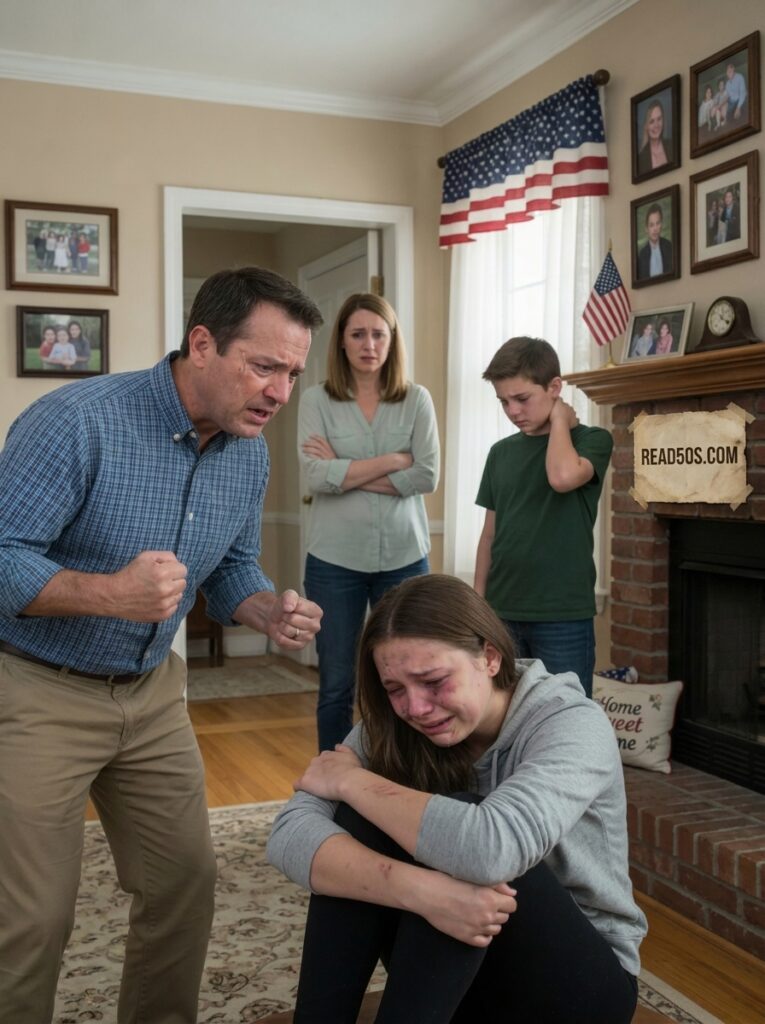
Mark stared at the phone in my hand.
For a moment, he looked like a boy who had been caught stealing, not a grown man standing over the woman he had promised to protect.
Then his face changed.
The fear slipped back behind something smoother.
Something rehearsed.
“She’s confused,” he said. “She gets emotional. She started recording because she wanted to make everyone look bad.”
Emily flinched at his voice.
That told me more than his words ever could.
Linda stepped forward quickly.
“She’s been unstable for weeks,” she said. “We were trying to calm her down. You don’t understand what it’s like living with someone who turns every disagreement into a scene.”
I stood slowly, keeping the phone in my hand and my body between Emily and the rest of them.
“Funny,” I said. “Nobody said anything about a disagreement until I found her on the floor.”
Mark’s jaw tightened.
“You’re trespassing.”
“My daughter called me.”
“This is my parents’ house.”
“And this is now a 911 call.”
I pressed the screen and dialed.
Linda’s eyes widened.
“No, no, there is no need for that.”
I looked at her while the call connected.
“There was need the moment you tried to keep me outside.”
The dispatcher answered.
I gave the address.
I gave my name.
I said my adult daughter was injured, on the floor, possibly being prevented from leaving, and that there was video evidence on her phone.
Mark’s hands came out of his pockets.
“Nobody prevented her from leaving,” he snapped.
The dispatcher asked, “Sir, is anyone armed?”
Before I could answer, Mark said, “Nobody touched her.”
Nobody had asked him that.
The room heard it.
Robert slowly lowered himself back into the armchair like his legs had stopped working.
Allison covered her mouth with one hand.
Linda whispered, “Mark.”
Just his name.
But in that one word was panic.
The kind that comes when the lie does not fail from the outside, but from someone inside it speaking too soon.
I gave the dispatcher the rest of the details, then stayed on the line.
Emily’s breathing was shallow.
I crouched beside her again.
“Can you stand?”
She shook her head.
“My side hurts.”
That sentence took the last bit of restraint I had and tested it hard.
I wanted to turn around.
I wanted to grab Mark by the collar and slam him into the perfect beige wall until every framed vacation photo fell.
But Emily needed a father, not an explosion.
So I swallowed the fire.
“You’re doing good, Em,” I said. “Just keep breathing.”
Her eyes filled.
“I tried to leave.”
“I know.”
“They took my keys.”
Linda’s voice cut through the room.
“That is not true.”
Emily looked at her mother-in-law, and something in her face changed.
The fear was still there.
But beneath it, something older woke up.
Anger.
“Yes, it is,” Emily whispered.
Linda’s mouth tightened.
“Emily, stop this right now.”
I turned toward Linda.
“You do not give my daughter orders.”
For once, Linda had no answer.
Police arrived six minutes later.
Paramedics arrived right behind them.
Six minutes sounds short when you say it later.
Inside that room, with my daughter curled against the wall and four Wilsons watching the door like judgment itself was walking up the steps, it felt like an hour.
The first officer entered carefully, one hand near his belt, eyes moving over everyone.
A second officer followed.
Then the paramedics.
“Who called?” the officer asked.
“I did,” I said.
Mark immediately stepped forward.
“Officer, this is a misunderstanding. My wife had a panic episode. Her father forced his way into my parents’ home and escalated everything.”
The officer looked at me.
Then at Emily.
Then at the phone in my hand.
“Sir, please hand me the device.”
I hesitated for half a second.
Emily reached toward me.
“It’s okay,” she whispered. “Give it to them before he deletes it.”
Mark’s face drained.
That was the second mistake.
The officer noticed.
He took the phone, asked Emily if he had permission to view the draft, and waited until she nodded.
That mattered.
For the first time that night, someone asked Emily instead of speaking over her.
The officer watched the video for only ten seconds before his expression hardened.
Then he handed the phone to his partner.
“Separate them,” he said.
Mark’s voice sharpened.
“Separate who?”
“You from her.”
Linda moved toward Mark.
“Officer, you don’t understand. Emily has been causing problems in this family for months.”
The officer turned to her.
“Ma’am, step back.”
Linda’s mouth opened.
No words came.
She was not used to being spoken to like someone without authority.
The paramedics reached Emily.
One of them knelt beside her.
“Hi, Emily. My name is Carla. I’m going to check you, okay? Can I touch your arm?”
Emily nodded.
Carla moved gently, carefully, explaining every step before she did it.
The second paramedic asked me to give them space, but Emily reached for my sleeve.
“Dad, don’t go.”
“I’m not going anywhere.”
So I stayed by her head while they checked her wrist, ribs, and breathing.
When Carla lifted the torn edge of Emily’s sweater just enough to examine the side she had been protecting, her face changed.
Professional.
Controlled.
But changed.
“We need transport,” she said.
Mark spoke quickly.
“She fell into the coffee table.”
Robert looked at him.
It was the first time I saw doubt on the old man’s face.
Not mild doubt.
The kind that arrives too late and realizes it has been sharing a house with truth for years.
“She fell?” Robert asked quietly.
Mark turned on him.
“Dad, stay out of this.”
Robert looked at Emily on the floor.
Then at Linda.
Then at the spilled coffee beside his chair.
His hand trembled.
“What happened before he got here?”
Linda’s face hardened.
“Robert, not now.”
But Robert did not look away from her.
“What happened?”
Allison made another small sound from the stairs.
The officer turned toward her.
“Ma’am, do you have something to say?”
Allison looked at Mark.
Mark’s eyes warned her.
That was when I understood the video was not the only thing in that house.
There were witnesses.
Not brave ones.
Not innocent ones.
But witnesses all the same.
Allison’s arms dropped to her sides.
Her voice was barely audible.
“She tried to leave after dinner.”
Mark took a step toward her.
The officer blocked him immediately.
Allison began crying, but she kept talking.
“She said she wanted to go to her dad’s. Mark took her keys. Mom said wives don’t run to their fathers every time marriage gets hard.”
Linda snapped, “Allison.”
But the room had shifted.
The private family matter was no longer private.
Allison looked at the officer.
“Emily tried to call him from the bathroom. Mark took the phone. She grabbed it back later. That’s why she was recording.”
Emily closed her eyes.
Tears slid into her hairline.
Robert slowly set his mug down with both hands.
“Linda,” he whispered, “you told me she slipped.”
Linda’s face went flat.
“She was hysterical. Someone had to control the situation.”
“That’s what you call this?” I asked.
She looked at me with hatred sharp enough to cut.
“You don’t know what she has done to our family.”
“My daughter being hurt is not your family’s reputation problem.”
The officer asked everyone to stop speaking.
Then he knelt beside Emily.
“Emily, do you want to make a statement?”
Her eyes flicked to Mark.
Then to Linda.
Then to me.
I wanted to answer for her.
Every fatherly instinct in my body screamed to carry the whole burden myself.
But this was her voice.
Her life.
Her bridge out.
So I said only, “I’m right here.”
Emily swallowed.
“Yes,” she whispered. “I want to make a statement.”
Mark was taken outside first.
He did not go quietly.
Not loudly enough to look guilty to the neighbors, but with controlled outrage.
He told the officers he was being falsely accused.
He told them Emily had “mental health issues.”
He told them I had always hated him.
He told them his family would sue.
Men like Mark do not run out of lies.
They only run out of people willing to believe them.
Linda tried one last time as paramedics lifted Emily onto a stretcher.
“She is my daughter-in-law,” she said, stepping toward the door. “I should ride with her.”
Emily’s hand shot out and grabbed mine.
“No.”
One word.
Tiny.
Terrified.
Final.
Carla, the paramedic, looked at Linda.
“She said no.”
Linda’s face turned red.
“I am family.”
I looked at my daughter on that stretcher.
Then at Linda.
“Not anymore.”
At the hospital, the truth came out in pieces.
That is how it happens when someone has been trained to survive.
Not one clean story.
Not a speech.
Fragments.
Mark had been controlling her calls.
Linda had been telling her that marriage required obedience.
They had taken her keys more than once.
They had called her dramatic, unstable, ungrateful.
They had told her if she ever involved me, they would make sure everyone believed she was the problem.
The video from 3:51 a.m. showed enough.
It showed Mark blocking the hallway while Emily begged for her phone.
It showed Linda standing beside him, arms crossed, telling Emily to stop embarrassing the family.
It showed Emily trying to move past him.
It showed the moment she fell.
It showed the moment nobody helped her.
Not at first.
Not until they realized she was still recording.
The voicemail on my phone caught Mark saying, “Give me the phone.”
The call log showed the time.
The emergency recording captured my arrival.
The officer’s body camera captured Linda’s attempt to explain.
Piece by piece, the private family matter became evidence.
Emily had two bruised ribs, a sprained wrist, and enough fear in her eyes that the attending physician asked a social worker to stay with her.
When the nurse asked who Emily wanted as her emergency contact, she looked at me.
“My dad.”
I looked away because I did not want her to see me cry.
The next morning, Robert came to the hospital.
I saw him through the glass before he came in.
He looked smaller than he had in the armchair.
Older.
He asked the nurse if he could speak to Emily.
The nurse asked Emily.
Emily said yes, but only if I stayed.
Robert entered holding his hat in both hands.
He did not come close to the bed.
“I’m sorry,” he said.
Emily stared at him.
He swallowed.
“I heard things. Saw things. I let Linda explain them away. I told myself Mark would never…” His voice broke. “I told myself a lot of things because they were easier than admitting what was in my own house.”
Emily did not comfort him.
I was proud of her for that.
Robert looked at me.
“I gave the police my statement.”
Linda had not.
Allison had.
By afternoon, protective orders were being discussed.
By evening, Mark’s version of the night had already begun to collapse.
The video.
The voicemail.
Allison’s statement.
Robert’s statement.
The missing keys found in Linda’s purse.
That detail nearly made me sit down when the officer told us.
Emily’s keys had been in Linda’s purse the entire time.
Linda claimed she had taken them “for safety.”
The officer wrote it down without expression.
Sometimes a person’s own explanation does the work for you.
Emily came home with me two days later.
Not to the apartment she had shared with Mark.
Not to the Wilson house.
To my place.
The house she grew up in.
The house where her mother’s recipe cards still sat in a wooden box near the stove.
The house where I had measured her height on the pantry door until she was sixteen and said it was embarrassing.
The first night, she slept in her old room with the door open and the lamp on.
I slept in the recliner in the hallway.
She found me there at 3:00 a.m.
“Dad,” she whispered.
I sat up fast.
“What? Are you hurting?”
She shook her head.
Then her face crumpled.
“I don’t know how to sleep without listening for footsteps.”
That sentence took something from me I will never get back.
I stood, wrapped a blanket around her shoulders, and made tea neither of us drank.
We sat at the kitchen table until sunrise.
She told me more in the thin gray light.
How Mark had started gently.
Calling too often.
Wanting to know where she was.
Saying my influence made her childish.
Saying a wife should not run to her father.
Saying Linda understood marriage better than a widower like me ever could.
How Linda had taken over decisions in their home.
Money.
Meals.
Visits.
Doctor appointments.
Holidays.
How every time Emily pushed back, Mark became colder, and Linda became sweeter in public.
“They made me feel like I was the storm,” Emily said. “Like peace only existed if I disappeared.”
I reached across the table.
I did not grab her hand.
I placed mine palm-up near hers.
She looked at it for a long moment.
Then she rested her fingers over mine.
“You are not the storm,” I said. “You are the person who finally opened the windows.”
Healing did not happen quickly.
The legal process moved in slow, exhausting steps.
Interviews.
Paperwork.
Court dates.
Medical follow-ups.
Requests for records.
Mark’s attorney tried to say Emily had exaggerated.
Linda tried to say she had been protecting her son’s marriage.
Allison testified that Emily had been blocked from leaving.
Robert testified that he had heard Linda tell Mark to take the phone.
The video testified louder than all of them.
In court, Mark kept looking at Emily as if eye contact could still control her.
But she did not look back.
She looked at the judge.
She spoke clearly.
And when her voice shook, she kept going.
I sat behind her, hands folded, trying not to shake with rage.
Not because rage was gone.
Because it had learned discipline.
A father’s fury can burn a world down.
But sometimes, the better fire is the one that lights the way out.
Mark was held accountable.
Linda faced consequences too, especially after the evidence showed she had taken Emily’s keys and tried to prevent her from leaving.
No sentence, no order, no courtroom phrase could undo the night I found my daughter on the floor.
But the law finally put something between Emily and the Wilsons that they could not smile through.
Distance.
Enforced distance.
Real distance.
Months later, Emily moved into a small apartment near my house.
The first thing she bought was a red kettle.
I asked why.
She shrugged.
“Because Mark hated red.”
That was the beginning of her coming back to herself.
Not in one grand moment.
In small choices.
Red kettle.
Yellow curtains.
A haircut Linda would have called too short.
A phone passcode no one else knew.
Dinner with me every Sunday.
Laughing without looking toward the doorway.
One afternoon, nearly a year after that night, Emily came over carrying a cardboard box.
Inside were the last things from her old life.
A wedding photo.
A set of keys.
A cream cardigan Linda had once given her.
And the phone.
The same phone.
The one she had held on the floor like it was the last thing in the world that still belonged to her.
“I don’t need to keep this anymore,” she said.
I looked at it.
The screen was cracked near the corner.
The case was scratched from where it must have hit the floor.
“What do you want to do with it?”
She thought for a moment.
“Save the evidence file. Then erase the rest.”
So we did.
Together.
The legal copy remained where it needed to remain.
But the phone itself no longer had to carry that night inside it.
Afterward, we sat on the porch while the evening turned gold.
Emily leaned back in the chair, eyes closed, face lifted toward the wind.
For the first time in a long time, she looked like someone resting instead of hiding.
“Dad?” she said.
“Yeah?”
“Do you ever feel guilty?”
I did not pretend not to understand.
“Every day.”
She opened her eyes.
“You came when I called.”
“I should have known before you had to.”
She shook her head.
“They worked really hard to make sure you didn’t.”
The truth of that settled between us.
Then she reached over and squeezed my hand.
“You didn’t leave quietly.”
I looked at her.
At my daughter.
Not broken.
Not erased.
Still healing, yes.
Still carrying nights no father could undo.
But alive.
Free.
Herself again.
“No,” I said. “I didn’t.”
That night, after Emily went home to her own apartment with her red kettle and yellow curtains, I stood in my hallway and looked at the framed photo of her as a child.
Pigtails.
Missing front tooth.
Mud on her shoes.
Back then, I thought protecting her meant holding her hand when she crossed the street.
Checking under the bed.
Making sure she wore a helmet.
I did not know protection would someday mean standing in a stranger’s living room at 4:00 a.m., listening to polished people lie while my daughter shook on the floor.
But I know this now.
When someone says, “It’s a private family matter,” look for the person who is not allowed to speak.
When someone blocks a door, ask who they are trying to keep inside.
And when your child calls in the dark and says, “Please come get me,” you do not ask whether it is convenient.
You go.
Because sometimes one answered call is the difference between a lie surviving another night and the truth finally getting out.
The End.
- THEY LAUGHED WHEN MY SISTER RIPPED MY DAUGHTER’S LEG BRACE OFF —
 THEY LAUGHED WHEN MY SISTER RIPPED MY DAUGHTER’S LEG BRACE OFF — UNTIL HER SURGEON WALKED IN AND EXPOSED EVERYTHING Continue … Dr. Caldwell did not raise his voice. That …
 - PREGNANT WIFE MADE ONE CALL AFTER HER SISTER PUSHED HER DOWNSTAIRS
 Continue… For the first time that afternoon, my mother truly looked afraid. Not because I was bleeding. Not because her unborn grandson might be in danger. Because someone outside that …
 - GRANDMA SHAVED LEO’S CURLS BEHIND HIS MOM’S BACK. THEN SUNDAY DINNER EXPOSED THE TRUTH
 Continue… Sunday dinner at Brenda’s house smelled like roast beef, rosemary, and the kind of family tension everyone pretends is normal because the table has been set nicely. The whole …
 - HER DAUGHTER WORE A SWEATER IN THE HEAT, THEN THE BRUISES SPOKE
 Continue… Nathan did not answer. That was answer enough. For one long second, I listened to the silence on the other end of the phone. My husband. The man who …
 - MY SON CALLED FROM HOME. THEN MY BROTHER BROKE DOWN THE DOOR
 Continue… The sound of Marcus shouting my son’s name nearly tore the steering wheel from my hands. “Marcus!” I yelled. “What do you see?” There was a crash. Then another. …