THEY LAUGHED WHEN MY SISTER RIPPED MY DAUGHTER’S LEG BRACE OFF — UNTIL HER SURGEON WALKED IN AND EXPOSED EVERYTHING
Continue …
Dr. Caldwell did not raise his voice.
That somehow made the room more frightening.
He crossed the dining room with the calm speed of a man who had spent his life walking toward emergencies while everyone else froze.
“Move back,” he said.
Caroline blinked.
“I didn’t—”
“Move back,” he repeated.
This time, something in his tone made her obey.
I knelt beside Mia, every instinct screaming at me to lift her into my arms.
But Dr. Caldwell’s warning held me still.
Mia was crying so hard she could barely breathe.
Her small hands clutched her knee.
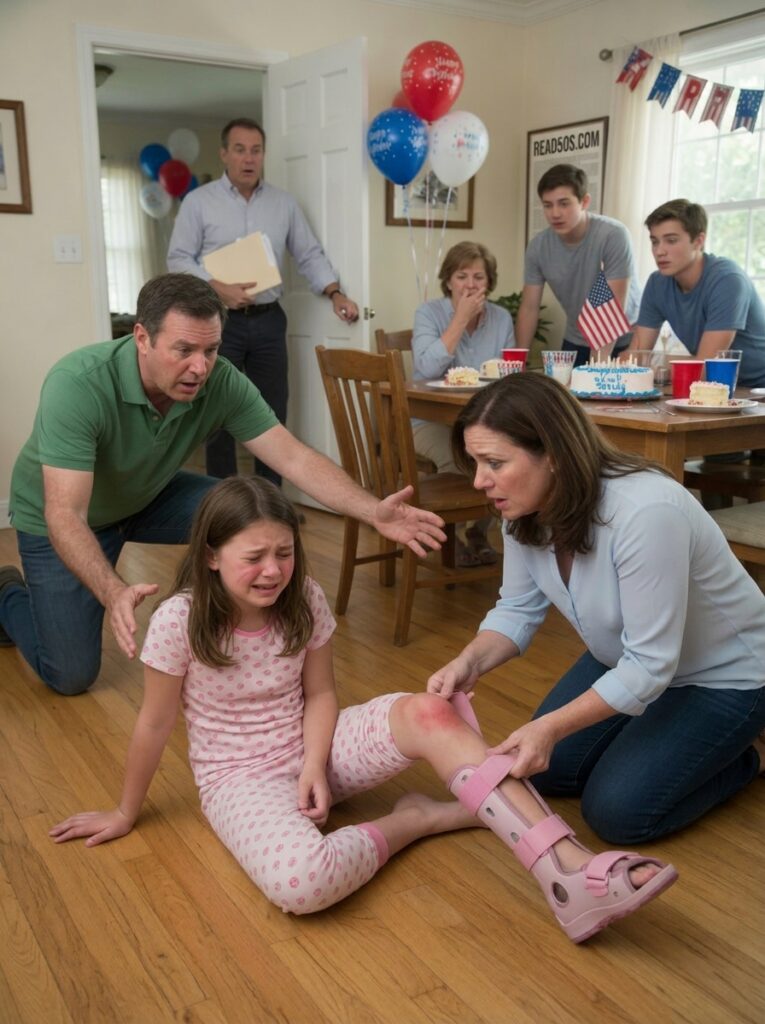
Her brace hung open, one strap twisted, the hinge sitting wrong against her leg.
“Daddy,” she sobbed. “It hurts.”
“I know, baby,” I whispered. “I’m right here. I’m not moving.”
Dr. Caldwell crouched beside her.
His face changed when he looked at her knee.
Not panic.
Not fear.
Something worse.
Recognition.
“Mia,” he said gently, “it’s Dr. Caldwell. I need to check your leg without moving it too much, okay?”
She tried to nod.
Her tears soaked the sides of her face.
He looked at me.
“Call 911.”
My mother gasped.
“Oh, come on. Isn’t that a little dramatic?”
Dr. Caldwell did not even look at her.
“Call 911,” he repeated.
I already had my phone in my hand.
My fingers shook so badly I almost missed the numbers.
The dispatcher answered.
I gave the address.
I said my six-year-old daughter had been injured after someone removed her prescribed brace and caused her to fall.
Caroline made a sharp sound.
“I did not cause anything.”
Dr. Caldwell looked up at her then.
Everyone saw his face.
Everyone stopped pretending.
“You forcibly removed a post-operative brace from a child recovering from reconstructive knee surgery,” he said. “Then she fell.”
Caroline’s mouth opened.
Nothing came out.
My father stepped forward.
“Doctor, this is a family matter. She’s always been a little sensitive.”
Dr. Caldwell stood slowly.
“Mr. Bennett, your granddaughter is not sensitive. She is recovering from surgery.”
My father’s face hardened.
“We don’t need a lecture in my house.”
“No,” Dr. Caldwell said. “You need an ambulance.”
Aunt Diane shifted in her chair.
The laughter had drained from the room now, leaving behind something sour.
Shame, maybe.
Or fear of witnesses.
My brother Mark looked at the floor.
My mother whispered, “Nobody meant for her to get hurt.”
I turned on her.
“She begged Caroline not to touch it.”
My mother’s eyes flicked toward the cake.
The candles.
The paper plates.
The whole ridiculous party still sitting there around my daughter’s pain.
“She was just joking,” she said weakly.
Dr. Caldwell’s voice sharpened.
“There is no joke that involves removing a medical device from a child.”
That sentence landed harder than any shouting could have.
Caroline’s face flushed.
“You’re acting like I attacked her. I just took off a brace. She can walk. Everyone knows she exaggerates.”
Dr. Caldwell stared at her.
“Everyone knows that because this family says it. Her medical file says something very different.”
He opened the rehab folder in his hand.
“I came tonight because I was already on my way to deliver updated therapy instructions and sign-off forms. Her father asked me to review them before her next session because he is careful. Because he listens. Because he follows medical guidance.”
He looked around the room.
“And you all laughed while a child cried on the floor.”
No one answered.
Not one person.
For years, that had been my family’s strongest weapon.
Silence after cruelty.
Silence that made you wonder if you were the one who had misunderstood.
But now there was a witness who did not belong to their rules.
Mia whimpered.
Dr. Caldwell knelt again and checked her pulse, sensation, and swelling as gently as he could.
His mouth tightened.
“We need imaging,” he said quietly to me. “I cannot confirm damage here. But the way she twisted is concerning.”
My stomach dropped.
“Could it have undone the surgery?”
He did not soften the truth.
“It might have affected the graft or surrounding tissue. We need to know quickly.”
Mia heard enough.
Her face crumpled.
“Daddy, did Aunt Caroline break my leg again?”
I could not answer.
Not right away.
Because if I spoke too fast, I would become the rage I was trying not to show.
Dr. Caldwell answered instead.
“We don’t know yet, Mia. But we are going to take care of you.”
Sirens sounded outside seven minutes later.
Those seven minutes felt like a lifetime.
Caroline stood near the wall, arms crossed, face hard again because shame had failed to become remorse.
My father muttered that everyone was overreacting.
My mother cried quietly into a napkin, but she did not come near Mia.
Mark kept looking at his beer like it might give him instructions.
Aunt Diane tried to leave the room.
Dr. Caldwell stopped her with one sentence.
“Everyone who witnessed this should remain available to speak with emergency responders.”
She sat back down.
The paramedics entered with a stretcher and a small pediatric immobilizer.
They spoke to Mia gently.
They asked permission before touching her.
They treated her like a person.
That alone made tears burn behind my eyes.
Because my family had treated her like a punchline.
When the lead paramedic asked what happened, Caroline spoke first.
“She tripped.”
I looked at her.
Dr. Caldwell said, “No. The child’s aunt removed her prescribed brace after the child asked her not to. The child’s leg buckled, and she fell.”
The paramedic wrote it down.
Caroline went pale.
My father snapped, “You can’t just blame family like that.”
I stood then.
I do not remember deciding to stand.
I only remember being upright, my hands shaking at my sides.
“She is my family,” I said, pointing to Mia. “And not one of you moved when she hit the floor.”
The room went quiet.
Not guilty quiet.
Caught quiet.
The kind of quiet that happens when a group realizes the story will not be told only by them.
At the hospital, Mia was taken for imaging.
I sat beside her bed and held her stuffed bunny because she was too scared to hold it herself.
Dr. Caldwell stayed.
He did not have to.
He had every reason to leave after giving his statement.
But he stayed beside the nurse’s station, speaking with the orthopedic team, making sure the doctors understood exactly what surgery Mia had undergone and exactly why the brace mattered.
When the results came back, the surgeon on call explained that there was no complete failure of the repair.
I nearly collapsed with relief.
But there was strain.
Inflammation.
A setback.
More immobilization.
More pain.
More therapy.
More weeks of caution because of one adult’s cruelty and one room full of laughter.
Mia heard the word setback and started crying again.
“I was doing good,” she whispered.
I leaned over her bed.
“You were doing amazing.”
“Now I have to start over?”
“Not all over,” I said, though my voice broke. “Just a few steps back.”
Her lip trembled.
“Because Aunt Caroline took it.”
I nodded.
Because I would not lie to her.
“Yes.”
She looked at the ceiling.
“Why did they laugh?”
That question cut deeper than anything else that night.
I thought of my mother pressing her lips together.
My father shaking his head.
Aunt Diane laughing.
My brother doing nothing.
All of them hearing a child scream and choosing the family joke over human decency.
“I don’t know,” I said honestly. “But I know this. You did nothing wrong.”
She turned her face toward me.
“Can we not go back?”
I kissed her hand.
“We are not going back.”
The next morning, I filed the reports.
Medical report.
Police report.
Statement from Dr. Caldwell.
Statement from the paramedics.
Photographs of the brace.
Photographs of Mia’s swollen knee.
The emergency record.
My family began calling before noon.
My mother first.
She cried.
She said things got out of hand.
She said Caroline had been drinking.
She said my father was humiliated.
She said we needed to handle this privately.
There it was again.
Privately.
That word families use when they want pain to stay hidden long enough to become tradition.
“No,” I said.
My mother gasped.
“She is your sister.”
“Mia is my daughter.”
“She didn’t mean—”
“She grabbed a medical device off a child’s body while the child begged her not to.”
My mother sobbed.
“You’re tearing this family apart.”
“No,” I said. “I’m refusing to let this family tear my daughter apart.”
Then I hung up.
Caroline sent a message an hour later.
You’re really going to ruin Dad’s birthday over a brace?
I stared at it in the hospital hallway.
Then I forwarded it to the officer handling the report.
For the first time in my life, I did not argue with Caroline.
I documented her.
Dr. Caldwell helped me write a letter to Mia’s school, her therapy clinic, and the family court attorney I contacted that afternoon.
Not because custody was involved.
Because access was.
I wanted it documented that Mia had a medical condition, that her brace was required, and that certain relatives had ignored medical instructions and harmed her recovery.
Caroline tried to apologize three days later.
Not to Mia.
To me.
That told me everything.
She came to my house with flowers and a face arranged into regret.
“I didn’t know it was that serious,” she said.
“You didn’t need to know how serious it was to stop when she said no.”
Her mouth tightened.
“I was joking.”
“She was screaming.”
“I said I’m sorry.”
“No,” I said. “You said you didn’t know. That is not the same thing.”
She looked past me toward the hallway.
“Can I see her?”
“No.”
“I’m her aunt.”
“You are the person who ripped off her brace.”
Her eyes flashed.
“There it is. You always make everything sound worse.”
I almost laughed.
Because even then, standing on my porch after injuring my child, Caroline still wanted control of the language.
“You’re lucky,” I said.
Her face twisted.
“Lucky?”
“Yes. Because I am using police reports, medical records, and boundaries instead of the rage you deserve.”
She stepped back.
For once, she had no audience.
Without an audience, cruelty looks much smaller.
The family split happened quickly after that.
Some relatives said I was doing the right thing.
Most said I was overreacting.
Aunt Diane claimed she had not laughed at Mia.
Then someone posted a short birthday video in the family group chat before realizing it captured the sound of her laughing after Mia fell.
I saved it.
My father called once.
He did not ask about Mia.
He asked whether I planned to “drag Caroline through court.”
I said, “If that is what protecting my daughter requires, yes.”
He told me I was no longer welcome in his house.
I looked at Mia’s brace sitting on the table beside her pain medication and therapy schedule.
“Good,” I said.
And I meant it.
Mia’s recovery took longer because of what happened.
For weeks, she was afraid to wear the brace in public.
She thought people were staring.
She asked if it made her look fake.
That word broke my heart.
Fake.
My daughter had learned that word from adults who wanted her pain to be convenient.
Dr. Caldwell became one of the people who helped undo it.
During her next therapy appointment, he crouched in front of her and said, “Mia, do you know why we use braces?”
She shook her head.
“To help strong people heal safely,” he said.
She frowned.
“I’m strong?”
He smiled.
“One of the strongest patients I have.”
She looked at her pink brace.
Then at him.
“Even if I cry?”
“Especially if you cry,” he said. “Crying means your body is telling the truth.”
That sentence changed something in her.
Not all at once.
Healing rarely does anything all at once.
But she stopped hiding the brace under long pants.
Then she chose stickers for it.
Stars.
Rainbows.
A tiny bunny to match her stuffed one.
At school, a little boy asked what happened to her leg.
Mia looked at him and said, “It’s healing. Don’t touch it.”
The teacher told me later that she said it clearly.
No shame.
No whispering.
Just a boundary.
I cried in my car after pickup.
Months passed.
Caroline faced legal consequences and was required to stay away from Mia.
Whether the punishment was enough, I do not know.
Nothing would have felt like enough after hearing my daughter scream.
But the point was never revenge.
It was safety.
My family kept waiting for me to “cool down.”
They sent messages around holidays.
My mother mailed gifts.
My father sent one birthday card with no apology inside.
I returned all of it.
I would not let presents become a side door back into Mia’s life.
One year later, Mia stood in our living room without the brace.
Not forever.
Not every day.
But for a short doctor-approved moment, during a balance exercise Dr. Caldwell had given her.
Her right leg trembled.
Her hands hovered at her sides.
I stood a few feet away, ready to catch her if she needed me.
“You’ve got this,” I whispered.
She took one careful step.
Then another.
Then she looked up at me and smiled.
“Did you see?”
I nodded, tears already blurring the room.
“I saw.”
She glanced toward the window, where late afternoon light filled the floor.
Then she said, “I’m not pretending.”
The words nearly brought me to my knees.
I crossed the room slowly and knelt in front of her.
“No,” I said. “You never were.”
She wrapped her arms around my neck.
For a long time, I held her there.
Careful of her leg.
Careful of everything she had survived.
That night, after she fell asleep, I took the old pink brace from her therapy bag and set it on the kitchen table.
The straps had been replaced.
The hinge repaired.
The stickers were peeling at the edges.
A brace is not just plastic and metal.
Sometimes it is proof.
Proof that pain was real.
Proof that healing needed protection.
Proof that a child should never have to beg adults to believe her.
I thought about my father’s sixtieth birthday.
The balloons.
The cake.
The laughter.
Caroline’s hand on the straps.
Dr. Caldwell’s voice cutting through the room.
Do not move her.
That was the moment everything changed.
Not because a doctor walked in like a hero from a movie.
But because someone outside my family’s cruelty finally named the truth.
My daughter was not dramatic.
She was recovering.
She was not weak.
She was healing.
She was not pretending.
She was a child.
And if protecting her meant losing every person in that room, then I did not lose a family that day.
I finally stopped mistaking one for mine.
The End.
- ON MY WEDDING DAY, I SHOWED UP WITH A BRUISED EYE… THEN MY FIANCÉ SMILED AND SAID, “IT’S SO SHE LEARNS”
 On the morning of her wedding, Valeria Salgado stood in front of the bridal suite mirror with concealer layered over her cheekbone and her swollen left eye. The makeup artist …
 - MY HUSBAND LEFT ME IN LABOR FOR HIS CAREER — BUT THE NEIGHBOR HE MOCKED BECAME THE ONE WHO SAVED US
 “I can’t pause my career for a hypothetical,” Ryan said, checking his passport while I sat doubled over on the sofa. I stared at him, one hand pressed against my …
 - CUT OFF MY ARM! THE BOY BEGGED THROUGH TEARS — HIS FATHER THOUGHT HE WAS LOSING HIS MIND UNTIL THE NANNY BROKE THE CAST AND FOUND THE TRUTH
 PART 1 “If you don’t stop screaming right now, I swear I’ll call the doctor first thing tomorrow and have you taken somewhere they can control this behavior.” Alejandro’s voice …
 - AT MY WEDDING, MY PARENTS CHOSE MY SISTER’S RICH HUSBAND OVER ME… THEN THE CHAPEL DOORS OPENED AND THEY LEARNED WHO MY FIANCÉ REALLY WAS
 The first thing I noticed was the sound. Crystal glasses clinking somewhere deep inside the steakhouse private room while I sat alone in a bathroom stall at my own rehearsal …
 - A 65-YEAR-OLD WOMAN THOUGHT SHE WAS FINALLY PREGNANT… BUT WHEN LABOR BEGAN, THE DOCTOR SAW SOMETHING THAT LEFT HIM SPEECHLESS
 At 65 years old, Margaret Hale saw two bold lines on a pregnancy test. For several seconds, she simply stood in the bathroom, staring at it. The window was open …