Inside Rosie’s Kitchen, an older waitress named Marlene led us to a booth by the window. She looked at my children’s tired faces and my shaking hands, then asked gently, “Rough day?”
“Yes,” I said. “But we’re going to eat now.”
Noah ordered pancakes. Lily asked for chicken tenders. I got coffee and fries because I knew I was too upset for anything heavier.
When the food came, Lily stared at it for a moment, like she needed permission.
I smiled at her. “Eat, baby.”
She picked up a fry and asked softly, “Will Grandma be mad?”
I held her hand across the table. “Grandma does not get a vote anymore.”
By the time we finished eating, I had missed calls, texts, and one photo from Vanessa that I refused to open while my children were with me.
At home, after I bathed them and got them into pajamas, I opened the photo.
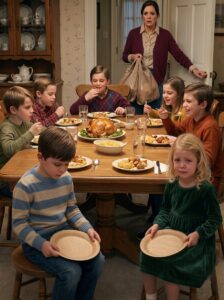
The dining room was a mess. Chairs were shoved back. A plate was broken on the floor. My mother was on a stretcher near the door, surrounded by paramedics. Vanessa had written: Look what you did.
I stared at it for a long time, then replied: Your children got sick because the food was bad. My children were humiliated because you are cruel. Those are two different things.
She answered right away: You abandoned us.
I looked at Noah and Lily on the couch, sharing the cookies Marlene had packed for them.
No, I typed. I chose my kids.
The next morning, I called my manager and switched to an earlier shift so I could be home when the kids got out of school. Then I called the pediatrician, not because my children were sick, but because I needed advice about how to help them after what they had seen.
The nurse told me, “Children remember exclusion, especially around food. Reassure them. Keep meals calm. Consider counseling if they seem anxious.”
That stayed with me.
When my mother called from the hospital later that day, she admitted the food had been left out too long and reheated. She said she could have hurt the children.
“Yes,” I told her.
Then she said, “You should have stayed.”
I gave a tired laugh. “That is what you want to say?”
“My children were hungry and humiliated in your house,” I said. “You will not see Noah or Lily until you can explain, without excuses, why what you did was wrong.”
She called me sensitive. I told her I had been trained to accept less. Then she hung up.
Over the next week, the truth spread. My father complained to relatives. Vanessa posted vague messages online about betrayal. But for once, I did not protect their image.
I told the truth simply: my children were told to wait while other children ate. I left. Then the people who ate the spoiled food became sick.
And one by one, people started telling me what they had seen for years. That my mother had always favored Vanessa. That my father had always treated love like a ranking system. That I was not imagining it.
Two weeks later, my father showed up at my apartment without calling. I opened the door but kept the chain lock on.
He said, “Your mother wants to see the kids.”
“No.”
He told me I could not cut them off over one meal.
“One meal?” I repeated.
He looked past me and saw the drawing Noah had made of our family: just me, him, and Lily.
“You’re turning them against us,” he said.
“No,” I answered. “You showed them who you were. I believed them when they were hurt.”
He tried to say family forgives.
I told him, “Family feeds children.”
When Noah appeared behind me, my father saw him step closer to me instead of to him. That tiny movement said everything.
I told my father to leave.
That night, Noah asked if Grandpa was angry. I told him adults can be angry and still not be right.
He said he didn’t like how Aunt Vanessa talked to us.
“I know,” I said. “We are not bad because we have less money. We are not leftovers.”
In March, I enrolled both children in counseling. Noah talked about stomachaches before visits to my parents. Lily admitted she used to hide snacks in her backpack after Sunday dinners because she was afraid Grandma might forget to feed her.
I cried in the parking lot after hearing that.
Then I went home and filled one kitchen cabinet with snacks. I wrote on a sticky note: Noah and Lily’s snack shelf. Always allowed.
Lily read it over and over and asked, “Always?”
“Always,” I said.
By summer, we moved into a small townhouse with two bedrooms and a little patch of grass out back. On our first night there, we ate spaghetti on the floor because the table had not arrived yet.
Noah lifted his cup and said, “To no crumbs.”
Lily giggled. “To big plates.”
I raised mine last. “To our home.”
A year later, a letter came from my mother. She wrote that she had treated Vanessa like she was special and expected me to accept less. She said she was sorry.
I did not call her that day.
Later, with the counselor’s help, I allowed one supervised meeting at a park. My mother came alone. She told Noah and Lily she was wrong, that she should have fed them and made them feel welcome.
Lily looked at me, and I nodded, letting her know she did not have to answer.
Noah said, “We’re not leftovers.”
My mother’s face crumpled. “No,” she whispered. “You are not.”
That was all the meeting needed to be.
We left after twenty minutes. No drama. No big reunion. Just a quiet step forward.
At the ice cream shop afterward, Lily chose strawberry with sprinkles, Noah chose chocolate chip cookie dough, and I chose vanilla.
Lily asked, “Mom, Grandma looked sad.”
“Yes.”
“Do we have to make her happy?”
“No,” I said. “That is not your job.”
Noah asked, “Is it yours?”
I smiled a little. “No. Not anymore.”
That night, after the children were asleep, I stood in our kitchen and looked at the snack shelf. It was messy and half-empty, but it was ours.
My phone buzzed with a message from my mother: Thank you for today.
I stared at it, then typed back: We will go slowly.
For once, slowly felt powerful.
For once, I was no longer chasing love or begging for a full plate at someone else’s table.
I had built my own.
And my children would never sit in a corner waiting for crumbs again.