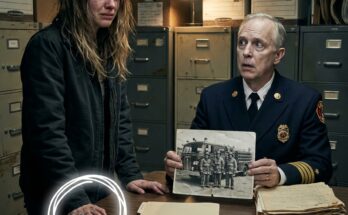
My parents left my grandfather to die alone in a small Montana hospital because they said he was “too difficult.” They skipped his funeral, sold his house three weeks later, and assumed the old silver ring I saved from his bedroom was worthless.
PART 3:
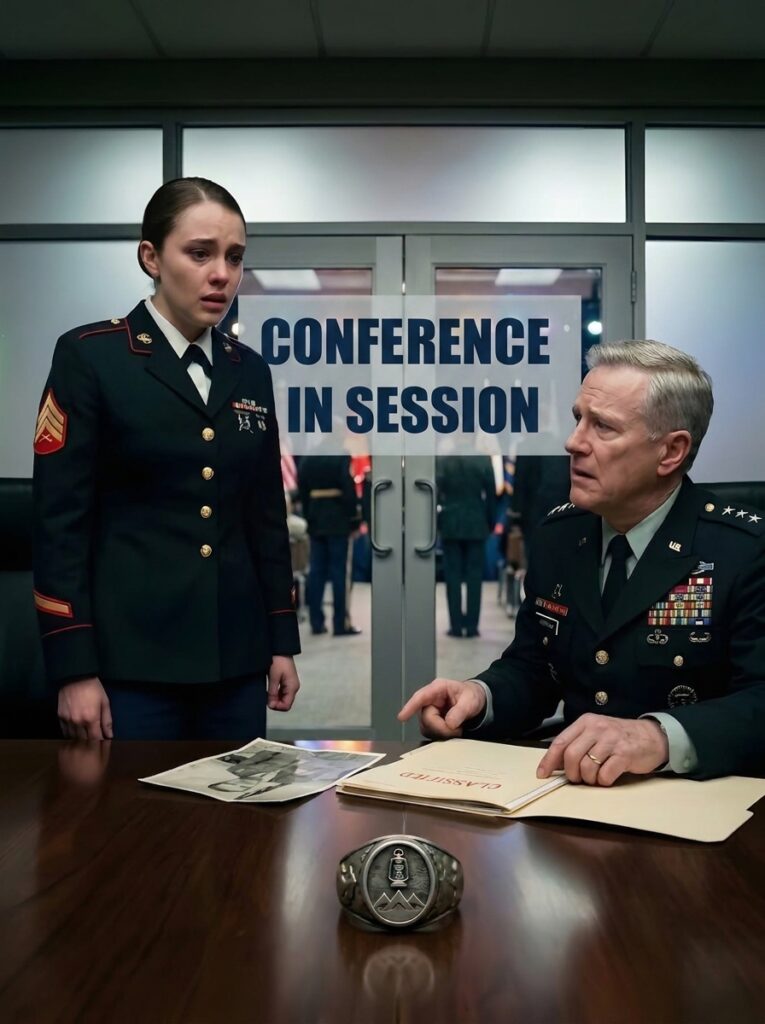
The military attorney entered the locked conference room carrying a leather case in one hand and a sealed envelope in the other.
The general did not take his eyes off my phone.
My mother’s voice still seemed to echo from the speaker.
That ring belongs to the estate. Give it back before your father reports you for theft.
For a few seconds, no one spoke.
Then General Adrian Mercer placed my phone facedown on the table beside Grandpa’s silver ring.
His expression had changed.
At first, when he saw the ring on my hand, he had looked shocked. Then grief-stricken. Then almost afraid.
Now he looked angry.
Not loud angry.
Controlled angry.
The kind of anger that had learned how to wait.
The attorney set the leather case on the table and looked at me.
“Sergeant Claire Hail?”
“Yes, ma’am.”
“I’m Colonel Miriam Sloane, retired. I represent the surviving legal interests of the Lantern unit and the estate instructions left by Thomas Hail.”
I looked from her to the general. “My grandfather had a military attorney?”
General Mercer’s mouth tightened. “Your grandfather had many things your family never bothered to ask about.”
Colonel Sloane sat down beside me and opened the case. Inside were several folders, a small recorder, and a document sealed in a plastic sleeve.
“Before we discuss the estate,” she said carefully, “I need to confirm something. Did Thomas Hail die alone?”
The question hit me harder than I expected.
I looked down at the ring.
“No,” I said. “Not at the end.”
The general lowered his eyes.
I told them everything.
The neighbor’s call at 2:17 in the morning. The emergency leave. The county hospital room with dim lights and untouched coffee beside the bed. Grandpa’s hand in mine. His whisper when he realized I had come.
Guess you’re the one who didn’t forget me.
I told them my mother said hospitals made her anxious.
I told them my father said the roads were bad.
I told them my brother had an important meeting.
I told them about the funeral.
Six people.
One priest.
Two neighbors.
An elderly nurse.
A man from the hardware store.
And me.
My parents had not come.
My brother had sent two words.
Busy week.
When I finished, Colonel Sloane’s face had gone very still.
General Mercer looked away toward the closed door.
For a moment, he was not a four-star general standing in a formal ceremony hall.
He was the young man in the old photograph.
The one my grandfather had carried down a mountain.
“He deserved better,” the general said quietly.
“Yes,” I said. “He did.”
Colonel Sloane reached into the leather case and removed an old envelope.
My name was written across it.
Not in legal print.
In Grandpa’s handwriting.
To the one who kept the ring.
My throat tightened.
“He wrote this?” I asked.
“Seven years ago,” Colonel Sloane said. “He updated it twice after that. The final copy was recorded and witnessed six months before his death.”
“My parents never mentioned any of this.”
“They were never meant to control it.”
Before I could answer, my phone buzzed again.
A message from my father.
Do not embarrass this family. Bring the ring back today.
I stared at the words.
All my life, my father had spoken about family like it was a business.
Something to manage.
Something to protect.
Something to profit from quietly.
I slid the phone toward Colonel Sloane.
She read the message once.
Then she placed it next to the recorded will.
“Useful,” she said.
The general gave a short, humorless breath. “Thomas always said his son loved paperwork more than people.”
I looked up sharply. “You knew my father?”
“I met him once,” General Mercer said. “After Thomas came home.”
“What happened?”
He looked at Colonel Sloane, and she gave a small nod.
The general opened the gray folder.
Inside were maps, radio transcripts, typed statements, and photographs so faded some of the faces looked like ghosts.
A mission summary sat on top.
OPERATION CINDER PASS.
CLASSIFICATION REMOVED.
Thirteen men had been sent across a border in 1972 to locate a missing aircraft and recover intelligence before enemy forces reached it. The mission had never been publicly acknowledged. Every man involved had signed silence orders.
Grandpa had been twenty-four years old.
A sergeant.
Trained in field medicine, communications, and survival.
His official record made him sound ordinary.
The statements inside the folder did not.
On the second night, their extraction helicopter was hit before it could land. The senior officer was lost. Supplies were scattered. Several men were injured across a steep mountain ridge.
Lieutenant Adrian Mercer had a shattered leg and a serious wound near his ribs.
Two others could not walk.
The radio operator sent one broken transmission before the equipment failed.
Command ordered the men who could move to reach the secondary extraction point.
Grandpa refused.
General Mercer pushed one page toward me.
A red line had been drawn under a radio transcript.
LANTERN TWO: NEGATIVE.
WE LEAVE TOGETHER OR NOT AT ALL.
My hand covered my mouth.
“That was him?” I whispered.
The general nodded.
“Lantern Two.”
Grandpa divided the survivors into pairs. He destroyed anything that could identify them. He built stretchers from parachute straps and broken branches. When the mountain became too steep, he carried Mercer himself.
They moved at night.
They hid during the day.
He rationed supplies, kept the wounded quiet, and led them through terrain no one believed they could cross.
Three times, he went back for men who had fallen behind.
Three times, he returned.
By the fifth night, only seven were still able to move without help.
By the sixth, Grandpa was carrying two men in turns.
By the seventh, he had stopped writing in his own field notes.
The last line in his notebook said:
If I make it home, I will never call this courage. Courage would have been bringing all thirteen back.
I could barely see the page through my tears.
“He blamed himself,” I said.
“For the rest of his life,” General Mercer said.
“But he saved you.”
“He saved more than me.”
The general turned another page.
There was a list of names.
Thirteen names.
Beside twelve of them were dates.
Beside Thomas Hail’s name, someone had written:
LAST LANTERN BEARER.
Colonel Sloane touched the silver ring gently with one finger.
“There were thirteen rings,” she said. “One for each member of the unit. They were made before the mission by one of the men, a mechanic from Wyoming. The lantern meant, ‘No man left in the dark.’ The three mountains represented the crossing.”
I looked at the small symbol engraved inside the silver.
A lantern above three sharp peaks.
All those years, Grandpa had carried the memory of men no one was allowed to mention.
And my family had called him difficult.
General Mercer’s voice lowered. “The other twelve rings were returned to families or buried with the men who wore them. Thomas kept his because he was the last one who could speak for us, even when he was ordered not to.”
“Why was this still hidden?” I asked.
“Because governments are slower to apologize than soldiers are to die,” Colonel Sloane said.
The room went silent.
Then she pushed the sealed envelope toward me.
“Your grandfather knew the record might eventually be opened. He also knew your father would come looking if he thought there was money attached.”
I let out a small bitter laugh. “There always has to be money.”
“There is some,” she said. “But not the way your family thinks.”
She removed another document.
It was Grandpa’s will.
Not the one my parents had filed through the county.
A later one.
Properly witnessed.
Properly recorded.
Properly hidden from the people he no longer trusted.
I read the first page.
My parents were not executors.
My brother was not listed.
Grandpa had left the house, his military records, personal items, service ring, and any future recognition benefits to me.
Only me.
My hands began to shake.
“He left me the house?”
“Yes,” Colonel Sloane said. “Your parents had no legal right to sell it. The sale can be challenged immediately.”
“They already signed papers.”
“Signing papers does not make theft become inheritance.”
The general looked at the door. “And their lawyer knew enough to request Thomas’s sealed service record.”
Colonel Sloane nodded. “Which suggests someone discovered the old recognition packet was moving forward.”
“What recognition packet?” I asked.
The general opened the final folder.
Inside was a formal recommendation.
Grandpa’s name was typed across the top.
For decades, the recommendation had been locked away because the mission itself had been hidden. Now that portions had been declassified, the surviving witnesses had pushed for Thomas Hail to receive public recognition.
Not because he wanted it.
He was gone.
But because the truth had waited long enough.
General Mercer looked directly at me.
“Your grandfather was approved for posthumous military honors. There will be a ceremony. His name will be restored to records where it should have been from the beginning.”
I thought of Grandpa in his sagging porch chair, drinking coffee from a chipped mug while my father talked over him.
I thought of my mother rolling her eyes when he forgot words.
I thought of my brother laughing at him.
My grandfather had crossed a mountain carrying men on his back, and no one in our family had even carried flowers to his grave.
Colonel Sloane placed the recorder in front of me.
“Are you ready?” she asked.
I nodded, though nothing in me felt ready.
She pressed play.
For a moment, there was only static.
Then Grandpa’s voice filled the room.
Older.
Rougher.
But his.
“If you are hearing this, then I am gone, and someone has finally asked about the ring.”
My heart broke quietly.
He coughed once on the recording.
“I never had much worth leaving. At least, that’s what my son believed. Maybe that made things easier. People show you who they are when they think there is nothing to gain.”
I closed my eyes.
“I leave my home, my ring, my letters, and any honor that comes too late to my granddaughter, Claire. Not because she wore the uniform. Not because she followed me into service. But because she came back when everyone else walked away.”
A tear slipped down my cheek.
“She sat with an old man when there was no audience. That tells me everything I need to know.”
The general turned away.
Colonel Sloane looked down at her hands.
Grandpa’s voice continued.
“If my son or his wife tries to take the ring, the house, or the records, let this statement stand as my answer: they did not want my life. They do not get to profit from my death.”
The room blurred.
The recording ended with one last sentence.
“Claire, if the ring ever feels heavy, remember what I told you. It reminds you who you are.”
I pressed my fist against my mouth.
For years, I had believed I was the only one who remembered him with love.
But Grandpa had known.
He had known exactly who came.
And who did not.
Colonel Sloane turned off the recorder.
“We will file immediately,” she said. “The sale of the house will be stopped. Your father’s lawyer will receive notice before the end of the day. If they continue making threats, we will handle that too.”
My phone buzzed again.
This time it was my brother.
Mom says you stole Grandpa’s ring. What is wrong with you?
I stared at the message for a long moment.
Then, for the first time in my life, I did not explain.
I did not defend myself.
I did not try to make them understand a man they had spent years refusing to see.
I typed only one sentence.
You should have come to the funeral.
Then I turned the phone off.
Two weeks later, the public ceremony took place.
Not in a small county church with empty pews.
In a military hall filled wall to wall with uniforms, veterans, families, reporters, and twelve folded flags placed in a careful row.
For the first time in forty years, the names of the Lantern unit were read aloud.
All thirteen.
When they said Thomas Hail, the hall stood.
I stood too, wearing my dress blues and Grandpa’s silver ring on my right hand.
My parents arrived late.
Of course they did.
My mother wore black and pearls, dressed as though grief were an outfit she could borrow for an afternoon. My father looked irritated by the cameras until he noticed how many important people were in the room.
They tried to sit in the reserved family row.
Colonel Sloane stopped them.
“I’m sorry,” she said politely. “Those seats are for the next of kin listed in Sergeant Hail’s final directive.”
My father’s face darkened. “I am his son.”
Colonel Sloane did not blink. “Then you should have been at his funeral.”
The words moved through the row like a quiet storm.
My mother’s eyes snapped toward me.
For once, I did not look away.
General Mercer took the podium.
He spoke of thirteen young men sent into a mission history had tried to bury. He spoke of loyalty, silence, sacrifice, and the cost of being forgotten by the country you served.
Then he spoke of Grandpa.
“Sergeant Thomas Hail was ordered to leave wounded men behind,” he said. “He refused. Because of him, I lived long enough to stand here today. Because of him, families received sons, brothers, husbands, and fathers they might never have seen again.”
His voice broke slightly.
“He spent the rest of his life in silence so others could keep their reputations clean. Today, that silence ends.”
The hall erupted in applause.
I did not move.
I could not.
Then the general stepped down from the podium carrying a folded flag, a framed citation, and Grandpa’s restored service record.
He stopped in front of me.
“Sergeant Hail,” he said, using my rank, “on behalf of the men who survived because of your grandfather, and the families of those who did not, it is my honor to return his story to the person he trusted most.”
I accepted the flag with both hands.
For a moment, I felt Grandpa’s hand around mine again in that hospital room.
Thin.
Warm.
Still trying to comfort me while he was the one leaving.
Across the aisle, my mother was crying now.
But I knew the difference.
Some tears come from love.
Some come from being seen.
My father approached me after the ceremony.
He waited until cameras were nearby.
Then he lowered his voice into the gentle tone he used when he wanted strangers to think he was a good man.
“Claire,” he said, “this has gone far enough. Your grandfather was my father. We should handle this as a family.”
I looked at him.
Really looked at him.
The man who had talked over Grandpa at dinner.
The man who had skipped the hospital.
The man who had missed the funeral and then asked about the house.
“No,” I said. “We should have handled it as a family when he was alive.”
His face hardened.
“Do not humiliate me.”
I almost smiled.
“You did that yourself.”
My mother reached for my arm. “Claire, please. We were grieving in our own way.”
I gently stepped back.
“You were selling his house.”
Her hand dropped.
A reporter nearby turned slightly.
My father noticed.
That was when I finally understood him completely.
He did not fear losing Grandpa.
He feared losing the story he had told about himself.
Colonel Sloane joined me before he could speak again.
“The court hearing regarding the attempted sale is next week,” she said to my father. “All further communication goes through my office.”
“My lawyer will respond,” he snapped.
“He already has,” she said. “Poorly.”
General Mercer walked up beside her.
My father’s anger faded the moment he recognized him.
The general looked at my parents for a long time.
Then he said, “Thomas talked about his granddaughter often. He did not talk about you.”
No one said anything after that.
There was nothing left to say.
Three months later, Grandpa’s house was mine again.
The antique clock my mother had taken was returned.
So was the truck.
So were the boxes of letters my father had dismissed as junk.
I went back to Montana on a cold morning just as snow began to fall over the porch.
The house looked smaller than I remembered.
The steps still creaked.
The kitchen still smelled faintly of coffee and old wood.
On the table, I placed the folded flag, the framed citation, and the photograph of thirteen young soldiers standing in front of a damaged helicopter.
Then I sat in Grandpa’s chair and finally opened the envelope he had written to me.
Inside was a short letter.
Sweetheart,
If you found the ring, then you already know the only thing worth keeping is not silver.
It is memory.
People will tell you a man’s life is measured by what he owned, what he won, or what people said about him after he was gone.
Do not believe them.
A life is measured by who comes when there is nothing left to take.
You came.
That is enough.
I pressed the letter to my chest and cried until the room grew quiet around me.
Later, I turned Grandpa’s house into a small retreat for veterans who had no family nearby.
I called it Lantern House.
Not everyone understood why.
But the ones who needed it did.
Every year, on the anniversary of the ceremony, General Mercer visited. He would sit on the porch with coffee in a chipped mug and tell me one story about Grandpa that had never made it into the official record.
How he sang softly when the wounded men were afraid.
How he gave away his last clean socks.
How he carried a man down a ridge and apologized the whole way for moving too slowly.
Each story gave me back a piece of him.
Not the quiet old man my family ignored.
The whole man.
The brave man.
The man who had been forgotten by everyone except the people he saved.
As for my parents, they tried to repair things once the story became public.
My mother sent long messages about misunderstandings.
My father sent one letter through his attorney asking for “privacy during a painful family transition.”
I did not answer either one.
Some doors do not close because of anger.
They close because truth finally arrives and stands in the doorway.
The ring stayed on my hand.
Not because it was valuable.
Not because generals had recognized it.
Not because my parents had wanted it back once they realized it mattered.
I wore it because Grandpa had been right.
It reminded me who I was.
I was the one who came.
And in the end, that was the only inheritance that mattered.