While the emergency call was still being made from Lily Carter’s classroom, the telephone in the principal’s office rang.
The principal had not yet seen Lily lying on the floor.
He had not heard the thin, nearly vanished breaths that frightened a room full of second-graders.
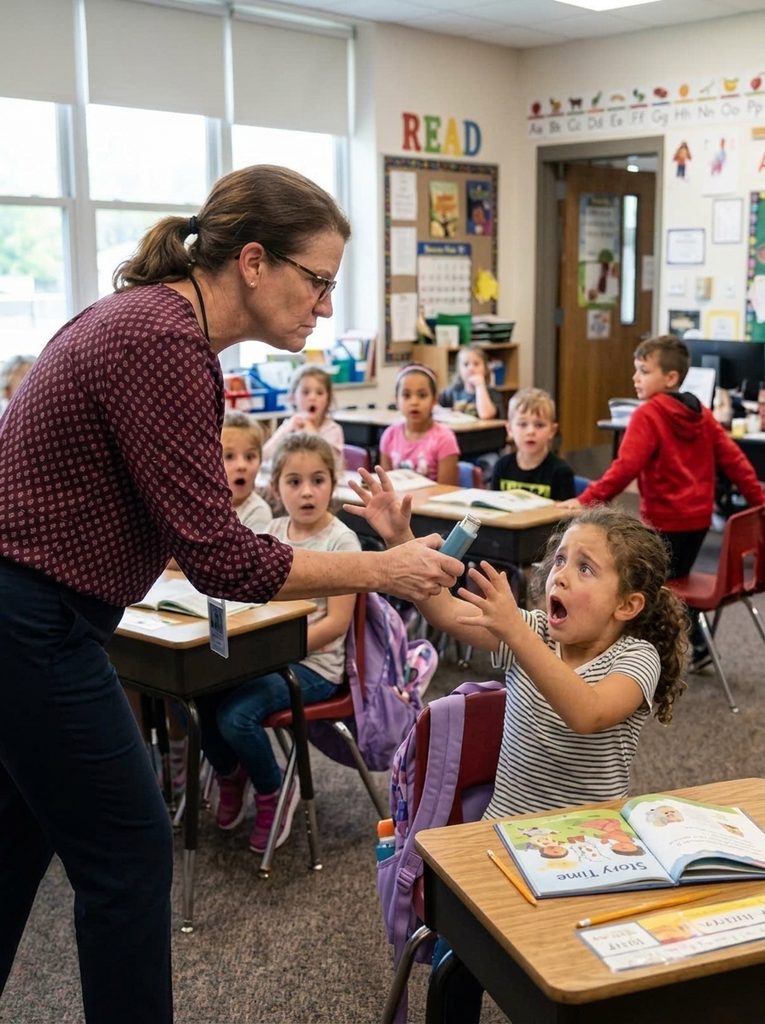
He had not seen the blue rescue inhaler still in Mrs. Grayson’s hand after Lily had asked for it, reached for it, and then collapsed without being able to speak.
All he knew was that the school nurse had requested an ambulance.
Then he answered the phone.
Lily’s mother was on the other end.
She had received the school’s emergency notification moments earlier.
But she wasn’t calling simply to ask whether her daughter was all right.
Her first question was sharper.
“Did Lily have her inhaler?”
The principal hesitated.
“The nurse is with her now.”
“That isn’t what I asked.”
Her voice remained controlled.
“She carries it herself. Her asthma plan says she can use it immediately when symptoms begin. You have the signed copy. I have your acknowledgment that the school received it.”
The principal looked toward the hallway.
Until that moment, he had been treating the incident as a medical emergency that happened at school.
Now another question existed.
Had the emergency become worse because an adult blocked the treatment Lily had specifically been allowed to use?
“I’m going to the classroom now,” he said.
“I’m already on my way.”
Down the hall, Rebecca Owens knelt beside Lily while another staff member relayed information to the 911 dispatcher.
Rebecca had taken the rescue inhaler from Mrs. Grayson and was following the emergency instructions already on file.
Lily was conscious.
But she was exhausted from fighting for each breath.
Rebecca kept her voice steady.
She did not ask Lily to explain what happened.
She did not ask the child to prove she needed medication.
She focused on breathing and getting emergency help there as quickly as possible.
Ethan Morales remained near the doorway.
The adrenaline that had carried him down the hallway was fading.
Now he looked exactly like what he was.
A frightened seven-year-old who had broken a classroom rule because another child was in danger.
When the principal entered, he saw Lily first.
Then Rebecca.
Then the inhaler.
His eyes moved toward Mrs. Grayson.
“What happened?”
Mrs. Grayson began with the part she could explain most easily.
Lily had complained that she could not breathe.
She had become upset.
The classroom had become distracted.
Mrs. Grayson believed Lily was panicking and making her breathing worse.
Rebecca looked up.
“Did she ask for this?”
She held up the inhaler.
Mrs. Grayson paused.
“Yes.”
“And did you take it away from her?”
Another pause.
“I was trying to calm her down.”
The principal said nothing immediately.
The answer mattered.
Lily’s emergency plan did not depend on whether a teacher personally believed her symptoms were serious enough.
That was exactly why the plan existed.
The sound of hurried footsteps ended the conversation.
Emergency responders entered carrying equipment.
The other children were moved away from the immediate area.
For the first time since Lily raised her hand, every adult around her was operating under the same assumption:
Her breathing difficulty was real.
Urgent.
And not something she needed to prove.
Ethan was guided into the hallway with his classmates.
He looked back once.
Rebecca remained beside Lily.
The inhaler was no longer held above anyone’s head.
It was where it should have been from the beginning.
Part of Lily’s care.
The principal asked for Lily’s health file.
When it arrived, he opened the emergency action plan.
The instructions were clear.
Lily had documented asthma.
Her rescue inhaler was to remain accessible according to her medical plan.
There was no instruction telling staff to wait until she collapsed.
Nothing said the medication should be withheld because someone thought she looked anxious.
Nothing required a seven-year-old to convince an adult she deserved access to her rescue medication.
Attached to the plan was the school’s acknowledgment showing it had been received.
The principal read it twice.
Then looked at Rebecca.
“Was Mrs. Grayson informed?”
Rebecca’s expression tightened.
Relevant health information had been communicated to classroom staff at the beginning of the school year.
That did not yet answer every question.
What Mrs. Grayson remembered.
What she understood.
What training she retained.
Those questions still had to be examined.
But one fact was already difficult to dismiss.
Lily’s asthma was not new information.
The school knew.
And Lily herself had recognized exactly what she needed before she became unable to speak.
The ambulance took Lily to the hospital.
Her mother arrived in time to accompany her.
She did not stop in the hallway to yell at Mrs. Grayson.
She did not confront the principal.
She looked at her daughter.
Got into the ambulance.
And went where Lily needed her most.
The confrontation could wait.
Breathing could not.