My Neighbor Said My Daughter Kept Leaving With My Husband During School Hours — So I Hid in the Trunk and Followed Them
Before leaving for work, my neighbor asked me a question that made the whole morning stop.
“Is your daughter going to miss school again today?”
I looked at her, confused.
“No,” I replied. “She goes every day.”
Mrs. Barragán adjusted the shawl around her shoulders and frowned, not with judgment, but with genuine confusion.
“That’s strange,” she said. “Because I always see her leaving with your husband after you’ve gone. Usually in the middle of the morning.”
For a moment, Verónica could not speak.
Her smile stayed frozen on her face, but inside, something shifted.
If the older woman had sounded nosy or excited to share gossip, Verónica might have dismissed it. She could have told herself that neighbors misunderstood things, exaggerated small details, or created stories out of boredom.
But Mrs. Barragán did not sound like someone spreading gossip.
She sounded puzzled.
And somehow, that made it worse.
Verónica forced a short laugh, said goodbye, and got into her car. She drove toward the office through the usual traffic of Narvarte, but the city around her seemed distant. Motorcycles moved between cars. Vendors shouted near intersections. Horns echoed down the streets.
But all she could hear was one sentence.
Your husband always leaves with her after you’ve gone.
All morning, the words repeated in her mind.
Maybe Mrs. Barragán was mistaken.
Maybe she had seen another child.
Maybe she had confused the days.
Maybe Emilia had stayed home sick once or twice, and Verónica had forgotten because life had become too heavy lately.
Work had been exhausting. Bills were piling up. The mortgage felt like a weight pressing against her chest. Every conversation with Daniel about money began carefully and ended in silence. Their marriage had not fallen apart, exactly. It had simply become tense, quiet, and tired.
The last thing Verónica needed was another worry.
But suspicion does not stay outside the door once it has been invited in. It follows you into every room. It changes the meaning of ordinary things.
That afternoon, when Verónica returned home, Emilia was in her bedroom. Her school uniform was folded neatly over a chair, and her tablet was open to a math exercise. The girl looked up and smiled softly, as if nothing unusual had happened.
Daniel was in the living room, leaning back on the couch with his phone in his hand.
Verónica set down her bag and tried to sound casual.
“Did you take Emilia out for anything today?”
Daniel did not look up.
“No. Why?”
“No reason.”
His answer came too quickly.
Or maybe Verónica’s suspicion was already turning every small thing into evidence.
During dinner, Emilia talked about a classmate who had brought mosaic gelatin to recess. Daniel complained about traffic on Viaducto. Verónica smiled when she needed to smile, answered when she needed to answer, and cleared plates like everything was normal.
But inside, she felt like she was watching her family perform a scene for her.
That night, she barely slept.
She lay beside Daniel in the dark, listening to his breathing. Then she began remembering things differently.
Emilia had complained about stomachaches.
Emilia had said she did not want to go to school.
Emilia had said she felt strange, tired, afraid, or upset.
And Verónica had always answered like a busy mother trying to keep life moving.
Everyone gets tired.
School is important.
You still have to go.
Now, in the darkness, those answers sounded different. Not cruel. Just incomplete. The kind of responses a tired parent gives when there are too many problems and not enough strength left to notice another one.
Before sunrise, Verónica made a decision.
She would not go to work the next day.
She would not accuse Daniel. She would not confront him without proof. She would simply stay behind and see what was really happening.
The next morning, she dressed as usual. She carried her heels in one hand and her bag over her shoulder.
“I have an early meeting,” she told Daniel.
He kissed her cheek.
“Good luck.”
Emilia sat at the table eating cereal, her eyes fixed on the television.
“Be good, my love,” Verónica said.
“Yes, Mom.”
Then Verónica stepped into the hallway and closed the door behind her.
Instead of leaving for work, she waited.
She heard the garage door open. Daniel’s car started. Then the sound faded down the street.
Only after she was sure he was gone did Verónica return upstairs. She unlocked the apartment quietly, slipped off her shoes, and stood still in the hallway.
The house felt different when she was hiding inside it.
Every sound became sharper. The refrigerator humming. A faucet ticking somewhere in the kitchen. The faint sound of morning television from the living room.
Then, at 9:17, the garage door opened again.
Daniel had come back.
Verónica’s heart started pounding so hard she had to steady herself against the wall.
She cracked the hallway door open just enough to see.
Moments later, Emilia’s bedroom door opened.
The girl stepped out fully dressed. Her hair was neatly combed. Her backpack hung from her shoulders.
But what froze Verónica was not the backpack.
It was Emilia’s face.
She looked serious. Not playful. Not annoyed. Not dramatic like a child trying to avoid school. She looked quiet, focused, almost resigned.
Daniel stood near the entrance and spoke softly.
“Ready?”
Emilia nodded.
Ready.
The word hit Verónica like a warning.
Ready for what?
A sharp fear moved through her chest. She did not stop to think. She did not ask herself whether there might still be an innocent explanation. Panic had already taken control.
While Daniel helped Emilia into the back seat, Verónica slipped into the garage. The trunk was open for a moment as Daniel moved something near the rear of the car.
She saw her chance.
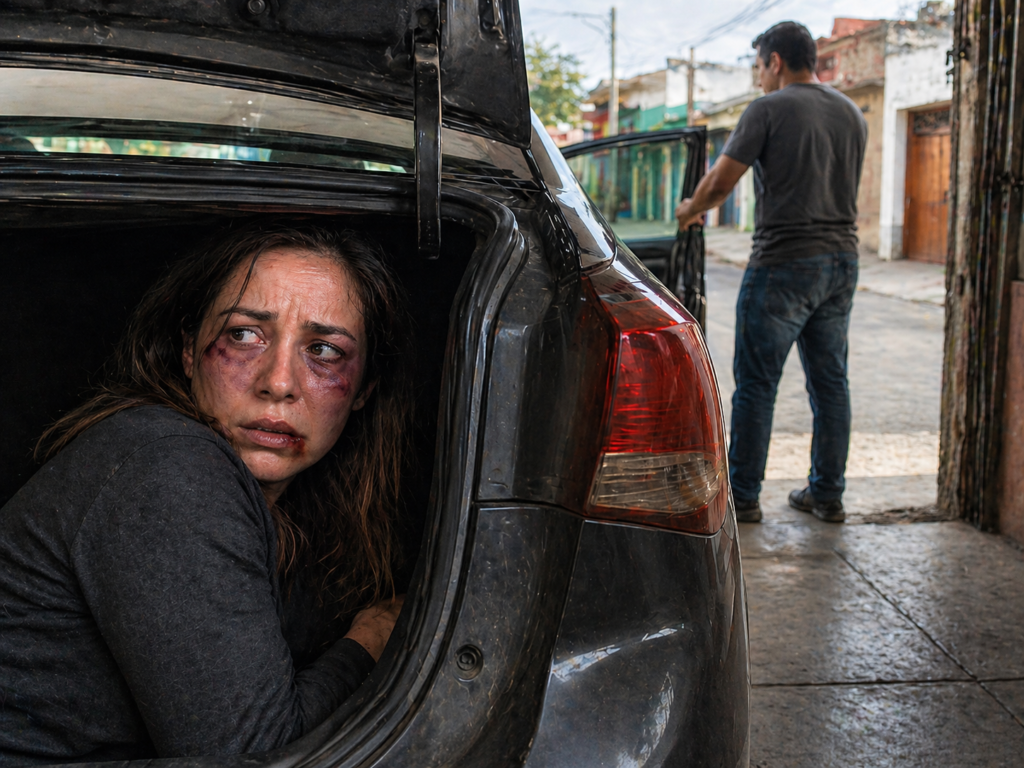
She lifted the trunk just enough, folded herself inside, pulled it down carefully, and let the darkness close around her.
The trunk smelled of rubber, dust, and gasoline.
It was warmer than she expected. Her breathing sounded too loud in the enclosed space. She curled her knees up and held her bag tightly against her chest so nothing would move.
A second later, she heard Daniel close the car doors.
Then the engine started.
The car began to move.
At first, Verónica tried to make sense of it.
Maybe Daniel was taking Emilia to a dentist appointment. Maybe a private meeting at school. Maybe an errand he had forgotten to mention.
She tried to track the route by feel.
A turn.
A stop.
Another turn.
The rhythm of traffic lights.
She knew the streets around Narvarte well enough to recognize the way to Emilia’s school or Daniel’s office. But the route did not match either one.
After nearly twenty minutes, the pavement changed.
The tires no longer moved smoothly over city asphalt. The car rattled over rough ground. Gravel, maybe. Or old industrial pavement.
The city sounds began to fade.
No buses. No street vendors. No busy intersections.
Just emptier streets and the low sound of the engine.
Then Daniel spoke.
“Almost there.”
Emilia answered softly, but Verónica could not hear the words.
The car slowed.
Then it stopped.
The engine turned off.
Verónica lay still, barely breathing.
She heard Daniel get out. Then the rear passenger door opened. Emilia stepped down. A heavy latch moved somewhere nearby. Footsteps crossed what sounded like concrete.
“Remember what we talked about,” Daniel said.
Emilia answered too quietly to understand.
Then a heavy door opened and closed.
They were inside.
Verónica counted slowly.
Thirty seconds.
Sixty seconds.
One hundred.
No one returned.
Carefully, she pushed against the trunk. To her relief, it had not fully latched. It lifted just enough to let in a thin line of daylight.
She looked out.
She did not recognize the place.
The car was parked behind a low gray industrial building. It was not abandoned, but it did not look welcoming either. There was no sign on the side she could see. Barred windows lined one wall. A high metal fence surrounded the lot. Weeds grew through cracks in the concrete.
Nothing about the place looked like a school.
Nothing about it looked like somewhere a child should secretly visit during the day.
Verónica climbed out of the trunk, her legs shaking. She crouched behind the car and looked around. The street beyond the gate was narrow and unfamiliar, lined with warehouses and closed storefronts.
Ahead of her was a plain gray metal door.
She walked toward it, barely feeling her feet.
The handle turned.
It was unlocked.
Inside, the air was cool and stale. It smelled faintly chemical, like a place that had once been cleaned too often. A narrow hallway stretched beneath humming fluorescent lights. At the far end was an empty reception counter. Two plastic chairs sat against the wall. A framed poster of a smiling family hung crookedly above them.
Verónica’s mind searched for explanations.
A tutoring center?
A clinic?
A private program?
The place did not look openly dangerous. In some ways, that made it worse. It looked ordinary enough to hide something.
Then she heard Emilia cry out.
Not loudly.
Just a small, frightened sound that had been quickly suppressed.
Verónica moved.
She hurried down the hallway, turned past the reception counter, and saw a partially open door.
Inside, Daniel was kneeling beside Emilia. A woman in her fifties stood near a desk holding a folder.
Everyone turned when Verónica appeared.
For one terrible second, no one spoke.
Daniel’s face emptied.
“Verónica—”
She cut him off.
“What is this?”
Her voice was sharper than she intended. Emilia flinched.
The room was small. A desk. A filing cabinet. Two chairs. A box of tissues. Children’s drawings pinned to a corkboard. A framed certificate on the wall.
The woman near the desk spoke first.
“Mrs. Salgado?”
Verónica stared at her.
“No one told me you were coming today.”
Today.
That word made Verónica’s stomach drop.
Daniel stood slowly.
“It’s not what you think.”
Verónica let out a short, shocked laugh.
“I found my husband taking my daughter in secret to an unknown building after telling me she was at school,” she said. “So please tell me what I’m supposed to think.”
Emilia began to cry.
Daniel turned toward her, but Verónica reached her first. She crouched in front of her daughter and pulled her close. Emilia’s body was rigid, shaking in her arms.
“It’s okay,” Verónica whispered. “I’m here.”
But nothing felt okay.
The woman behind the desk spoke carefully.
“My name is Laura Sarmiento. I’m a child psychologist.”
Verónica lifted her head.
“What?”
Daniel looked down.
“She’s been seeing Emilia for three months.”
The words struck like a confession.
“Three months?”
“I wanted to tell you,” he said.
“When?”
He swallowed.
“It’s not that simple.”
“No,” Verónica said, standing quickly. “What’s not simple is you taking our daughter to therapy behind my back and making me believe she was at school.”
Emilia cried harder.
Verónica turned back toward Daniel.
“What is wrong with her?”
Daniel’s face tightened.
“Nothing is wrong with her.”
“Then why is she here?”
Dr. Sarmiento answered calmly.
“Because Emilia has been showing clear signs of school-related anxiety and panic. Your husband contacted me after the episodes became more serious.”
Episodes.
Verónica looked at Daniel.
“What episodes?”
The silence changed the whole room.
Daniel looked at Emilia, then at the floor.
“She’s been having panic attacks.”
The words emptied everything from Verónica’s mind.
Panic attacks.
Not stomachaches.
Not laziness.
Not ordinary school resistance.
Not childish complaints.
Real fear.
“What are you talking about?” Verónica whispered.
But as soon as she asked, memories began returning.
The stomachaches.
The trembling.
The mornings when Emilia begged not to go.
The way Verónica had answered with rules because she did not know how to answer with patience.
Then Emilia spoke.
“I told you.”
Verónica turned.
Her daughter sat folded into the chair, hands twisting the straps of her backpack. Her eyes were red and full of hurt.
“I told you my stomach hurt,” Emilia said. “I told you I got scared.”
Verónica knelt in front of her again.
“My love…”
But Emilia kept going.
“I tried. But you always said I had to go. Dad said this doctor helps when the scared feeling gets big.”
Verónica reached for her daughter’s hands.
“Why didn’t you tell me again?”
Emilia looked at her with a pain so honest it almost broke her.
“Because you were always tired.”
There was no anger in the words.
Only truth.
And that made them hurt more.
Verónica lowered her head.
For months, she had come home carrying work, bills, pressure, and exhaustion. Emilia’s fear had reached her again and again, but Verónica had not heard it clearly. She had mistaken distress for resistance. She had answered fear with instructions.
Daniel’s secrecy looked different now too.
Not acceptable.
Not harmless.
But not the betrayal she had imagined.
He had been desperate.
“The school counselor called me in April,” Daniel said quietly. “Emilia had an episode in class. She was crying, shaking, and having trouble breathing. They thought it was asthma at first.”
“And you didn’t tell me,” Verónica said.
“I tried,” he replied. “But every time I started, you were exhausted or angry or worried about money. I thought if I handled it first, if I got answers first, I could tell you when I knew how to explain it.”
“So you lied.”
Daniel looked at her.
“Yes.”
The room held that truth.
“Yes,” he repeated softly. “I lied.”
It would have been easier if he had been cruel.
It would have been easier if the secret trips had led to some obvious betrayal.
But this was more painful because it revealed several failures at once.
Daniel had not trusted Verónica enough.
Verónica had not listened closely enough.
And Emilia had been carrying the weight of both.
Dr. Sarmiento finally spoke.
“I think today should not become another burden Emilia has to carry alone.”
That sentence brought the room back to its true center.
Not the marriage.
Not the secrecy.
Not the anger.
Emilia.
The girl sat in the chair with her backpack still on, as if she might have to leave quickly if the adults failed again.
Dr. Sarmiento asked gently if Emilia wanted water. She nodded.
While Daniel stepped into the hallway to get it, Verónica remained beside her daughter.
“What does it feel like?” she asked softly.
Emilia wiped her face.
“My chest gets tight,” she whispered. “My stomach hurts. And I think something bad is going to happen at school, even when I don’t know what.”
Verónica closed her eyes for a second.
Not to avoid hearing it.
To keep herself from breaking in front of her daughter.
“I’m sorry,” she said. “I am so sorry.”
When Daniel returned, Dr. Sarmiento explained more.
The panic symptoms had become clear four months earlier. The school had contacted Daniel because Verónica had been unreachable during work meetings. Mornings were the hardest. Crowded classrooms. Noise. Separation. The feeling of being left somewhere while everyone expected her to act normal.
“She is not being disobedient,” Dr. Sarmiento said. “She is not manipulating anyone. Her body is going into alarm.”
Verónica nodded because words felt too small.
Daniel sat by the wall, elbows on his knees. For the first time, Verónica noticed how exhausted he looked too. The strain around his mouth. The tightness in his hands. The tiredness he had been hiding in a different way.
“You should have told me,” she said.
“I know.”
“I might have reacted badly.”
“I know that too.”
“Then why didn’t you trust me enough to let me react?”
Daniel’s face tightened.
“Because I was afraid you would see it the way you’ve seen everything lately. Through pressure. Through deadlines. Through survival. I was afraid you would tell her to push through it again. And I couldn’t let that keep happening.”
It was painful to hear.
That did not make it false.
The rest of the morning was not dramatic.
There were no loud ultimatums. No clean forgiveness. No easy villain.
There was only the quiet, uncomfortable work of facing what had happened.
Verónica stayed.
She listened.
Dr. Sarmiento explained the treatment plan: reduced school exposure, breathing exercises, coordination with the school counselor, gradual reentry, and no more secrecy.
When they left the building together, the industrial lot no longer looked sinister.
It looked sad.
A place Verónica had entered expecting one kind of betrayal, only to discover another kind of truth.
The ride home was silent.
Emilia sat in the back seat, exhausted, holding her backpack. Verónica sat in the passenger seat this time, watching the streets become familiar again. Repair shops. Storage buildings. A small bakery on the corner. Then busy avenues, traffic, and the ordinary city returning around them.
At home, Emilia went to her room and fell asleep on top of the comforter without changing clothes.
Daniel stood in the kitchen as if he did not know whether he belonged there.
For a full minute, neither of them spoke.
Then Verónica asked, “How many times?”
He understood immediately.
“Eight sessions.”
Eight.
She placed one hand on the counter.
“You built an entire life around this without me.”
Daniel shook his head.
“No. I made appointments. I drove her. I sat in waiting rooms. That’s not a life. That was me trying to keep things from getting worse while not knowing how to bring you in.”
Verónica let out a bitter laugh.
“Well, that worked beautifully.”
Daniel looked away.
“I know.”
The silence between them was not peaceful.
But it was honest.
Trust had been damaged in both directions. He had deceived her. She had failed to notice her daughter’s fear. Neither truth erased the other.
That afternoon, Verónica did not go to work. She called her supervisor, who sounded irritated enough to make it clear that the absence would be remembered. Verónica said she understood and ended the call before shame could take over.
Then she sat at the kitchen table with a notebook and wrote down everything Dr. Sarmiento had said.
Panic symptoms.
Breathing exercises.
School counselor.
Triggers.
Emergency plan.
She wrote as if careful notes could make up for the months she had missed.
They could not.
But they gave her a place to begin.
That evening, while Daniel went to the pharmacy, Verónica sat on Emilia’s bed and watched her daughter color.
The room smelled faintly of crayons and strawberry shampoo. Sunlight came through the curtains in warm lines. It looked like an ordinary child’s room, which somehow made the conversation harder.
“Why didn’t you tell me you were seeing the doctor?” Verónica asked softly.
Emilia did not look up.
“Dad said we should wait.”
“Did you want to wait?”
The girl pressed her purple crayon too hard, and the tip broke.
Then she whispered, “I didn’t want you to be mad.”
Verónica took the broken crayon and set it aside. Then she held her daughter’s hand.
“I wasn’t mad at you.”
Emilia finally looked at her.
“I know. You were mad at everything.”
That sentence stayed with Verónica.
It stayed that night when Daniel slept on the couch without being asked.
It stayed the next morning when Emilia came into the kitchen cautiously, as if she expected the old routine to return.
It stayed when Verónica called Dr. Sarmiento and apologized for bursting into the office.
The psychologist only said, “What matters is what you do now.”
So they began again.
Slowly.
Verónica attended the next therapy session.
Then the one after that.
She listened as the school counselor explained that anxiety in children often hides behind stomachaches, tears, silence, resistance, and irritability. It is easy for exhausted families to mistake distress for attitude.
Emilia improved, but not in a straight line.
Some mornings were easier.
Some were not.
There were still tears in the hallway before class. There were still moments of panic in the car. There were still days when the thought of school made her shoulders tremble.
But now the adults around her no longer treated fear like weakness.
They treated it like something real.
Three weeks later, Mrs. Barragán saw Verónica on the sidewalk again.
The older woman looked guilty and curious.
“Everything all right, dear?”
Verónica paused.
It would have been easy to say yes and keep walking. It would have been easier to avoid the subject entirely.
But without that awkward conversation, she might have remained blind much longer.
“My daughter was getting help,” Verónica said. “I just didn’t know.”
Mrs. Barragán’s expression softened.
“Oh.”
Then she said quietly, “Well, I’m glad you know now.”
Verónica nodded.
“So am I.”
By December, the house had changed.
Daniel no longer moved around difficult subjects as if silence were a solution. Verónica no longer answered every sign of distress with urgency and instruction. They talked about money, fear, work, pressure, and how both of them had become worse versions of themselves while trying to survive.
Nothing was fixed instantly.
Truth did not repair trust all at once.
Trust had to be rebuilt through repetition.
Daniel shared every appointment, every school email, every note, and every concern. Verónica admitted when she did not know what to do instead of hiding uncertainty behind authority.
It was not graceful.
But it was real.
One Saturday morning, nearly two months after the day in the trunk, Verónica woke early and found Emilia already sitting at the kitchen table in pajamas, drawing.
“What are you making?” Verónica asked.
“A map.”
“A map of what?”
Emilia shrugged with the seriousness of a child deep in imagination.
“How to get somewhere if you don’t know where you’re going.”
Verónica sat across from her.
The paper showed streets, arrows, and landmarks that only partly resembled their neighborhood. At the edge of the page, in large uneven letters, Emilia had written one word:
HOME.
Verónica felt her throat tighten.
“That’s a good map,” she said.
Emilia studied it and added another arrow.
“I think so too.”
Later that day, while Daniel fixed a broken cabinet hinge in the kitchen and the radio played softly, Verónica stood in the garage and looked at the car.
The trunk was closed.
Ordinary.
Empty.
But in her mind, it would never be ordinary again.
She had hidden there expecting to uncover a terrible betrayal. Instead, she had found a child in pain, a husband afraid, and a mother so overwhelmed by life that she had stopped hearing what her daughter was trying to say.
Daniel came out and saw her standing there.
“Do you need something?” he asked.
Verónica shook her head.
“No. I was just thinking.”
“About what?”
She rested one hand on the roof of the car.
“How close you can live to people and still not see what’s happening.”
Daniel was quiet for a moment.
Then he said, “I think we both learned that.”
There was no perfect forgiveness in that moment. No cinematic ending. No simple way to turn what had happened into something clean.
There was only the truth.
Love had not been enough to keep them honest.
But honesty had finally arrived.
And maybe that was where repair had to begin.
That night, after Emilia fell asleep, Verónica opened the hallway closet and found the backpack her daughter had worn that day to Dr. Sarmiento’s office. It was still sitting in the corner where it had been tossed weeks earlier.
She unzipped it.
Inside were crayons, tissues, a small stuffed rabbit, and a folded piece of paper.
Verónica opened it carefully.
It was one of Emilia’s first therapy drawings.
A car.
A building.
A tiny figure hidden in a black rectangle at the back of the car.
Three stick figures standing outside the building afterward: one crying, one with open arms, and one with no mouth at all.
At the top, in uneven child handwriting, Emilia had written:
That was the day Mom found out.
Verónica sat on the hallway floor holding the picture for a long time.
Then she folded it carefully.
Not to hide it.
To keep it safe.
And only then did she understand what the day in the trunk had really been.
It was not the day her marriage broke.
It was not the day suspicion proved itself right.
It was the day the hidden pain inside her home finally became visible.
The day her daughter’s fear forced the adults around her to stop pretending everything was normal.
The day they finally began telling the truth.
- [FULL STORY] Before My Surgery, My Husband Texted: “I Want a Divorce. I Don’t Need a Sick Wife.
- My Husband Left Me for a 28-Year-Old on Christmas Eve…
- [FULL STORY] For Three Months, My Husband’s Side of the Bed Had a Terrible Smell… When I Finally Opened the Mattress, the Truth Changed Everything
- The 7:00 PM Pill: How a “Nice Guy” Broke Our Marriage
- I adopted four siblings who were about to be separated. One year later, a stranger appeared at my door and revealed the truth about their biological parents.