[Part 1] My Son Tried to Hide His Three-Legged Cat, Then Opened the Curtain Again
Part 1
My son tried to hide his three-legged cat after the neighbor boy laughed, and I knew something inside him had been hurt.
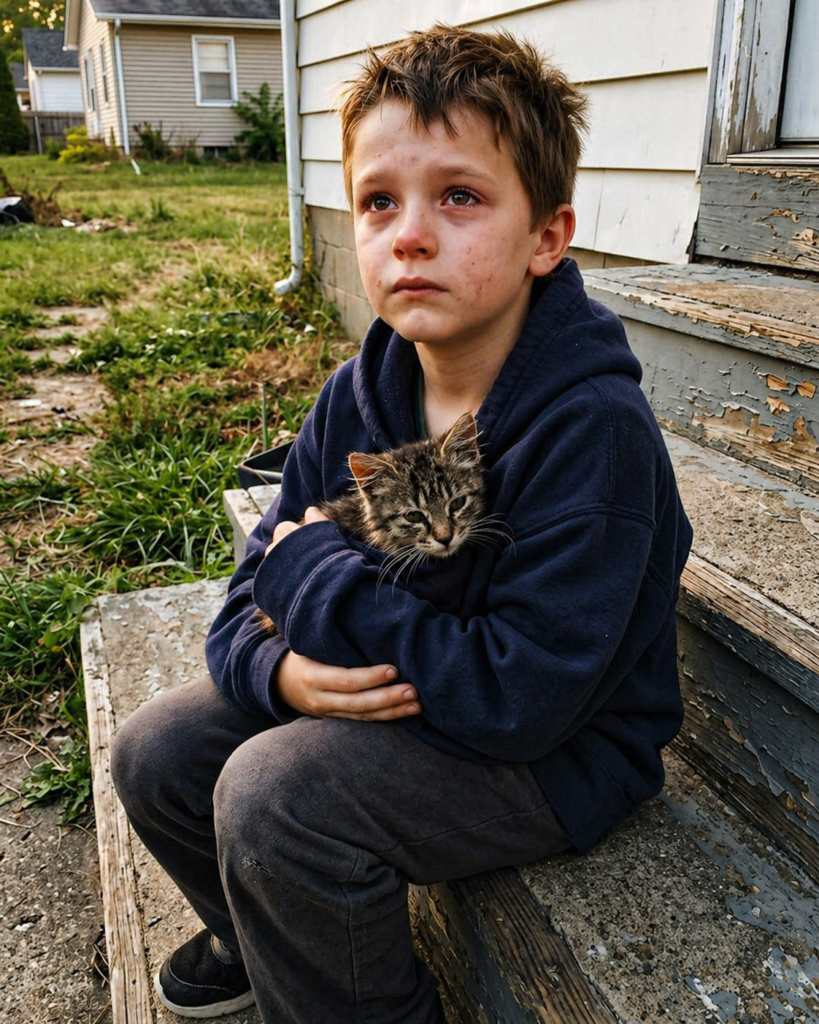
I found Ben sitting on the back steps with Cricket tucked under his hoodie, as if he were protecting something small and fragile.
Cricket was used to being carried.
He had lost one of his back legs before we adopted him, and ever since then, he moved through the world with a hop, a sway, and the kind of stubborn dignity I wish more people had.
Ben looked up at me with red eyes and said, “Maybe I should only let him outside after dark.”
For a second, I thought I had heard him wrong.
“Why?”
He swallowed hard and pressed his cheek against Cricket’s head.
“So nobody has to look at him.”
That was the kind of sentence that did not belong in a nine-year-old boy’s mouth.
I sat down beside him without saying anything at first.
Cricket gave one annoyed little chirp because Ben was holding him too tightly. Even then, he didn’t try to get away. He just settled deeper into Ben’s arms, as if he knew this was not really about him.
A few minutes later, Ben finally told me what had happened.
He had been in the front yard with Cricket, letting him sniff around the flower bed like he always did. The boy next door, Mason, came by carrying his own cat. That cat was one of those picture-perfect animals people stop and admire. Thick white fur. Blue eyes. A fancy little face. The kind of cat that looks like it belongs on a calendar.
Mason had laughed and said, “Why does your cat look like that?”
Ben told him Cricket only had three legs.
Mason shrugged and said, “Mine looks like a real cat. Yours looks strange.”
Then he laughed again.
Not loudly. Not in the harsh way adults sometimes can be.
Just casually.
As if he were commenting on a bent lawn chair or a bruised apple.
That somehow made it worse.
Ben did not cry in front of Mason. He brought Cricket inside, closed the front curtains, and stayed quiet for the rest of the afternoon.
That night, while I was rinsing plates, he asked me, “Do cats know when they don’t look normal?”
I turned off the water.
There are questions that make a mother search for a good answer.
And then there are questions that make her realize the answer is not only for the child who asked it. It is for the hurt sitting underneath.
I dried my hands and went to him.
Cricket was sprawled across Ben’s lap, belly up, with all the confidence of a creature who had never once checked a mirror.
“No,” I said. “I don’t think cats think that way.”
Ben stared down at him.
“Then why do people?”
I wish I could tell you I had a perfect line ready.
I didn’t.
I just said, “Sometimes people are taught to notice what is different before they learn how to notice what is brave.”
Ben’s face fell then, not in a loud way, but in that quiet, heartbreaking way children do when they have been trying very hard to act older than they are.
“When we picked him,” he whispered, “I thought he was the bravest one there.”
“You were right,” I said.
The next afternoon, Ben still would not open the front curtains.
Cricket sat by the window anyway, tail twitching, staring at the strip of sunlight on the rug like he was personally offended by the delay.
I was folding laundry when I saw Mason standing outside near the porch. He was alone this time, hands shoved in his pockets, shoulders pulled up around his ears.
Ben saw him too and froze.
I opened the door before either of them could run away from the moment.
Mason looked at the floor and said, “I came to say sorry.”
Ben said nothing.
Kids can be brutally honest, but they are also easy to read. Mason looked miserable.
“My grandma heard me yesterday,” he said. “She said I sounded mean.”
Still, Ben said nothing.
Mason glanced past him and spotted Cricket hopping across the hallway.
“He really only has three legs,” he said softly, as if it had just become real to him.
Cricket stopped, sat down crooked, and started washing his paw.
Mason watched him for a second and asked, “Does it hurt him?”
“Not anymore,” Ben said.
That opened something.
Ben told him how Cricket could still jump onto the couch when he wanted to. How he ran sideways when he got excited. How he had once stolen a whole slice of turkey off the counter and made it halfway across the kitchen before getting caught.
That made Mason smile.
Then Cricket, who had no interest in anyone’s guilt or personal growth, hopped right over and rubbed himself against Mason’s shin.
Mason looked stunned.
“He likes me?”
“Cricket likes everybody,” Ben said. Then he paused. “Even when they act dumb.”
I bit the inside of my cheek to keep from smiling.
Mason nodded like he deserved that.
Then he crouched down slowly and held out his hand. Cricket leaned into it without hesitation.
Kids do not always need speeches.
Sometimes they need one honest moment that embarrasses them just enough to help them change.
Mason scratched Cricket behind the ear and said, “I thought pretty meant better.”
Ben looked at him, then at Cricket.
“No,” he said. “Just easier to notice.”
That evening, Ben opened the curtains again.
Cricket climbed onto the front windowsill, awkward as ever, one leg missing, one ear nicked, fur sticking up in strange places.
He sat there in the full golden light like he had every right in the world to be seen.
And maybe that was the part that stayed with me most.
Not that a boy said something unkind.
Not even that he came back sorry.
It was the way my son, after one hard day, chose not to hide what he loved.
In a world that teaches kids to admire perfect things, my boy opened the curtain for a three-legged cat.
And that felt like hope to me.
Three days after my son opened the curtains again for his three-legged cat, a grown woman asked if we had a better picture.
That was when I realized the problem had never been just one boy in a front yard.
It was bigger than Mason.
It was older than Mason.
And it wore nicer shoes.
The sign-up table for the school fundraiser was set up in the elementary cafeteria under a string of paper paw prints.
Every spring, the school partnered with a local rescue group and created a pet calendar to raise money.
Parents donated cookies nobody really needed.
Kids dropped spare change into jars painted like little doghouses.
Twelve animals were chosen for the calendar.
One for each month.
Ben had been excited about it all morning.
Not loudly excited.
Not bouncing-off-the-walls excited.
The careful kind of excited.
The kind kids have when something matters enough to scare them.
He had dressed Cricket in the little blue bandana Mason’s grandmother had given him after the apology.
It had tiny white stars on it.
Cricket hated it for exactly four minutes, then forgot it existed and went back to being himself.
Which meant walking like the floor belonged to him.
Looking offended by closed doors.
And acting as though every human in the room had been placed there strictly to admire him.
Ben had taken the photo the night before.
He did not let me help much.
He wanted Cricket on the front porch in the late light, with the old planter behind him and the chipped railing showing.
“Don’t fix him,” he had said when I reached to smooth down the fur on Cricket’s back.
I pulled my hand away.
“I wasn’t fixing him,” I said.
Ben looked at me for a second.
Then he nodded once, like he believed me.
“Good,” he said. “Because I want him to look like Cricket.”
I wish I could say that sentence did not stay with me.
It did.
It stayed with me because children notice everything.
They notice when we straighten a collar.
They notice when we crop a photo.
They notice when love starts to sound a little too much like editing.
So the picture Ben chose was not polished.
Cricket’s fur stuck up around his neck.
One ear bent funny.
His missing back leg showed clearly.
And his face had that calm, half-annoyed expression cats wear when they have decided to tolerate your nonsense.
It was, in my opinion, perfect.
We stood in line behind a girl holding a rabbit in a pink carrier and a boy with a golden dog that looked like it had been brushed by a team of stylists.
Ben kept the photo clutched in both hands.
Mason stood beside him, rocking on his heels.
He had asked if he could come with us.
Not with his cat.
Just with Ben.
That mattered more than he knew.
When it was our turn, the woman at the table smiled too brightly and took Ben’s form.
She had one of those voices adults use when they are trying very hard to sound warm.
The kind that makes every sentence feel pre-approved.
“This is lovely,” she said, glancing down.
Then her eyes landed on the photo.
Her smile flickered.
Just once.
Small enough that maybe another adult would have missed it.
Kids never miss that kind of thing.
Neither do mothers.
“Oh,” she said.
That one word sat there between us.
Not rude.
Not kind.
Just revealing.
Ben straightened.
“This is Cricket,” he said.
The woman recovered quickly.
“Well, he’s certainly… memorable.”
I hate that I remember that exact word.
Not because it was the worst thing anyone could have said.
Because it was not.
Because it was one of those tidy little words people use when they want credit for kindness without doing the real work of being kind.
She looked at me, then back at the photo.
“If you happen to have another one,” she said, lowering her voice as if she were helping us, “sometimes the voting goes better with images that feel a little more cheerful.”
Ben blinked.
I said, “Cheerful?”
She gave a small apologetic laugh.
“You know what I mean. Something where the injury isn’t quite so front and center. Families are usually drawn to the more, well, uplifting entries.”
I stared at her.
There are moments when anger comes in hot.
This was not one of them.
This one came in cold.
Clean.
Sharp enough to slice.
Ben did not look at me.
He kept staring at the table.
At the stack of forms.
At the bowl of wrapped mints.
At anything but that woman’s face.
Mason, to his credit, frowned like someone had handed him a math problem full of lies.
I said, very evenly, “That is the cheerful picture.”
The woman looked embarrassed.
For about half a second.
Then she reached for another pen and did the thing adults do when they want a conversation to keep moving because moving is easier than examining.
“Of course,” she said. “It’s just that fundraising can be tricky. People respond to certain things.”
Ben’s fingers tightened on the edge of the table.
“What things?” he asked.
She looked at him then.
Really looked.
I think she realized too late that he had been listening to every word.
“Well,” she said, flustered now, “just pictures that pop.”
“My cat pops,” Ben said.
It was such a small sentence.
Such a child’s sentence.
Not polished.
Not clever.
And it broke my heart anyway.
The woman opened her mouth, then closed it.
I stepped in before she could make it worse.
“Please use the form as it is,” I said.
She nodded quickly and slid the paper into a folder.
“Of course,” she said again.
That phrase sounded even emptier the second time.
We walked away without taking one of the mints.
Ben made it all the way to the car before he asked the question.
He did not ask it like a child.
He asked it like someone trying not to feel foolish for hoping.
“Would he have a better chance if he looked normal?”
I wish people understood how many different ways there are to hurt a child’s heart.
It is not always name-calling.
It is not always laughter.
Sometimes it is a woman at a folding table teaching him, with perfect manners, which kinds of faces get picked first.
I buckled Cricket’s carrier into the back seat and shut the door.
Then I crouched in front of Ben.
“No,” I said.
He looked at me hard, like he needed more than comfort.
He needed truth.
So I gave him the kind I could.
“He would have an easier chance only if people were shallower than they want to admit.”
Mason snorted.
Not because it was funny.
Because sometimes nine-year-old boys hear the word “shallower” and know it is not a compliment.
Ben still looked wounded.
“But she said families like cheerful pictures.”
I nodded.
“Some people only call something cheerful when it makes them comfortable.”
He was quiet after that.
The ride home felt longer than it was.
Cricket, completely untouched by the moral failure of humanity, shoved one paw through the carrier door and meowed like he had been denied full seating rights.
Mason leaned over and stuck a finger through the grate.
Cricket licked it once, then bit him lightly.
Mason smiled.
“He does pop,” he said.
Ben almost smiled too.
Almost.
At home, he did something that scared me more than tears.
He went very still.
He took off his shoes.
He set Cricket down in the living room.
He sat on the rug and let the cat climb into his lap.
Then he said, “Maybe I should’ve picked a different one.”
I sat across from him.
“There is no different one,” I said.
“I know.”
His voice wobbled.
“I mean a picture where you can’t tell.”
There it was again.
That little, devastating urge to edit what he loved until the world would be gentler to it.
It is amazing how fast children learn that lesson.
It is amazing how many adults never unlearn it.
I looked at Cricket.
He was upside down now, back paws in the air, front paws folded in lazy surrender, as if to say that if anyone had a problem with the arrangement of his body, that sounded deeply personal and not at all his concern.
“Ben,” I said softly, “do you want people to like a picture that isn’t true, or do you want them to see him?”
His face crumpled a little.
Not all the way.
Just enough.
“I want them to see him.”
“I know.”
He swallowed.
“Then why does that feel like asking too much?”
I did not answer right away.
Because I did not trust the first answer in my mouth.
The first answer was anger.
The second answer was sadness.
The third was the one children can actually carry.
“Because a lot of people have been taught to love the polished version first,” I said. “It takes some of them longer to recognize the real one.”
Mason, who was sitting cross-legged nearby, said, “My grandma says grown-ups make weird rules and then act like they found them in nature.”
I looked at him.
He shrugged.
“That’s just what she says.”
That night, Mason’s grandmother came by with a covered dish and the kind of expression older women get when they know exactly why they have been invited without being invited.
Her name was June.
She had silver hair she never bothered to tame and a way of walking into a kitchen like she had known it for twenty years, even if she had only been in it once.
She set the dish on the counter and said, “I made casserole because casserole is what people bring when they don’t know whether to offer comfort or a shovel.”
I laughed despite myself.
Then I cried despite myself.
That was how tired I was.
We sat at the table while the boys played in the living room.
Cricket moved between them like a small, crooked referee.
I told June what had happened at the fundraiser table.
Every word.
She listened without interrupting.
When I finished, she shook her head slowly.
“People are so scared of looking cruel,” she said, “that they settle for being shallow and call it practicality.”
I leaned back in my chair.
“I keep thinking about how gentle she sounded.”
June nodded.
“That’s the trickiest kind. Sharp things wrapped in soft cloth.”
In the other room, Ben and Mason were building something out of blocks for Cricket to ignore.
Mason kept trying to make a tunnel.
Cricket kept sitting on top of it.
June watched them and smiled.
“Do you know what helped Mason yesterday?” she asked.
I looked at her.
“Embarrassment.”
That made me laugh again.
“I’m serious,” she said. “Not punishment. Not a lecture. He saw that cat trust him after he had been unkind. That kind of mercy can make a child feel ashamed in the right direction.”
I thought about that for a while.
Mercy is not something we talk about much anymore without making it sound dramatic.
But there it was in my living room.
A three-legged cat rubbing against the same leg that had stood nearby the day before during an unkind moment.
The next morning, Ben asked if the calendar votes would be online.
I said yes.
He nodded like he was bracing for weather.
When the entries went up two days later, there were dozens of them.
Dogs in bow ties.
Cats in flower crowns.
A rabbit wearing sunglasses.
A bearded lizard on a plaid blanket.
Every animal looked loved.
That part helped.
Then we found Cricket.
Ben had to scroll farther than he should have.
That mattered more than I wanted it to.
His picture was there.
Not hidden.
But not exactly showcased either.
Someone had used the longest, least necessary caption imaginable.
Cricket, a rescue cat with a unique story.
Ben read it out loud.
Then looked at me.
“I wrote his name,” he said. “That’s all.”
I knew.
Which meant somebody had decided his missing leg needed explaining before his actual self did.
That small editorial choice lit something sharp inside me.
Not because it was shocking.
Because it was common.
Because people do that to each other all the time.
They meet a person.
Then immediately make the wound the introduction.
Ben clicked on the comments under some of the entries.
Most of them were sweet.
So cute.
What a smile.
Love those eyes.
Under Cricket’s, there were fewer.
A lot fewer.
Some were kind.
Still adorable.
What a fighter.
Bless him.
I know those comments were meant well.
I do.
But there is a strange loneliness in being loved only as an example of survival.
Ben read one aloud.
“Poor thing.”
He said it flatly.
Then he looked at Cricket, who at that moment had leapt sideways onto the couch, missed slightly, hauled himself up with one front paw, and immediately began trying to steal a cracker from the coffee table.
“Why do people keep saying that?” Ben asked.
I sat beside him.
“Because they are seeing what happened to him before they see who he is.”
He kept scrolling.
Then he stopped.
Mason, sitting on the floor with a juice box, said, “Don’t read the unkind ones.”
Ben did not answer.
I leaned in and saw the comment.
It was from a parent I only vaguely knew.
No last names were visible.
No profile picture worth remembering.
Just the sentence.
I get the lesson, but maybe this isn’t the kind of image little kids need on a school page.
I felt my stomach go hollow.
Not because anonymous unkindness is rare.
Because it never stays anonymous inside a child.
Ben read it once.
Then again.
His face went blank.
That blankness scared me more than tears too.
Mason got to his feet so fast he knocked over his juice.
“That’s dumb,” he said fiercely. “It’s a cat. Not a crime scene.”
I almost laughed.
Almost.
Ben clicked away from the page.
“I don’t want to do it anymore,” he said.
And there it was.
The part no fundraiser woman, no commenter, no careless neighbor ever sees.
Not the moment of the hurtful comment.
The smaller moment after.
The one in the living room.
The one where a child quietly decides it is safer to disappear than to be misunderstood in public.
I said, “You don’t have to keep it up if you don’t want to.”
He looked at me.
I could tell he expected me to push.
To turn it into a lesson.
To say brave things about standing tall.
Sometimes children do not need another speech about courage from adults who are not the ones being stared at.
So I did not.
I just said, “Whatever we do next should be because it feels true. Not because anyone pressured us into it.”
He looked down at Cricket.
Cricket had managed to steal the cracker by then.
Crumbs clung to his whiskers.
He looked like a tiny, disreputable uncle.
Ben’s mouth twitched.
Then he started crying.
Not hard.
Not loudly.
Just the exhausted kind.
The kind that comes when you have tried very hard to handle something in a mature way and your actual age finally shows up to collect you.
I pulled him into me.
He buried his face in my shoulder.
“I hate that I care,” he whispered.
That sentence reached somewhere in me I cannot fully describe.
Because he was nine.
Nine.
And already he thought the goal was not to care.
Already he understood that caring made you easier to hurt.
I held him tighter.
“Caring is not the embarrassing part,” I said. “Being unkind is.”
He cried for another minute.
Then he wiped his face with both hands and asked if Cricket could still maybe go to the school event even if the calendar thing felt stupid.
“Yes,” I said.
“Even if he doesn’t win?”
“Yes.”
“Even if people stare?”
“Yes.”
He sniffed.
Then he said the thing that told me he was still my son.
“Okay. But I don’t want anyone calling him an inspiration unless they know he steals turkey.”
I laughed right into his hair.
“Fair.”
End of Part 1 — Ben decided Cricket would not be hidden, even if the world still had more to learn.
Next Part 2 My Son Tried to Hide His Three-Legged Cat, Then Opened the Curtain Again