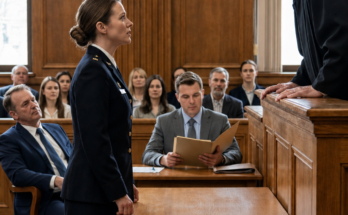
My Father Mocked Me in Court—Then the Judge Opened My File
He Said I Was a Disappointment, Until the Courtroom Learned the Truth
I Stood Alone in Uniform, But My Father Had No Idea What Was Coming
Part 4:
The legal heart of the dispute was my grandfather’s trust.
He had split the family homestead between my father and me. Everyone assumed I would eventually sign over my share.
I didn’t.
Instead, I quietly paid the property taxes. I covered insurance when it was about to lapse. I handled maintenance costs when no one else did.
Not because I wanted praise.
Because the place mattered to my grandfather.
Because if I didn’t help, it would fall apart.
My father decided my refusal to surrender control meant I had abandoned the family. He believed the court would agree.
He didn’t know that every claim in his petition left a paper trail.
And I had been trained to follow trails.
When I filed my response, the clerk asked twice if I was sure I didn’t want a lawyer.
“These cases get complicated when family is involved,” she warned.
“I know,” I said. “But I won’t need one.”
I could have hired someone. I had savings. I had prepared for emergencies my whole adult life.
But this wasn’t about clever arguments.
It was about the truth.
And the truth did not need expensive language.
Now, in the courtroom, the judge looked over the documents.
“Ms. Garrison,” he said, “you may respond.”
I stood slowly.
“I didn’t abandon my family,” I said. “I served my country, and I kept my distance because I was told my presence was unwelcome.”
“That’s not what I said,” my father snapped.
“You said I made you look bad,” I replied. “After enough years, that begins to mean the same thing.”
The judge asked me to address the claims about the property.
I opened my leather case and handed a folder to the clerk. She passed it to the bench.
“These are tax receipts, maintenance records, insurance payments, and trust correspondence,” I explained.
The judge began reading.
The room went quiet.
“These payments have been consistent,” he said, “and they originate from an account in your name.”
“Yes, sir.”
My father gave a short, disbelieving laugh.
“Anyone can send money,” he said. “That doesn’t mean they were present.”
The judge held up one hand, then turned another page.
“You maintained financial responsibility for the property despite not living here,” the judge said. “Why?”
“Because it mattered to my grandfather,” I answered. “And no one else was doing it.”
My father muttered that I was making myself sound noble.
I looked at him.
“You never asked.”
Those three words landed harder than anything else I had said.
The judge turned to my father.
“Mr. Garrison, are you confident that you are fully aware of your daughter’s conduct?”
“Yes,” my father said, straightening.
“Very well,” the judge replied. “Then we will explore that.”
He reached for a thin file with a red tab.
That file contained my service records, commendations, and medical separation paperwork.
I had included them for one reason.
My father had made my character the center of his argument.
Now the court was going to see the full picture.
“Mr. Garrison,” the judge said, “you stated that your daughter’s conduct brought embarrassment to this family.”
“Yes,” my father confirmed.
“Are you familiar with her service record?”
My father waved a dismissive hand.
“I know she enlisted. That is enough.”
The judge’s expression tightened.
“Is it?”
Then he looked down at the file and began reading into the official record.
“According to Department of Defense records, Ms. Garrison led a multi-agency evacuation during Hurricane Silas. She coordinated the rescue and safe movement of forty-seven civilians with no lives lost.”
The room went completely still.
My father blinked.
“What?”
“She received a formal commendation for that operation,” the judge continued.
My father looked at me like I had become someone he did not recognize.
“She never told us,” he whispered.
“That does not mean it didn’t happen,” the judge replied.
My father turned to his lawyer.
“Is that real?”
The lawyer swallowed and nodded.
The judge continued.
“Additionally, the property taxes were paid using her active-duty salary and later her pension.”
My father’s mouth opened slightly, but no words came out.
The judge turned another page.
“The record also shows that Ms. Garrison made anonymous donations to the local Veterans Relief Fund for six years. The anonymity was only lifted because the source of the funds became relevant today.”
My father looked at me with uncertainty.
“You did that?”
“I didn’t think it mattered who did it,” I said.
The judge closed the file.
“Mr. Garrison, you argued that your daughter was an embarrassment to this family. The evidence before this court suggests the opposite.”
My father’s attorney quickly stood.
“Your Honor, we request a brief recess.”
“Denied,” the judge said.
Then the courtroom became silent again.
“This court does not find grounds to transfer authority to the petitioner,” the judge ruled. “Ownership remains as documented.”
He lifted the gavel, then paused and looked at my father one final time.
“Mr. Garrison, sometimes what reflects poorly on a family is not what its members do. Sometimes it is what we choose not to see.”
The gavel came down.
And just like that, the case my father thought was already won was over.
Final Ending:
People began leaving the courtroom, but my father stayed in his seat.
For once, he wasn’t speaking.
He stared down at his hands as if they belonged to someone else.
I gathered my papers slowly and placed them back into my leather case. I could feel eyes on me, but I didn’t look around.
I had spent too many years trying not to be seen by the wrong people.
Now I didn’t need anyone’s reaction to prove what was true.
When I passed my father’s table, he looked up.
His face was different.
Not softer exactly, but less certain.
“I didn’t know,” he said quietly.
I stopped beside him.
“You never asked,” I replied.
He leaned back in his chair, and for the first time in my life, I saw something close to regret move across his face.
“I was wrong,” he said.
For a man like my father, those three words were enormous.
I didn’t cry.
I didn’t hug him.
I didn’t tell him everything was forgiven.
Some truths are too heavy to fix in one hallway.
So I simply nodded.
“Yes,” I said. “You were.”
Afterward, I stood near the courthouse window and looked outside. The clouds had started to break. A man in a veteran’s cap passed me in the hallway and quietly thanked me for my service.
I thanked him back.
Then I walked outside.
The air felt cleaner than it had that morning.
When I drove home, Duke met me at the door, tail moving slowly but faithfully. I sat beside him on the porch and watched the evening light fall across the yard.
For the first time in a long while, the world felt like it had reset itself.
The next morning, my mother called.
“Your father has been sitting on the porch all day,” she said softly. “He hasn’t said much.”
A week later, she left cookies on my porch.
Two weeks later, my father’s name appeared beside mine on the tax documents, not above mine, not instead of mine, but beside mine.
Eventually, he began asking questions.
Not all at once.
Not in a dramatic way.
He asked about my service. He asked what my work had been like. He asked about the things he had spent years refusing to see.
We started working on the property together.
We fixed fences.
We cleared the orchard.
We repaired the porch steps.
Most of the time, we didn’t say much.
But the work itself became a kind of language.
We never had a grand reconciliation. No perfect speech. No sudden healing that erased the past.
But we had the orchard.
We had the fence lines.
We had the quiet.
And slowly, that became enough.
The last time we were at the orchard together, I carved my new initials into the porch rail with my grandfather’s old knife.
E.G.T.
My father watched me carefully.
For once, he didn’t correct me.
He didn’t question me.
He didn’t look away.
He simply stood there and saw me.
Not as a disappointment.
Not as a runaway.
Not as a stain on the family name.
But as the daughter who had always been there, waiting for him to finally look close enough to understand.
THE END.
______________________________________________________________________
- My Father Mocked Me in Court—Then the Judge Opened My File…
 My Father Mocked Me in Court—Then the Judge Opened My FileHe Said I Was a Disappointment, Until the Courtroom Learned the TruthI Stood Alone in Uniform, But My Father Had …
 - My Father Mocked Me in Court—Then the Judge Opened My File…My Father Mocked Me in Court—Then the Judge Opened My FileHe Said I Was a Disappointment, Until the Courtroom Learned the TruthI Stood Alone in Uniform, But My Father Had …
- My Father Mocked Me in Court—Then the Judge Opened My File…My Father Mocked Me in Court—Then the Judge Opened My FileHe Said I Was a Disappointment, Until the Courtroom Learned the TruthI Stood Alone in Uniform, But My Father Had …
- My Father Mocked Me in Court—Then the Judge Opened My File…My Father Mocked Me in Court—Then the Judge Opened My FileHe Said I Was a Disappointment, Until the Courtroom Learned the TruthI Stood Alone in Uniform, But My Father Had …
- [FULL STORY] For Three Months, My Husband’s Side of the Bed Had a Terrible Smell… When I Finally Opened the Mattress, the Truth Changed Everything
 For three long months, every night I lay beside my husband, I was haunted by a smell so unpleasant that it turned my stomach and kept me awake in the …