Two years after losing my wife and our six-year-old son in a car accident, I was living, but barely.
My name is Michael Ross. I was forty years old, and from the outside, people probably thought I was surviving. I went to work. I paid the bills. I answered messages when I had to. I nodded when people asked if I was doing okay.
But inside, everything had gone quiet.
My wife, Lauren, and our little boy, Caleb, had been taken from me in a crash caused by an impaired driver. One moment, they were on their way home. The next, I was standing in a hospital hallway while a doctor looked at me with the kind of sadness that tells you the truth before the words even come.
“I’m so sorry,” he said.
That was when my old life ended.
After the funeral, the house no longer felt like home. Lauren’s coffee mug still sat near the machine. Caleb’s sneakers were still by the front door. His drawings were still on the refrigerator, held up by colorful magnets he had picked out himself.
I stopped sleeping in the bedroom. I slept on the couch with the television on, not because I was watching anything, but because silence felt too heavy.
People told me, “You’re so strong.”
I wasn’t strong.
I was just still breathing.
About a year after the accident, I was on that same couch at two in the morning, scrolling through Facebook because sleep would not come. I passed posts about politics, pets, family vacations, and people sharing dinner photos.
Then one post stopped me.
It was from a local child welfare page.
The headline read: “Four siblings need a home.”
There was a photo of four children sitting close together on a bench. The caption explained that they were ages three, five, seven, and nine. Their parents had passed away. No extended family member was able to care for all four of them. If a home was not found soon, they would likely be placed in separate adoptive families.
One line seemed to reach through the screen and press against my chest.
“They will likely be separated.”
I stared at the picture.
The oldest boy had his arm around the girl beside him. The younger boy looked restless, as if he had been caught between moving and sitting still. The smallest girl clutched a stuffed bear and leaned into her brother.
They did not look hopeful.
They looked like children preparing themselves for one more loss.
I opened the comments.
“So heartbreaking.”
“Shared.”
“Praying for them.”
But no one was saying, “We’ll take them.”
I put my phone down.
Then I picked it up again.
I knew what it felt like to walk out of a hospital alone. I knew what it felt like to have your whole world disappear in a single day. Those children had already lost their parents. Now, on top of that, the system was preparing to separate them from each other.
I barely slept that night. Every time I closed my eyes, I imagined four children sitting in an office, holding hands, waiting to hear which one had to leave.
The next morning, the post was still open on my phone. There was a number at the bottom.
Before I could talk myself out of it, I called.
“Child Services, this is Karen,” a woman answered.
“Hi,” I said, my voice rough from lack of sleep. “My name is Michael Ross. I saw the post about the four siblings. Are they still needing a home?”
There was a pause.
“Yes,” she said carefully. “They are.”
“Can I come in and talk about them?”
She sounded surprised, but kind. “Of course. We can meet this afternoon.”
On the drive there, I kept telling myself I was only asking questions.
But deep down, I already knew that was not true.
Karen’s office was small, with file cabinets against the wall and children’s drawings taped near the door. She placed a folder on the table between us.
“They’re good kids,” she said softly. “They’ve been through a lot.”
She opened the file.
“Owen is nine. Tessa is seven. Cole is five. Ruby is three.”
I repeated the names silently.
Owen. Tessa. Cole. Ruby.
“Their parents passed away in a car accident,” Karen continued. “They’re currently in temporary care, but we haven’t found anyone able to keep them together.”
“What happens if no one takes all four?” I asked.
Karen exhaled. “Then they will be placed separately. Most families can’t take four children at once.”
“Is that what you want?”
“No,” she said. “But it’s what the system allows when there are limited options. It isn’t ideal.”
I looked down at the file.
Then I said the words before fear could stop me.
“I’ll take all four.”
Karen’s eyes lifted. “All four?”
“Yes,” I said. “I know there’s a process. I know it won’t happen overnight. But if the only reason they’re being separated is because nobody wants four children together… I do.”
She studied my face.
“Why?”
I swallowed hard.
“Because they already lost their parents,” I said. “They shouldn’t have to lose each other too.”
That answer started months of paperwork, background checks, home visits, interviews, and appointments. I met with a therapist as part of the process. She asked me how I was handling my grief.
“Badly,” I admitted. “But I’m still here.”
The first time I met the children, it was in a visitation room with ugly chairs, a low table, and bright fluorescent lights. All four of them sat together on one couch, shoulders touching, knees pressed close.
I sat across from them.
“Hey,” I said gently. “I’m Michael.”
Ruby hid her face against Owen’s shirt. Cole stared at my shoes. Tessa folded her arms and lifted her chin like she had already decided not to trust me. Owen watched me with the serious eyes of a child who had been forced to grow up too fast.
“Are you the man who’s taking us?” Owen asked.
“If you want me to be,” I said.
“All of us?” Tessa asked quickly.
I nodded. “All of you. I’m not interested in taking just one.”
Her expression changed, just a little. “What if you change your mind?”
“I won’t,” I said. “You’ve had enough people change things on you already.”
Ruby peeked out from behind Owen’s sleeve.
“Do you have snacks?” she whispered.
For the first time that day, I smiled.
“Yes,” I said. “I always have snacks.”
Karen laughed softly behind me.
The process was not easy, and I would never pretend it was. There were court dates, forms, evaluations, and questions that made me nervous. At one hearing, the judge looked directly at me.
“Mr. Ross, do you understand that you are assuming full legal and financial responsibility for four minor children?”
“Yes, Your Honor,” I said.
I was scared.
But I meant it.
The day they moved in, my house stopped echoing.
Four sets of shoes lined up near the door. Four backpacks landed in a pile. The quiet rooms filled with movement, questions, arguments, laughter, and the sound of small feet running down the hall.
The first weeks were hard.
Ruby woke up crying for her mother almost every night. I would sit on the floor beside her bed until she fell asleep again, her little hand wrapped around two of my fingers.
Cole tested every rule he could find.
“You’re not my real dad!” he shouted once when I told him no.
“I know,” I said calmly. “But the answer is still no.”
Tessa watched everything. She hovered in doorways, studied my face, and stayed ready to step in if she thought her brothers or sister needed protecting.
Owen tried to parent everyone. He tied shoes, answered for Ruby, corrected Cole, and reminded Tessa where she had left her homework. He was nine years old and carrying a weight no child should have to carry.
Some nights, after everyone was finally asleep, I sat on the bathroom floor with the door closed just to breathe.
I burned dinner more than once. I stepped on Legos in the dark. I forgot school spirit day. I signed forms at the last minute. I learned that silence could be painful, but noise could also be overwhelming.
And yet, slowly, the house became alive again.
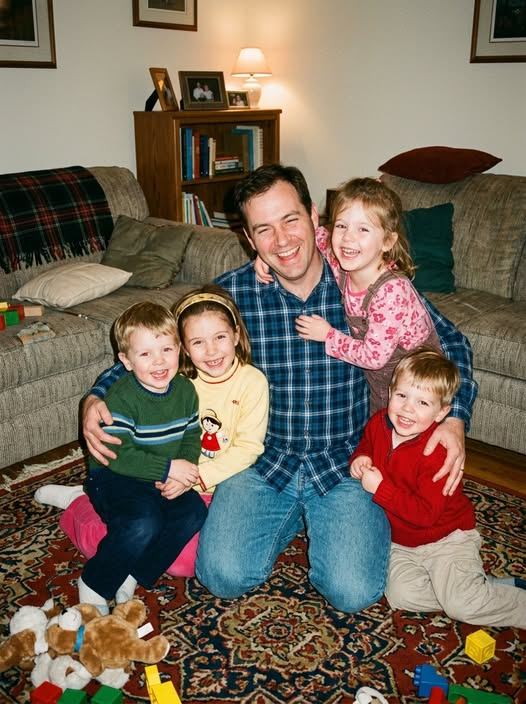
Ruby fell asleep on my chest during movies. Cole handed me a crayon drawing of five stick figures holding hands and said, “This is us. That’s you.”
Tessa slid a school form across the table one evening and asked, “Can you sign this?” She had written my last name after hers.
I looked at it for a long moment before signing.
One night, Owen stopped in my doorway.
“Goodnight, Dad,” he said.
Then he froze, as if the word had slipped out before he could catch it.
I pretended it was normal because I didn’t want to make him feel embarrassed.
“Goodnight, buddy,” I said.
But inside, something in me shook.
About a year after the adoption was finalized, life looked normal in the messy, beautiful way family life does. There were school drop-offs, homework battles, soccer practices, doctor appointments, lost socks, bedtime negotiations, and arguments about screen time.
The house was loud.
The house was full.
And for the first time in years, I did not dread coming home.
One morning, after dropping the kids off at school and daycare, I returned home to start work. I had just poured coffee when the doorbell rang.
I was not expecting anyone.
When I opened the door, a woman in a dark suit stood on the porch holding a leather briefcase.
“Good morning,” she said. “Are you Michael Ross? The adoptive father of Owen, Tessa, Cole, and Ruby?”
My heart tightened immediately.
“Yes,” I said. “Are they okay?”
“They’re fine,” she said quickly. “I should have started with that. My name is Susan. I was the attorney for their biological parents.”
I stepped aside. “Please come in.”
We sat at the kitchen table. I pushed aside cereal bowls, crayons, and a half-finished drawing Ruby had left behind.
Susan opened her briefcase and removed a folder.
“Before their passing, their parents came to my office to prepare a will,” she explained. “They were young and healthy, but they wanted to plan ahead.”
My chest felt heavy.
“In that will, they made provisions for the children,” she continued. “They also placed certain assets into a trust.”
“Assets?” I asked.
“A small house,” she said. “And some savings. Not a fortune, but meaningful. Legally, it belongs to the children.”
“To them?”
“To them,” she confirmed. “You are listed as guardian and trustee. You may use the funds for their needs, but the property and remaining assets belong to the children. When they become adults, whatever remains will be theirs.”
I leaned back, trying to take it in.
“Okay,” I said quietly. “That’s good. That’s really good.”
Susan looked down at the folder again.
“There’s one more important thing.”
I waited.
“Their parents were very clear that they did not want their children separated. They wrote that if they were ever unable to raise them, they wanted all four children kept together in the same home with one guardian.”
For a moment, I could not speak.
While the system had been preparing to separate them, their parents had already written down the one thing they wanted most.
Keep our children together.
They had tried to protect them, even from beyond their own lifetime.
Susan looked at me gently.
“You did exactly what they asked,” she said. “Without ever seeing this.”
My eyes burned.
“Where’s the house?” I asked.
She gave me the address.
It was across town.
That weekend, I loaded all four kids into the car.
“We’re going somewhere important,” I told them.
“Is it the zoo?” Ruby asked from her car seat.
“Is there ice cream?” Cole added.
“There might be ice cream after,” I said, “if everyone behaves.”
We pulled up in front of a small beige bungalow with a maple tree in the yard.
The car went quiet.
Tessa leaned forward slowly.
“I know this house,” she whispered.
Owen’s voice was even softer.
“This was our house.”
I looked at them through the rearview mirror. “You remember it?”
All four nodded.
I unlocked the door with the key Susan had given me.
Inside, the house was empty, but the children moved through it like their memories had been waiting there. Ruby ran toward the back door.
“The swing is still there!” she shouted.
Cole pointed to a wall in the hallway.
“Mom marked our heights here,” he said. “Look.”
Faint pencil lines were still visible beneath the paint.
Tessa stood in a small bedroom, touching the window frame.
“My bed was there,” she said. “I had purple curtains.”
Owen walked into the kitchen and placed one hand on the counter.
“Dad burned pancakes here every Saturday,” he said with a small smile.
For a while, I let them explore. I stood back and watched them remember.
Then Owen came back to me.
“Why are we here?” he asked.
I crouched so I was at his level.
“Because your mom and dad took care of you,” I said. “They put this house and some money in your names. It belongs to you four. For your future.”
Tessa’s eyes filled.
“Even though they’re gone?”
I nodded. “Even though. They planned for you. They loved you that much.”
Owen’s face changed.
“They didn’t want us split up?”
“No,” I said. “Not ever. That part was very clear.”
He looked around the empty house, then back at me.
“Do we have to move here now?” he asked. “I like our house. With you.”
I shook my head.
“No. We don’t have to do anything right now. This house isn’t going anywhere. When you’re older, we’ll decide what to do with it together.”
Ruby climbed into my lap and wrapped her arms around my neck.
Cole wiped his face with his sleeve and asked, “Can we still get ice cream?”
I laughed through the tightness in my throat.
“Yes, bud. We can definitely still get ice cream.”
That night, after the kids were asleep back in our crowded rental, I sat on the couch and looked around.
There were four toothbrushes in the bathroom now. Four backpacks near the door. Four pairs of shoes I was always tripping over. Four voices yelling “Dad!” when I walked in carrying pizza.
I still missed Lauren and Caleb every day. I always would. Grief does not disappear just because life gives you something beautiful again.
But I had learned that love could grow around grief. It could make room. It could bring noise back into a silent house.
I did not call Child Services because of a house or a trust. I did not know any of that existed.
I called because four siblings were about to lose each other, and something in me could not let that happen.
The rest was their parents’ final way of saying thank you for keeping them together.
I am not their first dad.
But I am the man who saw a late-night post, picked up the phone, and said, “All four.”
And now, when they pile onto me during movie night, stealing my popcorn, arguing over blankets, and talking over the movie, I look at them and think the same thing every time.
This is what their parents wanted.
Us.
Together.