Rain hammered John Katon’s windshield so hard the wipers could barely keep up.
Cleveland looked hollow beneath the storm, all blurred streetlights, flooded gutters, and dark houses sitting behind sheets of water. John pulled his truck into his daughter Renee’s driveway at nine o’clock on a Tuesday night and sat there for a moment, staring at the house through the windshield.
No front room light.
No glow behind the curtains.
No television flicker.
That was wrong.
Renee always left the front room lamp on when Caleb was awake. Her eight-year-old son hated dark corners, and John had fixed that lamp himself after Caleb told him the room felt less scary when it was bright.
Small things mattered to children.
Especially children who needed proof that someone was still watching over them.
At fifty-eight, John had spent most of his life operating heavy machinery. That kind of work taught a man to trust warning signs. When a machine sounded wrong, you stopped it. When a load shifted wrong, you moved fast. And when a house with a sick child inside sat dark and silent at night, you did not drive away.
He killed the engine.
Rain soaked his jacket before he reached the front door. His boots splashed through puddles as he knocked hard.
“Renee,” he called. “It’s Dad.”
No answer.
He knocked again, louder this time.
The door cracked open just enough for Harrison Boone’s face to appear. Harrison was John’s son-in-law, thirty-six years old, with stubble on his jaw and irritation in his eyes.
“What do you want, John?” Harrison muttered. “It’s late.”
“I came to check on Caleb.”
“He’s sick,” Harrison said. “He’s fine. Go home.”
John looked past him into the dim hallway. The smell hit him even through the rain—stale beer, cigarette smoke, old food, and something sour underneath.
“I’ll see for myself.”
Harrison shifted into the doorway, but John pushed past him before the younger man could decide whether he was brave enough to stop him.
The living room was worse than the smell promised.
Empty bottles crowded the coffee table. Pizza boxes sat open on the floor. Ashtrays overflowed. A blanket had been kicked into a corner. A stained pillow sat under the window where the lamp should have been glowing.
But John only looked at the couch.
Caleb lay there motionless.
Eight years old. Small for his age. Swallowed by an oversized sweatshirt and a blanket that had slipped halfway off his body. His skin looked gray in the dim light, and his lips had a faint bluish tint that made John’s blood go cold. Dark circles ringed his closed eyes. His chest moved, but barely.
Each breath was shallow.
Thin.
Wrong.
“Oh, Caleb,” John whispered.
He crossed the room in three strides and dropped beside the couch. He pressed his palm to Caleb’s forehead, then his cheek.
Cold and clammy.
Not feverish like Harrison had suggested.
Something far worse.
“Buddy,” John said, forcing his voice to stay calm. “Can you hear me?”
Caleb did not respond.
John checked for a pulse. Weak, but there.
His stomach tightened.
“What happened to him?” John asked.
Harrison dropped into the recliner like the question bored him.
“Kid wouldn’t stop crying all day,” he said. “Kept whining about being thirsty and hungry. So we shut him up.”
The words hit John like a hammer.
“You shut him up?”
Harrison waved one hand.
“Told him to knock it off and go to sleep. Sometimes kids need firmness.”
Heavy footsteps came from the kitchen.
Marlene Boone appeared with a beer in one hand. Harrison’s mother was sixty, with greasy gray hair and a mouth permanently fixed in a sneer.
“Oh, it’s you,” she said. “Come to stick your nose where it doesn’t belong again?”
John stood slowly.
“This boy needs a hospital.”
“Kids get sick,” Marlene said, waving her drink like she was brushing away a fly. “He’ll be better by morning.”
“Look at him,” John said, his voice low. “Really look at him.”
Harrison glanced at Caleb with the same interest a man might give a broken appliance.
“He’s just tired. Been sleeping most of the day.”
“When did he last eat?” John asked.
Harrison frowned.
“Yesterday, maybe. Hard to keep track.”
John felt his self-control begin to fray.
“What about water?”
“There’s a faucet in the kitchen,” Harrison said. “Kid knows where it is.”
For one terrible second, the room went still.
John looked at Harrison, then at Marlene, and saw the truth sitting there in plain sight.
Not confusion.
Not panic.
Not overwhelmed adults who had misjudged a child’s illness.
These were people who had looked at a child fading on a couch and decided his need was an inconvenience.
Rage rose in John’s chest, but rage would not help Caleb.
Caleb needed doctors.
Caleb needed fluids, warmth, scans, and someone who cared whether he survived the night.
John forced his hands open.
“I’m taking him to the emergency room.”
“Like hell you are,” Harrison snapped. “That’s my son. I decide what happens to him.”
“Your son?” John gave a bitter laugh. “When did you start acting like it?”
Marlene stepped between him and the couch.
“You’ve got no rights here, old man.”
John met her stare.
“Move.”
“Make me.”
The words hung in the room, stupid and dangerous.
John had spent his life around machines that could crush a man for one wrong move. He knew when to push and when to step back.
This was not a time to step back.
“I’m taking my grandson to the hospital,” John said. “Call the police if you want. But before you do, ask yourself if you really want officers walking through this house and asking why an eight-year-old boy is lying here like this.”
Harrison’s face went pale.
Marlene’s mouth opened, but no sound came out.
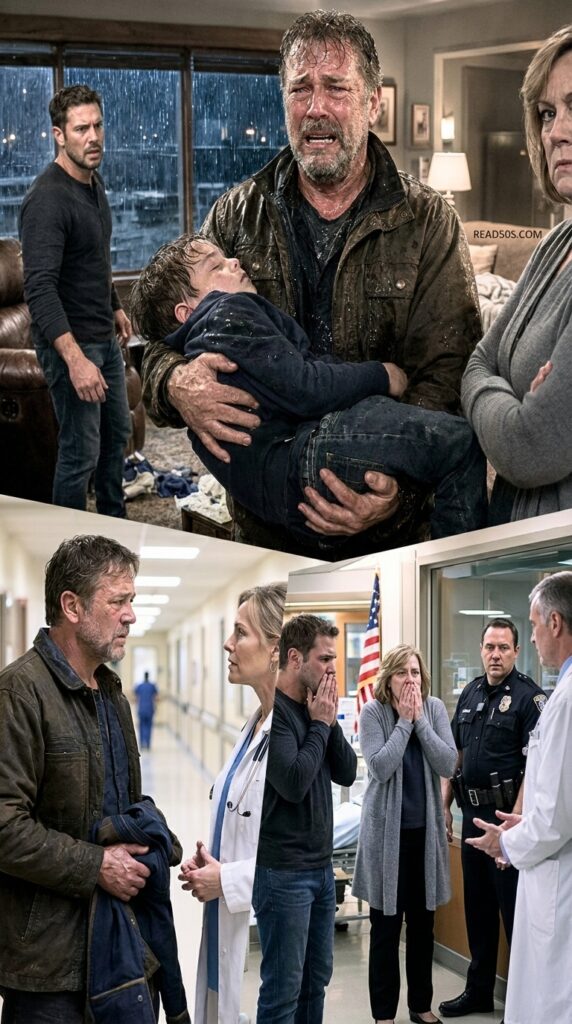
John brushed past her and scooped Caleb into his arms.
The boy weighed almost nothing.
That detail nearly broke him.
Not the gray skin. Not the weak pulse. Not even the shallow breathing.
It was how light Caleb felt, like a child slowly emptied out while adults stepped over him.
Caleb’s head rested against John’s shoulder.
“If something happens because you waited too long—” Harrison started.
John turned back.
“If something happens,” he said, “it will be because you left him like this.”
Then he carried his grandson into the storm.
Rain poured over them as John reached the truck. He settled Caleb carefully in the passenger seat, buckled the seat belt around his small frame, and tucked his own jacket around him for warmth.
Caleb gave a faint moan.
“Hang on, buddy,” John whispered. “We’re going to get help.”
The drive to Cleveland General felt endless.
Every red light stretched like punishment. Every slow car ahead of him made John’s hands tighten around the wheel. Beside him, Caleb remained limp, his breathing growing rougher with every mile.
John had made many promises in his life.
Some he had kept.
Some he had failed.
But as he drove through the storm with his grandson fading beside him, he made a new one.
They would never leave Caleb alone like that again.
The emergency room at Cleveland General blazed with harsh fluorescent light. John carried Caleb through the automatic doors with rain dripping from his jacket and boots leaving dark marks across the polished floor.
“I need help,” he called.
The triage nurse looked up, and her eyes widened the moment she saw Caleb.
“What happened?”
“I found him like this,” John said. “He’s been sick for days, maybe longer. They wouldn’t get him help.”
“Who’s they?”
John swallowed the bitterness in his throat.
“His parents. My daughter and her husband.”
Within minutes, Caleb was taken into an examination room. John paced outside while nurses connected monitors, started fluids, adjusted oxygen, and spoke in quick, urgent voices.
Through the partially open door, he saw Caleb lying on the narrow bed, dwarfed by wires and machines.
“Mr. Katon?”
John turned.
A woman in a white coat approached. She was somewhere in her forties, with tired eyes and graying brown hair pulled back.
“I’m Dr. Celia Monroe. I’ve been examining your grandson.”
“How is he?”
Her expression stayed controlled, but John saw anger beneath it.
“Why don’t we sit down?”
“I’ll stand,” John said. “Just tell me.”
She took a breath.
“Caleb is severely dehydrated. His blood work shows signs of repeated malnutrition over an extended period. He has also sustained a concussion that could have become much worse if left untreated much longer.”
The words landed like hammer blows.
Dehydrated.
Malnutrition.
Concussion.
“How long?” John asked. “How long has this been happening?”
“Based on his weight and muscle condition, I would estimate weeks,” Dr. Monroe said gently. “Possibly months of inadequate nutrition.”
John’s hands curled.
“And the concussion?”
Her jaw tightened.
“Head trauma. Consistent with force, not a simple minor bump.”
For a moment, the hallway seemed to tilt.
John thought of Harrison saying Caleb had been crying, so they “shut him up.” He thought of Marlene saying the boy would be better by morning. He thought of the dark living room, the empty bottles, and a child left on a couch like his suffering was background noise.
“Will he be okay?” John asked.
Dr. Monroe looked toward the room.
“We’re doing everything we can.”
A short while later, Renee arrived at the hospital with rain in her hair and fear all over her face.
“Dad,” she cried. “Where’s Caleb? Is he—”
“He’s alive,” John said. “Barely.”
Renee’s face crumpled.
“I didn’t know it was this bad. Harrison said he was sleeping. He said he had been difficult and needed rest.”
Dr. Monroe stepped closer.
“Mrs. Boone, I need to ask you some direct questions. When did Caleb last have a proper meal?”
Renee opened her mouth, then stopped.
“I work double shifts,” she whispered. “Harrison said he was feeding him.”
“Children do not sleep for days without food or water,” the doctor said. “They cry. They ask. They show signs.”
Renee’s eyes filled.
“He did cry,” she whispered. “Harrison said he was acting out.”
John looked at his daughter.
For the first time, he saw it clearly.
The exhaustion. The fear. The way she flinched when Harrison’s name came up. The way she had become smaller inside her own life.
“What has he done to you?” John asked quietly.
Renee shook her head.
“Dad, please.”
“When did you start being afraid to come home?”
“I’m not—”
“Renee.”
Her face broke.
“I can’t fight him,” she whispered. “You don’t know what he’s like when he gets angry.”
“Then leave him.”
“It’s not that simple.”
“It is now,” John said. “You take Caleb, and you come with me.”
“He’ll never let me leave.”
“He doesn’t get to decide anymore.”
Renee sank into a chair, crying into her hands.
“I thought if I worked more, brought in more money, he’d be less stressed. I thought if I stayed quiet, he wouldn’t get worse. I thought I was protecting Caleb by not making Harrison angry.”
John knelt in front of her.
“You were surviving,” he said. “But Caleb needs more than survival now. He needs protection.”
Renee looked toward the hospital room where her son lay connected to machines.
Something changed in her face.
Fear was still there.
But beneath it, something else appeared.
A spark.
“I want out,” she whispered. “I want my son safe.”
“Then we start now,” John said.
Child protective services was contacted. Hospital records were documented. Dr. Monroe filed a report. A social worker named Tanya Ruiz arrived before dawn and listened carefully as Renee described the threats, the isolation, the way Harrison controlled her phone, her money, her schedule, her friendships, and even her fear.
The truth came out in pieces.
Harrison had made Renee quit nursing school years earlier.
He had pushed her into double shifts at the diner, then blamed her for being away.
He checked her phone.
He kept her from friends.
He told her John hated her choices and would never help.
And whenever Caleb cried, Harrison called him weak.
Renee had not seen all of it.
But deep down, she had suspected enough to feel ashamed.
“I should have known,” she said.
John took her hand.
“You know now. That is where we begin.”
Caleb spent the next several days in the hospital. Slowly, his color improved. Fluids helped. Food came carefully and gradually. His breathing steadied. When he finally opened his eyes and whispered, “Grandpa?” John had to step into the hallway because he could not stop crying.
Renee stayed beside her son every day.
At first, Caleb flinched whenever a male voice sounded too loud in the hallway. He hid his face when a tray clattered. He asked twice if he had to go back home.
Renee held him and said, “No, baby. Not to that house. Not with him.”
John watched his daughter say it, and for the first time in years, he recognized the girl he had raised.
The legal process was not easy.
Harrison denied everything.
Marlene claimed John was exaggerating.
They said Caleb was “sensitive.” They said Renee was dramatic. They said John had interfered where he did not belong.
But the evidence was stronger than their lies.
Medical records showed long-term neglect. Dr. Monroe testified that Caleb’s condition was not a simple childhood illness. Tanya presented the reports. Renee gave her statement. A teacher remembered Caleb coming to school tired and asking for extra snacks. A neighbor admitted hearing shouting at night.
And then Renee found the recordings.
Short audio clips she had secretly saved over the years.
Harrison threatening her.
Harrison calling Caleb weak.
Harrison warning that if Renee ever left, she would “regret taking what belonged to him.”
In court, Harrison looked smaller than John remembered.
Without the dim living room, without the beer, without fear protecting him, he was just a man trying to explain away cruelty.
Judge Patricia Hernandez reviewed the records with a face like stone.
After hours of testimony, she finally spoke.
“Based on the medical evidence, witness statements, and recorded threats, this court finds credible evidence that Caleb Boone is not safe in his father’s care.”
Renee’s hand flew to her mouth.
John closed his eyes.
Emergency custody was granted to Renee. Harrison was ordered to stay away from Caleb and Renee. Marlene was barred from contact. Further criminal investigation continued, and Harrison was later arrested after violating the protective order by showing up near the hospital parking lot and trying to pressure Renee into dropping the case.
This time, Renee did not freeze.
She called the police.
John stood beside her while officers led Harrison away.
Harrison glared at her and said, “You’ll regret this.”
Renee lifted her chin.
“No,” she said. “I regret not doing it sooner.”
Months passed.
Caleb moved into John’s house with Renee while she rebuilt her life. John turned the spare bedroom into a bright room with blue curtains, a new bookshelf, and a night-light shaped like a moon.
The first week, Caleb slept with the hallway light on.
The second week, he asked if Grandpa could leave the door open.
By the third month, he slept through the night.
He gained weight. His cheeks filled out. He began smiling again. He started drawing trucks and dinosaurs and houses with yellow windows. In every drawing, there were three people standing outside.
Grandpa.
Mom.
Caleb.
Renee returned to nursing school part-time. It was not easy. Some days she cried over textbooks at the kitchen table after Caleb went to sleep. Some days she doubted herself. Some days she apologized to John for needing help.
Every time, John told her the same thing.
“You are not a burden. You are coming back to life.”
One evening, almost a year after the storm, John found Caleb sitting on the porch steps with a blanket around his shoulders.
“You okay, buddy?”
Caleb nodded.
“Grandpa?”
“Yeah?”
“Why did you come that night?”
John sat beside him.
“Because I had a feeling something was wrong.”
Caleb looked down at his hands.
“I tried to be quiet. I thought if I was quiet, nobody would be mad.”
John’s chest tightened.
“You never have to earn care by being quiet,” he said. “If you’re hungry, you tell us. If you’re scared, you tell us. If you’re hurt, you tell us. That’s what family is supposed to be.”
Caleb leaned into him.
“Are we safe now?”
John wrapped an arm around his grandson.
“Yes,” he said. “We are safe now.”
Inside the house, Renee stood in the kitchen doorway, watching them with tears in her eyes.
For years, Harrison had made her believe fear was normal.
But that night, watching her father hold her son beneath the porch light, Renee finally understood something.
Family was not the people who demanded your silence.
Family was the people who came through the storm, carried you out, and stayed until the lights came back on.
And John?
He still remembered the weight of Caleb in his arms that night.
Too light.
Too pale.
Too still.
He remembered the dark house, the rain, the smell of neglect, and the two adults who had treated a child’s pain like an inconvenience.
But he also remembered what came after.
The hospital lights.
The truth.
The judge’s order.
Renee’s courage.
Caleb’s first real smile after coming home.
That was the ending he held on to.
Not the darkness of what nearly happened.
But the proof that one person trusting their instinct can change everything.
━━━━━━━━━━━━━━━━━━━━━━━━━━━━━━━━━━━━━━