PART 2 — FULL CONTINUATION WITH COMPLETE ENDING:
For several seconds, the courtroom was so quiet I could hear the faint buzz of the lights above us.
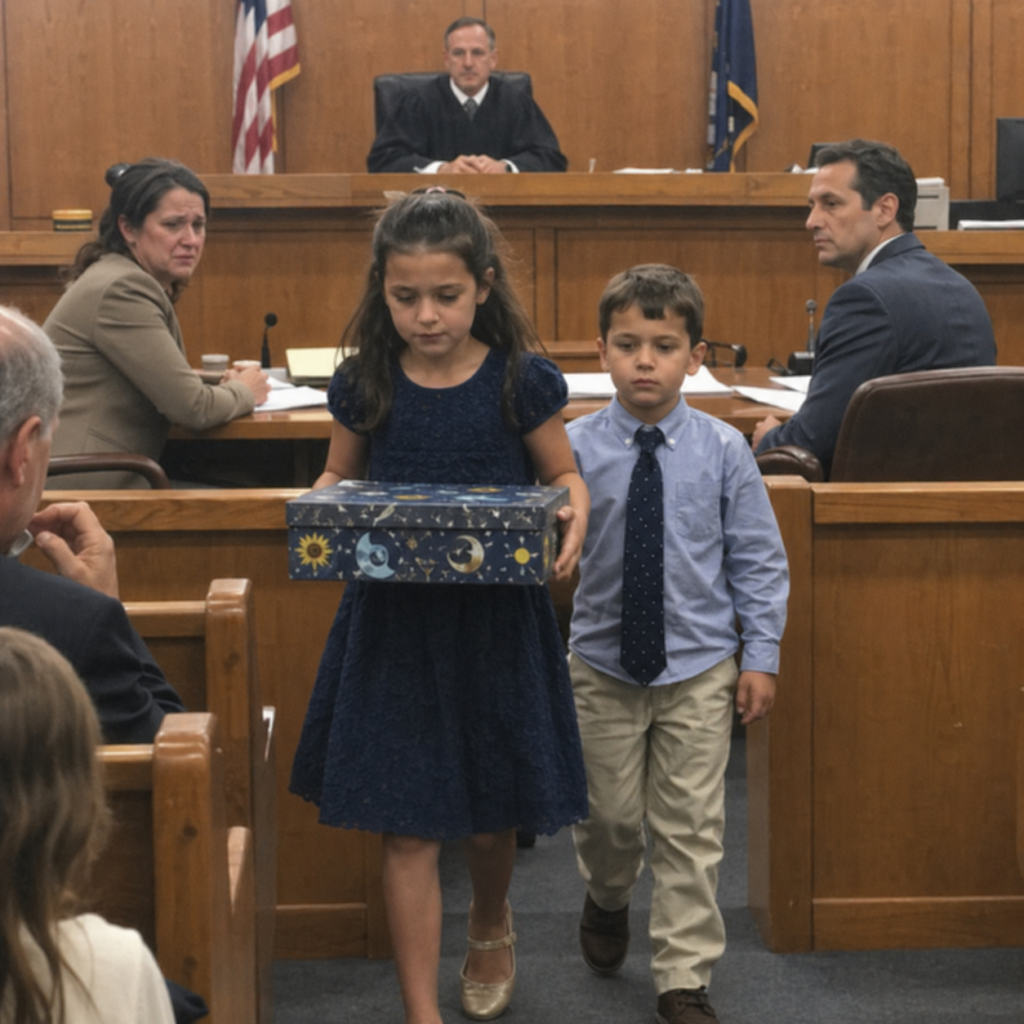
Lily stood beside the table with her glitter-covered shoebox open in front of her, one small hand resting on the lid, the other clutching the sleeve of her dress.
Her sparkly shoes caught the light every time she shifted her weight.
I had bought those shoes secondhand for a school concert. They were a little scuffed at the toes, but Lily loved them because she said they made her feel brave.
That morning, I had not known how much she would need that bravery.
“Lily,” I said softly, “baby, you don’t have to do this.”
She looked at me, and her eyes were wet but determined.
“Yes, I do,” she whispered. “He’s lying.”
Garrett’s chair scraped against the floor as he stood.
“Your Honor,” his attorney said quickly, “this is completely inappropriate. This child has obviously been influenced.”
Lily turned toward him before anyone else could speak.
“I was not influenced,” she said. “I listen.”
That one sentence landed harder than anything I could have said.
The judge lifted a hand.
“Mr. Cole, sit down. Counsel, I will decide what is appropriate in my courtroom.”
Garrett slowly lowered himself back into his chair, but his eyes stayed fixed on Lily.
Not with love.
Not with concern.
With warning.
I saw it.
So did Ms. Delaney.
She stood immediately.
“Your Honor, may we request a brief recess to review the contents of the box? Some items may be relevant to the claims made by opposing counsel.”
The judge looked at Lily’s shoebox, then at Garrett.
“Ten minutes.”
The gavel sounded.
The moment we stepped into the hallway, I dropped to my knees in front of my daughter.
“Lily, why didn’t you tell me you had all this?”
Her chin trembled.
“Because you already worry too much.”
Those words broke me in a way Garrett’s lies never could.
Children should not know their mothers worry too much.
Children should not save receipts.
Children should not carry evidence in glitter shoeboxes.
They should be carrying toys, library books, snacks, and drawings made for refrigerators.
Not proof that their home is safe.
I pulled her gently into my arms.
“I’m sorry,” I whispered into her hair.
She pulled back quickly.
“No, Mom. Don’t be sorry. You feed us. You take care of us. Dad said you don’t, but you do.”
I looked over her shoulder and saw Garrett watching us from near the courtroom door.
His face was tight.
For years, he had used that look to make me shrink.
In our marriage, it had worked.
A raised eyebrow.
A disappointed sigh.
A quiet, “You’re making this harder than it needs to be.”
He never had to shout. He knew how to make me feel guilty with silence.
But that day, standing in the courthouse hallway with my daughter’s shoebox between us, his look did not make me shrink.
It made me stand straighter.
Ms. Delaney guided us to a bench and began carefully reviewing the contents.
The first item was the receipt Lily had mentioned.
Date: Monday morning.
Time: 8:14 a.m.
Milk, bread, eggs, apples, peanut butter, pasta, chicken thighs, carrots, cereal, yogurt, rice, and frozen vegetables.
The same morning Garrett had taken the refrigerator photo.
Then Lily pulled out a picture from her small tablet.
“I took it because Ben was making a tower with the cereal boxes,” she said.
The photo showed grocery bags on the kitchen floor, the counter crowded with food, and Garrett standing by the open fridge with his phone in his hand.
Ms. Delaney’s eyes sharpened.
“This is very important.”
Lily nodded seriously.
“I know.”
My throat tightened.
She should not have known.
Then came the school notes.
One from Lily’s teacher thanking me for sending extra granola bars for the class snack bin.
One from Ben’s teacher reminding me that he loved the turkey sandwiches I packed.
One lunch calendar Lily had marked with stickers.
Green stars for days they brought lunch from home.
Blue hearts for school lunch days.
Yellow dots for “Mom made breakfast-for-dinner.”
I pressed my hand to my mouth.
Then Ms. Delaney opened the notebook.
Things Mom Does So We Don’t Worry.
The first page had a drawing of me standing at the stove.
Under it, Lily had written:
Mom makes dinner even when she is tired.
The next page:
Mom says she is not hungry when there is only one piece of chicken left, but I know she is hungry.
I had to turn away.
The hallway blurred.
I remembered that night.
Ben had asked for more chicken, and there had only been one piece left. I had put it on his plate and told him, “I had a big lunch.”
Lily had looked at me for too long.
I thought she did not understand.
She understood.
Another page said:
Mom comes home late and still checks our blankets.
Another:
Mom cried in the kitchen, but then she packed our lunches.
Another:
Dad has a big house, but Mom’s house feels safe.
Ms. Delaney closed the notebook slowly.
Her eyes were damp.
“This is heartbreaking,” she said quietly. “But it helps.”
I looked at Lily.
“I wish it didn’t have to.”
She leaned against my side.
“Me too.”
Garrett approached then, his attorney behind him.
“Lily,” he said, soft and controlled, “why would you bring private things to court?”
She stiffened.
I placed one hand on her shoulder.
Garrett took another step.
“You know Daddy loves you. You don’t have to make up stories because Mom is upset.”
Lily’s face went pale.
Before I could speak, Ms. Delaney stepped between them.
“Mr. Cole, do not address the child about evidence during a recess.”
His attorney grabbed his arm lightly.
“Garrett.”
But Garrett was looking at me now.
“You turned her against me.”
I shook my head.
“No. You made her feel like the truth needed protection.”
His jaw tightened.
The bailiff appeared at the hallway entrance.
“Everyone back inside.”
When the hearing resumed, Ms. Delaney requested permission to submit the receipt, the tablet photo, school notes, childcare statement, and teacher communications for the court’s review.
Garrett’s lawyer objected, of course.
He argued the items were informal, emotionally charged, and improperly introduced.
The judge listened.
Then he turned to Garrett.
“Mr. Cole, did you take the photograph of the refrigerator on Monday morning?”
Garrett adjusted his tie.
“Yes, Your Honor.”
“Were there grocery bags present in the kitchen at that time?”
Garrett hesitated.
It was brief.
But not brief enough.
“I don’t remember.”
The judge looked down at the printed image Ms. Delaney had obtained from the court clerk during the recess.
“You don’t remember standing beside multiple grocery bags while photographing the refrigerator?”
Garrett’s lips pressed together.
“There may have been groceries.”
“There may have been?”
“Yes.”
“Did you mention those groceries when your attorney presented the refrigerator photograph as evidence of neglect?”
Garrett looked toward his lawyer.
His lawyer looked at his papers.
“No,” Garrett admitted.
The judge leaned back.
The courtroom felt different now.
Not safe, exactly.
But awake.
For weeks, Garrett had made me feel like poverty itself was a crime. Like every repaired seam in my suit, every long shift, every tired morning, every off-brand cereal box meant I was failing my children.
But the judge looked at him and said, “This court is concerned by evidence presented without necessary context.”
Those words were calm.
Professional.
But I felt them like someone had opened a window in a room full of smoke.
Ms. Delaney stood.
“Your Honor, my client does work long hours. She does so because she is providing for two children with inconsistent support from Mr. Cole. The children attend school, have regular meals, receive appropriate care, and are watched after school by a trusted neighbor. We have statements and records to support this.”
Garrett’s lawyer stood too.
“My client’s concern is genuine.”
The judge looked at him.
“Genuine concern should not require misleading photographs.”
Garrett’s face flushed.
I looked down at my hands and realized they had stopped shaking.
The judge did not make a final ruling that day.
Real life does not always give you a perfect ending before lunch.
Instead, he ordered a review of both homes, updated financial disclosures, school records, and statements from childcare providers. He also warned both parents against speaking to the children about court matters or pressuring them in any way.
Then he looked at me.
“Mrs. Cole, financial hardship is not the same thing as neglect.”
I had held myself together all morning.
That sentence almost undid me.
Because shame had been sitting on my shoulders for so long that I no longer knew how heavy it was until someone lifted part of it.
After court, Lily cried in the hallway.
Not loudly.
Not dramatically.
Just the silent kind of crying that shakes a child’s chest.
I knelt and held her.
“I’m sorry,” she whispered. “I didn’t want Dad to be mad.”
“You did nothing wrong.”
“But he looked mad.”
“That is his feeling to handle. Not yours.”
She pulled back and looked at me.
“Are we still going home?”
“Yes, baby.”
“Do we have food?”
“Yes.”
“Can we have spaghetti?”
I laughed through tears.
“Yes. We can have spaghetti.”
That night, I made spaghetti with the jar of sauce I had bought on Monday morning—the same grocery trip Garrett had tried to erase.
Ben twirled noodles around his fork and got sauce on his shirt.
Lily ate quietly, still tired from the day.
After dinner, she brought me the shoebox.
“Do we have to keep using this?” she asked.
I sat beside her on the couch.
“No. Not like that.”
“Then what do we do with it?”
I looked at the glitter letters and the little notebook inside.
“We keep it somewhere safe for now. But from now on, I want you to let grown-ups handle grown-up proof.”
She frowned.
“But what if nobody believes you?”
That question broke my heart all over again.
I touched her cheek gently.
“Then I will find more grown-ups who do. That is not your job.”
She leaned into me.
“I just didn’t want him to take us.”
“I know.”
“I like our house.”
“It’s small.”
“It’s ours.”
I held her until she fell asleep against my side.
After that hearing, Ms. Delaney and I got organized.
Truly organized.
Not the kind of organization you pretend to have when life is moving too fast and bills are stacked under school forms.
The real kind.
Receipts by date.
Work schedules.
Childcare notes.
Photos of the apartment.
School attendance records.
Medical records.
Messages from Garrett.
Mrs. Alvarez, my seventy-three-year-old neighbor, wrote a statement that made me cry before I finished the first paragraph.
She described how she watched Lily and Ben after school on late workdays. How they did homework at her kitchen table. How I always left meals prepared or money for food. How the children were clean, loved, and safe.
At the bottom, she wrote:
Their mother is tired, not neglectful. There is a difference.
I wanted to frame that sentence.
The home study came two weeks later.
I cleaned the apartment until my hands ached.
Not because it was dirty, but because fear makes you scrub baseboards at midnight.
The evaluator was kind but serious. She checked the bedrooms, the pantry, the refrigerator, the homework area, the bathroom, the smoke detectors.
There was food.
Not fancy food.
Not overflowing shelves.
But enough.
Rice, eggs, bread, apples, peanut butter, soup, pasta, frozen vegetables, chicken in the freezer, cereal on top of the fridge because Ben liked to climb.
Lily showed the evaluator her bed, her books, and the shoebox on the closet shelf.
The evaluator asked, “What is that?”
Lily glanced at me.
I nodded.
She said, “That is from when I had to be brave, but Mom says I don’t have to use it anymore.”
The evaluator wrote something down.
Ben showed her his glow-in-the-dark stars and announced that Mrs. Alvarez made better pancakes than me.
“That is true,” I admitted.
The evaluator almost smiled.
Garrett’s home study looked better on paper.
Bigger house.
New furniture.
Full pantry.
Separate bedrooms for the kids.
But appearances can be staged.
The evaluator noticed that many of the children’s clothes still had tags, bought after the court hearing. She noticed Ben’s inhaler was not there, though Garrett claimed he handled medical needs. She noticed Lily became quiet when asked if she liked sleeping there.
Garrett tried to charm his way through the visit.
He was good at charm.
But charm does not answer follow-up questions well.
Then came the financial disclosures.
That was where Garrett’s polished story began to crack badly.
For years, he had told the court and me that his income was unpredictable. He said his consulting work was slow. He said he paid what he could. He said if I budgeted better, I would not need to work so many hours.
Ms. Delaney found missing bonuses.
Side payments.
A second account.
Business expenses that looked suspiciously like vacations.
A country club membership.
Private dinners.
Luxury purchases.
All while he let me work two jobs and then accused me of neglecting our children because I worked too much.
When I saw the records, I felt something colder than anger.
He had not only lied about me.
He had created the conditions he then used against me.
At the next hearing, I wore the same navy suit.
Still repaired.
Still old.
But this time, I did not feel small inside it.
Ms. Delaney had a binder in front of her.
So did I.
Plain black binders from the discount store.
But inside them was truth.
The judge reviewed the home study, the financial records, the school statements, the grocery evidence, and Garrett’s misleading refrigerator photograph.
Garrett’s attorney tried to argue that his client had simply been worried.
The judge’s expression did not change.
“Concern for children is commendable,” he said. “Manipulating evidence is not.”
Garrett stared straight ahead.
The judge continued.
“The court finds that Mrs. Cole’s home is modest but stable. The children are fed, enrolled in school, appropriately supervised, and emotionally bonded to their mother. The court also finds that Mr. Cole failed to provide complete financial disclosure and presented misleading evidence regarding the conditions in Mrs. Cole’s home.”
My heart pounded so hard I could barely hear the next words.
Primary custody remained with me.
Garrett’s child support was recalculated based on actual income.
Communication had to go through a monitored parenting app.
Neither parent could speak negatively about the other to the children.
Garrett was ordered to complete a co-parenting course and correct his financial disclosures under penalty.
Then the judge looked toward Lily, who sat beside Aunt Rachel in the back row.
“She is a child,” he said. “She should not have felt responsible for proving the truth in this courtroom.”
I felt that sentence in my bones.
Because I was grateful for what Lily had done.
But I hated that she had needed to do it.
When the hearing ended, Garrett did not approach us.
For once, he left through the side door with his lawyer, his shoulders stiff, his expensive suit no longer enough to make him look powerful.
Lily ran to me.
“Did we win?” she asked.
I knelt in front of her.
“We are safe,” I said. “And the judge knows the truth.”
She thought about that seriously.
“That’s better than winning.”
“Yes,” I whispered. “It is.”
Life after that did not become perfect.
The recalculated support helped, but I still worked hard. Bills still came. Ben still outgrew shoes overnight. Lily still watched me too closely whenever I paid bills, as if she was waiting to see whether she needed to start collecting evidence again.
So I changed the way we talked at home.
I stopped pretending everything was fine when it was hard.
Instead, I told them the truth in safe pieces.
“We are budgeting this week, but we have what we need.”
“I am tired, but I am not upset with you.”
“This is a grown-up problem, and I have a plan.”
Those words helped.
Not all at once.
But slowly.
The glitter shoebox stayed on the top shelf of my closet for a while. One evening, Lily asked if we could change the label.
“What do you want it to say?” I asked.
She thought for a long time.
Then she wrote in purple marker:
Memories of When We Were Brave.
We placed the notebook, the receipt, and the sparkly shoes inside once she outgrew them.
Not as evidence anymore.
As history.
One Friday night, I came home from work and found Lily, Ben, and Mrs. Alvarez in the kitchen.
They had made grilled cheese and tomato soup.
Lily wore an apron too big for her.
Ben had sauce on his chin.
Mrs. Alvarez sat at the table pretending she had not done most of the cooking.
“Surprise,” Lily said.
The table was set with paper napkins folded into crooked triangles. A candle sat in the middle, unlit because Ben was not trusted around fire.
I stood there in my work shoes, exhausted, hungry, and suddenly unable to speak.
For so long, Garrett had made me feel like I was failing because our life was not polished.
But standing there in our little kitchen, with soup steaming on the table and my children smiling at me, I finally understood something.
My home did not need to look impressive to be safe.
It did not need full marble counters, matching furniture, or a refrigerator staged for court.
It needed honesty.
Warmth.
Food enough.
Love that did not ask children to lie.
I sat down and declared it the best dinner in the world.
Ben cheered.
Lily smiled so brightly the room felt larger.
A year later, I opened the refrigerator one night and stood there longer than necessary.
There were eggs, apples, leftover soup, milk, carrots, pasta sauce, and half a watermelon Ben had begged for and then abandoned.
Ordinary food.
Enough food.
On the refrigerator door were drawings.
Ben’s dinosaur.
Lily’s rainbow.
A crooked family portrait of the three of us holding hands under a yellow sun.
Under it, Lily had written:
Home is where people tell the truth.
I touched the paper gently.
Garrett had tried to use an empty shelf to define me.
But he had only captured one moment.
Not the grocery bags on the floor.
Not the work shifts.
Not the neighbor who helped.
Not the packed lunches.
Not the bedtime kisses after late nights.
Not the mother who skipped dinner sometimes but never skipped loving her children.
One photograph had lied.
My daughter’s shoebox had told the truth.
And after everything, I made myself one promise:
Lily would not spend her childhood being my witness.
She would spend it being my child.
So I let her put the shoebox away.
I let her wear new sparkly shoes to school dances.
I let Ben build cereal-box towers without worrying whether anyone would twist them into evidence.
And I kept working, not to prove Garrett wrong, but to build a life where my children never had to defend my love again.
Because hardship was not neglect.
A small apartment was not neglect.
A tired mother was not neglect.
And the truth, even when carried in a glitter-covered shoebox by a brave little girl in sparkly shoes, was still stronger than any lie dressed up in an expensive suit.