PART 2 — FULL CONTINUATION WITH COMPLETE ENDING:
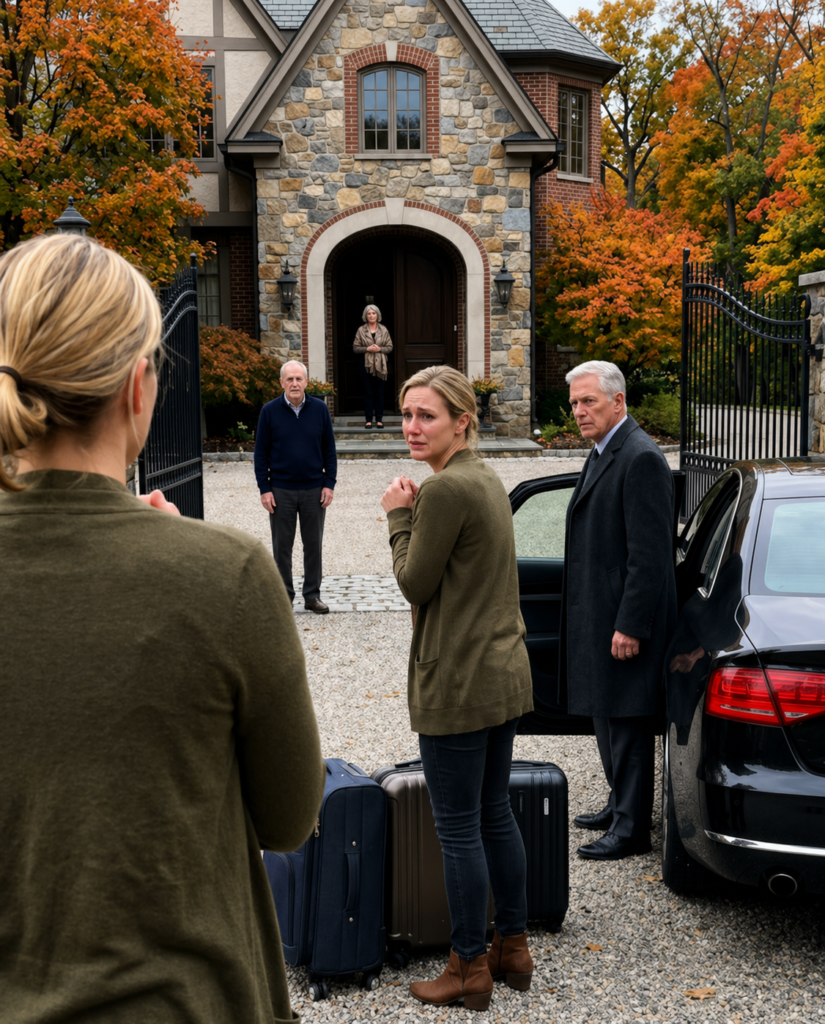
The man walking toward me was Arthur Aldridge.
I knew the name before I truly understood the man.
In Boston, certain names were not spoken loudly. They moved through private clubs, boardrooms, charity committees, bank mergers, and real estate deals with the quiet force of weather.
Aldridge was one of those names.
I had seen it on hospital wings, university buildings, legal foundations, and old financial articles my mother once folded quickly when I entered the kitchen. I knew he was powerful. I knew he was private. I knew people like Richard Whitmore measured entire rooms by whether Arthur Aldridge’s name might one day enter them.
But I did not know why he was standing in front of my in-laws’ house.
I did not know why my father-in-law looked like the driveway had opened beneath him.
And I did not know why this man, with silver hair and a dark overcoat, looked at me with something that was not politeness.
It was grief.
Recognition.
A promise carried too long.
He stopped a few feet away from me.
“Clara,” he said softly.
My heart shook at the sound of my name.
Not Mrs. Whitmore.
Not Andrew’s wife.
Clara.
The driver moved to take my suitcases, but Arthur lifted one hand.
“Only if she allows it.”
That small sentence nearly broke me.
For three years, things had been taken from me without asking.
Space.
Dignity.
Privacy.
My right to be believed inside my own marriage.
This stranger, who made Richard Whitmore tremble at the door, asked permission before letting someone touch my luggage.
“Yes,” I whispered.
The driver carefully took the bags.
Behind me, Richard finally found his voice.
“Mr. Aldridge,” he said, too loudly, too quickly. “This is unexpected.”
Arthur did not look at him right away.
That was its own kind of power.
He kept his eyes on me.
“Are you injured?”
The question was calm, but I heard steel beneath it.
“No.”
“Have they prevented you from leaving?”
I swallowed.
“Not physically.”
His face tightened by one small degree.
That was all.
Then he turned toward Richard.
The air seemed to shift.
Richard straightened, but not with confidence. With fear trying to disguise itself as manners.
“Arthur,” he said, attempting warmth and failing. “Had we known you were coming—”
“You would have behaved better?” Arthur asked.
Richard’s mouth closed.
Evelyn appeared behind him then, one hand at her pearl necklace, her expression sharpened by confusion and offense.
“I’m sorry,” she said. “What exactly is happening?”
Arthur looked at her.
“I am taking Clara home.”
Evelyn’s eyes flicked to me.
“Home? This is her home.”
The words were so false that I almost laughed.
Arthur’s face did not change.
“No,” he said. “This is where she has been kept uncomfortable.”
Richard flushed.
“That is an outrageous thing to say.”
“Is it?”
Arthur glanced around the circular drive, the trimmed hedges, the stone columns, the perfect windows.
“Your house is beautiful, Richard. It always was. Unfortunately, beauty does not disinfect cruelty.”
Evelyn inhaled sharply.
Richard stepped down one stair.
“I don’t know what Clara has told you, but this is a private family matter.”
Arthur’s eyes turned colder.
“You lost the right to call it private when she had to use a twenty-year-old emergency number to be treated like a person.”
That sentence silenced everyone.
Even me.
The cold October wind lifted the edge of my coat. I wrapped my arms around myself, suddenly aware that I was standing outside with two suitcases and no real plan beyond leaving.
Arthur noticed.
“Clara,” he said gently, “the car is warm. You do not have to stand here while I speak to him.”
Richard looked at me then.
For the first time in three years, he did not look at me with contempt.
He looked at me with calculation.
As if I had become a document he had failed to read properly.
“Clara,” he said, his tone smoother now, “perhaps we should all go inside and talk.”
I felt the old instinct rise.
To keep peace.
To not make a scene.
To smooth the room before someone called me dramatic.
But something about seeing Richard afraid made the old rules look ridiculous.
“No,” I said.
One word.
Plain.
Quiet.
Final.
Evelyn’s face hardened.
“Do not be foolish. You have no idea what you are doing.”
Arthur turned his head slightly toward her.
“Mrs. Whitmore, I would strongly advise you not to mistake her freedom for foolishness.”
Evelyn went pale.
I walked to the sedan.
The driver opened the rear door, and warm air spilled out. Before I got in, I looked back once at the house.
For three years, I had tried to become acceptable inside it.
Smaller.
Quieter.
More polished.
Less like myself.
Now, with one foot outside that world, I saw the truth.
The house had never rejected me because I was not enough.
It had rejected me because it was built by people who only knew how to value themselves by lowering someone else.
I got into the car.
Arthur followed after one final look at Richard.
“Expect a call from my office,” he said.
Richard’s face tightened.
“About what?”
Arthur’s mouth formed the faintest, coldest smile.
“Everything you hoped I would never review.”
Then he entered the car, and the door closed.
The sedan moved down the drive.
Through the tinted window, I watched the Whitmore mansion recede behind us. Richard remained at the doorway, one hand still gripping the frame, Evelyn frozen beside him in her pearls.
For the first time since marrying Andrew, I left that property without asking permission.
For several minutes, neither Arthur nor I spoke.
The inside of the car smelled faintly of leather and cedar. My suitcases rested in the trunk. My hands were folded in my lap so tightly my fingers hurt.
Finally, Arthur said, “Your mother looked like you when she was trying not to cry.”
I turned to him.
“You knew my mother.”
“Yes.”
“How?”
He looked out the window for a moment, and when he spoke again, his voice had changed.
Softer.
Older.
“Marianne worked as a nurse at St. Bartholomew’s when my wife was dying.”
I had not expected that.
“She was assigned to my wife’s care during the final months. Most people treated Eleanor like a diagnosis by then. Your mother treated her like a woman. She brushed her hair. Brought music. Hid contraband chocolate in her nightstand because Eleanor hated hospital pudding.”
A small, broken laugh escaped me.
That sounded exactly like my mother.
Arthur’s eyes softened.
“After Eleanor died, I was not kind to the world. Grief made me arrogant, impatient, and cruel in ways I regret. Your mother was one of the few people who told me the truth.”
“What truth?”
“That my pain did not make me important enough to hurt people.”
I looked down.
Arthur continued.
“I offered her money. A better job. Anything she wanted. She refused most of it. But years later, when she became ill, she came to see me once.”
My throat tightened.
“She never told me.”
“She was proud.”
“Yes,” I whispered. “She was.”
“She asked for one favor. Not money. Not treatment. She asked that if her daughter ever called the number on my card, I would come without question.”
Tears blurred my vision.
“She knew?”
“She knew enough.”
I covered my mouth.
All those years, I had thought the sealed envelope was only my mother being dramatic in the way dying people sometimes prepare for fears that never arrive.
But she had seen something ahead of me.
Maybe not Richard.
Maybe not Andrew.
But the possibility that love could become a room with no exit if pride kept you standing inside it.
Arthur reached into his coat and removed a folded piece of paper.
“She also left this with me. I was told to give it to you only if you called.”
My hands shook as I took it.
My mother’s handwriting.
My Clara,
If you are reading this, then you stayed too long somewhere your heart already knew it was time to leave.
Do not be ashamed.
Women like us are taught to endure with grace. We are praised for patience until patience becomes a cage.
I asked Arthur for help because he owes me no kindness, which makes his kindness safer than the kind that asks for obedience in return.
Let him help you leave.
You do not owe anyone your suffering just because they once called it family.
Come home to yourself.
Mom
The tears came then.
Not loudly.
Not beautifully.
They came the way grief comes when it has been waiting in the hallway for years.
Arthur said nothing.
He simply handed me a clean handkerchief and looked away so I could cry without feeling watched.
The sedan did not take me to a hotel.
It took me to a quiet brownstone in Back Bay. Inside, a woman in her forties introduced herself as Helen, Arthur’s chief counsel. Another woman named Marisol showed me to a guest suite with soft lamps, fresh towels, and a door that locked from the inside.
That detail mattered.
A door that locked from the inside.
I sat on the edge of the bed and breathed for what felt like the first time in months.
Helen came by later with tea and a folder.
“Nothing legal tonight unless you want it,” she said. “But I want you to know you have options.”
Options.
The word felt almost foreign.
I had spent three years being told why there were none.
No apartment because Andrew needed to stay near the family business.
No separation because it would embarrass the Whitmores.
No direct conversation because Evelyn was sensitive.
No boundaries because Richard paid for everything.
Now, in one quiet room, a stranger told me there were options.
I slept badly but safely.
The next morning, my phone showed twenty-two missed calls.
Andrew.
Richard.
Evelyn.
Andrew again.
One text from my husband:
Clara, what did you do? My father is furious. We need to talk before this gets worse.
I stared at it for a long time.
Before this gets worse.
Not, Are you safe?
Not, I am sorry my parents laughed at you.
Not, I should have defended you years ago.
Worse, to Andrew, meant inconvenience spreading into his world.
I handed the phone to Helen when she returned.
“May I respond through counsel?” I asked.
Her smile was small but approving.
“Yes. You may.”
By noon, my divorce filing was underway.
By three, Arthur’s office had begun its review.
That was when I learned why Richard had panicked.
Whitmore Holdings was not as independent as Richard liked to pretend. Decades earlier, Arthur Aldridge had quietly financed a major restructuring that saved Richard’s father from ruin. In exchange, Aldridge Trust retained certain preferred shares, debt instruments, and oversight rights that Richard had spent years hoping would remain buried in old files.
Arthur had never interfered.
Until now.
Helen laid it out plainly.
“Your father-in-law has been courting new financing while concealing certain liabilities. Some of those disclosures involve Aldridge-linked obligations. Arthur’s office requesting a review could create significant pressure.”
I stared at her.
“Are you destroying him because of me?”
“No,” Helen said. “We are examining documents because his panic suggested there was something to examine.”
That mattered.
I did not want revenge built on lies.
I wanted truth.
Truth was enough.
Over the next week, the Whitmore family changed their tone.
Richard left one voicemail so stiff with forced politeness it almost sounded painful.
“Clara, perhaps my words were harsher than intended. We should resolve this privately.”
Evelyn sent a message saying she had always considered me “part of the family despite our differences.”
Andrew sent flowers.
White roses.
The card read:
Let’s not let this get out of hand.
I threw the card away.
I kept the vase.
On the eighth day, Andrew came to Arthur’s brownstone.
He was not allowed inside without my permission.
I almost refused.
Then I decided I wanted to see who he was without his parents standing behind him.
We met in a sitting room with Helen present. Andrew looked tired, pale, and smaller than I remembered.
“Clara,” he said. “You scared everyone.”
I waited.
He swallowed.
“I mean… we were worried.”
“No, you weren’t.”
His face reddened.
“I didn’t know things were that bad.”
I looked at him.
“You moved me into a guest suite.”
“That was temporary.”
“For nine months.”
“You said you wanted space.”
“I said I was tired of crying in the bathroom after dinner.”
He looked down.
For the first time, shame touched his face.
“My parents are difficult,” he said.
“Your parents are cruel. And you were their silence.”
He flinched.
Good.
Some truths should sting.
“I loved you,” he said.
“I believe you did in the way you understand love.”
“What does that mean?”
“It means you liked having me there when I made your life softer. But you did not protect me when loving me required discomfort.”
His eyes filled.
“I can change.”
“Maybe.”
“Then come home and let me prove it.”
“No.”
The answer came faster than I expected.
His face crumpled.
“No?”
“No. You can change without me living under the same roof as your parents. You can change without me being the test subject.”
“Clara, please.”
“I asked for three years.”
“I know.”
“No,” I said. “You heard me for three years. You are only knowing it now because I left.”
He had no answer.
The divorce moved forward.
Andrew fought briefly, then less when it became clear I had legal support he could not intimidate or exhaust. Richard tried to frame the situation as a misunderstanding, but the Aldridge review exposed financial misstatements, improper transfers, and pressure tactics inside the family business.
It did not destroy the Whitmores overnight.
Life is rarely that clean.
But it stripped away the shine.
Investors hesitated.
Board members asked questions.
Richard stepped down from two committees “for health reasons.”
Evelyn stopped appearing at certain charity lunches when people began whispering that perhaps she was less graceful in private than in public.
Their world did not end.
But it stopped obeying them.
That was enough.
As for me, I began rebuilding.
Not dramatically.
No mansion.
No sudden inheritance.
No fairy-tale transformation.
Arthur offered more than I accepted. I let him pay legal costs because my mother had asked him to help me leave, and I finally understood that accepting help was not the same as surrendering control.
But I found my own apartment.
Small, sunny, with uneven floors and a view of a brick wall that caught gold light in the afternoon.
I returned to work.
I bought dishes that no one called cheap.
I slept with my bedroom door closed and locked, not because I was afraid, but because I could.
Arthur became, unexpectedly, part of my life.
Not like a father.
Not exactly.
More like a witness my mother had left behind.
Once a month, we had tea. He told me stories about her I had never heard. How she smuggled flowers into hospital rooms against policy. How she argued with doctors when patients were being dismissed too quickly. How she once told Arthur Aldridge, richest man in the room, to stop frightening nurses who were just trying to do their jobs.
“She was fearless,” he said once.
I smiled sadly.
“She was afraid of many things. She just did right anyway.”
Arthur nodded.
“That is the better definition.”
Months later, the divorce finalized.
Andrew and I met once more outside the courthouse.
He looked different.
Less polished.
More human.
“I’m in therapy,” he said.
“I’m glad.”
“I moved out of the house.”
That surprised me.
“Where?”
“Cambridge. Small apartment. Terrible parking.”
I almost smiled.
“My condolences.”
He gave a weak laugh.
Then his eyes filled.
“I should have left with you the first time you asked.”
“Yes,” I said.
“I’m sorry.”
“I know.”
“Do you forgive me?”
I looked at the courthouse steps.
Forgiveness was such a heavy word. People ask for it like a key, hoping it will unlock all doors at once.
“I am not carrying anger every day,” I said. “That is what I can give you now.”
He nodded slowly.
“That’s more than I deserve.”
“Yes,” I said gently. “It is.”
We parted without hugging.
That felt right.
A year after the day I left, I returned to my mother’s grave with the letter she had left me.
I sat on the grass and read it aloud.
Let him help you leave.
You do not owe anyone your suffering just because they once called it family.
Come home to yourself.
The wind moved through the trees.
I folded the letter carefully and pressed it to my heart.
“I did,” I whispered. “I came home.”
Not to a house.
Not to a family name.
Not to a man.
To myself.
That evening, Arthur’s sedan arrived at my apartment, but this time it was not to rescue me. It was to take me to a foundation dinner honoring nurses.
Arthur had asked if I would speak about my mother.
I wore a simple green dress and my mother’s old earrings. No one there knew me as Andrew Whitmore’s ex-wife. No one looked at me like I had married above myself.
I stood at the podium and spoke about women who work quietly, love fiercely, and leave doors open for daughters even after they are gone.
Arthur sat in the front row, eyes bright.
When I finished, the room stood.
Not for my marriage.
Not for the Whitmore name.
For my mother.
For me.
For a life no longer hidden behind someone else’s gate.
Later, while waiting outside beneath the city lights, Arthur said, “She would be proud of you.”
I looked at the black sedan at the curb.
The same kind of car that had once rolled through the Whitmore gates and made Richard’s face go white.
That day, I had thought the car was my rescue.
Now I understood it had only been transportation.
The real rescue had begun upstairs in that guest suite when my shaking hand dialed the number.
It continued when I said no to going back.
It grew each time I accepted help without giving away my voice.
And it became real when I stopped measuring my worth through the eyes of people determined not to see it.
“I think she would be relieved,” I said.
Arthur smiled faintly.
“Yes. That too.”
Years later, people still ask about the sedan.
They love that part.
The black car.
The powerful man.
Richard Whitmore whispering, “No, this can’t be happening.”
But that was not the most important moment.
The most important moment was quieter.
It was me standing in the study with two suitcases, hearing Richard laugh and Evelyn say good riddance, and realizing their cruelty no longer had the power to keep me there.
The sedan did not give me dignity.
It arrived after I had already found it.
And that is the part I remember when someone asks how I left.
I say:
I stopped waiting for people who looked down on me to admit I was worthy.
Then I picked up my bags.
And when the gate opened, I walked through it.