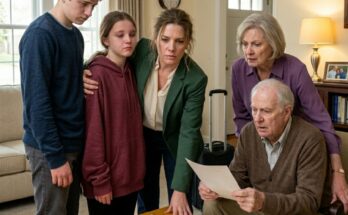
PART 2 — FULL CONTINUATION WITH COMPLETE ENDING:
For a few seconds, nobody spoke.
My mother’s eyes were fixed on the first page inside the folder.
My father’s mouth opened slightly, then closed again.
Marcus straightened from the wall.
That was when I knew.
They recognized it.
Not the whole file yet.
Not everything I had found.
But enough.
Enough for fear to arrive before denial.
My mother reached for the folder.
I pulled it back.
“No,” I said.
The word was quiet.
It startled all of us.
For thirty-five years, I had rarely said no to my mother without adding something after it.
No, I’m sorry.
No, not right now.
No, please don’t be mad.
This time, the word stood alone.
My mother’s eyes narrowed.
“Jane, don’t be dramatic. We are your parents.”
I looked at her linen dress, the coral bracelet on her wrist, the sandals still dusted with beach sand.
“You missed their funeral.”
Her jaw tightened.
“We told you why.”
“You called it too trivial.”
My father sighed heavily, as if grief was another bill he did not want to pay.
“Your mother chose poor wording. This is not the time to punish everyone.”
I almost laughed.
Punish everyone.
My husband was dead.
My daughter was dead.
They had come to my house asking for money.
And somehow, in my father’s mind, they were still the wounded party.
Marcus stepped closer.
“Look, Jane, we’re not here to fight. We just need the money fast. Mom and Dad already committed to the investment.”
I turned to him.
“What investment?”
He hesitated.
My mother answered quickly.
“That is none of your concern.”
“But my money is?”
Her face flushed.
“Samuel’s insurance payout is more than enough. Don’t pretend you’re helpless.”
The sound of his name in her mouth made my fingers tighten around the folder.
Samuel.
The man she had ignored at family dinners because he refused to be impressed by her.
The man my father called “too ordinary” because he taught high school history instead of chasing wealth.
The man who held Penelope every night and made dinosaur pancakes on Sundays.
The man who once told me, “Your family treats love like a receipt, Jane. One day they’ll demand payment for things they never gave.”
I had not wanted to believe him.
Now he was gone, and the proof of his warning was in my hands.
I opened the folder again and took out the first document.
“Do you remember this?” I asked.
My father’s face hardened.
“It’s an old bank statement.”
“It is my college savings account.”
My mother looked away.
I continued.
“The account Grandma Ruth opened for me when I was born. She deposited money every birthday and Christmas until she died. You told me there was barely anything left because her medical bills had been expensive.”
My mother snapped, “They were expensive.”
“Yes,” I said. “But they were paid from her estate. Not from this.”
I placed the statement on the table.
“According to the records, there was $62,000 in that account when I turned eighteen.”
Marcus muttered, “So?”
I looked at him.
“So I never used it. I took student loans because Mom and Dad told me Grandma’s money was gone.”
My father’s voice dropped.
“Careful.”
That single word took me back twenty years.
Careful, Jane.
Careful with your tone.
Careful not to embarrass us.
Careful not to make your mother cry.
Careful not to ask questions that made adults uncomfortable.
But grief had burned something clean inside me.
I no longer had room for fear of their disappointment.
I took out the second page.
“Three withdrawals were made over six months. Every withdrawal required my signature.”
My mother crossed her arms.
“You were young. You don’t remember what you signed.”
I looked her directly in the eyes.
“I never signed them.”
The room went still.
Marcus shifted.
Dad said, “You have no proof of that.”
I turned to the next document.
“Actually, I do.”
This time, I smiled.
Not because I was happy.
Because Samuel had been smarter than all of us.
“When Samuel and I were applying for our first mortgage, the bank flagged old inconsistencies on my credit history. I brushed it off. Samuel didn’t. He requested copies. He saved everything.”
My mother’s face changed.
Small.
Fast.
But I saw it.
“You knew?” I whispered.
She said nothing.
I continued.
“Credit cards opened in my name when I was nineteen. A personal loan when I was twenty-one. A utility account that went unpaid for eight months. I thought I was irresponsible because my credit was terrible before I had even started my life.”
Dad stood straighter.
“That was years ago.”
“Yes,” I said. “It was.”
I removed another paper.
“And then there is this.”
My father’s eyes flicked down.
For the first time, real panic entered his face.
It was the title document to the lake cabin.
Grandma Ruth’s cabin.
The little blue house by the water where I spent summers catching frogs, eating watermelon, and sleeping beneath quilts that smelled like cedar.
I had been told it was sold years ago to cover family debts.
It had not been sold.
It had been transferred.
To my mother.
Then mortgaged.
Then used as collateral for Marcus’s failed business.
My brother finally spoke.
“You don’t understand how hard things were.”
I looked at him.
“For you?”
His face reddened.
“For all of us.”
“No,” I said. “Things were hard for me because all of you decided my inheritance was family money.”
My mother slammed her purse onto the table.
“You ungrateful little girl.”
There it was.
The voice from my childhood.
The voice that had made me cry in bathrooms, apologize for asking questions, and believe love meant permanent debt.
I looked at her calmly.
“I am a widow.”
She blinked.
“I am a mother who buried her only child.”
My voice trembled, but I did not stop.
“And you came here three days later asking for forty thousand dollars.”
My father looked uncomfortable.
Not ashamed.
Just uncomfortable that I had said it so plainly.
“Jane,” he said, softer now, “we understand you’re emotional.”
“No,” I said. “You don’t get to call this emotion because the facts are inconvenient.”
I placed the final stack of papers on the table.
“These are messages Samuel saved between him and Dad.”
My father went pale.
He knew now.
He knew exactly what was coming.
Samuel had not told me because he wanted to protect me from more pain while Penelope was still alive and our life was still full of school drop-offs, bedtime stories, and grocery lists.
But he had saved everything.
Every message.
Every threat.
Every demand.
Dad asking Samuel not to tell me about the old accounts.
Dad saying, Jane is sensitive. This would destroy her.
Dad asking for money after Marcus’s business collapsed.
Samuel refusing.
Dad writing, You married into this family. You should help us before Jane finds out things she doesn’t need to know.
And Samuel’s final response:
Jane deserves the truth. If you ask us for money again, I will tell her everything.
That message was dated six days before the accident.
Six days.
I looked at my father.
“You were pressuring Samuel.”
His eyes dropped.
“You don’t understand.”
“Then explain.”
He said nothing.
I looked at Marcus.
“You knew too?”
Marcus lifted both hands.
“I knew some of it. Not all.”
“Enough?”
He looked away.
Enough.
My mother’s voice turned sharp again.
“Samuel had no right to interfere.”
The room changed.
Not because she had raised her voice.
Because in that one sentence, she told me exactly who she blamed.
Not herself.
Not the lies.
Not the theft.
Samuel.
My dead husband.
The man she had refused to bury because the beach was warmer.
I closed the folder slowly.
“You need to leave.”
My father stepped forward.
“Jane, let’s calm down.”
“No.”
“You are grieving. You’re not thinking clearly.”
“I have never thought more clearly in my life.”
My mother laughed once, cruel and thin.
“And what are you going to do? Sue your own parents?”
I looked at her.
“Yes.”
For the first time, she had no answer.
Marcus swore under his breath.
Dad said, “You wouldn’t.”
I picked up my phone and tapped the screen.
“My attorney already has copies. So does Samuel’s brother. So does the financial investigator I hired this morning.”
My mother’s lips parted.
“You what?”
“You heard me.”
Dad’s face twisted.
“After everything we did for you—”
“What did you do?” I asked.
The question came out quietly.
That made it more dangerous.
My father stared at me.
“What did you do for me that was not paid for with money you stole from me, credit you ruined in my name, or guilt you used to keep me obedient?”
My mother’s eyes filled with instant tears.
Too fast.
Too familiar.
The old performance.
“Jane, how can you say that to your mother?”
I felt nothing move toward her.
No guilt.
No panic.
No need to comfort the person who had hurt me and then cried because I noticed.
“I learned from you,” I said. “You taught me family can survive one night somewhere else. So go.”
She flinched.
Maybe because she had not said those exact words.
But the spirit was hers.
My father grabbed her purse.
“Come on.”
Marcus glared at me.
“You’re going to regret this.”
I looked past him at Penelope’s yellow rain boots by the door.
“No,” I said. “I regret not believing Samuel sooner.”
They left angry.
Not sorry.
Anger was easier for them.
It let them pretend they were victims of my cruelty instead of witnesses to their own.
When the door closed behind them, the house went silent again.
But this silence was different.
The earlier silence had been grief.
This one had edges.
It was the sound of something ending.
I sank to the floor beside Penelope’s boots and finally cried the way I had not cried at the funeral.
Not because my parents had betrayed me.
I had known pieces of that for years.
I cried because Samuel had been carrying part of the truth alone, probably waiting for the right time, probably trying to spare me from choosing between the family that raised me and the family we had built together.
And now the family we built was gone.
The lawsuit took time.
Real life does not deliver justice in one dramatic afternoon.
There were documents to gather, accounts to trace, signatures to examine, old records to request, lawyers to pay, and conversations that made me feel like I was pulling bones from a grave.
But the truth held.
My college fund had been drained using forged paperwork.
Credit had been opened in my name.
The lake cabin had been transferred through pressure and deception after Grandma Ruth died.
The money trail led through my parents’ accounts and into Marcus’s business ventures, vacations, debt payments, and private expenses they had disguised for years.
My parents denied it first.
Then minimized it.
Then blamed Samuel.
Then claimed I had “benefited from the family” and should not be counting old debts during a time of grief.
But paper does not respond to guilt.
Paper stays.
My attorney, Elaine Porter, was calm in the way I needed.
She never called it family drama.
She called it financial abuse.
The first time she said those words, I cried in her office.
Financial abuse.
It gave a name to something I had been trained to call help, sacrifice, obligation, family.
Elaine handed me tissues and said, “You are not wrong for wanting the truth.”
I wrote that sentence down later.
I needed to see it.
My parents tried to turn relatives against me.
Aunt Carol called and said, “Your mother is devastated.”
I said, “So am I.”
She said, “But she’s still your mother.”
I said, “Penelope was still my daughter.”
Aunt Carol had no answer.
People often do not know what to do when the person they expect to bend becomes the one who speaks plainly.
My brother Marcus sent one long message saying I was destroying the family over money I did not even need now that Samuel’s insurance existed.
I read that line three times.
Money I did not even need.
As if money meant for my future did not matter because tragedy had produced a payout.
As if the price of my husband and child could erase what they stole before.
I forwarded the message to Elaine.
She replied:
Helpful evidence. Do not respond.
So I did not.
The settlement came eleven months later.
My parents avoided criminal court by agreeing to repay a large portion of the stolen funds, relinquish any remaining claim connected to the lake cabin, and sign a public acknowledgment within the family trust records that the accounts had been misused without my consent.
It was not everything.
It could never be everything.
No number could return the years I lived with damaged credit and false guilt.
No payment could bring Samuel back.
No signed statement could make Penelope’s laugh fill the hallway again.
But it was something.
More importantly, it was the truth written down where they could not edit it.
I sold the lake cabin at first.
At least, I thought I would.
I drove there alone after the settlement, planning to meet a realtor.
The cabin was smaller than I remembered. The blue paint had faded. Weeds grew along the steps. The dock leaned slightly to one side.
Inside, dust covered everything.
But when I opened the back bedroom, I saw the window where I used to sit as a child watching rain hit the lake.
Then I saw Penelope in my mind, wearing her yellow rain boots, running along the shore, shrieking with joy because mud had no rules.
I sat on the old wooden floor and cried until the realtor knocked twice and then quietly left her card under the door.
I did not sell it.
Instead, I repaired it slowly.
Not to preserve my parents’ memory.
To reclaim mine.
Samuel’s brother, David, helped rebuild the dock. My friend Marcy painted the kitchen. Elaine connected me with a contractor who gave honest estimates and did not speak to me like grief made me stupid.
The first night I slept there after the repairs, I placed Penelope’s rain boots by the door.
I placed Samuel’s coffee mug on the kitchen shelf.
Not as shrines.
As proof they had belonged to a life that mattered.
Over time, I created the Samuel and Penelope Hart Fund.
It helped grieving spouses and parents cover funeral costs, legal consultations, and emergency living expenses after sudden loss. Not because money fixes grief. It does not.
But money can keep cruelty from arriving with paperwork while your hands are still shaking.
The first woman we helped was named Teresa.
Her husband had died in a workplace accident, and his family was pressuring her to sign over settlement rights before she understood what they meant.
I sat with her in Elaine’s office while she cried into her sleeve.
“I feel stupid,” she whispered.
I shook my head.
“You are not stupid. You are grieving. People who exploit that should be ashamed.”
The words felt like something I was saying to both of us.
Years passed.
Grief did not disappear.
It changed shape.
Some days, it was still sharp enough to steal my breath. Especially in October, when the air smelled the way it had on the day of the accident. Especially in the grocery aisle when I saw the cereal Penelope loved. Especially when I woke and forgot for half a second that Samuel was not already downstairs making coffee.
But other days, grief sat beside me quietly.
Not gone.
Not cured.
Just woven into a life I was still living.
My parents tried to contact me twice.
The first time, my mother wrote a letter.
It began with:
We are sorry you feel we mishandled things.
I stopped reading there.
I sent it to Elaine and asked her to keep it in the file.
The second time came four years later, when my father was ill. Marcus called from an unknown number.
“He wants to see you,” he said.
I stood on the porch of the lake cabin, watching sunlight move across the water.
“Why?”
“He’s dying.”
I closed my eyes.
There was a time that sentence would have pulled me across any distance.
Not because he deserved it.
Because I would have needed to prove I was not cruel.
But I had buried the two people who most deserved my softness while my father drank from a coconut on a beach.
I owed him no performance.
“What does he want to say?” I asked.
Marcus exhaled angrily.
“Does it matter?”
“Yes.”
“He wants forgiveness.”
I looked down at Penelope’s boots, still by the door, smaller than memory and somehow larger than life.
“Tell him forgiveness is not something I can deliver on demand because he is afraid.”
Marcus cursed.
I hung up.
My father died two weeks later.
I felt sad.
That surprised me.
Not devastated.
Not guilty.
Sad.
Sad for what he had been.
Sad for what he chose.
Sad that some people reach the end of life with their hands still closed around excuses.
I did not attend the funeral.
My mother called that unforgivable.
Maybe it was.
But I had already learned what she considered trivial.
On the fifth anniversary of Samuel and Penelope’s funeral, I went back to the cemetery under another gray sky.
This time, I was not alone.
David came.
Marcy came.
Elaine came, surprisingly, holding flowers and pretending she had something in her eye.
Teresa came too, with her little boy, because the fund had helped her keep her home and she said she wanted to thank the names that made that possible.
We stood beside the graves.
Samuel Hart.
Beloved husband, teacher, friend.
Penelope Hart.
Beloved daughter. Brightest joy.
For a long time, I could not speak.
Then I told them about the folder.
Not the whole legal story.
Just the moment my parents stood in my living room demanding forty thousand dollars and I realized grief had not made me powerless.
It had made me unwilling to lie anymore.
Afterward, Teresa hugged me and whispered, “Thank you for not letting them win.”
I looked at the two stones.
“They didn’t,” I said.
And it was true.
My parents took money.
They took peace.
They took years of certainty.
But they did not take Samuel’s love.
They did not take Penelope’s joy.
They did not take the woman I became after I finally opened the folder and let truth walk into the room.
Sometimes people ask how I survived losing them.
The honest answer is, I did not survive all at once.
I survived in minutes.
Then hours.
Then mornings.
I survived by keeping Penelope’s boots near the door until I was ready to move them.
I survived by drinking coffee from Samuel’s mug on the days I could bear it.
I survived by reading documents when I wanted to disappear.
I survived by letting people help me who did not demand ownership over my pain.
And I survived by understanding that family is not always the people who raised you.
Sometimes family is the friend who sits beside you in a lawyer’s office.
The brother-in-law who fixes a dock without asking questions.
The attorney who calls harm by its real name.
The stranger whose funeral bill gets paid because your loss became a doorway for someone else’s relief.
My parents once told me I owed them.
They were wrong.
I owed the truth to myself.
I owed protection to Samuel’s memory.
I owed dignity to Penelope’s life.
And I owed nothing to people who could stand on a beach, call my heartbreak trivial, then knock on my door with their hands out.
The day I opened that folder, I thought I was exposing them.
But really, I was freeing myself.
Because some people only love you while you are useful.
And the moment you stop paying the debt they invented, they finally show you the receipt was blank all along.