PART 2 — FULL CONTINUATION WITH COMPLETE ENDING:
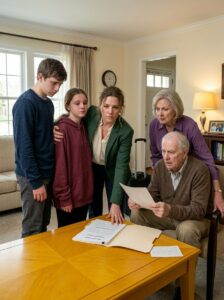
My father stared at the first page like the words had rearranged themselves just to betray him.
At first, his face held that familiar expression I had known since childhood.
Bored annoyance.
The look that said I was being emotional and he was waiting for me to finish so he could explain why I was wrong.
Then his eyes caught the header.
Reeves Residence Property Agreement.
His thumb stopped moving.
My mother leaned forward from her chair, lips already pinched, ready to dismiss the whole thing as dramatic nonsense.
But when she saw the second page, the color drained from her face too.
“What is this?” she whispered.
I stood beside Emma with one hand resting gently on her shoulder.
My daughter was wearing an oversized hoodie Mrs. Donnelly had given her. Her eyes were dry now, but her face still had that pale, careful look children wear when adults have made the world feel unsafe and then expected them to stay polite about it.
I looked at my parents.
“You signed it six years ago.”
My father’s mouth opened.
Closed.
Opened again.
“Where did you get this?”
I almost laughed.
The question itself told me everything.
Not “What does this mean?”
Not “Why are you doing this?”
Not “Is Emma okay?”
Where did you get this?
As if the real problem was not what they had done, but the fact that I could prove it.
“I got it from the lawyer who drafted it,” I said.
My mother stood quickly, grabbing the documents from my father’s hand.
Her eyes moved over the page.
Then she looked at me like I had walked into her house carrying a weapon.
“This is an eviction notice?” she said.
Her voice rose sharply.
“For us?”
Tyler sat on the couch, one knee bouncing. He was sixteen, thin, nervous, and clearly wishing he could disappear into the cushions.
I did not blame Tyler.
He had not asked for any of this.
His mother, my sister Dana, had relapsed again and gone back into treatment. Tyler needed stability. He needed adults who could help him without turning another child into collateral damage.
My parents had made their choice.
They had chosen to help one grandchild by humiliating another.
My father stood so fast his knee struck the coffee table.
“Claire, you have lost your mind. This is our house.”
“No,” I said.
The word landed hard.
The room went still.
“It was your house,” I continued. “Until you almost lost it.”
My mother’s face tightened.
“Don’t you dare bring that up.”
“I will bring up whatever matters.”
Emma shifted closer to me.
That small movement steadied me more than any anger could.
I looked directly at my father.
“Six years ago, the bank was closing in because the family business was buried in debt. You called me in tears.”
His jaw hardened.
“I did not call you in tears.”
“My mistake,” I said. “Mom was crying in the background. You were just desperate.”
His face darkened.
I kept going.
“You needed two hundred fifty thousand dollars to clear the corporate debt and keep this house out of foreclosure. I gave it to you. Not as a gift. Not as a handshake. I structured it properly because even then, I knew better than to trust your version of family.”
My mother’s voice shook with rage.
“We are your parents.”
“Yes,” I said. “And that is why I helped you.”
I pointed to the documents.
“But my LLC took full ownership of the property. You retained a revocable life estate. You could live here as long as you maintained the property, paid the taxes, and kept this home safe for my immediate family.”
My father looked down at the page again.
Memory was beginning to fight denial.
He remembered signing.
He remembered the initials.
He remembered my lawyer explaining every clause while he nodded impatiently because all he cared about was keeping the house.
My mother gripped the paper.
“That was just paperwork.”
“No,” I said. “It was the only reason you still had a roof.”
Her mouth snapped shut.
For most of my life, my parents had taught me that gratitude only flowed upward.
Children owed parents.
Parents did not owe children honesty, respect, or safety.
When I was young, I believed them.
I believed love meant absorbing pain without naming it.
I believed a peaceful family was one where the most hurt person stayed quiet.
Then I had Emma.
And every old rule began to look different when I imagined someone applying it to my daughter.
My father’s voice dropped.
“You can’t throw us out over one mistake.”
“One mistake?”
I reached into my bag and pulled out the photo Emma had sent me.
The floral recipe card.
The suitcase on the porch.
The closed front door behind it.
I placed the photo on the coffee table.
“You wrote this.”
My mother looked away.
“You’re not welcome here,” I read aloud.
Emma’s fingers curled into the sleeve of my jacket.
I kept my voice steady, though every word hurt.
“You wrote that to a fourteen-year-old child. My child. You put her suitcase outside and locked the door while I was across the country.”
My father said, “She was safe next door.”
“Because Mrs. Donnelly found her.”
“She could have called you.”
“She did.”
My mother snapped, “And look at the scene you made.”
There it was.
Not shame.
Not remorse.
Not even fear for Emma.
Only outrage that I had refused to keep the injury quiet.
I turned toward Tyler.
He looked miserable.
“Tyler,” I said gently, “none of this is your fault.”
His eyes filled.
“I didn’t know they left the note.”
“I believe you.”
My mother scoffed.
“Oh, now you care about Tyler?”
I looked back at her.
“I care that you used him as an excuse to hurt my daughter.”
Her face twisted.
“Your sister is in crisis. Tyler needs stability.”
“And Emma needed safety.”
“She is your child. You figure it out.”
The sentence came so easily.
So naturally.
As if she had not just revealed exactly how little she valued my daughter.
I nodded slowly.
“You’re right.”
My mother blinked.
“I will figure it out.”
The front door opened behind me.
My lawyer, Arthur Bennett, stepped inside carrying a clipboard and a second folder. He was not theatrical. He never had been. He was short, gray-haired, and calm in the way lawyers become calm after years of watching people realize documents matter.
My father turned sharply.
“What is he doing here?”
Arthur nodded politely.
“Mr. Reeves. Mrs. Reeves.”
My mother pointed toward the door.
“Get out of my house.”
Arthur looked at me.
I gave one small nod.
Then he turned back to her.
“As of forty-eight minutes ago, your conditional life estate has been formally revoked due to breach of the safety clause within the property agreement. You have forty-eight hours to remove your personal belongings from the premises.”
My mother’s face went slack.
My father whispered, “No.”
Arthur continued.
“At 9:00 a.m. on Monday, the locks will be changed. If you remain on the property after that time, it will be treated as civil trespass.”
My father sank slowly back into the chair.
For the first time in my life, he looked old.
Not wise.
Not powerful.
Just old.
My mother began crying then.
Loudly.
Shaking.
A performance aimed directly at me.
For thirty-eight years, that sound had worked.
When I was eleven, she cried because I did not want to wear the dress she chose for church, and I apologized.
When I was seventeen, she cried because I wanted to attend a college three hours away, and I chose one closer to home.
When I was twenty-eight, she cried because I did not call enough, and I started calling every Sunday even when those calls ruined my mood for the whole week.
When I was thirty-two, she cried because Dad was “too proud” to ask for financial help, and I saved their house.
Her tears had been a leash wrapped in silk.
But that night, Emma was watching.
And I refused to teach my daughter that tears from the person who hurt you are more important than your own safety.
“Claire,” my mother sobbed, “how can you do this to us?”
I looked at the recipe card on the table.
“I’m doing what you told Emma to do.”
Her crying faltered.
“I’m making space,” I said.
The room went silent.
Arthur lowered his gaze slightly, professional enough not to react.
My father’s voice cracked.
“Where are we supposed to go?”
“You told Emma she was old enough to stay with a friend for one night,” I said. “You have forty-eight hours.”
My mother covered her mouth.
My father looked at Emma then, truly looked at her for the first time since we entered.
Maybe he saw the hoodie.
The pale face.
The suitcase handle still in her hand.
Maybe he saw, finally, that she was not an inconvenience or a symbol in his argument with me.
She was a child.
His granddaughter.
The child he had locked out.
“Emma,” he said weakly.
Emma stiffened.
I placed my arm around her.
“No,” I said. “Not unless she wants to answer.”
Emma shook her head.
Small.
Firm.
My father closed his eyes.
For once, nobody forced her to be polite.
That mattered.
I looked toward the stairs.
“Emma, go pack the rest of your things from your room. We’re staying at a hotel tonight.”
She swallowed.
“And after that?”
“On Monday, we are moving back in.”
My mother’s head snapped up.
“What?”
I did not look away from Emma.
“And we are repainting your room.”
For the first time that day, something flickered across my daughter’s face.
Not happiness.
Not yet.
But the beginning of relief.
“Can it be blue?” she asked.
“Any blue you want.”
Her mouth trembled.
Then she nodded and went upstairs.
Tyler stood awkwardly.
“Should I… should I pack too?”
I turned to him.
“You can stay tonight if you need to. But not in Emma’s room. And not because they pushed her out.”
His eyes filled.
“I’m sorry.”
“I know.”
“I didn’t know they wrote that note.”
“I believe you.”
He looked toward my parents, then back at me.
“I don’t want to be the reason she got kicked out.”
“You are not,” I said. “Adults made this choice.”
That distinction mattered.
I would not let my parents use one hurting child to justify hurting another.
Compassion was not the problem.
Sacrifice demanded from the wrong child was.
I went upstairs to help Emma.
Her room looked almost untouched from when I left for Phoenix. Her library books sat in a neat stack on the desk. A sweatshirt was folded on the chair. Her favorite mug, the one with a fox on it, sat on the nightstand half full of cold tea.
I imagined my mother entering this room, packing Emma’s suitcase, placing it on the porch, and writing that card.
My throat tightened.
Emma stood near the closet, holding a small stuffed rabbit she pretended she had outgrown two years ago.
“Can I take this?” she asked.
“Of course.”
She looked embarrassed.
“I know it’s babyish.”
“No,” I said. “It’s yours.”
Her eyes filled.
That was when she finally cried.
Not loudly.
She simply folded in half, clutching the rabbit against her chest.
I crossed the room and held her.
“I’m sorry,” she whispered.
My heart broke.
“For what?”
“For being trouble.”
I pulled back and held her face gently.
“No.”
“But if I wasn’t here, they wouldn’t be losing the house.”
“Listen to me carefully,” I said. “They are not losing the house because of you. They are losing access because they broke an agreement and hurt a child.”
“But Tyler needed help.”
“Yes. And we can help Tyler without making you disappear.”
She stared at me.
I said it again because children need truth more than once when adults have made them doubt it.
“You do not have to disappear so someone else can be safe.”
Her shoulders shook.
I hugged her until the worst of it passed.
Downstairs, my parents’ voices rose and fell. Arthur’s remained calm. That was the sound of paperwork holding firm against panic.
When Emma and I came down with her bags, Mrs. Donnelly was standing on her porch across the lawn, arms folded over her cardigan, watching with the righteous anger of an elderly woman who had seen more than enough nonsense in her life.
She called out, “Emma, honey, you forgot your charger.”
Emma almost smiled.
“Thank you.”
Mrs. Donnelly handed it to her, then looked at me.
“You did right.”
Those three words meant more than she knew.
That night, Emma and I checked into a hotel.
She ate half a grilled cheese and fell asleep with the television on mute. The stuffed rabbit was tucked under her chin.
I sat by the window answering emails from Arthur and Daniel Mercer, the child welfare attorney I had called from Phoenix.
I did not feel victorious.
People imagine moments like this feel powerful.
They do not.
They feel like standing in the ashes of a house you once hoped would become warm.
But beneath the sadness was something clean.
I had not abandoned my daughter to keep peace.
I had not minimized her pain so adults could avoid consequences.
I had not let my parents rename cruelty as family.
On Monday morning, the locks were changed at 9:00.
Arthur documented everything.
My parents removed their personal belongings over the weekend, arguing about what belonged to them and what belonged to the house. My mother tried to take the dining room chandelier until Arthur reminded her it was a fixture. My father tried to claim he had never understood the agreement, until Arthur produced the signed acknowledgment page.
The paperwork did not become less real because they were angry.
They moved into a short-term rental arranged by my aunt, who called me harsh, unforgiving, and “not raised this way.”
I told her calmly, “I was raised exactly this way. That is why I had to change.”
She hung up.
Tyler did not become homeless.
I made sure of that.
Daniel helped connect him with support services and a temporary placement through his school counselor until his mother completed treatment. I bought him a winter coat and a prepaid phone card, but I did not let him move into Emma’s room.
He understood.
That boy had more grace than the adults who used him as an excuse.
A week after we moved back into the Reeves house, Emma and I repainted her room.
She chose pale blue.
Not baby blue.
Not bright blue.
Soft morning-sky blue.
We wore old clothes, ordered too much pizza, and accidentally got paint on the hardwood floor. For the first time since Phoenix, Emma laughed.
A real laugh.
Small, but real.
We made new rules and taped them inside the pantry door.
No child gets locked out.
No one uses “family” as a threat.
No apology counts unless behavior changes.
Emma wrote the last one herself in purple marker.
For months, she still flinched when my phone rang and my mother’s name appeared.
So I blocked both my parents for a while.
Not forever.
Just long enough for my daughter’s nervous system to stop believing every call might open the door to another disaster.
Relatives talked.
Of course they did.
My mother told people I had thrown my elderly parents into the street. My father told everyone I had been manipulated by lawyers. A cousin posted a vague quote online about respecting parents before it was too late.
I did not respond publicly.
I had learned something important.
People who need the truth already ask for it.
People who prefer drama will not be corrected by facts.
When relatives called privately, I sent one sentence:
They locked my fourteen-year-old daughter out of a home I legally own, after signing an agreement that required the home to be safe for her. The rest is paperwork.
Most stopped calling after that.
Six months later, my father asked to meet.
I agreed to a public café with Emma’s permission and without bringing her.
He looked smaller than I remembered. His shoulders had rounded. His hair seemed thinner. He sat across from me with both hands wrapped around a paper coffee cup.
“Your mother didn’t want me to come,” he said.
“That sounds familiar.”
He winced.
I did not soften it.
For most of my life, I had softened everything.
No more.
He stared into his coffee.
“I told myself Emma would be fine.”
“She was sitting outside with a suitcase.”
“I know.”
“You wrote the note?”
He shook his head. “Your mother wrote it.”
“But you allowed it.”
His eyes closed.
“Yes.”
That mattered.
Not enough.
But something.
“I thought Tyler needed us more,” he said.
I waited.
“And I thought Emma had you.”
“She did. That is why I came home.”
He nodded slowly.
“I was wrong.”
I studied his face.
My father had said many defensive things in my lifetime.
That was the first simple truth.
“Have you told Emma that?” I asked.
He swallowed.
“Would she even want to hear from me?”
“That is not the first question.”
“What is?”
“Can you apologize without asking her to make you feel better?”
He looked at me then.
Really looked.
“I don’t know,” he admitted.
“Then practice before you call her.”
He nodded.
We finished the coffee without resolving everything.
That was okay.
Real life rarely resolves cleanly.
My mother took longer.
Much longer.
Her first letter was not an apology. It was a defense with nicer handwriting. She said she had been overwhelmed, Tyler needed immediate stability, and she never imagined Emma would “take it so personally.”
I did not answer.
Her second letter blamed me less but still centered her embarrassment.
I did not answer that one either.
The third letter arrived almost a year after the incident.
It was shorter.
Claire,
I keep seeing Emma’s suitcase on the porch.
At first, I told myself I did what I had to do. Then I told myself you overreacted. Then I told myself I was the one being punished.
But the truth is, I wrote something cruel to a child because I was angry at you and overwhelmed by Tyler’s situation.
I am ashamed.
I do not expect Emma to forgive me. I do not expect you to forgive me. But I am sorry.
Mom
I read it twice.
Then I showed Emma.
She sat on the couch holding the letter in both hands.
“What do I have to do?” she asked.
“Nothing.”
“Do I have to forgive her?”
“No.”
“Do you want me to?”
“I want you to be honest with yourself.”
Emma folded the letter carefully.
“I don’t want to see her yet.”
“Then you won’t.”
The relief on her face told me I had given the right answer.
Years passed.
The Reeves house became ours in a way it had never been before.
We replaced the heavy curtains with light ones. We turned the formal dining room into a study because neither of us liked eating under a chandelier. We planted lavender along the walkway. Mrs. Donnelly came over every Thursday for tea and gossip, and Emma began calling her “the good grandma” only half joking.
Tyler visited sometimes after he turned eighteen.
He and Emma built a careful cousin friendship from the wreckage adults had made. He apologized once while they were sitting on the porch steps.
“I’m sorry my life messed up yours,” he said.
Emma replied, “It wasn’t your life. It was their choice.”
I heard that from the kitchen window and cried quietly into a dish towel.
She had learned.
Not the easy way.
But she had learned.
My parents never moved back into the Reeves house.
I sold it when Emma left for college.
She did not want me to keep it.
“Too many ghosts,” she said.
She was right.
With part of the money, I bought a smaller house near the river. With another part, I created an emergency housing fund through a local youth organization for teenagers who needed safe temporary placement when adults failed them.
Emma helped name it.
The Porch Light Fund.
Because, she said, “No kid should sit outside wondering if someone will open a door.”
At the launch event, Mrs. Donnelly sat in the front row wearing a blue cardigan and a look that dared anyone to make her cry.
Emma spoke briefly.
She did not share every detail.
Only enough.
“I learned that being told you are not welcome can feel like the end of the world,” she said. “But sometimes it is also the moment someone proves they will come for you.”
I sat in the audience with tears running down my face.
Afterward, my father came up to Emma.
He had asked me first.
She had agreed to five minutes.
He stood before her looking nervous, which was almost unimaginable to the girl I used to be.
“Emma,” he said, voice rough, “I am sorry. I should have protected you. Instead, I let you be hurt because I wanted the easier choice. You did not deserve that.”
Emma listened.
Then she said, “Thank you for saying it.”
He waited, perhaps hoping for more.
She did not give more.
And to his credit, he accepted that.
My mother sent flowers to the event but did not attend. The card said:
I hope the fund helps many children. I am sorry you needed it first.
Emma kept the card in a drawer.
Not displayed.
Not thrown away.
A place between memory and decision.
When Emma graduated from college years later, she wore a blue dress the color of that bedroom we painted after the locks changed. In her speech as student speaker, she said one line that made me grip my program so hard it bent.
“Home is not the place that claims you when it is easy. Home is the place that protects you when it costs something.”
People applauded.
I could barely breathe.
After the ceremony, she found me in the crowd and hugged me tightly.
“You came home,” she whispered.
I held her face in my hands.
“Always.”
And I meant it in every direction.
I came home from Phoenix.
I came home to the daughter I had almost trusted to people who had not earned it.
I came home to the part of myself that had spent too many years trying to be acceptable to parents who confused control with love.
That was the truth the Reeves house taught me.
A family can hand you rules and call them love.
They can hand you guilt and call it gratitude.
They can hand your child a suitcase and a note and call it a temporary adjustment.
But proof matters.
Paper matters.
Photos matter.
A neighbor opening her door matters.
And most of all, the moment you decide to stop letting people rename harm matters.
My parents did not lose their home because I was cruel.
They lost access to a house they no longer owned because they broke the one condition that should have been easiest to keep:
Do not hurt my child.
Everything after that was just paperwork.
And if I had to make the same choice again, I would.
Every time.
Because peace that costs your child’s safety is not peace.
It is surrender.
And I was done surrendering.