I Found My Daughter-in-Law’s Family Living in My Cabin—They Said, “It’ll Be Ours Someday Anyway.” So I Changed the Locks and My Will
PART 2
The new deadbolt was already in his hand.
For the first time all weekend, Brenda looked uncertain.
“Diane,” she said sharply, clutching the belt of her bathrobe, “what exactly do you think you’re doing?”
“I’m taking back my property,” I replied.
The cousins in the living room had finally stopped laughing. One man slowly set down his wineglass. Another looked toward the lake through the tall windows as though he hoped someone else might appear and solve the situation for him.
The locksmith stood calmly beside me with his tool case on the hardwood floor.
I had already spoken to him outside. I had shown him my identification, the deed copy from my folder, and the latest property tax statement with my name on it. He knew exactly who owned the cabin.
Brenda took two angry steps forward.
“You can’t just throw family out like this.”
“I can,” I said. “Especially when that family entered my house without permission and decided to stay until the end of the month.”
Larry came in from the living room at last, moving with the slow, uncomfortable caution of a man who had finally realized the joke was ending.
“Now, Diane, let’s not make this ugly,” he said. “Sarah told us it was all settled.”
I looked at him.
“Sarah lied.”
Nobody answered that.
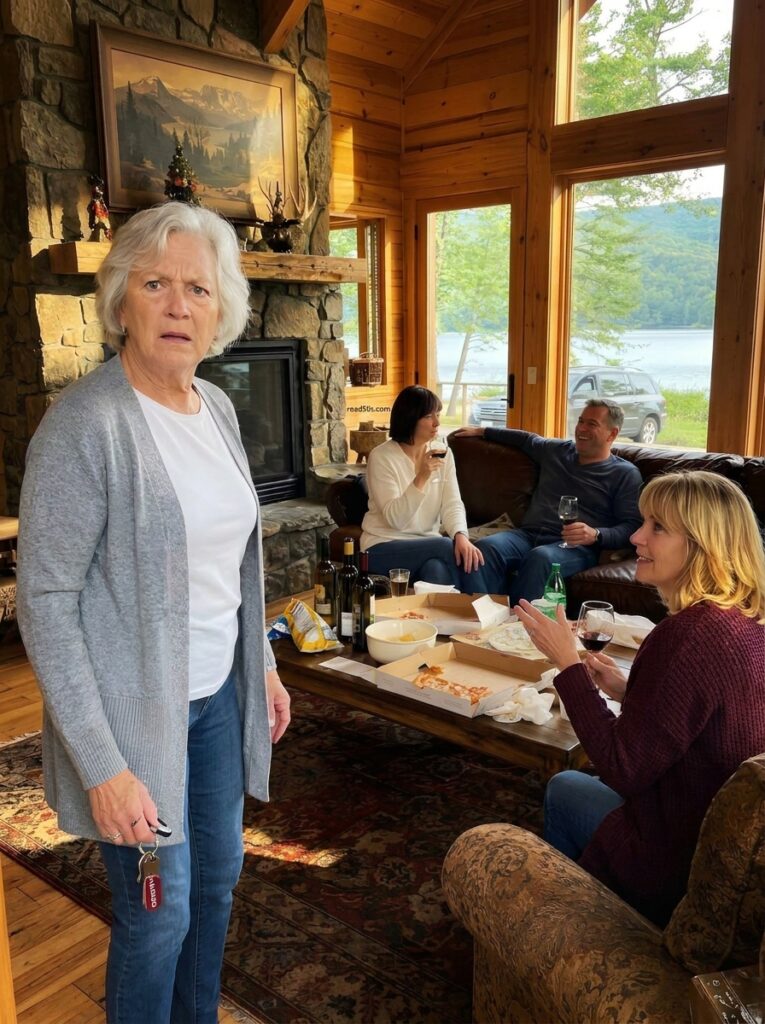
From where I stood, I could see the whole room behind them.
The leather sofa I had paid for.
The framed landscape above the stone fireplace.
The lake shining beyond the tall windows.
Half-empty pizza boxes on my cherrywood coffee table.
Wineglasses resting on coasters I kept in a brass tray by the armchair.
They had not treated the cabin like borrowed space.
They had treated it like an inheritance that had already been delivered.
Brenda lifted her chin, trying one more time to sound superior.
“We drove four hours to get here. You can at least let us finish the weekend.”
“No,” I said.
I pulled my phone from my coat pocket.
“I’ve already called the county sheriff’s office. A deputy is on the way in case anyone refuses to leave.”
That changed the room.
One cousin muttered something under his breath and stood up immediately. Another began gathering jackets from the back of the sofa. Larry turned toward Brenda with an expression that suggested this was no longer a battle he wanted.
Brenda, however, was not finished.
“You are humiliating us over nothing,” she snapped. “This is exactly why Sarah says you are impossible.”
I gave her a long, steady look.
“Sarah can say whatever she likes after she explains why she offered a house that doesn’t belong to her.”
At that exact moment, my phone rang again.
Jason.
This time, I answered.
“Mother, please,” he said the instant I picked up. “Can we just talk about this calmly?”
“We are talking calmly.”
“Sarah said you completely overreacted. Her parents thought the place was available.”
“Your wife’s parents are standing in my living room right now with five people, my wine, and a sink full of dishes. Stop insulting me by pretending this is a misunderstanding.”
He exhaled hard.
“I didn’t know they brought relatives.”
“But you did know they were there.”
Silence.
That silence answered more than any explanation could have.
I closed my eyes for a brief second.
Not because I was surprised.
Because a disappointment you expect still hurts when it arrives.
“Jason,” I said, “did you give Sarah permission to use my cabin?”
“I told her it would probably be fine for a couple of days.”
Probably be fine.
As if the cabin were an extra blanket in the hall closet.
As if my property were a suggestion instead of an asset I depended on.
“You had no right,” I said.
“I was trying to help her family.”
“With my retirement property. Without asking me.”
“Mom, please don’t do this in front of everyone.”
I looked at Brenda, who was now listening openly, arms folded, face red.
“This was done in front of everyone the moment they moved themselves into my house.”
I ended the call.
Brenda stared at me with open hostility.
“You are going to destroy your relationship with your son over one cabin.”
I almost laughed.
“No,” I said quietly. “Your daughter and my son are destroying it over entitlement.”
The deputy arrived twelve minutes later.
He was polite, middle-aged, and entirely uninterested in family politics.
He asked one question first.
“Who owns the property?”
“I do,” I said, handing him my identification and the documents from my folder.
He reviewed them, nodded, and turned to the others.
“If you don’t have the owner’s permission to be here, you need to gather your things and leave.”
Brenda tried indignation.
“We’re relatives.”
The deputy did not blink.
“You still need permission.”
That was the end of it.
No dramatic final speech.
No emotional breakthrough.
Just the practical sound of people who had overestimated themselves collecting overnight bags, charger cords, pill bottles, and leftover pizza from a house that had never been theirs.
I stood by the stone fireplace and watched.
Not triumphantly.
Just clearly.
Brenda was the last one to reach the door.
She turned in the entryway and gave me a look sharp enough to cut paper.
“Sarah is going to remember this.”
“I hope so,” I said.
The deputy waited until every vehicle had backed out of the gravel drive and disappeared down the mountain road. Only then did the locksmith begin replacing the deadbolt.
The cabin felt strangely quiet once they were gone.
The silence came back in layers.
First the absence of voices.
Then the absence of music.
Then the ordinary sounds I actually belonged with—the hum of the refrigerator, the distant call of a bird outside, the soft movement of wind across the lake.
I rolled up my sleeves and began cleaning.
Not because it was my job to erase their disrespect.
But because I wanted my house back in my own hands.
I boxed the open food.
Poured the leftover wine down the sink.
Wiped grease from the coffee table.
Opened windows to let fresh mountain air push out the stale smell of pizza and perfume.
When I was halfway through washing the dishes, Jason walked in.
He had used his spare key.
I dried my hands and turned slowly.
He stood in the kitchen doorway looking tired, uneasy, and much younger than forty-three.
“Where are they?” he asked.
“Gone.”
He glanced toward the front door, then at the changed lock, and understood immediately.
“Mom…”
“No,” I said. “You can listen first.”
He fell silent.
I had spent years speaking gently to Jason because he disliked conflict so much that even ordinary boundaries sounded harsh to him. But avoiding hard truths had not protected him. It had only made him easier for stronger personalities to steer.
So I told him the truth plainly.
I told him I knew Sarah believed the cabin would belong to them.
I told him I knew he had let her believe it.
I told him I knew he had viewed the savings account as part of their home purchase, even though it was still my money.
I told him that giving away what belongs to someone else is not generosity. It is cowardice dressed as kindness.
Jason sat down heavily at the kitchen table.
For a long time, he said nothing.
Then he asked the only question that proved he still did not fully understand.
“Did you really move the sixty thousand?”
“Yes.”
His head jerked up.
“You knew we needed that money next week.”
“I knew you expected it.”
He stared at me.
The mountain light came through the windows behind him, and for the first time in years, he looked like a boy caught between fear and embarrassment.
“That gift was based on trust,” I said. “You and Sarah just showed me exactly how little respect you have for my property, my plans, and my independence. Why would I reward that?”
He rubbed both hands over his face.
“This is going to ruin everything.”
“No,” I said. “It’s going to clarify everything.”
He looked around the cabin then.
At the counters.
The fireplace.
The old wood beams overhead.
The lake beyond the glass.
Maybe, for the first time, he saw the cabin not as an eventual possession but as a place I had worked for, maintained, and counted on.
“Sarah thought…” he began.
“I know what Sarah thought.”
“She thought someday—”
“Someday is not a legal document.”
He had no answer for that.
When he finally spoke again, his voice was quieter.
“What do you want me to do?”
I had already decided.
“I want every key to this cabin returned. Yours included.”
He flinched.
“I also want you to understand that until I choose otherwise, no one uses this property. No weekend visits. No family stays. No ‘probably fine for a couple of days.’”
He nodded once.
“And the house money?” he asked.
I folded the dish towel and set it on the counter.
“That account is closed to you now.”
His face changed.
“Mom, please.”
“You are old enough to buy a house without using my future as your cushion.”
“That money was for the kids too.”
“It was for a future I believed would include gratitude and respect.”
He stared at the floor.
Part of me wanted to soften.
Part of me wanted to say I had not meant for things to become so severe.
But severity is sometimes just what truth feels like to the people who benefited from your silence.
Jason left before sunset.
He handed over his key without argument.
That mattered less than it should have, because I knew the harder battle would begin at home when Sarah learned I had not reversed anything.
She called that night.
I did not answer.
She sent three messages.
The first accused me of embarrassing her parents.
The second said I was jeopardizing her children’s future over a misunderstanding.
The third told me I was using money to control people.
That one almost made me smile.
For years, they had mistaken my quiet financial help for an endless obligation. The moment I stopped providing it, I became controlling.
I blocked her number and slept in my cabin that night with the bedroom window cracked slightly open to the cool mountain air.
The next week, I met the realtor as originally planned.
The house was photographed, listed, and shown to prospective long-term tenants.
Within twelve days, I signed a solid year-long lease with a retired couple from Asheville who wanted a quiet lake property and had the decency to ask permission before stepping over the threshold.
The rental agreement provided exactly the stability I had hoped for.
Reliable income.
Clear terms.
Respect.
I also met with my attorney.
That appointment took less than an hour.
I updated my will.
Jason remained in it, because he was my son and I loved him.
But the cabin was removed from every casual assumption anyone had ever made about it. It would no longer pass automatically to a household that viewed my effort as a waiting room for their entitlement.
Instead, the property would be converted to a trust, with strict instructions and charitable provisions unless certain conditions were met—conditions based not on blood, but on responsibility.
If that sounds cold, you have probably never watched people plan your future while helping themselves to your present.
A month later, Jason came to see me alone.
He looked thinner.
Older.
Humbled in a way I had not seen before.
He sat in my townhome kitchen, turning a teacup slowly between both hands, and finally admitted the truth.
He said Sarah had pushed hard for access to the cabin because her parents wanted a free vacation place.
He said he knew I would object, so he chose not to ask.
He said the savings account had already been counted in their home plans, and when I moved the money, everything collapsed.
They lost the house they wanted.
They blamed me.
Then Sarah blamed him.
And somewhere in the middle of all that, he realized how much of his adult life had been built on avoiding the exact conversations he should have had first.
“Are you asking for the money back?” I asked.
He shook his head immediately.
“No. I know I can’t.”
That, more than anything, was the first honest thing he had said in weeks.
“Are you apologizing?” I asked.
He looked up.
“Yes.”
“For what?”
He swallowed.
“For treating your help like it belonged to me. For letting Sarah speak about your property as if it were ours. For not protecting you from that disrespect. And for using your kindness to keep peace in my own house.”
I believed he meant it.
An apology does not erase behavior.
But a real one at least tells you the person finally sees what they did.
I nodded.
Then I told him something I should have said years earlier.
“Jason, love does not mean permanent access.”
He sat with that quietly.
His marriage did not survive the year.
I take no pleasure in saying that.
But some relationships collapse the moment financial support is withdrawn, because money was the only structure holding them upright.
Sarah had never truly wanted boundaries.
She had wanted benefits.
When the down payment disappeared, the cabin became unavailable, and I stopped smoothing over her behavior, she turned her anger fully on Jason. By spring, they were separated.
He moved into a modest apartment.
Started managing his own finances.
Spent more time with the children without Sarah directing every conversation.
We built a different relationship after that.
Slower.
Honester.
Less sentimental, perhaps, but more real.
As for the cabin, my tenants renewed their lease the following year.
The income did exactly what I needed it to do.
It strengthened my retirement.
Protected my independence.
And reminded me, each month, that boundaries are not punishments.
They are protections.
The last time I visited the cabin that summer, the lake was bright under the afternoon sun.
The tenants had left a thank-you note on the kitchen counter and a small vase of wildflowers on the table.
The house felt peaceful again.
Not empty.
Not lonely.
Just properly occupied.
I stood in the living room for a while, looking at the stone fireplace, the cherrywood coffee table, and the windows framing the water beyond the trees.
Then I thought about Brenda saying, “This house will be hers someday anyway.”
She had been wrong in more ways than she understood.
Because the real issue had never been the cabin itself.
It was the assumption beneath her words—that age makes a woman’s life negotiable, that future inheritance is the same thing as present ownership, and that a polite woman can be pushed aside if everyone does it casually enough.
They were wrong.
And once I finally decided to act like the owner of my own life, everything changed.