THE LIFE RACHEL LEFT BEHIND
The Open Door Initiative began inside two modest rooms attached to the women’s shelter where I had met Sarah.
One room held desks, donated computers, and shelves of legal and housing information.
The second contained comfortable chairs, toys for children, and a door that locked from the inside so frightened people could make phone calls without being overheard.
Sarah completed her nursing certification program.
She found work at a rehabilitation center and moved with her children into an apartment she could afford without foundation assistance.
On the day she signed her first independent lease, she brought me a small potted herb.
“It’s basil,” she said. “I know it isn’t much.”
“It’s alive,” I replied. “That is more than enough.”
She later returned to volunteer with women completing job-training applications.
The initiative expanded.
We created emergency relocation grants.
Transportation assistance.
Temporary childcare.
Legal clinics for young people aging out of foster care.
Scholarships for women whose education had been interrupted by unsafe relationships.
Arthur handled financial strategy and rarely interfered with program decisions.
Whenever I asked why he trusted me with so much authority, his answer remained the same.
“Rachel did.”
That trust frightened me at first.
Julian had spent years treating my decisions like small domestic conveniences that required his approval.
Suddenly, people were asking me to vote on multimillion-dollar budgets.
I worried about making the wrong choice.
Arthur never told me not to worry.
He simply reminded me to ask better questions.
Who benefits?
Who might be overlooked?
What would make this help accessible to someone too frightened to ask twice?
Those questions guided me better than confidence ever could.
A year after Rachel’s gala, we held the first Open Door scholarship dinner.
There were no auction paddles.
No humiliating speeches.
No person displayed for entertainment.
Instead, twelve scholarship recipients stood one by one and spoke about what education meant to them.
One young woman said it meant never again needing permission to buy groceries.
Another said it meant becoming the attorney she had needed as a child.
A third said it meant proving to her little brother that leaving foster care didn’t mean leaving hope behind.
I sat near the stage beside Arthur.
There was an empty chair between us.
A cream-colored envelope rested on it.
It contained a copy of Rachel’s first letter to me—the one Julian had ordered hidden.
I had finally read it several months earlier.
Rachel wrote about the bus station, her law degree, and the foundation she was building.
She hadn’t asked for money or public recognition.
She had wanted to invite me to lunch.
At the bottom, she had written:
I hope life has been kind to you. If it hasn’t, I hope you know you once taught me that it is never too late to walk toward safety.
For a long time, I couldn’t forgive myself for not receiving that letter.
Arthur reminded me that the choice had been taken from me.
Still, grief doesn’t always obey logic.
Sometimes I imagined the lunch we might have shared.
The stories she might have told.
The questions I would have asked.
The years of friendship we had lost.
I couldn’t recover those years.
But I could refuse to waste what remained.
WHAT TWO MILLION DOLLARS REALLY BOUGHT
People continued asking about Arthur’s two-million-dollar bid.
Reporters called it the offer that rescued me.
They were wrong.
Arthur didn’t rescue me.
Rachel’s letter gave me information.
The foundation gave me opportunity.
But I still had to pack the suitcase.
I had to sign the lease.
I had to stand at the podium and allow the truth to be heard.
No amount of money could make those choices for me.
The two million dollars didn’t purchase a boring wife from a cruel husband.
It funded hundreds of nights in safe apartments.
It paid tuition.
It covered childcare during court hearings.
It bought bus tickets, replacement identification documents, security deposits, work uniforms, and emergency medication.
It gave people time to make decisions without someone standing over them demanding an immediate answer.
That was what Rachel had wanted.
Not revenge.
Room.
A place where a frightened person could take one full breath and understand that another life was possible.
Three years after the gala, I returned to the Grand Regency Hotel for the first time.
The Open Door Initiative had been nominated for a statewide community-service award.
The ceremony took place in the same ballroom where Julian once offered me to hundreds of laughing guests.
The crystal chandeliers looked exactly as I remembered.
The stage was in the same place.
For a moment, I could almost hear his voice through the microphone.
Who wants my boring wife for twenty dollars?
Then Sarah walked toward me wearing a dark-blue dress.
Her children were beside her.
They were older, healthier, and arguing quietly over which dessert they wanted after dinner.
“You’re staring at the stage,” she said.
“I was remembering something.”
“Bad?”
“Once.”
She looked at the room.
“Do you want to leave?”
I smiled.
“No. I belong here tonight.”
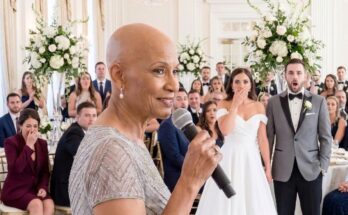
When our initiative’s name was announced, I walked toward the stage.
This time, nobody pulled me forward.
Nobody placed a heavy hand on my shoulder.
Nobody laughed while I stood beneath the lights.
I accepted the award on behalf of Rachel, Arthur, our staff, the volunteers, and every person who had been brave enough to enter through our doors.
Then I looked out across the ballroom.
“For many years, I believed dignity meant remaining quiet while other people behaved cruelly,” I said. “I know better now.”
The room became still.
“Silence can look graceful from a distance. But when silence protects humiliation, control, or harm, it is not dignity. It is disappearance.”
I thought about Rachel beneath the bus-station awning.
About the bowl of soup.
About the letters locked away in a corporate archive.
About the woman I had become after finally reading them.
“Kindness sees a person before asking whether helping them will be convenient. Control does the opposite. It decides what another person is allowed to know, choose, and become.”
I raised the award slightly.
“This belongs to everyone who opened a door when closing it would have been easier.”
The applause that followed sounded nothing like the laughter from years earlier.
When I left the ballroom, Arthur was waiting near the entrance in another gray suit.
“You did well,” he said.
“I didn’t ask whether you approved.”
He smiled.
“Rachel would have enjoyed that answer.”
Outside, Chicago lights reflected against the wet pavement.
I stood beneath the hotel awning where the air smelled of rain and traffic.
Thirty-three years earlier, I had stopped beneath another awning and asked a frightened teenager whether she was hungry.
I hadn’t understood that the question would travel through decades.
That it would become a law degree, a foundation, a hidden letter, a two-million-dollar grant, and a doorway through which hundreds of people would eventually walk.
Julian once called me the least interesting woman in the room.
He believed kindness was boring because it rarely demanded applause.
He believed quiet work was insignificant because someone else could take credit for it.
He believed my loyalty meant I had nowhere else to go.
He was wrong about all of it.
I had never been for sale.
Arthur’s offer didn’t determine my worth.
Rachel’s inheritance didn’t create it.
The foundation didn’t grant it.
My worth had been there all along—in every quiet decision, every person I helped, and every time I chose compassion when nobody was watching.
The only person who failed to recognize it was the man who stood closest to me.
And by the time he finally understood what he had mocked before hundreds of people, I was already gone.