My own son locked the dog cage every night.
He would throw a bowl of leftover dog food inside as though that settled the question of whether I deserved dinner.
Then he stood there watching to see whether hunger would eventually make me touch it.
When I pushed the bowl away, he found another way to punish me.
There was a large plastic storage bin in the backyard that collected rainwater.
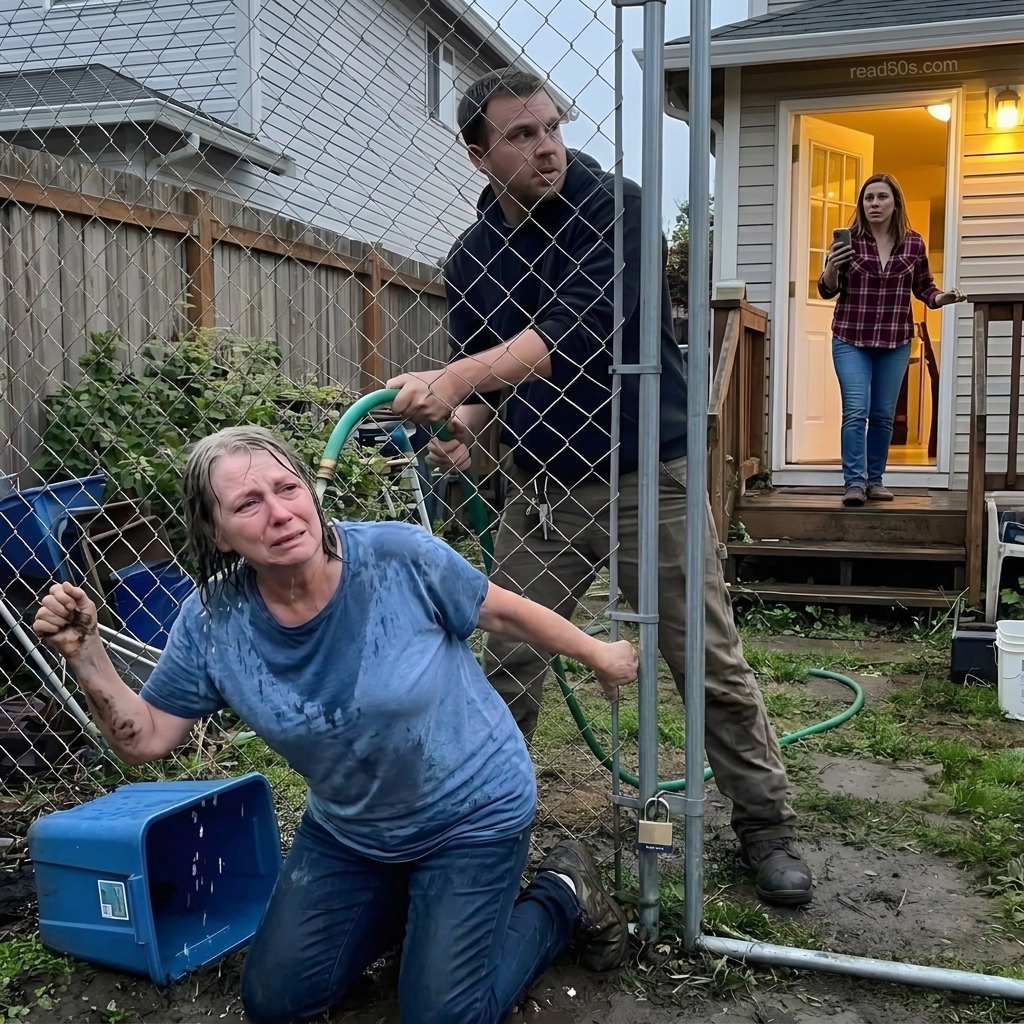
He would drag it across the grass, tip it over me, and leave me soaked while the ground beneath my knees turned to mud.
Then came the garden hose.
He struck my back with it while cursing, stopping just long enough between each blow to tell me I had caused everything.
That was how he kept the world arranged inside his head.
He was never cruel because he chose cruelty.
I was difficult.
Confused.
Ungrateful.
I embarrassed him.
I forced him to lose his temper.
And because he was my son, I had spent far too long trying to believe him.
But that night, something changed before either of us understood how important it would become.
He had raised the hose again when the porch light at the house next door suddenly switched on.
The hose stopped inches above my shoulder.
For a moment, neither of us moved.
Water ran from my hair into my eyes, carrying thin streaks of dirt down my T-shirt.
My knees were buried in the muddy corner of the cage.
When I wrapped my fingers around the metal bars, they were so slick that my grip almost slipped.
My son was no longer looking at me.
He was staring at the neighboring house.
Not casually.
Not with irritation.
He looked at that light as though someone had just called his name from the darkness.
Then the back door opened.
A woman stepped onto the porch wearing jeans and an old flannel shirt.
I had seen her before.
Usually near the mailbox.
Sometimes crossing her yard.
But my son had spent months turning every ordinary encounter with her into something suspicious.
She was nosy, he said.
She watched people.
She had nothing better to do.
Good neighbors minded their own business.
Whenever she waved at me from her mailbox, he somehow appeared behind me.
Sometimes he placed one hand lightly on my shoulder and said:
“Come inside.”
The words sounded harmless if anyone else could hear them.
The pressure of his fingers never did.
So I learned to keep conversations short.
I stopped lingering near the fence.
Stopped accepting the small openings other people gave me.
Eventually, I stopped stepping outside unless my son wanted me outside.
Now that same woman stood beneath her porch light.
She did not glance toward the street.
She did not pretend she had come outside for some unrelated reason.
Her eyes went directly to the cage.
Then the overturned storage bin.
Then the garden hose in my son’s hand.
He lowered it immediately.
The speed of that movement told me something I should have understood much earlier.
He knew exactly how the scene looked.
“She fell,” he called across the fence.
His voice changed.
The anger disappeared so completely that if I had not heard him only seconds earlier, I might have wondered whether I had imagined it.
“I’m cleaning her up.”
The woman did not answer him.
She called my name.
Hearing it from another person almost hurt.
My son used my name when he wanted my attention.
But lately, he preferred other words.
Stubborn.
Pathetic.
Crazy.
Problem.
The neighbor simply said my name as though it still belonged to me.
Then she asked:
“Can you hear me?”
My son stepped between us.
The movement was small.
But there was nothing accidental about it.
His body blocked part of my view through the bars.
“She gets confused at night,” he said. “Please go back inside.”
There was that voice again.
Patient.
Concerned.
Almost embarrassed on my behalf.
I had heard him use it when people asked why I no longer came to the door.
Why I missed gatherings.
Why I stopped returning calls.
He never needed a complicated story.
He only needed to make me sound unreliable.
The woman raised one hand.
A phone was pressed against her palm.
“Then unlock the cage.”
My son’s shoulders tightened.
“It isn’t what it looks like.”
She pointed toward the padlock near my ankle.
“I saw you fasten that yesterday. I thought it was empty until I heard her tonight.”
Something inside me shifted.
For weeks, my son had insisted that nobody could hear me from our backyard.
The houses were too far apart.
The windows were closed.
People had their own lives.
Besides, he told me, everyone nearby already believed I had chosen to stop seeing people.
That frightened me more than almost anything else.
A locked door can keep someone physically inside.
A convincing story can make people stop asking why.
He had worked carefully on that story.
When someone called, he sometimes answered for me.
When I did speak to somebody, he stayed close enough to hear both sides.
If I sounded unhappy, he reminded me afterward how embarrassing it would be if people thought I could not handle my own family.
And I let shame do part of his work for him.
I told myself things would improve.
I told myself he was stressed.
I told myself there were things a mother did not say about her own child.
Then the cage appeared in the backyard.
At first, he treated it like a threat.
Later, it became routine.
By then, he had already trained me to wonder whether anyone would believe me.
But the neighbor had seen the padlock.
She had heard me.
And her porch light was still on.
That light proved at least one of my son’s claims had been a lie.
Maybe more than one.