Martha had heard her son’s warnings for days, yet she was still fighting to keep us from seeing beneath the cast.
For several seconds, she would not answer me.
Her fingers tightened around the coffee cup until the lid shifted, but her eyes remained fixed on her son’s arm.
I stepped closer to the stretcher.
The boy barely moved.
His breathing was shallow.
His face was pale.
And those blue-tipped fingers still showed no sign that circulation was improving.
“Mrs. Harris,” I said, keeping my voice controlled, “you were willing to bring him into an emergency room with a 103.8-degree fever. You let us begin treating him. Why is removing this cast the one thing you’re fighting?”
Her expression changed again.
Not anger this time.
Hesitation.
Marcus stopped what he was doing long enough to look toward her.
Clara stayed beside the bed, one hand near the cast saw and the other close to the boy’s shoulder.
Martha swallowed.
Then she admitted something she should have told us the moment she walked through the door.
Her son had been complaining for days.
Not about the fever.
About the cast.
He kept telling her that something inside it felt terribly wrong.
I looked from Martha to the stained fiberglass surrounding his swollen hand.
A child had been warning the adult responsible for him that something was happening underneath that cast.
Now his body was showing us just how serious the delay might have become.
“So you knew he was having trouble with the arm before this morning,” I said.
Martha did not deny it.
Suddenly, the question was no longer whether the cast had to come off.
It was why a mother who had heard those warnings for days was now desperate to keep us from seeing underneath it.
Her coffee cup finally lowered to her side.
“He said it was tight,” Martha said. “Kids complain about casts. They itch. They’re uncomfortable.”
I asked when she had last spoken with the orthopedic surgeon she had mentioned earlier.
She looked at me without answering.
“The surgeon who told you the cast had to stay on another two weeks,” I said. “When did you speak to that doctor?”
Her gaze dropped.
“At the appointment.”
“What appointment?”
“When they put the cast on.”
That sentence changed the room for me.
She had been presenting that instruction as though a doctor had recently evaluated her son and told her not to interfere with the cast.
That was not what had happened.
She was repeating the original plan from nearly a month earlier.
Before the fever.
Before the swelling.
Before the discoloration.
Before her son began telling her that something beneath the fiberglass felt wrong.
Clara glanced toward me.
She had understood the same thing.
Marcus had already secured IV access.
Fluids were running.
Antibiotics were being prepared as part of the emergency treatment already underway.
I turned back to Martha.
“Did you call anyone when he started complaining?”
“No.”
“Did you call when his fingers began swelling?”
She rubbed her thumb against the side of the coffee cup.
“I didn’t notice them looking like that.”
Maybe that had been true at first.
But the cast itself was telling a longer story.
The dark staining was not limited to one fresh spot.
And the odor was strong enough to reach the nurses’ station before the stretcher arrived.
I asked another question.
“Did the cast get wet?”
Martha’s head came up so quickly that the answer was visible before she spoke.
Clara stopped adjusting the monitor lead.
Marcus looked toward me.
Martha took several seconds before saying:
“A little.”
“How long ago?”
“A few days.”
I felt my jaw tighten.
Anger was useless unless it helped me make the next decision clearly.
“What happened after it got wet?”
“He complained that it felt strange inside,” she said. “I tried to dry it at home.”
“And then?”
“He said it hurt.”
The boy shifted weakly on the stretcher when she said the word.
Martha noticed too.
For the first time since she entered the room, she set the coffee cup down.
“He exaggerates,” she said.
But there was less certainty behind the words now.
“He always has. He gets scared. He makes things sound worse than they are.”
I looked at his hand.
His fingers were purple and swollen.
The nail beds were still slow to regain color when pressed.
Whatever explanations might have sounded reasonable at home had stopped mattering the moment his body began failing in front of us.
“We’re removing it,” I said.
Martha started to object again.
This time, I did not debate with her.
The boy was critically ill.
Our immediate responsibility was the emergency in front of us.
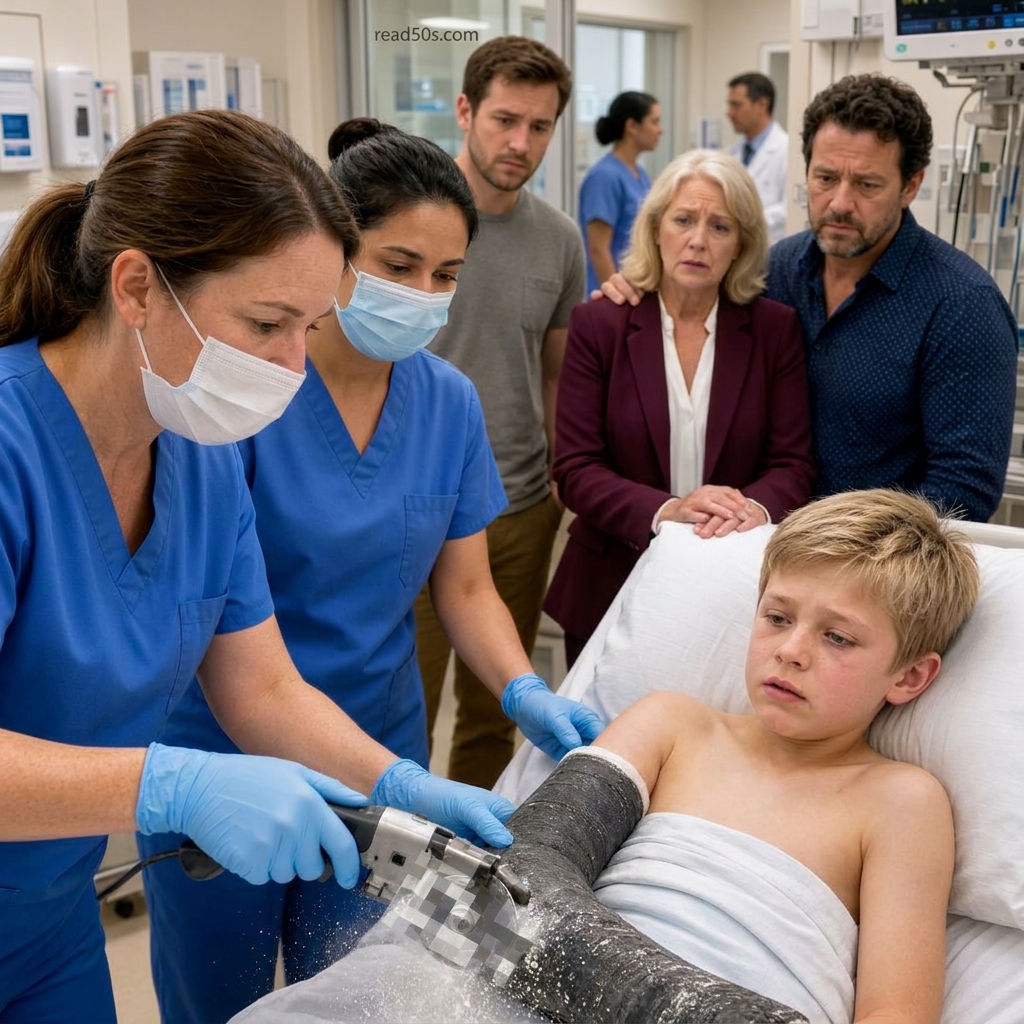
Security kept Martha several feet from the stretcher while Clara positioned the boy’s arm and Marcus stayed near his IV and monitor.
I warned the boy that he might hear noise and feel vibration from the cast saw.
He barely opened his eyes.
Then we started.
The first cut through the fiberglass released an even stronger odor.
Clara’s eyes tightened above her mask.
Marcus turned his head for half a second before forcing his attention back to the monitor.
I worked carefully down the cast.
Whenever the boy reacted, I stopped.
I checked his hand repeatedly.
Martha had gone completely still behind the security officers.
The woman who had threatened to sue us was no longer arguing.
She was watching.
When the fiberglass shell finally separated enough for us to spread it apart, the padding underneath was damp and badly discolored.
The boy’s forearm was severely swollen.
There were areas of damaged, inflamed skin beneath the material.
Signs of a serious infection had been trapped out of sight.
Nothing about it resembled a problem that had begun that morning.
Clara inhaled sharply through her mask.
Marcus said my name quietly.
I looked toward the monitor.
The boy’s blood pressure had dipped again.
We moved faster.
The damaged padding came away piece by piece.
The pressure around his arm finally began to ease.
I did not yet know how much tissue was involved or whether relieving that pressure would be enough to protect his hand.
But we had crossed the point where anyone could pretend this was a seasonal virus.
Martha stared at her son’s exposed arm.
Her expression changed in a way I had not seen before.
Not outrage.
Not polished irritation.
Fear.
“I didn’t know it was that bad,” she whispered.
I believed she had not known exactly how bad it was.
That was different from not knowing there was a problem.
“You knew it was wet,” I said. “You knew he said it hurt. You knew he kept telling you something was wrong inside it.”
Martha pressed both hands together.
“He didn’t have a fever then.”
“That doesn’t make the earlier warnings disappear.”
She looked toward her son instead of at me.
For the next several minutes, there was no room for more questions.
His condition demanded all of our attention.
We continued fluids and antibiotics.
The orthopedic team was urgently contacted to take over care of the arm.
We monitored circulation in his hand now that the rigid pressure of the cast was gone.
Slowly, one fingertip began looking less blue.
Then another.
The change was small.
But it mattered.
Clara pressed one of his fingers and watched the color return more quickly than before.
“Better,” she said quietly.
Better did not mean safe.
The infection remained serious.
His fever was still high.
His other vital signs showed that his body had been under enormous strain.
But for the first time since he arrived, something we had done was moving in the right direction.